


CRE Lenders

September 14, 2026
CRE Lenders
September 14, 2026
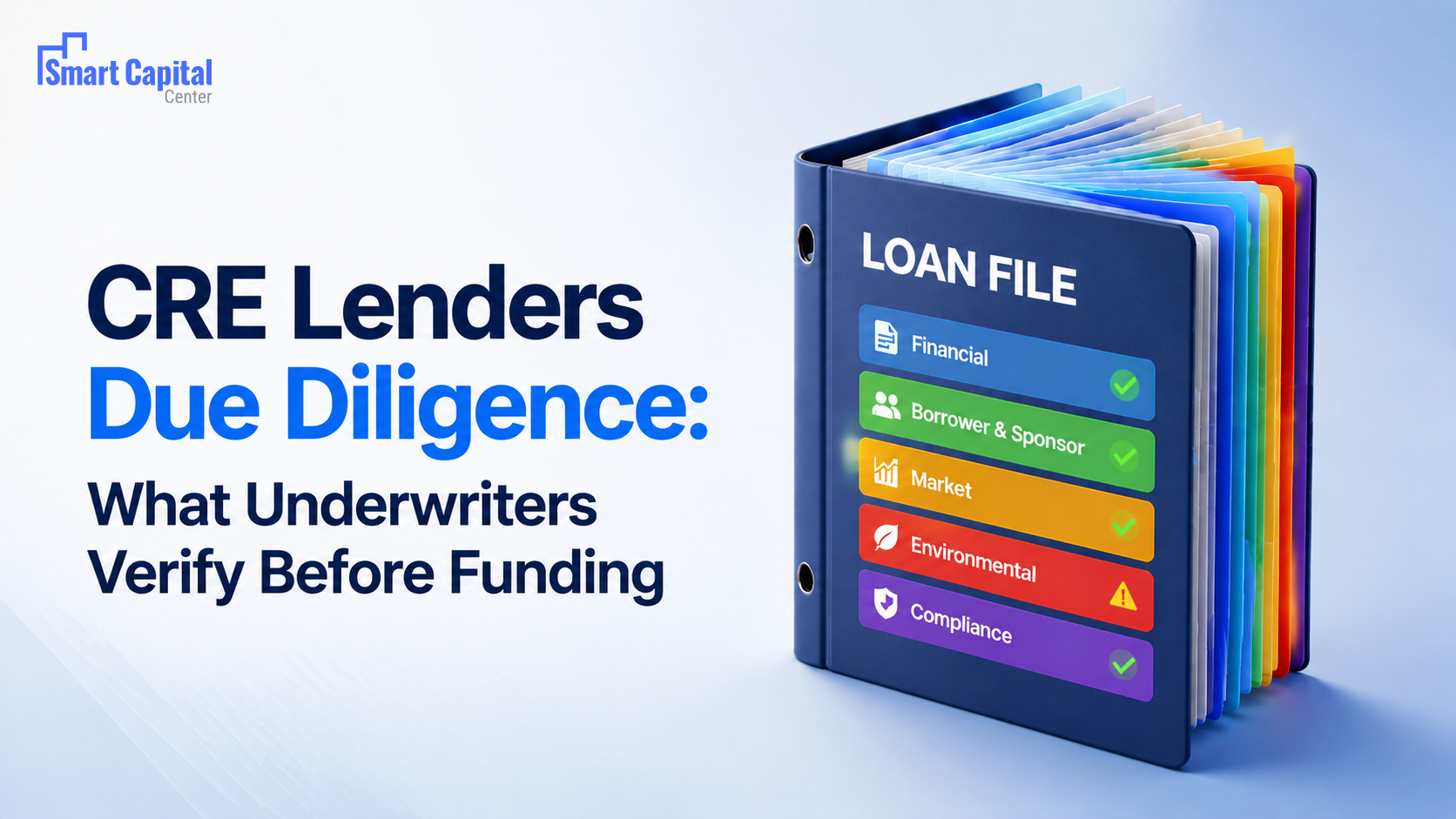
For CRE lenders, due diligence is the audit trail examiners look for and the speed borrowers respond to. Smart Capital Center gives underwriting teams both: continuous document extraction that turns rent rolls, T-12s, and offering memorandums into structured, cited data in minutes, and complete audit trails that satisfy OCC and FDIC examination standards. Lenders using Smart Capital Center evaluate more deals with the same headcount and close faster than borrowers can go elsewhere. The stakes are higher in 2026, with the MBA's 2026 CREF Forecast projecting $805 billion in commercial mortgage originations. Reggie Booker, Associate VP of CREF Research at the MBA, framed the context: “2025 was an active year for commercial real estate lending, with strong origination activity across all commercial capital sources.”
KYC (Know Your Customer): the identity verification and background review process banks conduct on borrowers and beneficial owners before extending credit.
OFAC screening: a check against the U.S. Treasury Office of Foreign Assets Control sanctions lists, required for all lending transactions.
Phase I ESA: the standard first-step environmental review of a property’s historical land use and current condition, involving records review and site inspection but no sampling.
Property Condition Assessment (PCA): a licensed engineer’s evaluation of a property’s physical condition, systems, and deferred maintenance, producing a capital reserve schedule.
Debt Service Coverage Ratio (DSCR): a property’s net operating income divided by its total debt service. A core lender covenant metric: most lenders require a minimum of 1.20x–1.35x at origination.
CRE lenders due diligence adds credit-specific layers that investor DD does not require: borrower and sponsor net worth and liquidity testing, OFAC and KYC compliance screening, DSCR stress testing under multiple rate scenarios, and the construction of an examiner-ready documentation file. The OCC’s Fall 2025 Semiannual Risk Perspective (December 2025) identified that “credit conditions and refinancing risk in certain segments of commercial real estate lending and private credit markets warrant ongoing monitoring”, meaning examiners are reviewing whether the origination-stage DD file demonstrates consistent credit standards.

The table below maps the five core categories of CRE loan due diligence for lenders, with the specific items to verify in each category and the standard against which each is measured.
“Lenders have as little as 48 hours to reach borrowers when they’re ‘in the money.’ That means technology must support real-time borrower monitoring, quick loan structuring, and fast-cycle processing.” – Mike Fratantoni, Chief Economist, Mortgage Bankers Association
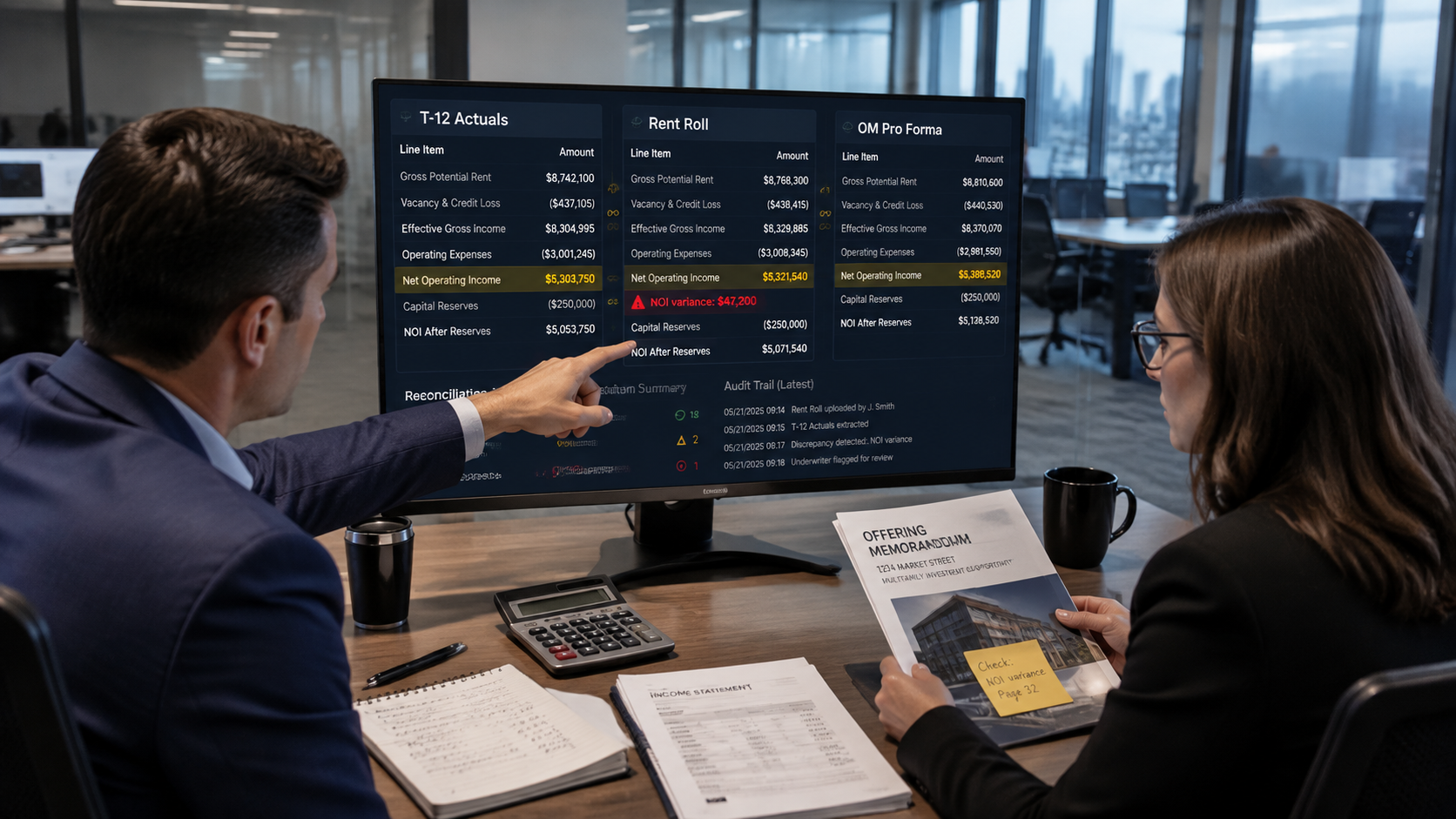
The reconciliation step with verifying that NOI in the OM is consistent with the T-12, and both consistent with the rent roll, is the highest-friction task in lender due diligence. These three documents are produced by different parties using different conventions; manual reconciliation consumes most of the first analyst day and still misses footnote-level modifications. Smart Capital Center extracts data from all three simultaneously, flags cross-document discrepancies before they reach the financial model, and links every figure to its source line. KeyBank achieved a 40% reduction in loan model preparation time. JLL achieved a 30x productivity gain in financial statement processing. See 6 Reasons Why Faster CRE Underwriting Wins More Deals.
Property-level cash flow is a necessary condition for credit approval. Commercial real estate underwriting requires parallel verification of the borrower’s financial capacity to support the loan if property performance deteriorates:
• Personal financial statement, verified against bank statements and brokerage confirmations
• Liquidity verification: post-close liquidity meets lender minimums (typically 10–15% of loan amount)
• Real estate schedule, credit report, and background search: all properties owned, trade lines, prior defaults, and judgment history
• Litigation history and prior foreclosure or deed-in-lieu, documented regardless of how long ago it occurred
The CREFC December 2025 Monthly CMBS Loan Performance Report documented an effective CMBS delinquency rate of approximately 8.75% when performing matured balloons are included, noting that “extension and modification activity is masking underlying refinancing stress.” That stress traces to origination-era assumptions never validated against transaction-level submarket data. A 3.5% rent growth assumption in a market producing 1.8% is the loan performance problem of 2026 and 2027, written in 2021. Smart Capital Center benchmarks every market assumption against 1B+ live signals across 120M+ properties, filtered to the specific submarket and prior 90 days.
A Phase I ESA with no RECs closes the environmental track. A Phase I identifying RECs requires a Phase II before commitment, adding 7–14 days that cannot be compressed. The PCA produces a deferred maintenance schedule and capital reserve requirement; when the PCA’s capex estimate significantly exceeds the OM’s reserve assumption, the lender carries a collateral underwriting gap that compounds over the hold period. Smart Capital Center’s cross-document verification flags this inconsistency automatically when both the PCA and appraisal are uploaded.
OFAC screening must be completed on all principals and beneficial owners before commitment, with results documented in the loan file at the time of verification. KYC documentation includes entity structure verification, beneficial ownership certification, and AML review, all required before funding regardless of lender type. Smart Capital Center automates OFAC and entity screening, logs every check with a timestamp and source data, and operates on SOC 2 Type II infrastructure with AES-256 encryption on private US-based servers.
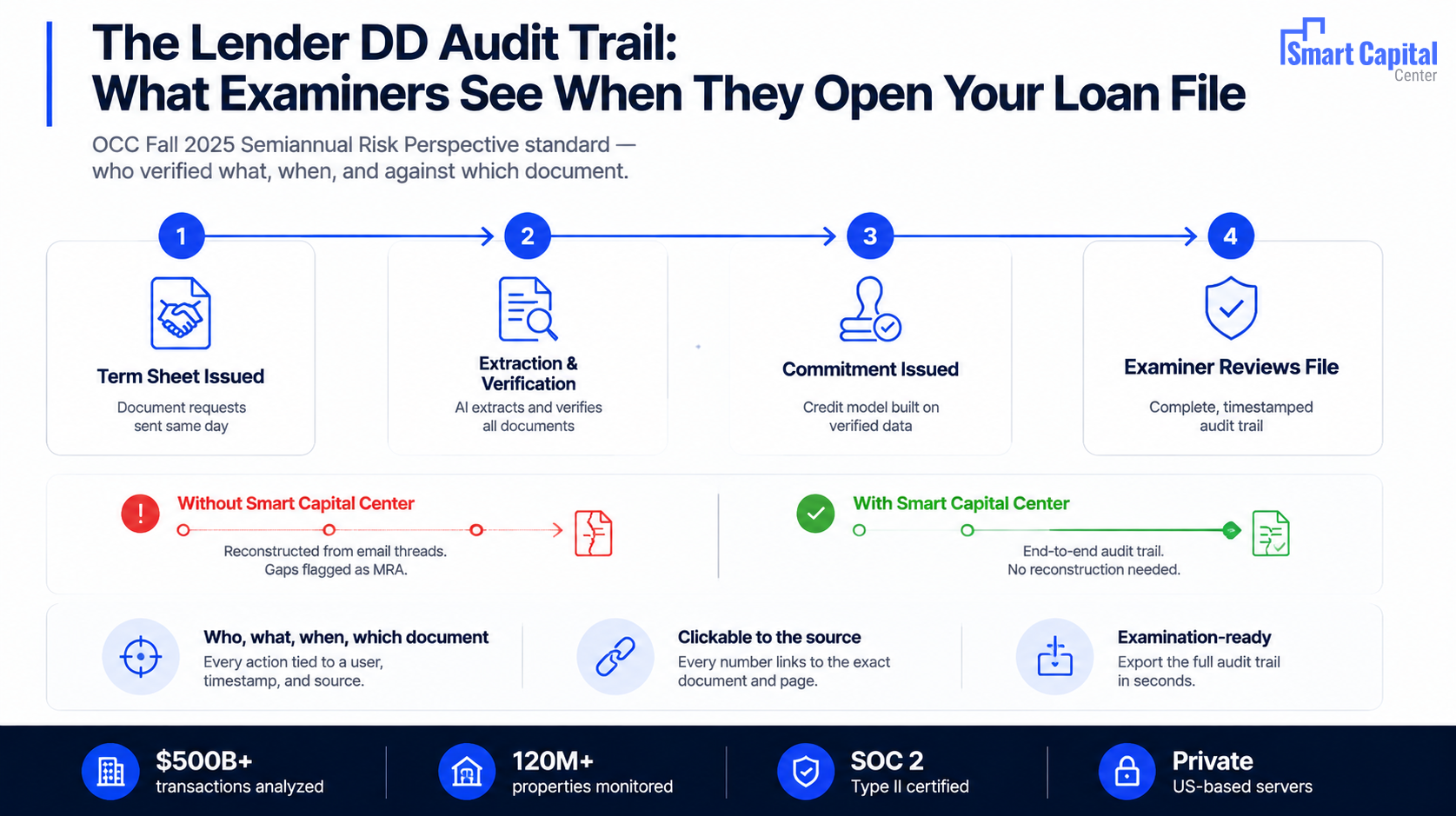
Reconciliation bottleneck: T-12, rent roll, and OM pro forma reconciled manually consumes the first analyst day on every deal and misses footnote-level modifications – the exact discrepancies examiners expect the credit file to have caught.
Non-standard document formats: different sponsors, different line-item conventions. Manual extraction at scale produces inconsistency that creates both credit risk and documentation risk across the same portfolio.
Audit trail gaps: examiners want to see who verified what, when, and against which document. A file where every verification step is timestamped and linked to its source satisfies this standard.
The table below compares manual and AI-assisted approaches to the five highest-friction tasks in software for CRE lenders due diligence.
1. Send a comprehensive document request at term sheet. Every day the clock runs without documents is a day lost from the analytical window. Request T-12, rent roll, all leases, Phase I ESA, PCA, and borrower financial statements on the day the term sheet is issued.
2. Run financial extraction and cross-document reconciliation before building any model. Verify that NOI from the T-12 matches the OM and that rent roll occupancy is consistent with T-12 revenue. Any discrepancy at this step invalidates the credit model until resolved. Smart Capital Center automates this step on upload.
3. Complete OFAC and KYC verification on all beneficial owners before issuing commitment. Results must be documented in the loan file at the time of verification. Timestamp and source documentation are required for examination.
4. Order Phase I ESA and PCA no later than day 3 of the diligence window. Both take 7–14 days to complete. A Phase II triggered with 10 days left in the window cannot be resolved within a standard commitment timeline.
5. Ensure that DD data captured at origination flows directly into post-close portfolio monitoring without re-entry. The covenant thresholds, lease terms, and financial baselines documented in DD are the inputs that drive ongoing monitoring. Smart Capital Center carries these through the loan lifecycle, eliminating the manual re-entry step that creates transcription risk and compliance gaps.
The lenders managing the highest origination volume without proportional credit staff growth are those whose DD process produces accurate, reconciled, source-traceable outputs without requiring a full document re-read for every verification step.
Smart Capital Center’s CRE lenders due diligence platform automates financial extraction and reconciliation, cross-document verification, market assumption benchmarking, compliance screening, and audit trail generation, with every figure linked to its source and every verification step logged for examiner review. The same data captured in DD flows directly into post-close portfolio monitoring without re-entry.
Cut lender DD from days to hours without creating the file gaps examiners flag. Book a demo with Smart Capital Center.
CRE due diligence for lenders adds credit-specific layers investor DD does not require: borrower financial capacity testing, OFAC and KYC compliance screening, DSCR stress testing, and an examiner-ready documentation file. Investor DD focuses on return underwriting; lender DD requires both return underwriting and regulatory defensibility of the credit decision.
Per the OCC’s Fall 2025 Semiannual Risk Perspective, examiners look for consistent application of credit standards across comparable loans, documented verification of income and expense figures against source documents, completed OFAC and KYC screens with timestamps, and Phase I ESA and PCA results. The core question: can the lender demonstrate who verified what, when, and against which document.
Cross-reference three documents simultaneously: T-12, current rent roll, and OM pro forma. NOI on the T-12 must be consistent with the revenue derivable from the rent roll at the same occupancy, and both must be consistent with the OM. Manual reconciliation runs 30 to 40 minutes per document. Smart Capital Center processes all three simultaneously and flags inconsistencies automatically before they reach the credit model.
OFAC screening on all beneficial owners with 25%+ ownership interest, with results and screening date in the loan file before commitment. KYC includes government-issued ID verification, entity formation documents verified against current Secretary of State filings, beneficial ownership certification, and an AML risk assessment, all at origination.
AI improves lender due diligence in three measurable ways: extraction (JLL 30x productivity gain, 30–40 min per statement to 1–3 min); cross-document verification (simultaneous comparison across T-12, rent roll, and OM, catching discrepancies manual review misses); and audit trail generation (every step logged automatically with timestamp and source, satisfying examiner standards). KeyBank achieved a 40% reduction in loan model preparation time using Smart Capital Center.
Source-level traceability on every extracted figure; cross-document consistency checks across all uploaded files simultaneously; automated OFAC and entity compliance screening with documented results; real-time submarket benchmarking; and a continuously generated, exportable audit trail satisfying OCC and FDIC examination standards.