


CRE Lenders

September 15, 2026
CRE Lenders
September 15, 2026

First half 2026 commercial real estate transaction volume grew 31 percent year over year to $293 billion, the strongest first half since 2022, according to Newmark's 2Q26 U.S. Capital Markets Conditions and Trends report. A disposition decision made against a hold-period calendar instead of current evidence is a decision made blind, and every gap the seller did not close before launch becomes a retrade item once a buyer starts testing the data room.
This analysis draws on Smart Capital Center, a commercial real estate database and asset management platform built on 120M+ properties, 1B+ signals, and $500B+ analyzed, which monitors portfolio performance continuously, to show what investors and asset managers should review before a commercial property disposition.
A commercial property disposition review covers four areas: the hold-or-sell analysis, current market timing signals, marketing readiness across financial and physical records, and the pricing evidence supporting a listing price. Each area should be checked against current data, not the assumptions made at acquisition.
● Disposition, in real estate: the sale or transfer of a property out of a portfolio, including the analysis, preparation, and marketing that lead up to it.
● Broker opinion of value: a pricing estimate prepared by a broker, generally based on comparable transactions and current market conditions, and not a formal appraisal.
● Estoppel certificate: a signed statement from a tenant confirming the terms of its lease and the absence of landlord defaults.
● Exit cap rate: the capitalization rate assumed at sale in an underwriting model.
● Net sale proceeds: gross sale price less closing costs, brokerage fees, loan payoff, prepayment costs, and reserves.
● Hold period: the length of time an asset is expected to be owned, usually set at acquisition and revisited as conditions change.
● Retrade: a buyer request to reduce the agreed price after diligence turns up something the seller did not disclose or resolve.
A hold-or-sell decision is only as good as the inputs compared side by side.
The refinance alternative deserves particular weight this year. The Mortgage Bankers Association reports $875 billion of commercial mortgages maturing in 2026, which puts a hard debt maturity date on many hold-or-sell decisions.
Transaction volume is not the same story across property types this year. Newmark's 2Q26 data shows senior housing volume up 96 percent, industrial up 50 percent, and office up 37 percent in the first half, meaning the buyer pool and available financing differ sharply by property type.
Cap rates and distress levels round out the picture. Transaction cap rates held largely flat outside industrial through the second quarter, and office distress accounted for 7.2 percent of office transaction volume, roughly half its Global Financial Crisis peak, signaling contained stress. Deloitte's 2026 Commercial Real Estate Outlook, a survey of more than 850 C-level executives across 13 countries, found nearly 75 percent of global respondents expect to increase their real estate investment over the next 12 to 18 months, with hedging against inflation and portfolio diversification the two most-cited reasons. The same survey found 21 percent of respondents do not expect to pay off maturing loans in full, and 15 percent anticipate foreclosure, a buyer pool shaped as much by debt position as by conviction.
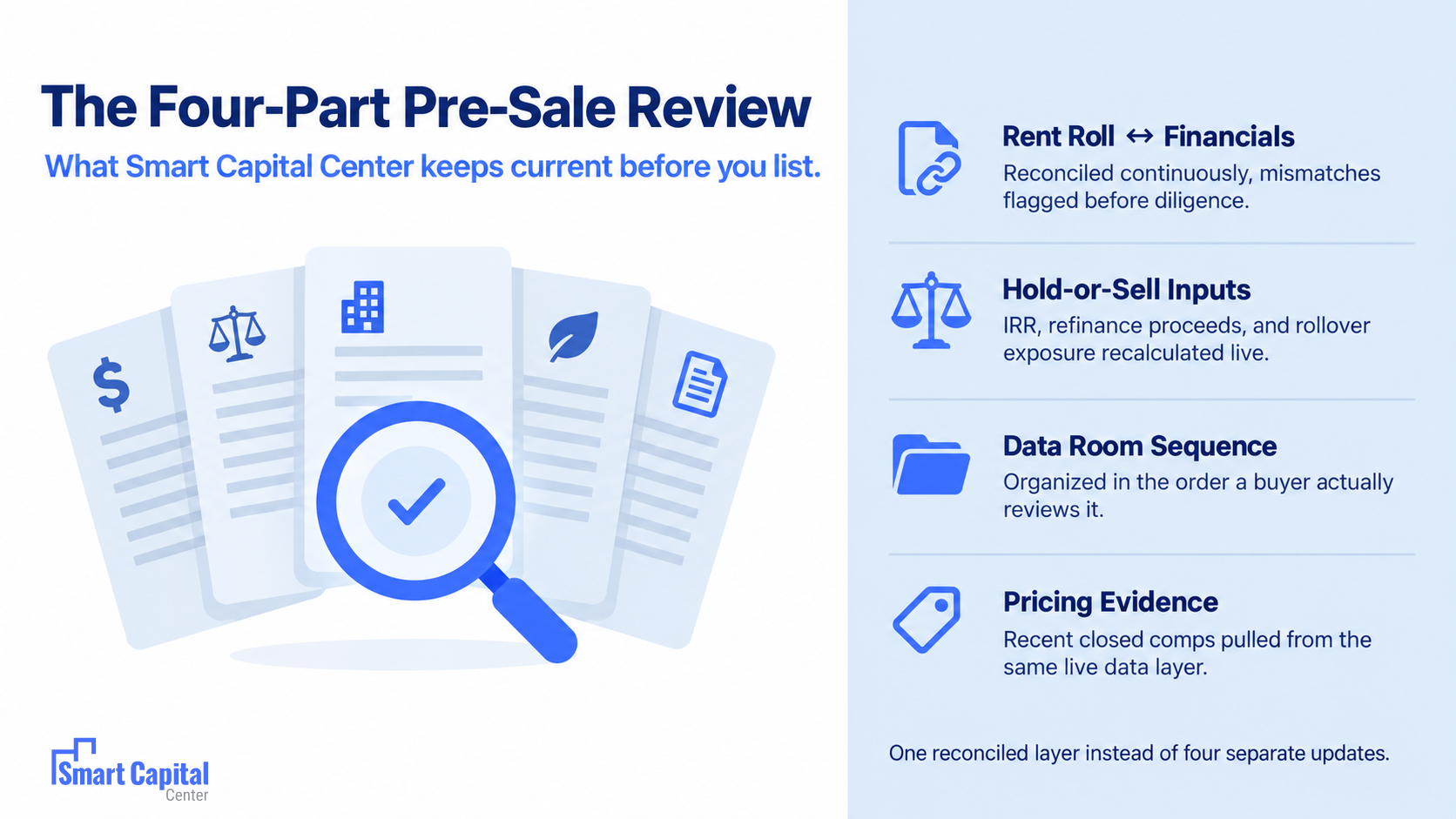
Selling commercial property starts with records a buyer will test in week one, not week six.
● Rent roll accuracy: checked against current leases and reconciled to the trailing 12 months.
● Lease abstracts and estoppels: requested early since tenant response time varies widely.
● Trailing 12-month financials and normalization: adjusting for one-time items before a buyer does it for you.
● Capex records: documenting what was spent and what remains deferred.
● Service contracts: confirmed for assignability and any change-of-control terms.
● Title and survey: ordered early enough to resolve any exceptions before they become closing conditions.
● Environmental records: updated if the existing Phase I is aging toward its useful life for lender reliance.
A pricing expectation needs evidence behind it before it goes to market.
A broker opinion of value is a pricing estimate built from comparable transactions and current market conditions, not a formal appraisal, and works best as a reality check against internal assumptions.
Testing that expectation before launch means pulling recent closed comps in the same submarket and asset class, confirming they reflect executed terms, and stress-testing the number against a range of buyer profiles, since an all-cash buyer and a leveraged buyer will price the same asset differently.
CBRE's U.S. Cap Rate Survey H2 2025, published February 2026 from roughly 3,600 estimates supplied by more than 200 CBRE capital markets and valuation professionals, found cap rates largely unchanged across major property types, with a majority of respondents believing yields had reached their cyclical peak. A pricing expectation built on comps from the past two quarters is therefore less likely to be stale than it would have been during the 2023 to 2024 repricing, which argues for pulling the most recent closed comps instead of widening the window.

A data room built in the order a buyer actually reviews it moves faster than one organized by internal convenience.
1. Corporate and ownership documents: entity formation, organizational chart, and any existing loan documents.
2. Financial records: trailing 12-month financials, normalized adjustments, budgets, and accounts receivable aging.
3. Lease documentation: the rent roll, full lease files, amendments, and estoppels as they come back signed.
4. Physical asset records: capex history, building systems reports, and any outstanding warranty documentation.
5. Legal and title: current title commitment, survey, zoning confirmation, and any pending litigation disclosures.
6. Environmental: the current Phase I, and a Phase II if the Phase I flagged anything requiring further study.
7. Service contracts and vendor agreements: assignability terms and notice periods for each.
Buyers now test the rent roll against the trailing financials early, often in the first week, so any mismatch surfaces before a seller has a chance to explain it in context. Closing that gap before the process starts is what keeps a commercial real estate acquisition and disposition process moving instead of stalling on a document request that should have been resolved months earlier.
A single disposition rarely stands alone. Selling an asset changes portfolio concentration by submarket, property type, or tenant, and that shift should be modeled before launch, not discovered afterward. Fund lifecycle and distribution timing add a second layer, since a sale that closes a quarter early or late can change what a fund reports to its limited partners. LP reporting needs the same reconciled figures used in the hold-or-sell analysis: current NOI, the resulting valuation, and a clear accounting of net sale proceeds.

Working backward from a target launch date keeps the marketing readiness work from compressing into the final weeks.
1. Ninety days out: run the hold-or-sell comparison and confirm the decision against current data.
2. Seventy-five days out: order title, survey, and an updated environmental report if the existing one is aging.
3. Sixty days out: request estoppels and begin normalizing the trailing 12-month financials.
4. Forty-five days out: assemble the data room in buyer-review order and confirm the rent roll reconciles to the financials.
5. Thirty days out: commission or update the broker opinion of value and stress-test the pricing expectation.
6. Fifteen days out: finalize marketing materials and confirm service contract assignability terms.
7. Launch: go to market with a data room that answers a buyer's first questions instead of prompting new ones.
Four gaps account for most of the value lost in a commercial real estate disposition process. A rent roll that does not tie to the trailing 12-month financials raises an immediate question about which number is accurate. Unresolved deferred maintenance, discovered during a buyer's inspection, becomes a negotiating point instead of a known cost. Missing estoppels slow a closing timeline and can void financing contingencies tied to specific lease terms. A pricing expectation set on stale comps invites an opening bid that undershoots the asset's actual value.
A note on tax treatment: the tax consequences of a sale, including depreciation recapture and any available deferral strategies, should be reviewed with a qualified tax advisor before a disposition decision is finalized. This article does not provide tax advice.
The pre-sale review, not the marketing launch, is where a commercial property disposition either holds its value or starts losing it. Every gap left unresolved before a data room opens becomes leverage in a buyer's hands during diligence, while a reconciled rent roll, a tested pricing expectation, and a documented hold-or-sell comparison remove that leverage before it exists. Smart Capital Center supports this by monitoring asset and portfolio performance continuously, so the analysis and the resulting data room both run against current data.
See the hold-or-sell comparison run against current data, not last quarter's numbers.
Book a demo with Smart Capital Center →
Q: What should I review before selling a commercial property?
A: Review the hold-or-sell analysis against current data, current timing signals for your property type, marketing readiness across rent roll, financials, and legal records, and the pricing evidence supporting your target price. Each area should reflect current conditions, not the assumptions made at acquisition.
Q: What are the best property disposition strategies for commercial real estate?
A: The strongest strategies combine four things: confirming the sale is the right call by comparing it against a continued hold and a refinance on current data, timing the launch to current transaction volume and cap rate signals for that specific property type, closing every marketing-readiness gap (rent roll, estoppels, normalized financials, capex records) before the data room opens, and testing the pricing expectation against recent closed comps. Sellers who front-load this work into the 90 days before launch consistently see fewer retrade requests, since buyers test the rent roll against the trailing financials in week one and any unresolved gap becomes their leverage.
Q: How long does a commercial property sale take?
A: A disposition typically runs 90 to 180 days from launch to closing, depending on financing conditions, buyer pool depth for the property type, and how much of the data room work happens before marketing begins. Starting the pre-sale review 90 days before launch shortens the diligence period that follows.
Q: What is a broker opinion of value?
A: A broker opinion of value is a pricing estimate prepared by a broker using comparable transactions and current market conditions, and it is not a formal appraisal. It works best as an early reality check on a pricing expectation, tested against recent closed comps.
Q: What documents does a buyer expect to see first in commercial real estate acquisition and disposition?
A: The rent roll and trailing 12-month financials come first, since buyers test these two documents against each other early in the process. A mismatch between them, discovered in week one, is one of the fastest ways a process loses momentum.
Q: What happens if my rent roll does not match my trailing financials?
A: A buyer will treat the discrepancy as a red flag and typically request an explanation before proceeding further, which slows the process and can lead to a retrade. Reconciling the two before a data room opens removes the question before a buyer has the chance to ask it.
Q: Should I hold or sell my commercial property this year?
A: The answer depends on comparing IRR to date, forward IRR under a continued hold, the refinance alternative, remaining capex, lease rollover, debt maturity, and tax position, all run against current data. With $875 billion in commercial mortgages maturing in 2026, many hold-or-sell decisions are being forced by a debt maturity date.
Q: How does Smart Capital Center support a commercial real estate exit strategy?
A: It monitors asset and portfolio performance continuously, so the hold-or-sell comparison, the current NOI figures, and the resulting data room all reflect live data instead of a quarterly snapshot. Rose Community Capital reviews significantly more applications with greater depth and consistency using the platform's traceable, reconciled data.