


AI in Commercial Real Estate

July 30, 2026
AI in Commercial Real Estate
July 30, 2026

According to CBRE’s 2025 U.S. Real Estate Market Outlook, transaction velocity in commercial real estate is accelerating across all major asset classes, and lenders that cannot match the pace of well-capitalized competitors on term sheet delivery are losing mandates before credit committees ever convene. The commercial real estate underwriting process has not changed in structure, but the tolerance borrowers have for slow execution has narrowed considerably. In a market where a sophisticated sponsor tracks response time across their lender relationships, speed is a qualification criterion.
This analysis draws on Smart Capital Center, a CRE AI platform that has processed $500B+ in transactions across 120M+ properties, used by institutional lenders including KeyBank and asset managers including JLL, to map why fast underwriting is now a structural competitive advantage and what AI-assisted workflows make it achievable.
The market context makes execution speed more consequential. The MBA’s 2026 CREF Forecast projects total commercial mortgage originations will reach $805 billion in 2026, a 27% increase from 2025’s already-elevated $634 billion. Reggie Booker, Associate Vice President of CREF Research at the MBA, noted at the MBA CREF 2026 Conference: “2025 was an active year for commercial real estate lending, with strong origination activity across all commercial capital sources. Many borrowers took advantage of favorable rates to refinance or acquire properties, setting the stage for continued growth into 2026.” In a lending environment where deal volume is expanding, the efficiency gap between lenders with AI-assisted underwriting and those working manually widens with every new origination.
Before examining what faster execution delivers, it is worth naming precisely where the time goes. Most lender teams describe the same three bottlenecks:
• Manual data extraction: Analysts open each document manually, locate the relevant figures, and transfer them into a model. A single deal package with five documents and three properties can consume a full analyst day before a single underwriting judgment has been made.
• Model setup from scratch: Without pre-configured assumptions or templates that carry through deal types, every loan starts from a blank spreadsheet. Duplicate data entry across credit memos, approval forms, and agency portals adds to the delay.
• Credit memo writing: After the model is complete, a narrative credit package still needs to be written, formatted, and reviewed, often consuming as much time as the financial analysis itself.
Each of these is a candidate for automation. The question is which platforms eliminate them end to end rather than accelerating one step while leaving the others intact.
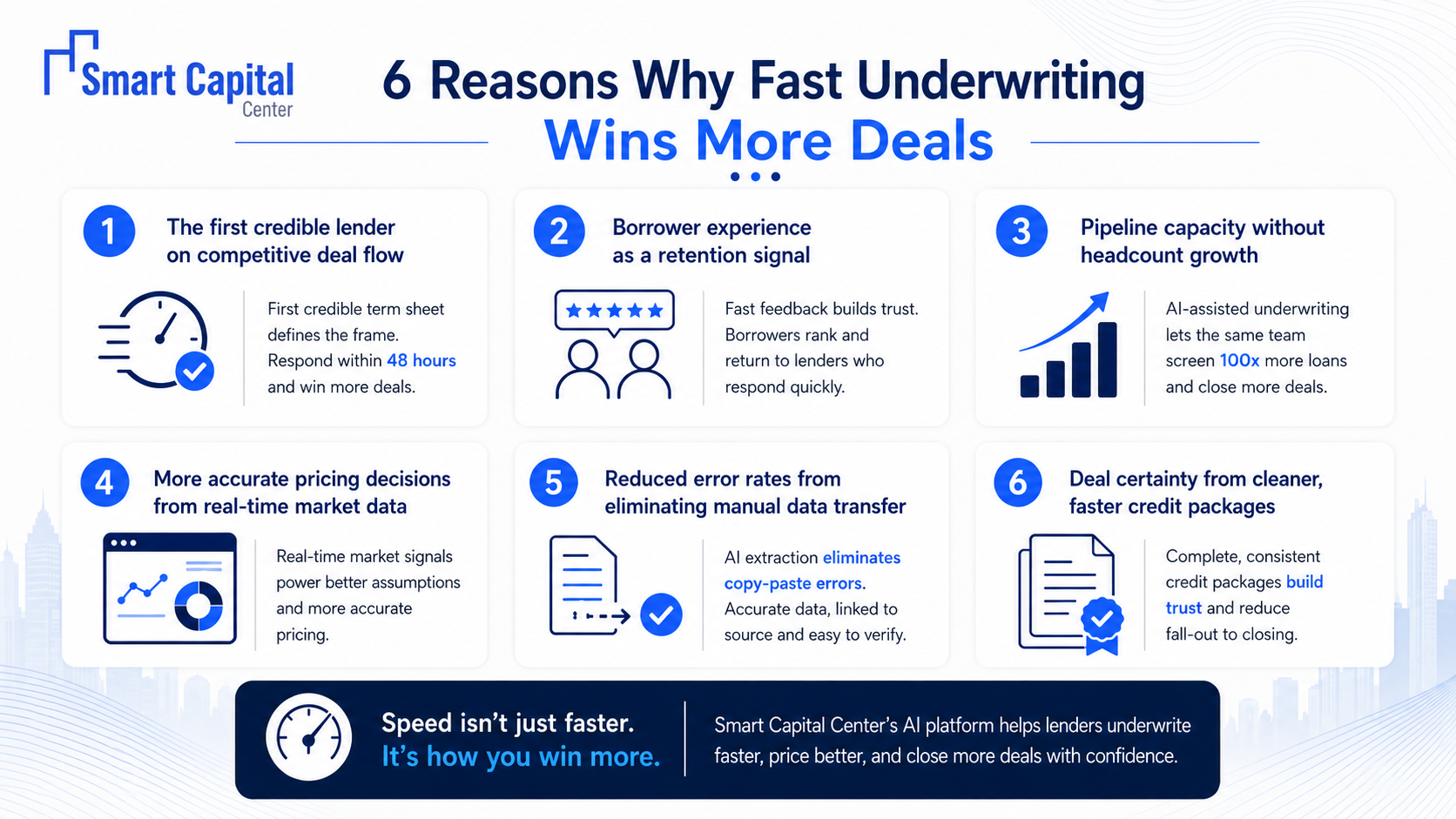
In a market where multiple lenders are competing for the same loan opportunity, the first credible term sheet defines the negotiating frame. Borrowers who receive a well-structured indication of interest within 48 hours are significantly more likely to advance with that lender than those who receive a comparable term sheet five days later. According to JLL’s Global Real Estate Perspectives, February 2026, deal velocity is now cited by sponsors as a top-three factor in lender selection, ranking alongside pricing and relationship depth.
Mike Fratantoni, Chief Economist and SVP of Research and Business Development at the MBA, has been explicit about the time pressure: “Lenders have as little as 48 hours to reach borrowers when they’re ‘in the money.’ That means technology must support real-time borrower monitoring, quick loan structuring, and fast-cycle processing.” That 48-hour window is the market standard that fast-moving lenders are already meeting.
Smart Capital Center’s AI extraction layer ingests rent rolls, T-12s, OMs, and lease abstraction in any format and maps extracted data directly into the lender’s own Excel model or Smart Capital Center’s integrated DC. No reformatting, no manual transfer. The front-end bottleneck that consumes the first analyst day on every new deal is eliminated before underwriting judgment begins.
Sophisticated sponsors maintain informal rankings of lender responsiveness across their relationships. A lender that consistently delivers preliminary credit feedback within two days of receiving a deal package earns repeat allocations. One that takes two weeks earns a footnote in the borrower’s lender comparison matrix.
This is a volume and pricing dynamic: sponsors who value a lender’s speed are more likely to bring that lender into deals earlier in the process, at more competitive spreads, because borrowers will pay a small premium for execution certainty.
The traditional response to increased deal flow is to hire. AI-assisted underwriting breaks that linear relationship. Smart Capital Center allows the same credit team to screen 100x more loans by automating the extraction and model population stages that currently consume the majority of analyst hours. KeyBank reported a 40% reduction in loan model preparation time after deploying Smart Capital Center – gains realized mid-implementation, before any workflow redesign was complete. That 40% gets reallocated to credit judgment, relationship management, and deal sourcing.
Manual underwriting pulls market assumptions from the most recent available source, which, for many lenders, is a quarterly brokerage report or a saved comp set from a prior deal. The assumptions feeding the model may be 60 to 90 days stale by the time the credit committee reviews them. In a market where CBRE’s 2025 U.S. Real Estate Market Outlook documents near-record spreads between asset tiers and rapid cap rate divergence by submarket, that lag produces assumptions that are both harder to defend and more likely to misprice risk.
Smart Capital Center’s underwriting layer integrates 1B+ real-time market signals directly into the model, so rent growth assumptions, vacancy benchmarks, and cap rate inputs reflect current conditions at the time the analysis is run.
Manual data extraction introduces a consistent and well-documented failure mode: copy-paste errors. A transposed figure in a rent roll, a miscategorized expense line in a T-12, or a missed footnote that modifies a base rent figure can produce a DSCR that looks acceptable while resting on an incorrect input. These errors are the predictable output of a process that asks humans to transfer data from one format to another across hundreds of line items per deal.
AI extraction eliminates the transfer step entirely. Data maps directly from source documents into the underwriting model, with every figure linked to its source for spot-check review. JLL documented a 30x productivity gain in financial statement processing after deploying Smart Capital Center, and the accuracy benefit was as significant as the speed benefit, with extraction errors falling to near zero on documents processed through the platform.
A credit package that arrives complete, internally consistent, and formatted to committee standards on the first submission signals something beyond efficiency. It signals institutional competence. Borrowers and their advisors notice when a lender’s credit memo is clearly structured, when the assumptions are sourced and dated, and when the underwriting matches the term sheet that was issued. That consistency builds the trust that reduces fall-out between term sheet and closing. For a look at how AI is reshaping what lenders can deliver at the MBA CREF level, see MBA CREF 2026 Technology Council: AI and Connected Intelligence in CRE Lending.
Smart Capital Center generates credit memo drafts in minutes from the underlying underwriting data, with customizable templates that match the lender’s own format and committee conventions. The analyst reviews and refines rather than builds from a blank page.
Speed without accuracy is worse than speed alone, because it produces confident-looking outputs built on incorrect inputs. The most common failure mode in automated underwriting is an extraction error that reaches the model unchecked – a rent roll line misread, a T-12 expense miscategorized, a footnote-modified rent figure taken at face value. If the automation accelerates data transfer but does not validate it, the error rate drops in volume but increases in consequence.
Smart Capital Center mitigates this through AI-powered validation that cross-checks extracted figures against source documents before they populate the model, with exception flags on low-confidence extractions and inconsistencies between documents. Every figure is linked to its source for analyst review, so speed does not come at the cost of traceability.
A credit memo generated in minutes from model outputs is only as defensible as the model it draws from. If the auto-generated narrative presents stale market assumptions or unreviewed rent growth inputs as current, the committee receives a polished document built on a weak analytical foundation. The risk is that their speed and polish can reduce the scrutiny they receive before submission.
Smart Capital Center mitigates this through a human-in-the-loop workflow where auto-generated credit memo drafts are reviewed and refined by the analyst before submission. The platform produces the structure, sources the market data, and populates the financials. The analyst validates the judgment calls before the package advances.

Speed in CRE underwriting comes from eliminating manual steps that add days without adding judgment.
Smart Capital Center’s AI-assisted commercial real estate underwriting process automates document ingestion, data extraction, model population, market benchmarking, and credit memo generation in a single workflow that carries data from origination through asset management without re-keying. The result is a faster process that is also more accurate, more defensible, and more consistent than the manual alternative it replaces.
Prepare loan models 40% faster, from borrower documents to credit memo in hours. Book a demo with Smart Capital Center.
With AI-powered extraction and model population, the front-end stages of underwriting compress from a full analyst day to hours or less. KeyBank reported a 40% reduction in loan model preparation time after deploying Smart Capital Center, with gains realized mid-implementation. Credit memo drafts that previously required a separate writing session are generated in minutes from completed underwriting data. The time savings compound across a full pipeline: a team that previously processed 10 deals per month can screen materially more without additional headcount.
The most reliable software to speed up loan underwriting combines three capabilities in a single platform: AI-powered document extraction that handles any format without reformatting, direct model population that maps extracted data into the lender’s own Excel model or an integrated DCF, and automated credit memo generation from the underlying analysis. Platforms that accelerate only one of these stages leave the others as manual bottlenecks. Smart Capital Center covers all three end to end, with pre-configured underwriting assumptions that auto-apply across deal types and a data layer that carries through from origination to asset management without re-keying.
The counterintuitive finding is that AI underwriting reduces error rates rather than compounding them. Manual data extraction introduces transposition errors, miscategorized line items, and missed footnotes at a rate that increases with deal volume and analyst fatigue. AI extraction eliminates the transfer step entirely, with validation logic that flags inconsistencies between documents before they reach the model. Every extracted figure is linked to its source for spot-check review, making the audit trail more complete than manual processes typically produce.
The key is separating the stages that require human judgment from those that do not. Data extraction, model population, market benchmarking, and memo formatting require accuracy and consistency, which loan management software delivers more reliably than manual processes at scale. Credit analysis, risk assessment, and final approval require analyst expertise that AI supports but does not replace. Smart Capital Center is designed around this division: it automates the mechanical stages and presents structured, sourced outputs for analyst review, so the analyst’s time concentrates on the fast underwriting decisions that require it.
Examiners look for two things: documented assumptions and a defensible audit trail. AI-assisted underwriting strengthens both. Every figure in a Smart Capital Center credit package is linked to its source document – a DSCR back to the T-12 line that generated it, a rent growth assumption back to the dated market signal that sourced it. Pre-configured assumptions apply uniformly across deal types, eliminating the model variations examiners flag when reviewing underwriting standards across a portfolio. Manual underwriting rarely produces this level of consistency and traceability at speed.