


AI in Commercial Real Estate

September 14, 2026
AI in Commercial Real Estate
September 14, 2026
CRE due diligence is where competitive advantage is built for both investors and lenders. Smart Capital Center helps teams compress every layer of the DD process, from financial and physical to legal, environmental, and market, from weeks into hours. Analysts evaluate more deals with the same headcount, and every underwriting decision remains defensible with source-traceable data. That capacity matters more in 2026: the MBA's 2026 CREF Forecast projects $805 billion in commercial mortgage originations for the year, a 27% increase from 2025, and the firms winning the most deals will be the ones scaling without sacrificing rigor.
Due diligence: structured verification of financial, physical, legal, environmental, and market information before a purchase or loan closes.
Letter of intent (LOI): non-binding document outlining deal terms and initiating the formal diligence period.
Purchase and sale agreement (PSA): binding contract specifying closing conditions and the hard deadline by which diligence must be complete before earnest money becomes non-refundable.
Phase I ESA: standard environmental records review and site inspection identifying recognized environmental conditions (RECs) without sampling.
Phase II ESA: follow-up assessment involving soil, groundwater, or air sampling, triggered only when a Phase I identifies specific concerns.
The standard for due diligence in commercial real estate has tightened in 2026 for three compounding reasons. The OCC’s Fall 2025 Semiannual Risk Perspective identified that “credit conditions and refinancing risk in certain segments of commercial real estate lending and private credit markets warrant ongoing monitoring”. This is a signal that examiners are scrutinizing underwriting documentation more closely. Meanwhile, $875 billion in commercial mortgage maturities are scheduled for 2026, per the MBA, creating refinancing and workout volume that existing analyst teams were not sized to handle. And the Deloitte 2026 CRE Outlook found that 27% of CRE firms are experiencing challenges with AI implementation, meaning most teams are managing document-heavy workflows manually at exactly the moment volume is expanding most rapidly.
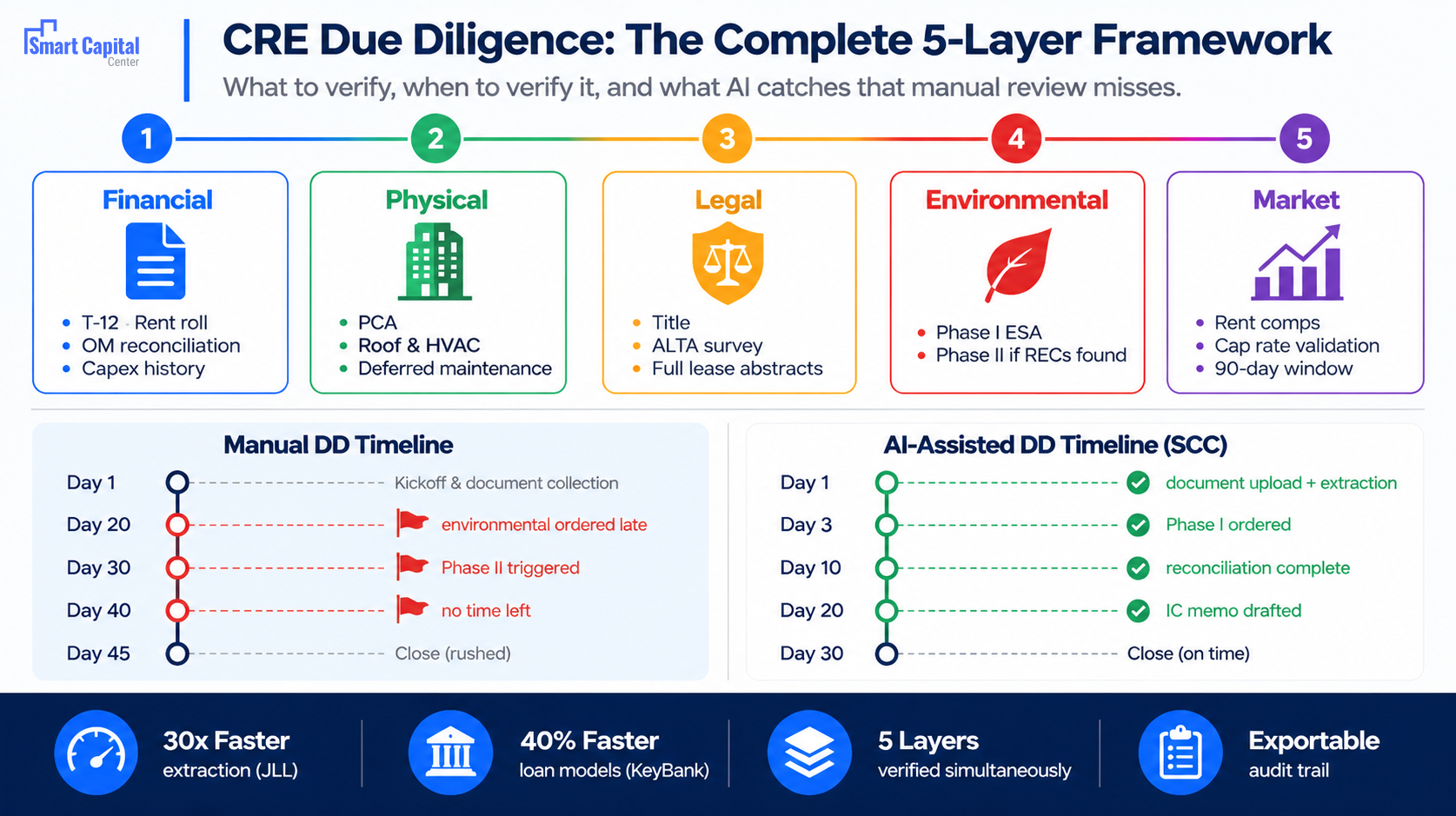
Verifies that the NOI, occupancy, and expense figures supporting the deal’s valuation are accurate and consistent across the T-12, rent roll, and OM pro forma. Discrepancies between these three documents are the most consistent source of underwriting errors. Smart Capital Center processes all three simultaneously, flagging inconsistencies before they reach the financial model. JLL documented a 30x productivity gain from 30–40 minutes per statement to 1–3 minutes after deployment.
Answers whether the asset is in the condition the seller represented and whether the capital required to maintain it is correctly accounted for. A Property Condition Assessment (PCA) examines structural and mechanical systems and produces a capital reserve schedule. Deferred maintenance not reflected in the OM’s capex reserve assumption is the most consequential finding. Smart Capital Center’s cross-document verification flags this automatically when both the PCA and appraisal are uploaded.
Confirms the seller’s right to convey, clean title, and that the lease structure matches the financial model. The most common failure is a lease provision that modifies economic terms without appearing in the rent roll headline figures. Full lease abstracts are the only protection.
Establishes whether historical contamination creates remediation liability. A Phase I with no RECs closes the track. A Phase I identifying RECs triggers a Phase II, adding 7 to 14 days. Environmental review ordered late in the diligence window is the most common source of PSA extension requests.
Validates whether income assumptions reflect what the specific submarket will support over the hold period. Convention-based assumptions, applying a metro-level rent growth figure to a supply-pressured submarket, are the most frequently missed source of model error. Smart Capital Center gives investors and lenders the evidence to defend every underwriting assumption in credit committee or IC, benchmarking every input against 1B+ live signals across 120M+ properties, filtered to the specific submarket and prior 90 days.
“$875 billion in scheduled maturities in 2026 and $652 billion in 2027 will fuel additional lending activity.” – Mike Fratantoni, Chief Economist, MBA, 2026 CREF Convention
Smart Capital Center automates the mechanical steps of CRE transaction due diligence: extraction, reconciliation, and market benchmarking, and surfaces structured, exception-flagged outputs for analyst review. KeyBank achieved a 40% reduction in loan model preparation time. JLL achieved a 30x productivity gain in financial statement processing. Neither result required hiring.
1. Send a document request list the day the LOI is executed. Request the T-12, rent roll, all leases, Phase I ESA (if available), and existing PCA on day one.
2. Run financial extraction and cross-document reconciliation before building any model. Verify NOI, occupancy, and expense consistency across T-12, rent roll, and OM. Smart Capital Center runs this step on upload.
3. Order the Phase I ESA and PCA no later than day 3. Both take 7–14 days to complete. Diligence timelines collapse at the back end when these reports arrive with 5 days left.
4. Abstract every material lease before the financial model is finalized. Renewal options, co-tenancy clauses, and rent escalation structures are not captured in rent rolls and not visible in the OM.
5. Validate all market assumptions against current transaction data. Comp sets must be filtered to the specific submarket, asset class, vintage, and prior-90-day window.
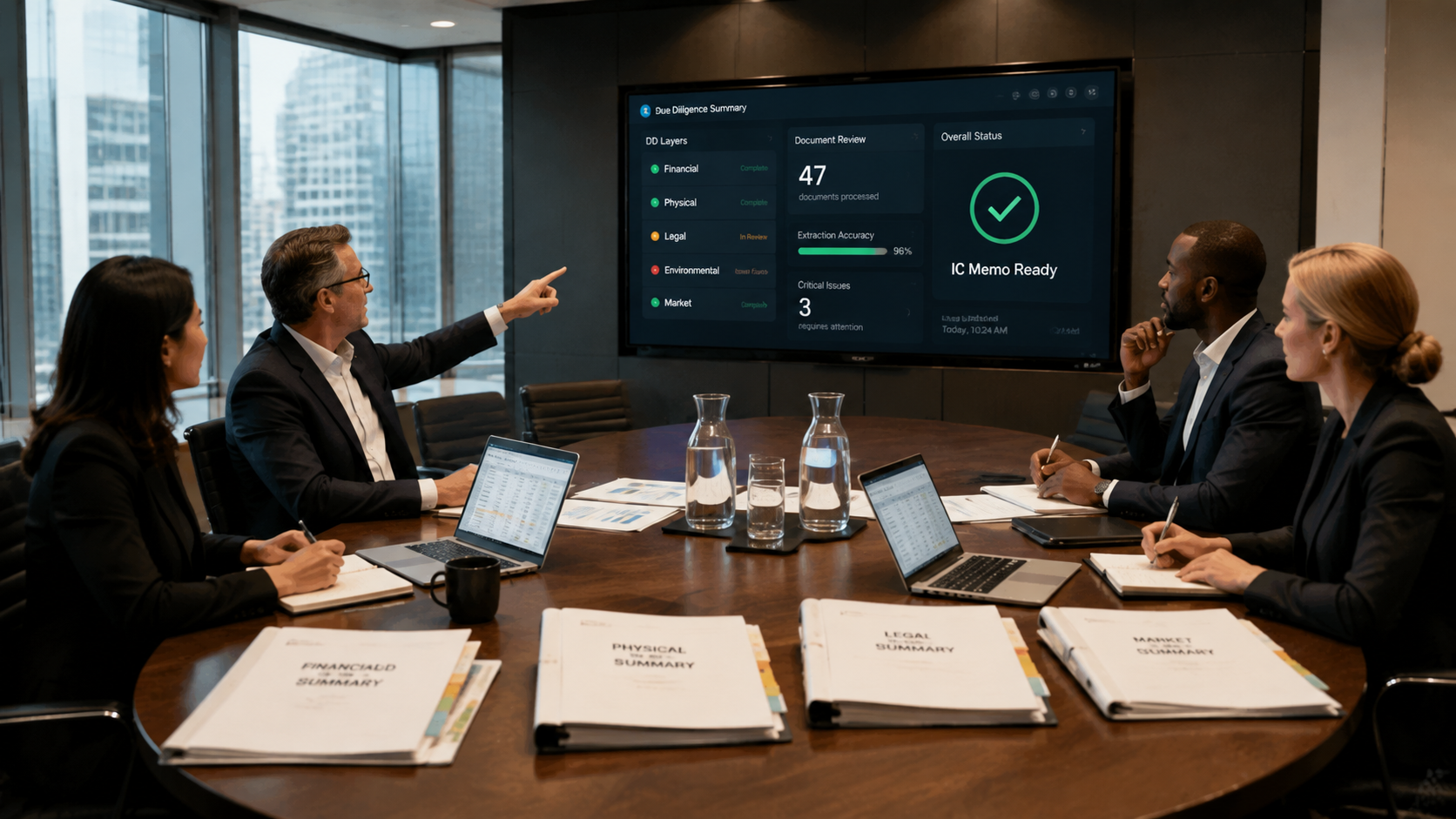
6. Build the IC memo from extracted and verified data. Smart Capital Center generates IC memo drafts from underlying deal data with every figure source-linked.
• Accepting the OM pro forma without reconciling it against the T-12: the OM is a marketing document
• Running environmental review too late in the window: a Phase II triggered with 10 days left cannot be resolved within the PSA timeline
• Using metro-level market data to validate submarket-specific assumptions: averages conceal the local variance the validation is meant to surface
• Skipping full lease abstracts on non-anchor tenants: co-tenancy clauses and termination options exist only in the lease documents
• Building the financial model before cross-document reconciliation is complete: precision on wrong inputs produces precisely wrong outputs

• Source-level traceability: every extracted figure clickable to its source document location
• Cross-document consistency checks running simultaneously across all uploaded files
• Confidence signaling on low-certainty extractions, directing analyst review to the outputs that warrant it
• Any-format ingestion without clean broker exports or standardized templates
• Real-time submarket benchmarking
• Continuously generated, exportable audit trail satisfying credit committee and regulatory review requirements
Smart Capital Center delivers all of these in a single platform.
The deals that close cleanly are those whose due diligence produced accurate, reconciled, source-traceable outputs before the credit committee deadline.
Smart Capital Center’s commercial real estate due diligence platform automates document ingestion, cross-document reconciliation, market validation, and IC memo generation, with every figure linked to its source and every assumption benchmarked against live market data.
Run a full CRE due diligence checklist against your next deal package in hours. Book a demo with Smart Capital Center.
Commercial real estate due diligence is the structured verification of financial, physical, legal, environmental, and market information about a property before a purchase or loan closes. It runs across five parallel tracks, each with its own document set and failure modes, that all feed into a single credit or investment decision.
The standard CRE due diligence period is 30 to 45 days from PSA execution. Financial reconciliation, physical inspection, Phase I ESA, and initial title review should be complete by day 20. A Phase I that triggers a Phase II adds 7 to 14 days. In 2026, sponsor-driven compression is pushing many competitive deals toward 21 to 30 day windows, making AI-assisted extraction the difference between meeting and missing the PSA deadline.
At minimum: T-12 operating statement, current rent roll, all leases and amendments, OM, prior-year financials, Phase I ESA, property condition assessment, title commitment, ALTA survey, zoning verification, and current insurance certificates. Lender-specific checklists add borrower entity documents, guarantor financials, and an environmental questionnaire.
Separate the mechanical steps (extraction, reconciliation, market benchmarking) from the judgment steps (risk analysis, assumption refinement, IC recommendation). AI platforms automate the mechanical steps and surface exceptions for analyst review. Smart Capital Center compresses financial extraction from a full analyst day to hours, flags cross-document discrepancies automatically, and benchmarks assumptions against live market data.
The five most cited failures: accepting the OM pro forma without T-12 reconciliation; running environmental review too late for a Phase II to complete; using metro-level comps to validate submarket assumptions; skipping lease abstracts on non-anchor tenants; and building the financial model before cross-document reconciliation is complete. Each is avoidable with the right process sequencing and platform.
AI improves CRE due diligence in three specific, measurable ways: document extraction (JLL 30x productivity gain, 30–40 min per statement to 1–3 min); cross-document verification (simultaneous comparison across all uploaded documents, catching discrepancies sequential review misses); and market validation (live submarket benchmarking against 1B+ signals, not quarterly brokerage reports). The combined effect is the same analytical depth in a fraction of the time, with a more complete and defensible audit trail.
The capabilities that distinguish effective commercial real estate due diligence software from document storage: source-level traceability on every extracted figure, cross-document consistency checks, confidence signaling on uncertain outputs, any-format ingestion, real-time submarket benchmarking, and a continuously generated audit trail. Platforms that accelerate extraction but skip cross-document verification have addressed one bottleneck while leaving the most consequential error sources intact.