


AI in Commercial Real Estate

September 16, 2026
AI in Commercial Real Estate
September 16, 2026

According to CBRE's Lending Momentum Index, Q3 2025, commercial real estate loan closings rose 112% year-over-year – reaching levels not seen since 2018. More volume, faster borrower expectations, and tighter spreads mean lenders who rely on manual origination workflows are not just slower: they are structurally disadvantaged.
This analysis draws on Smart Capital Center – a CRE AI platform that has processed $500B+ in transactions across 120M+ properties, used by KeyBank, JLL, and leading institutional lenders – to show exactly where AI loan origination removes friction from the lending lifecycle and how that translates to a measurable 40% reduction in deal preparation time.
The 40% figure is not a projection. KeyBank's Senior Vice President reported that figure mid-implementation, before Smart Capital Center was fully deployed across their team. That kind of result, achieved before full rollout, signals that the bottlenecks AI targets are structural – not situational.
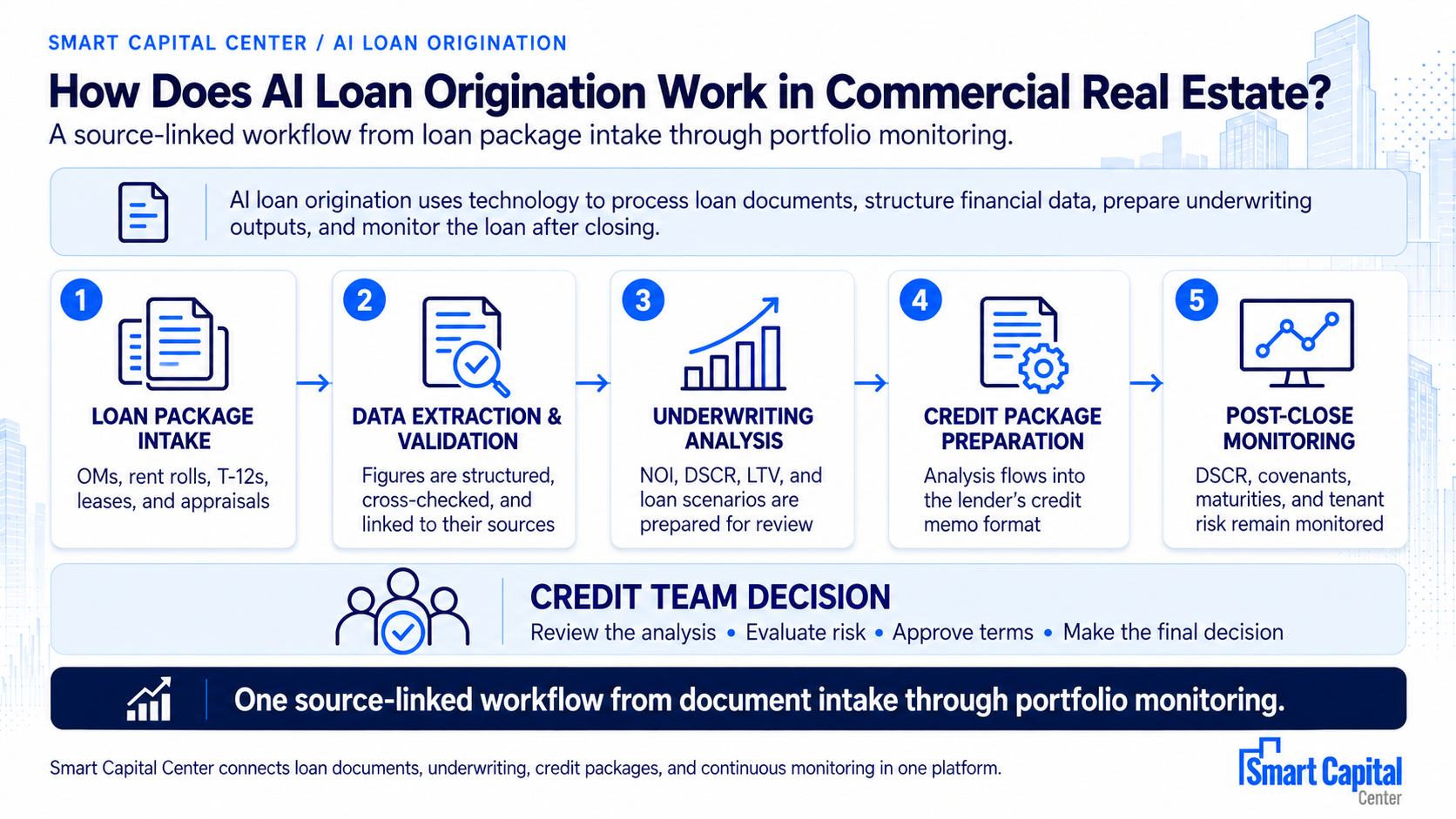
AI loan origination refers to the use of machine learning and automation to manage the full commercial real estate lending workflow – from document ingestion and underwriting to credit package generation and post-close monitoring.
Instead of relying on analysts to manually extract data, build models, and prepare credit memos, AI-powered platforms process loan documents automatically, structure financial data in real time, and generate underwriting outputs with full traceability.
In practice, this means:
Platforms like Smart Capital Center combine all of these steps into a single system, allowing lenders to move from initial document review to credit decision without switching tools or re-entering data.
Manual CRE loan origination typically breaks down across the same three stages, regardless of lender size or loan type.
The first is document ingestion. A single loan package – offering memorandum, rent roll, T-12, appraisal, leases – arrives as a mix of PDFs, spreadsheets, and scanned files. An analyst manually extracts figures, reformats them, and enters them into the underwriting model. One financial statement alone takes 30 to 40 minutes to process. Multiply that across a full loan package and two to three analyst days disappear before underwriting has technically started.
The second is credit memo preparation. After underwriting is complete, someone has to draft the credit package: NOI analysis, DSCR calculation, tenant review, market comparables, risk narrative. Most lenders still build these largely by hand, pulling data from multiple systems and reformatting it for committee review.
The third is compliance and covenant tracking. Confirming that a loan meets internal credit policy, environmental requirements, and covenant thresholds requires checking data across documents that rarely live in the same place. Manual compliance review adds days, and errors surface at the worst possible moment – during committee review or at closing.
With CRE lending volumes up sharply and deal competition intensifying, the manual model hits a ceiling fast. Adding loan volume without adding headcount means either slower turnarounds or corners cut on diligence. Neither option is acceptable for lenders trying to grow their book while managing portfolio risk.

AI-powered loan origination software built for CRE addresses the document ingestion problem directly. Rather than requiring an analyst to read and transcribe each figure, machine learning models trained on CRE document libraries extract data fields by context – handling non-standard rent rolls, inconsistent T-12 formats, and multi-tenant lease structures without rigid templates.
Smart Capital Center reduces financial statement processing from 30 to 40 minutes per document down to 1 to 3 minutes, with every extracted figure traceable back to its source. That traceability matters: it is not just speed, it is defensibility when the credit package goes to committee.
Once document data is extracted and structured, AI for loan origination can generate credit memos directly from the underwriting model. Smart Capital Center produces compliant credit packages – including NOI analysis, DSCR, LTV, tenant-level review, and SWOT analysis – in minutes rather than the half-day or full-day drafting cycle most lenders currently run.
The output is not a first draft that needs heavy editing. It is a structured package with a full audit trail, built from the same data the underwriter reviewed. That consistency reduces the back-and-forth between origination and credit teams that typically adds days to a deal timeline.
AI-enabled loan origination software extends beyond closing. Smart Capital Center monitors covenant compliance, DSCR thresholds, and tenant risk continuously – flagging exceptions as they emerge rather than waiting for quarterly review cycles. For lenders managing large pipelines, automated compliance monitoring is the difference between catching a problem early and discovering it at renewal.
According to Deloitte's 2026 Commercial Real Estate Outlook, 27% of CRE firms report significant challenges with AI implementation – most citing data quality and integration issues, not model performance. The firms gaining ground are those deploying AI within existing workflows rather than running it as a parallel experiment.
AI in loan origination is not without risk. Lenders should address these before deployment.
If the AI system ingests an outdated rent roll, the coverage ratio it calculates will not reflect actual tenancy – and the system may alert on a threshold that does not match current conditions. Smart Capital Center mitigates this through continuous document ingestion: as updated rent rolls arrive, they flow directly into the underwriting model, keeping DSCR calculations current rather than anchored to deal-screening data.
AI platforms that rely on periodic data refreshes rather than live market signals can produce credit memos with cap rate comparables that are 60 to 90 days old – a meaningful lag in a recovering lending market. Smart Capital Center draws on 1B+ real-time market signals across 120M+ properties, so comps in a generated credit package reflect current conditions, not last quarter's.
On construction loans, AI-matched draw requests that contain falsified invoices or budget line mismatches can pass automated reconciliation if the system relies solely on dollar-amount matching. Smart Capital Center's draw management layer verifies completion percentage, lien waiver documentation, and budget line alignment – flagging discrepancies before disbursement rather than discovering them during audit.

Smart Capital Center satisfies all five criteria – live data, configurable templates, end-to-end lifecycle coverage, and native integration with major accounting and servicing platforms.
AI loan origination changes how lenders process volume, manage risk, and scale operations.
By automating document extraction, underwriting, and credit package generation, AI reduces the time required to move from initial loan package to credit decision. Tasks that previously required multiple days of analyst work can be completed within a single session, with outputs that remain fully traceable to source data.
This shift allows lenders to:
The result is a more efficient and controlled lending process, where speed does not come at the expense of accuracy or oversight.
Most CRE lending teams are not limited by deal flow – they are limited by how quickly they can process and validate each loan.
Smart Capital Center combines AI-powered document extraction, real-time underwriting, and continuous compliance monitoring into a single platform.
See how your current origination process compares. Book a demo with Smart Capital Center and evaluate your next loan in a single session.
How can I tell if AI loan origination software will actually reduce my team's workload?
Request a parallel run: have the platform process a sample of your last 10 closed loans and compare extraction time, credit package output, and error rate against your current process. The gap between manual and AI-powered workflows becomes clear immediately when tested on documents your team already knows.
How long before my team starts seeing faster deal timelines after deployment?
KeyBank's Senior Vice President reported a 40% reduction in loan model preparation time mid-implementation – before full deployment. Most teams see measurable extraction time savings within the first week, with credit package generation and compliance workflow improvements following as document volume through the platform accumulates.
How do I know AI-generated credit packages will meet my institution's compliance requirements?
Smart Capital Center generates credit packages with a source-level audit trail on every figure – each data point traces back to the specific document line it came from. Compliance verification is built into the workflow rather than added as a manual step at the end. Templates are configurable to match your institution's credit committee format and internal standards.
Can AI-enabled loan origination software integrate with our existing loan management systems?
Smart Capital Center connects directly with Yardi, SS&C Precision, Midland Enterprise, PNC Enterprise, and other major CRE accounting and servicing platforms via API. This eliminates manual data exports and ensures loan-level data flows from origination through post-close monitoring without re-entry.
What happens when documents arrive in non-standard formats or poor scan quality?
The extraction model identifies data fields by context rather than fixed template position, so it handles non-standard formatting, handwritten annotations, and lower-quality scans. Where extraction confidence is below threshold, the platform flags those fields for analyst review rather than passing uncertain figures silently into the model.
How does AI loan origination improve borrower experience without compromising underwriting standards?
AI loan origination reduces turnaround time at every stage of the process — from document review to credit decision — which shortens response times for borrowers. At the same time, structured data extraction and audit trails ensure that underwriting standards remain consistent and verifiable, so faster processing does not reduce credit discipline.