


AI in Commercial Real Estate

September 25, 2026
AI in Commercial Real Estate
September 25, 2026

According to Deloitte's 2026 Commercial Real Estate Outlook, a survey of more than 850 C-level executives at commercial real estate owners and investment companies with at least $250 million in assets under management, the functions where firms report the most trouble with AI integration are the same ones they buy software to fix: property operations and management leads at 42 percent, followed by property marketing and construction projects at 39 percent each. Among firms reporting positive results, tenant relationship management leads at 41 percent. The gap between those two lists is the evaluation problem in miniature. Most selection processes get driven by demo impressions and feature grids rather than the questions that determine whether a system still works in year two, once document volume is higher and the original champion has moved to a different role.
This analysis draws on Smart Capital Center, a commercial real estate database and investment management platform, as one example to evaluate against the questions below, alongside any other system under consideration.
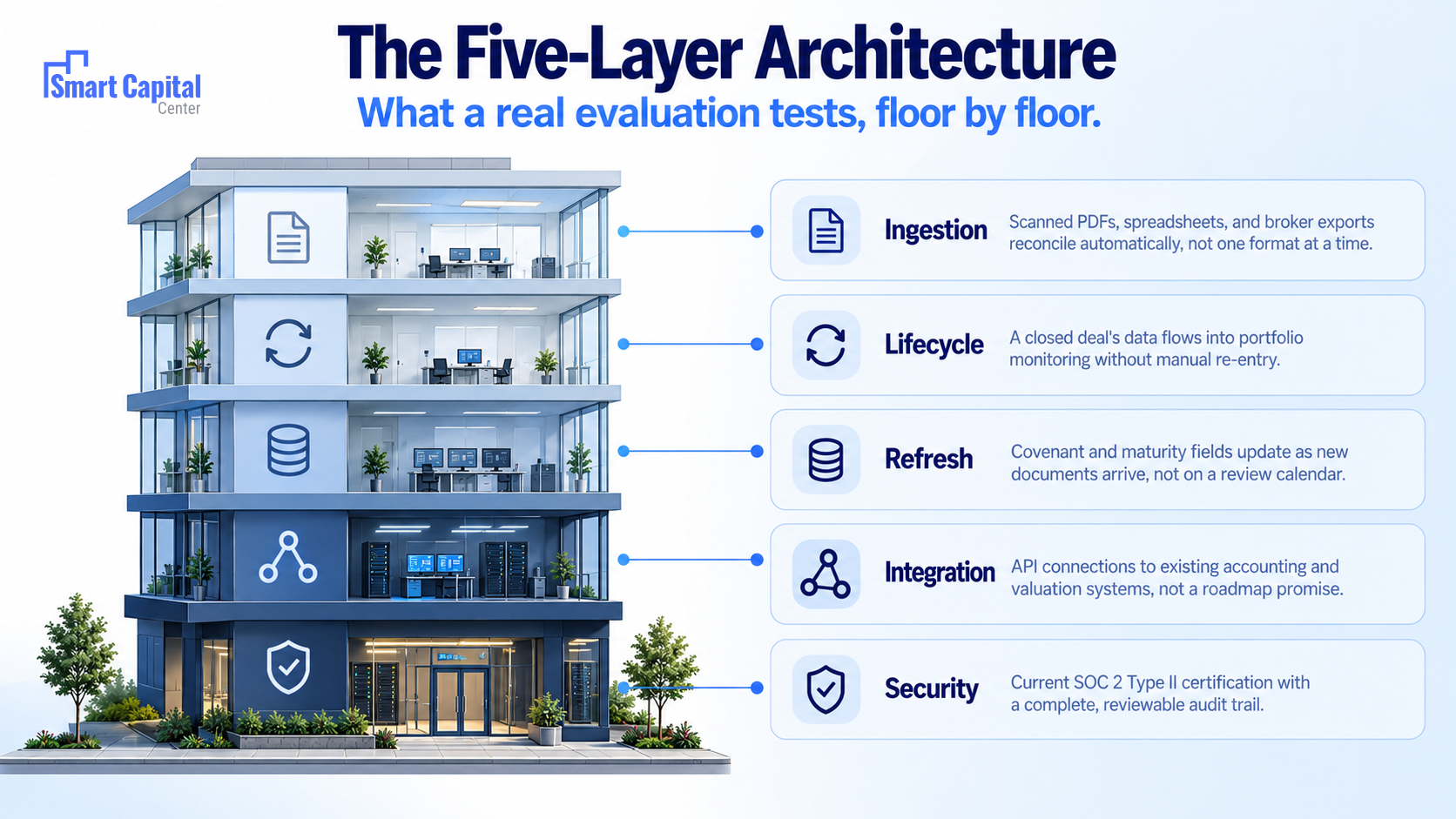
Ask whether the system ingests documents the way they actually arrive, covers the full investment lifecycle instead of one stage, refreshes data on its own, connects to what a firm already runs, and holds up under a security and audit review. These five questions matter more than a feature list, because features are easy to demonstrate in a demo and operating behavior at volume is not.
● CRE investment management software: a system that supports the deal pipeline, underwriting, portfolio monitoring, asset management, and reporting for commercial real estate investments.
● Source traceability: the ability to trace any figure back to the specific document or record it came from.
● Audit trail: a durable record of what changed, when, and by whom.
● API integration: a direct, programmatic connection between two systems that does not depend on manual export and import.
● SOC 2 Type II: an independent audit of how a service organization operates its security controls over a period of time.
● Agentic AI: AI that carries out multi-step work on its own, pulling from documents and external sources and reconciling what it finds, then handing conclusions to a person to decide on.
● Intelligent workflow automation: automation that handles the sequence of steps in a business process, including the judgment-adjacent steps, instead of automating a single task.
Commercial real estate investment management spans pipeline and deal screening, underwriting, portfolio monitoring, asset management, debt and covenant tracking, and investor and committee reporting. A platform covering only underwriting, or only reporting, still requires a firm to manage handoffs between systems, which is where data quality erodes fastest.
Real estate investment management software built for residential portfolios or general-purpose asset tracking rarely handles commercial requirements well, since the underlying data structures differ. Multi-tenant rent rolls with staggered lease terms, percentage rent tied to tenant sales, tenant improvement and leasing commission treatment spanning multiple accounting periods, and covenant structures tied to debt yield or coverage ratios are commercial-specific complexities a residential or generic platform typically was not built to model. A firm evaluating commercial property investment management software should confirm the system was built around these structures from the start.
Real estate asset management software generally covers property-level performance tracking, but commercial investment management requires more: portfolio-level concentration analysis, debt maturity monitoring across a loan book, and reporting built for investment committees and limited partners. A system marketed broadly as asset management software may cover the property-level layer well and still fall short on the portfolio and investor-facing layer a commercial firm actually needs.

The five questions run in order, because each one narrows what the next is testing.
Rent rolls, T-12s, and offering memorandums arrive as scanned PDFs, inconsistent spreadsheets, and broker-formatted exports. A system that only handles one format forces a firm to keep doing manual data entry for everything else, defeating the purpose of adopting the software. Beyond ingestion, every figure that ends up in a model or a committee memo should trace back to the specific document it came from, since that traceability makes a number defensible when someone asks where it originated.
A point solution that handles underwriting well but stops there still requires manual handoffs into portfolio monitoring and asset management, and each handoff is a place where a number can drift from its source. Ask what happens to a deal's data once it closes: does it flow automatically into ongoing portfolio monitoring, or does someone re-enter it into a separate system.
This question separates systems that monitor a portfolio from systems that store one. Ask which fields update automatically as new documents and market data arrive, and which fields require someone to manually re-enter or re-upload information on their own schedule. A platform requiring manual refresh for covenant tracking or debt maturity dates is one where those figures are only as current as the last time someone had time to update them.
The useful version of this question is what data moves, how often, and in which direction. Ask about connections to the accounting system, any existing asset management or valuation tools, and whether an API exists for systems not explicitly supported today. A platform whose integration story depends entirely on a future roadmap item does not, as of the demo, actually connect to what a firm runs.
Security and audit questions tend to arrive late in most evaluation processes, which is expensive when the answers change the shortlist after weeks already invested. Ask for current SOC 2 Type II certification status, how access permissions are scoped by role, and whether the audit trail records who changed a figure and when. A vendor unable to answer with specifics has not been through a real security review recently.

A weighted scorecard keeps a selection team from over-indexing on whichever demo felt most polished.
A platform's own timeline estimate should be tested against how much historical data needs to migrate and how many document types the migration touches. Ask who inside the firm will own the transition, since a system with no internal owner tends to stall regardless of how capable the platform is. Adoption also depends on whether the people doing daily work were part of the evaluation, since a tool solving a leadership-level problem but adding friction for analysts will see resistance.
Pricing structures vary enough that a straight cost comparison across platforms can mislead without knowing what actually drives the number.
● What scales with the number of users, and what happens to cost as a team grows.
● What scales with assets under management or property count, and at what threshold the pricing tier changes.
● What scales with document or transaction volume, since a firm's document load can grow faster than its headcount.
● Whether implementation, data migration, and training are included or billed separately.
A few patterns in a demo are worth treating as disqualifying:
● A canned data set that never gets replaced with the firm's own documents during the evaluation, which hides how the ingestion step actually performs.
● No specific answer on refresh cadence, deflected into general language about real-time capability.
● No willingness to show source traceability on a specific figure, live, during the demo.
● An integration story that depends entirely on a future roadmap item.
Deloitte's 2026 outlook also found valuation to be a persistent data problem rather than a modeling one: globally, difficulty forecasting valuation assumptions ranked first among appraisal experiences, while “market data readily available and appropriately reflective of current market conditions” ranked near the bottom. A platform's value is therefore decided at the ingestion layer, before any analytics run on top of it. “Workflows have to change, people have to be upskilled, organizations have to reinvent themselves,” said Kartik Hosanagar, professor at the Wharton School, on the Wharton Club of Northern California “Scaling Smarter With AI 2.0” panel, April 22, 2026. With the Mortgage Bankers Association's 2026 CREF Forecast projecting $805.5 billion in originations for 2026, up 27 percent from 2025, returning volume is about to test whether a platform's capacity claims hold up in practice.
Features are easy to demonstrate in a controlled setting, and operating behavior at real document volume is not, which is why the five questions above deserve more weight than a side-by-side feature comparison. Smart Capital Center answers all five directly. Documents arrive in whatever format the market produces and come out reconciled. A deal's data carries from underwriting into portfolio monitoring without anyone re-entering it. Covenant and maturity fields update on their own rather than when someone remembers. The platform connects to existing accounting and valuation systems by API, and it holds current SOC 2 Type II certification with a complete audit trail. Evaluate it, and any other system under consideration, against the same five questions. Smart Capital Center runs on 120M+ properties, 1B+ signals, and $500B+ analyzed.
Ask us the five questions directly and see how the answers hold up.
Book a demo with Smart Capital Center →
Q: What is CRE investment management software?
A: It is a system that supports the deal pipeline, underwriting, portfolio monitoring, asset management, debt and covenant tracking, and investor reporting for commercial real estate investments. The best commercial real estate investment management software covers these functions from one reconciled data layer.
Q: How long does implementation take?
A: Timelines vary based on how much historical data needs to migrate and how many document types the transition touches, but a realistic range runs from several weeks for a straightforward portfolio to a few months for a large, document-heavy book. Ask specifically about data migration scope and internal ownership before accepting a vendor's general timeline estimate.
Q: What is the difference between commercial and residential real estate software?
A: Commercial software has to model multi-tenant rent rolls, staggered lease terms, percentage rent, tenant improvement and leasing commission treatment, and covenant structures tied to debt yield or coverage ratios, none of which residential software is built to handle. A platform adapted from a residential product with commercial fields added later often struggles with these structures even if it demos well on a simple example.
Q: What should I look for in commercial real estate investment management software?
A: Look for document ingestion across the formats that actually arrive, full lifecycle coverage from underwriting through reporting, data that refreshes automatically, real API connections to existing systems, and current SOC 2 Type II certification with a detailed audit trail. A platform that answers all five with specifics is worth taking to a deeper evaluation.
Q: What questions should I ask about pricing before choosing a platform?
A: Ask what scales with user count, what scales with assets under management or property count, what scales with document or transaction volume, and whether implementation and training are included or billed separately. A firm growing its document volume faster than its headcount should weight the document-volume pricing question heavily.
Q: What red flags should I watch for during a software demo?
A: Watch for a canned data set that never gets replaced with the firm's own documents, vague answers on refresh cadence, an unwillingness to demonstrate source traceability live, and an integration story built entirely on a future roadmap. Any one of these is worth pausing the process to investigate further.
Q: What is the recommended real estate investment management software for commercial investors?
A: The right platform depends on a firm's document volume, existing systems, and lifecycle coverage needs, which is why the five questions in this article matter more than any single recommendation. Smart Capital Center is purpose-built for the full commercial lifecycle and is worth evaluating directly against these same five questions alongside any other system under consideration.