


AI in Commercial Real Estate

October 1, 2026
AI in Commercial Real Estate
October 1, 2026
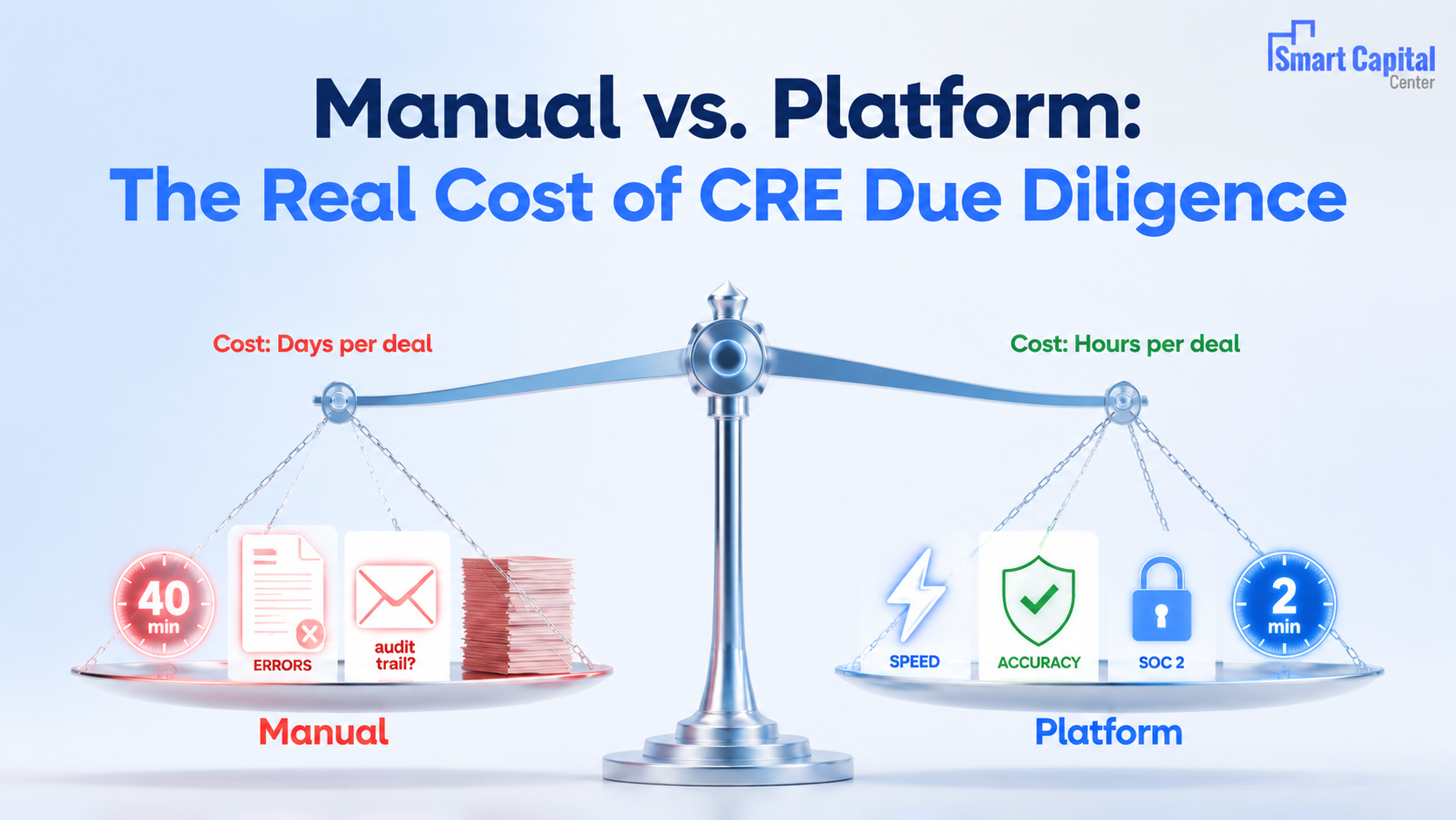
For lending and acquisitions leaders evaluating whether to move from manual due diligence to an AI-powered platform, the answer comes down to a straightforward economic comparison: cost per deal, throughput, and error rate. Smart Capital Center delivers measurable results on all three, with JLL achieving 30x productivity gains and KeyBank reporting a 40% reduction in loan model prep time. The market opportunity is significant: the McKinsey Global Institute estimates AI applied to knowledge work could unlock $430 billion to $550 billion in annual value globally across real estate, construction, and adjacent sectors, but that value only materializes when platforms replace the mechanical work analysts currently spend most of their time on.
DD platform: software that ingests borrower and property documents, extracts structured data, and surfaces exceptions for human review, distinct from a system of record or a loan management system.
Audit trail: a complete, timestamped record of every extracted data point and its source document, exportable for IC review or regulatory examination.
Exception routing: the mechanism by which a platform surfaces low-confidence extractions or cross-document discrepancies to a human reviewer instead of passing them silently into the model.
Document intelligence layer: the extraction and structuring tier of a lending or investment tech stack, distinct from the system of record and the financial model.
A fully-loaded CRE analyst costs $150,000 to $250,000 per year in salary, benefits, overhead, and management time. At 2,000 billable hours per year, that is $75 to $125 per hour. At 30 to 40 minutes per financial statement in manual CRE due diligence, a deal package with 15 documents consumes 7.5 to 10 analyst hours on extraction alone, before a single underwriting judgment is made.
“Lenders have as little as 48 hours to reach borrowers when they’re ‘in the money.’ That means technology must support real-time borrower monitoring, quick loan structuring, and fast-cycle processing.” – Mike Fratantoni, Chief Economist, Mortgage Bankers Association
The hidden cost is the hours on losing ones. A team running detailed DD on 10 deals per month with a 15% close rate spends 85% of its DD capacity on deals that produce no revenue. That is the cost structure that CRE due diligence technology directly addresses by compressing it to a fraction of its current cost.

| Transaction Type | Manual DD Time | Platform DD Time | Cost Differential Context |
|---|---|---|---|
| Small deal (<$5M) 5 documents avg |
6–8 analyst hours | ~45 min analyst time | Full day = $150–250/hr loaded cost vs. platform subscription fraction |
| Mid-market deal ($10–50M) 15 documents avg |
2–3 analyst days | 3–4 hours analyst time | ~90% time savings on extraction; analyst day redirected to underwriting judgment |
| Large deal ($50M+) 40+ documents avg |
5–7 analyst days | 8–12 hours analyst time | Entire first week of DD compressed to one day; parallel deal processing becomes possible |
| Portfolio review 100+ loans |
Weeks; impractical at volume | Hours; automated at scale | Manual approach caps throughput; platform removes the headcount ceiling |
JLL’s Director of Asset Management documented a 30x productivity gain in financial statement processing after deploying Smart Capital Center: per-document time fell from 30–40 minutes to 1–3 minutes. KeyBank achieved a 40% reduction in loan model preparation time. Neither result required additional headcount. Both required eliminating the extraction step that currently consumes the first analyst day on every new deal.

| Dimension | Manual Review | CRE DD Platform (Smart Capital Center) |
|---|---|---|
| Document extraction speed | 30–40 min per T-12 or rent roll; errors compound with volume | 1–3 min per document; error rate near zero (JLL 30x result, Smart Capital Center 2024) |
| Cross-document reconciliation | Manual; sequential; inconsistent across analysts | Automated simultaneous comparison; exceptions surfaced for review |
| Market assumption validation | Quarterly brokerage reports; 60–90 day lag; metro-level averages | 1B+ live signals; submarket-specific; prior-90-day transaction data |
| Error detection | Caught in credit committee or post-close; expensive to remediate | Flagged at ingestion before model is built; low-confidence extractions routed to human |
| Audit trail | Reconstructed from email; incomplete; fails examination standard | Continuous; field-level; timestamped; exportable on demand |
| Loan model preparation | Full analyst day; KeyBank baseline pre-deployment | 40% faster; KeyBank result post-deployment (Smart Capital Center 2024) |
| Security and compliance | Varies; often email-based document transfer | SOC 2 Type II; AES-256 encryption; private US-based servers |
| Scalability | Linear: more deals = more analysts | Non-linear: same team handles significantly more deal volume |
The error modes in manual CRE due diligence software evaluation typically undercount are the ones that result from sequential processing. Manual review reads T-12, rent roll, and OM sequentially. AI reads all three simultaneously and cross-references them. The discrepancies that sequential review misses: a footnote-modified rent figure, a capex assumption in the OM that contradicts the PCA deferred maintenance schedule, and an occupancy rate in the rent roll inconsistent with the T-12 revenue line are caught at ingestion by a platform.
The Deloitte 2026 CRE Outlook found that 27% of CRE firms are experiencing challenges with AI implementation: “technical issues, lack of expertise, or resistance to change.” Those challenges are real. The correct response is to adopt platforms with strong exception routing and source traceability, so the analyst reviews exceptions instead of trusting outputs blindly.
“Full scaling will require redesigning workflows around AI capabilities, and establishing the operating discipline to make those workflows reliable.” – Alex Singla, Alexander Sukharevsky, Lareina Yee, and Michael Chui, McKinsey QuantumBlack (2025 State of AI Survey)
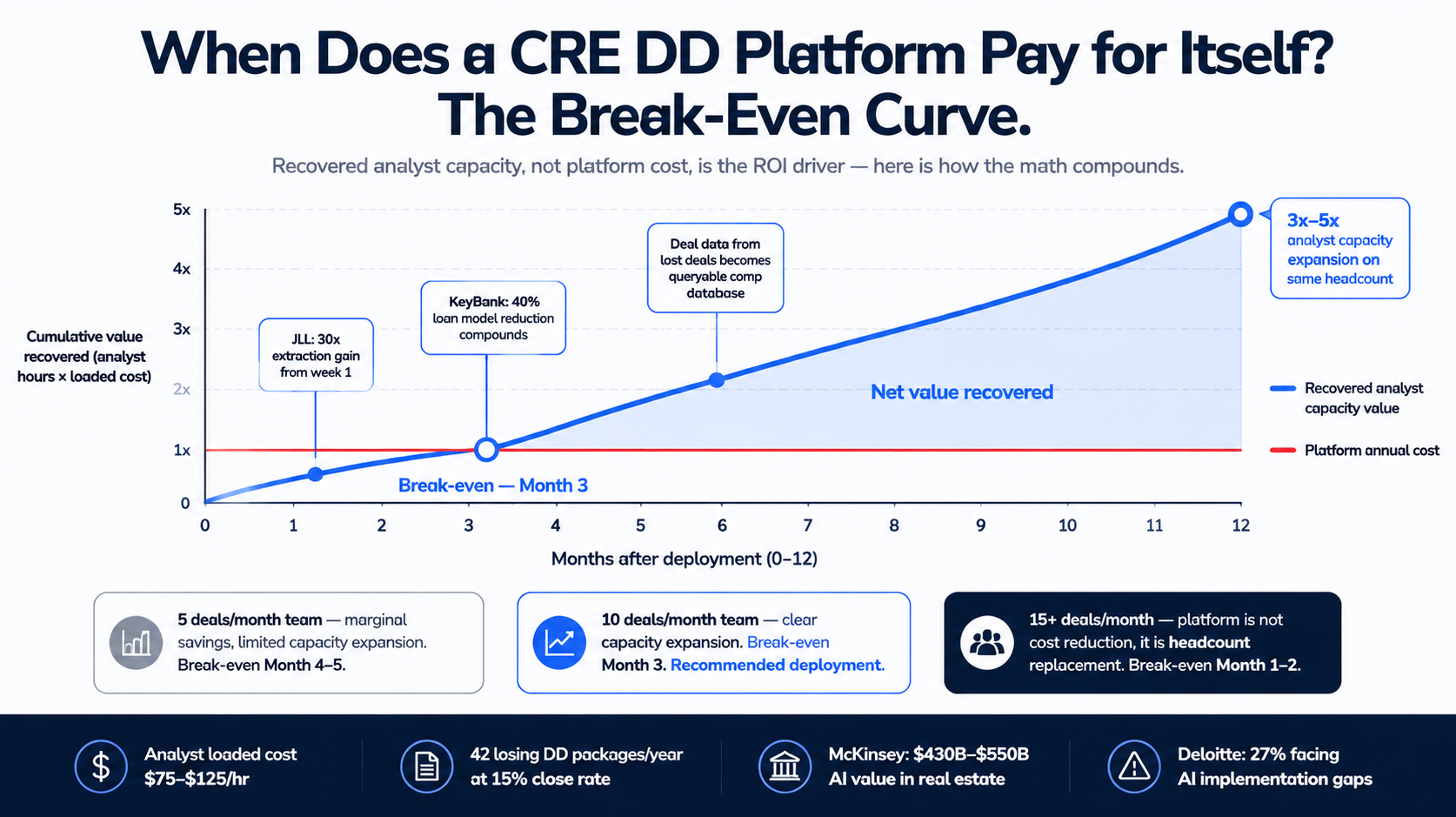
The break-even calculation for a CRE due diligence platform is a capacity question: how many deals can the same team close with and without a platform, and what is the revenue value of the additional deals?
At a team of three analysts averaging 10 deals per month in manual DD, the extraction bottleneck limits throughput. The same team on a platform can screen 3x to 5x the deal volume in the same period, because the mechanical front-end no longer consumes their capacity. For firms with deal-flow growth targets, the platform is a capacity expansion that enables revenue growth the firm cannot achieve through hiring alone.
The specific break-even point depends on deal volume, average deal size, analyst fully-loaded cost, and close rate. Firms consistently closing fewer than 5 deals per month may see marginal savings but limited capacity expansion impact. Firms closing 10+ deals per month with growing pipelines hit break-even within the first quarter of deployment.
The four capabilities that separate effective CRE due diligence software from document management systems:
1. Accuracy validation on your own documents: run the platform in parallel with your existing manual process for 30 days on live deals. Compare extraction accuracy on your specific document types before committing to full deployment. Any platform confident in its accuracy will support this evaluation.
2. Cross-document consistency checking: verify that the platform compares figures across all uploaded documents simultaneously: T-12 vs. rent roll vs. OM. Extraction without reconciliation addresses speed but not error rate.
3. Integration with existing systems: confirm native connectivity to your origination, asset management, or portfolio monitoring platforms. A platform that requires a manual export step between DD and the system of record reintroduces the re-entry risk it was meant to eliminate. See Top 5 Solutions for CRE Lenders in 2026.
4. Security and audit trail: for regulated institutions, verify SOC 2 Type II certification, encryption standard (AES-256 minimum), server location, and the format of the exportable audit trail. Smart Capital Center operates on private US-based servers with AES-256 encryption and generates a continuous, field-level audit trail exportable for OCC, FDIC, or IC review without manual reconstruction.
The platform ROI question is ‘where does the recovered analyst time go?’ Firms that answer ‘into more deals’ consistently demonstrate measurable revenue impact. Firms that answer ‘into deeper analysis on the same deal count’ demonstrate measurable error reduction and better credit outcomes. Both are valid. Neither requires more headcount.
Smart Capital Center’s CRE due diligence platform compresses document extraction from 30–40 minutes per statement to 1–3 minutes, runs cross-document reconciliation automatically, benchmarks assumptions against 1B+ live market signals, and generates a continuous audit trail for every deal, closed or passed. For lenders, the same data flows directly into post-close covenant monitoring without re-entry. For investors, DD data on every analyzed deal remains queryable for future submarket analysis.
See where your recovered analyst time goes. Book a demo with Smart Capital Center.
The ROI of a CRE due diligence platform has two components: cost reduction (analyst hours recovered from mechanical extraction, reconciliation, and benchmarking tasks) and capacity expansion (additional deals the same team can process). For a three-analyst team closing 10 deals per month, a 30x improvement in document processing speed (JLL benchmark) recovers approximately 70–80% of current extraction time, time that can be redirected to underwriting judgment on more deals or deeper analysis on the existing pipeline. KeyBank’s 40% reduction in loan model preparation time represents the lender-side parallel. Break-even for most institutional teams occurs within the first quarter of full deployment.
Implementation timelines for CRE due diligence technology range from days to weeks depending on integration complexity. Document ingestion and extraction typically requires no integration to begin generating value: upload documents, receive structured outputs, review exceptions. Integration with origination or portfolio management systems (Yardi, SS&C, ARGUS) adds 2 to 6 weeks depending on the systems involved. Smart Capital Center supports native integrations with leading CRE platforms, with a parallel-evaluation period standard for enterprise deployments so teams can validate accuracy on their own document types before full commitment.
Effective CRE due diligence software in 2026 combines four capabilities: AI-powered document extraction that handles any format without requiring clean broker exports; cross-document consistency checking that runs simultaneously across all uploaded files; real-time submarket benchmarking, not quarterly brokerage reports; and a continuously generated audit trail satisfying credit committee and regulatory review requirements.
The most reliable validation method is a parallel-run evaluation: process a sample of live or recent deals through the platform while your team continues its normal manual workflow. Compare extraction accuracy on your specific document types and verify that every discrepancy the platform flags represents a genuine data conflict. Look specifically for the platform’s handling of low-confidence extractions: a well-designed platform surfaces these for human review instead of passing them silently. Smart Capital Center supports 30-day parallel evaluations as standard practice for institutional deployments.
Regulated financial institutions require at minimum: SOC 2 Type II certification confirming security controls are operational; AES-256 encryption for data at rest and in transit; US-based server infrastructure; and role-based access controls limiting document visibility to authorized team members. Smart Capital Center meets all four requirements, operating on private US-based servers with SOC 2 Type II infrastructure and AES-256 encryption. The platform’s exportable audit trail also satisfies OCC and FDIC examination documentation standards, eliminating the manual reconstruction step that email-based DD workflows require.