


AI in Commercial Real Estate

October 1, 2026
AI in Commercial Real Estate
October 1, 2026

Most buyers of commercial real estate never order their own property condition assessment. They read the one the lender’s consultant produced, pull the immediate repair schedule and the reserve table into the model, and close. It is faster, and it is already paid for.
The risk in that is easy to miss. That report was scoped to answer the lender’s question about a loan, and the buyer is using it to answer a different question about a five to seven year hold. A building system nobody scoped is still a system that fails, and when it does the cost lands on the equity. With rent growth doing far less of the work than it did three years ago, an unbudgeted roof or chiller is much harder to absorb.
Smart Capital Center keeps capital needs connected to the numbers that follow them, reading property condition and inspection reports against subsequent financials and flagging the gap when work a report called for never turns into spend. A later section covers how that works across a portfolio.
This article draws on a session at the IMN Real Estate Private Funds Summer conference in Newport in June 2026, titled "Cash flowing properties & long term holds: should investors favor certainty?" The panel was made up of owners who hold assets through cycles instead of trading them, and the closing audience question asked what overlooked practices they use to protect cash yield. Their answers are the substance of what follows.
Most of the panel answered the cash yield question with operations. The moderator, Jariel Bortnick of Quad Property Group, answered with diligence, and said it starts before the deal closes. His firm orders an equity-level assessment on every acquisition, and he described how much a lender-level report can leave out.
His example was a deal his firm had recently bought in Tennessee. The lender’s report said the roofs were great. The equity-level report said the roofs had to go. He called it a surprise that would have been unfortunate and pretty devastating had they not paid for the second look.
Two consultants, one set of buildings, opposite conclusions. Neither of them was wrong, and the reason is worth understanding.
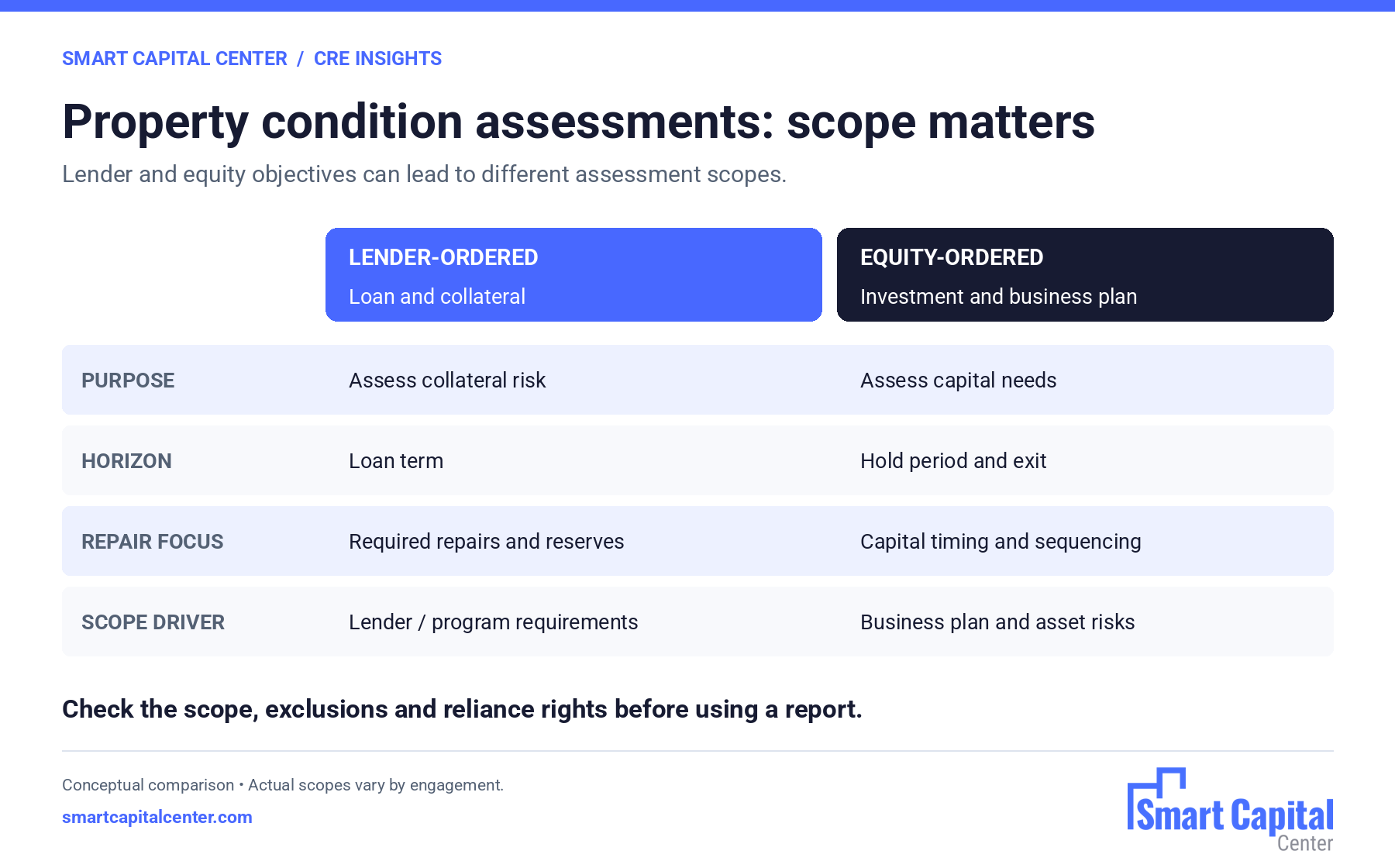
A property condition assessment is a walk-through survey and document review of a commercial property, performed to identify what the standard calls material physical deficiencies. The deliverable is a property condition report, and the two sections that reach an investment model are the immediate repair schedule and the replacement reserve table.
The reference point is ASTM E2018, the Standard Guide for Property Condition Assessments. The guide describes itself as a voluntary baseline process carrying a moderate level of uncertainty, and it says following it is not required for an assessment to have been performed in a commercially prudent manner. Section 11 and Appendix X1 list conditions and procedures outside its scope that parties may want to add. Anything in that territory happens only if someone asks for it and pays for it.
A baseline is a floor, which is the whole point. The report is the product of a scope of work, and the scope of work belongs to whoever commissions it.
The lender’s version answers a defined question. Agency programs publish theirs: under Fannie Mae’s multifamily requirements, the site visit must fall within 90 days before the commitment date, and a new full assessment comes due after five years absent a waiver. The lender wants to know whether the collateral survives the loan term and whether the escrow and reserve amounts are sized correctly. That is a real question, well answered.
The buyer is asking what the capital plan looks like across the hold, which item lands in year two during lease-up, and what the previous owner deferred. Those answers require a different scope.
Nothing in the lender’s report is wrong. The trouble starts when a buyer treats it as a complete picture of the asset.
Scope matters most on exactly the deals long-hold buyers want. Henry Manoucheri, Chairman and CEO of Universe Holdings, which operates roughly 18,000 multifamily units across California, Florida, and New Jersey, described the profile his firm hunts for: an asset held by the same family for decades where the owner has fallen asleep at the wheel and is not capturing the upside because they stopped putting capital into it.
That profile is the thesis and the risk in one asset. Strong occupancy alongside thin capital reinvestment is what creates the opportunity, and it is also what guarantees the condition report matters. A buyer underwriting deferred capital as the value-add case needs a scope that measures the deferral accurately, because the number in the reserve table is the number the returns depend on.
Manoucheri was also direct about the market he is underwriting into. He described holding rent growth assumptions at 1.5 percent or lower for the first two years, and said he tells his team to throw the 3.5 to 4 percent they used to argue for internally in the garbage can. When rent growth stops carrying the business plan, capital accuracy carries more of it.
The panel’s other answers to the cash yield question were all versions of the same idea: physical and operational condition is a cash flow variable, and it has to be managed continuously instead of inspected once.
Manoucheri described sharing the underwriting with the operating team and telling them exactly what is expected, down to the rent number. If the model says $4,500 and in-place rent is $4,000, somebody has to produce that difference, and bonuses at his firm are tied to property performance. On new assets he described a one-year look period where he visits personally and, in his words, kicks the tires, because he does not want to hear excuses or stories after the fact.
He keeps management in house for the same reason. His firm uses third-party managers on close to nothing it owns, handles its own hiring and firing down to the maintenance staff, and runs a weekly Friday call that has grown past 50 people, with every property manager and the corporate office going through the portfolio property by property for an hour or more. He described turning down large institutional partners who wanted a local fee manager on an asset far from his corporate office, on the grounds that losing operating control was not worth the capital.
Bill Comeau, CFO of First National Realty Partners, made the most practical point about where condition and operations actually bite. In grocery-anchored retail the anchors stay more or less forever, but the in-line tenants represent roughly the last 25 percent of the cash flow, and that slice is where the problems live. Two do not pay, three sit vacant, and somebody has to go out there.
He described sending a staff member to Kansas for a week without knowing whether the trip would accomplish anything, and flying a property manager out because the asset is too far to reach otherwise. His conclusion was that some of these assets are a local game, and a national owner often lacks the people on the ground to play it. His example was a property in Connecticut where the anchor across the street was rehabbing office space upstairs and his team did not know. They could have canvassed those office tenants for their own vacancies, and instead they found out late.
Comeau also raised the item he considers most overlooked, which is collections. Rent is only good if you can collect it, and in retail the problem splits in two: national tenants holding back significant sums over CAM calculations, and local tenants who pay slowly until something forces the issue. His firm devotes real resources to keeping arrears low. On the expense side he put it simply, a dollar of reduced expense is worth the same as a dollar of rent, and described going back through vendor contracts and general administrative costs after taking over a project to find it.
Dana Rowan, Managing Partner of The Exeter Companies, described the first decision her side typically makes when a deal stops going to plan: whether the operator is totally competent, and whether a better one could realistically replace them. Beyond competence she looks for transparency and a sense of trust, and whether the operator will do everything possible to keep the asset cash flowing. She also pointed at operational drag, the things that slow transactions and business down, addressed through digital efficiencies, streamlined systems, and continuous process improvement, and recommended continuing to explore cost segregation on the tax side.
Comeau offered the shortest version of the same test. He quoted Milton Cooper, who told him every great real estate company has three things: great assets, a great balance sheet, and great people. All three are required.

Everything above protects the acquisition. None of it protects the four years that follow, and that is where capital quietly goes missing.
The pattern is familiar to anyone who has taken an asset to market. A report identifies significant roof work across a portfolio in year one. Nobody opens that report again. Three years later the financials show no roof spend, the condition has worsened, and the first person to notice is whoever orders the next assessment or runs the sale process. The owner Manoucheri goes looking for, the one who stopped putting capital in, is what any owner becomes when nobody is checking.
Smart Capital Center closes that loop by reading the documents against each other over time. The system takes in property condition and inspection reports alongside appraisals, rent rolls, and financials, then watches for drift between them. When an inspection notes a deteriorating roof and no matching capital expense shows up in the financials in the periods after, the gap gets flagged in real time. When an older inspection called out a roof issue and current financials do show a roof expense, the system connects the two and explains the variance instead of leaving the spend unaccounted for.
Three things keep that useful instead of noisy. Every flag carries clickable source links back to the document and line item behind it, so an analyst verifies in seconds without digging through a folder. Factors are configurable, so a team switches on what matters for its portfolio and leaves the rest off. And every action taken on a flag is logged and exportable, which matters for anyone reporting to an investment committee or a capital partner. The system finds the pattern. The judgment about what it means stays with the person.
Manoucheri’s point about sharing the underwriting with the operating team applies to the condition report too. The immediate repair schedule and the reserve table belong where someone is held to them, connected to the financials that will eventually show whether the work happened.
Pricing tracks size, age, asset type, and how much scope gets added.
Moe Bedard, a certified commercial property inspector who writes about what lenders want in a property condition assessment report, puts the fee for a single commercial building at $2,500 to $8,000 depending on size, age, and asset type, with turnaround of 10 to 15 business days. Published consultant pricing puts smaller and simpler buildings in the $1,250 to $2,500 range, with large or complex assets running past $10,000.
Set against the cost of replacing every roof on a garden-style property, a second assessment is a small line item. The fee is not where the money is. The assumptions inside the report are, and the one that moves the most is remaining useful life, meaning how many years are left in the roof, boilers, and chillers. As Bedard puts it, an assessor who inflates remaining useful life makes the loan look cheaper and leaves the lender exposed, while one who is needlessly conservative kills deals. Buyers should ask how the assessor arrived at the roof and mechanical estimates before accepting the reserve figure into a model.
Four practices separate a scope written for a business plan from one inherited by default.
The panel was asked about optimizing cash yield and the answer that stood out was about diligence ordered before closing, paid for by the equity, scoped to the business plan. That tracks with how the standard actually works, because a baseline is a floor and the report belongs to whoever commissions it.
It tracks with the market too. When an owner is underwriting 1.5 percent rent growth and buying a seller who stopped reinvesting, the capital plan is doing most of the work in the return. The wider scope protects the acquisition. Reading that scope against the financials for the rest of the hold protects the return.
Smart Capital Center flags the gap between what a report identified and what the financials show, the first time it opens instead of the day the asset goes to market. Book a demo today.
Q. What is a property condition assessment?
A. It is a walk-through survey and document review of a commercial property that identifies material physical deficiencies and estimates the cost to correct them. It is performed under ASTM E2018, and the deliverable is a property condition report containing an immediate repair schedule and a replacement reserve table.
Q. What is an equity-level PCA?
A. It is an assessment commissioned by the buyer instead of the lender, scoped around the hold period and the capital plan. Because the buyer writes the scope, it can cover systems and testing a baseline lender scope leaves out. One owner-operator at the 2026 IMN private funds conference described ordering one on every acquisition after a lender report called roofs on a Tennessee deal sound while his own report concluded they had to be replaced.
Q. Why would a buyer pay for a second assessment?
A. Because the two reports answer different questions. A lender scope is sized to protect the loan across its term and to set escrow and reserve amounts. A buyer scope is written around the business plan, which matters most on value-add deals where deferred capital is the thesis.
Q. How much does a property condition assessment cost?
A. Roughly $1,250 to $2,500 for a small, simple building and $2,500 to $8,000 for a typical single commercial building under a lender scope. Large or complex assets run past $10,000, and turnaround is commonly 10 to 15 business days.
Q. Is ASTM E2018 mandatory?
A. No. The guide describes itself as a voluntary baseline process carrying a moderate level of uncertainty, and it identifies conditions and procedures outside its scope that parties may want to add.
Q. How do owners track whether identified repairs actually get done?
A. Manually, most do not, which is why deferred capital tends to appear at refinance or sale instead of when it happens. Smart Capital Center reads property condition and inspection reports against subsequent financials and flags the gap when a report identified capital work that never appears as spend, or when noted deteriorating conditions go unaddressed. Each flag links back to the source document and line item, and every action taken on it is logged and exportable.