



CRE Lenders

November 23, 2026
CRE Lenders
November 23, 2026

Smart Capital Center heard Laura Smith of Resilience Insurance Analytics tell MBA’s CRE Insurance Conclave in October 2026 that “the insurable value from an appraisal in 2018 is not the insurable value of a property now,” which is why a lender needs a current statement of values behind every policy limit.
A policy limit can match the loan file and still leave the lender short. The number may come from an old appraisal, the policy may be a blanket spread across many properties, and the deductible may be larger than the borrower can pay. This article explains what a statement of values should show, how to update insurable value, what to ask about blanket policies and retentions, and how lenders and Asset Management teams can keep a record of each check.
The material comes from the MBA CRE Insurance Conclave in Chicago on October 4 to 6, 2026. Smart Capital Center heard Laura Smith of Resilience Insurance Analytics and Veronica Yamasaki of PGIM walk through common compliance gaps, and heard Rachel Vaccaro of Colliers raise the statement of values on a separate catastrophic coverage panel. Our Conclave recap covers the wider event.
Smart Capital Center’s AI agents read insurance policies and certificates and write up what they find, with each statement linked to its source passage. Smart Capital Center built this for lender and Asset Management teams that have to check limits across large portfolios, and a section below shows how it works.
A statement of values (SOV) is a schedule of the properties a policy covers and the value placed on each. Yamasaki, who leads an insurance team at PGIM, said lenders should ask for one whenever a certificate shows a blanket policy. Yamasaki said the schedule should list the total insurable value (TIV), the locations, and the geographic concentration. Vaccaro, who manages the insurance team at Colliers, put it more strongly on the catastrophic coverage panel: “I cannot emphasize enough the importance of making sure that you have the statement of values.”
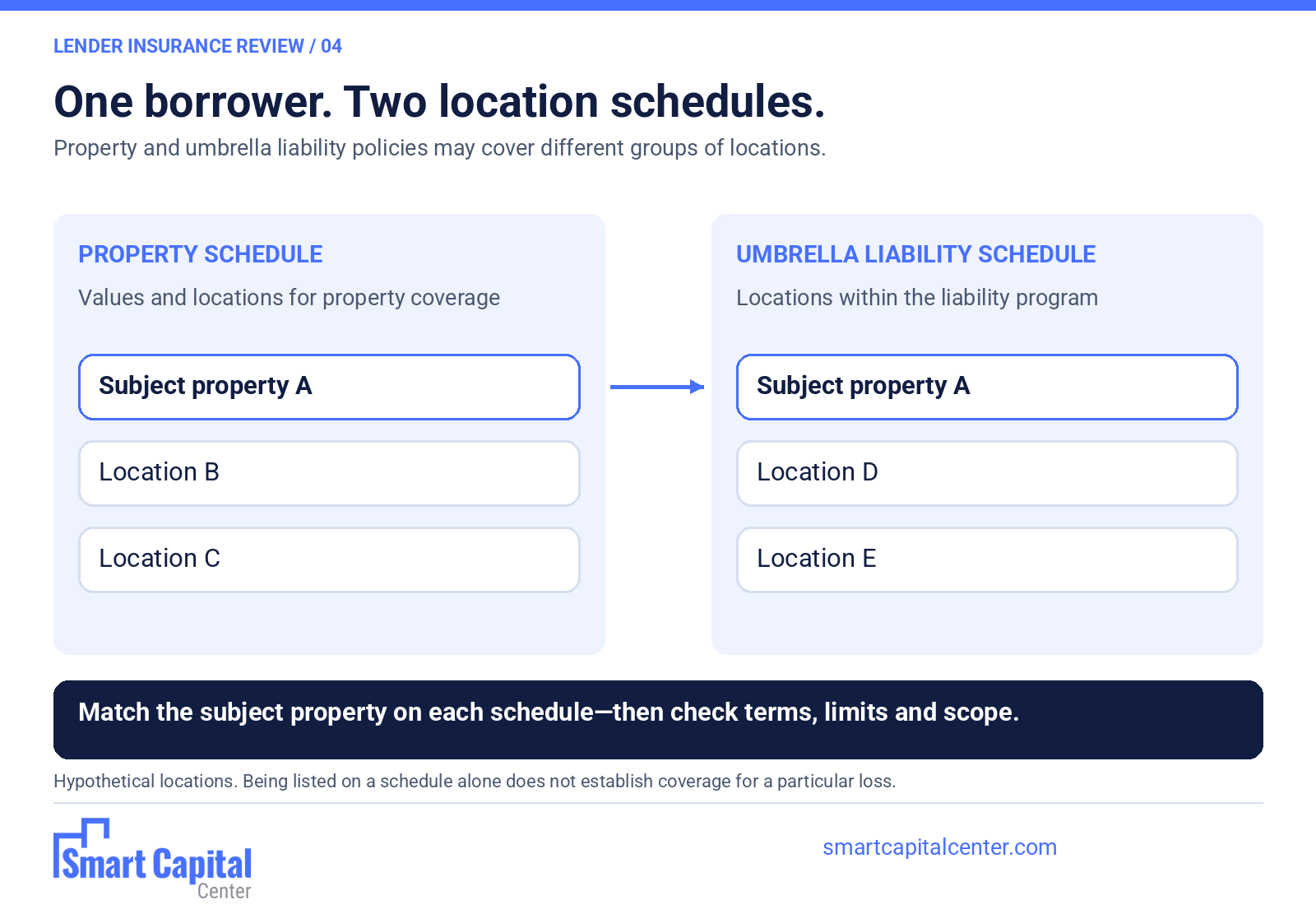
The blanket box on a certificate needs care. Yamasaki said the blanket box is “used so loosely” because a policy marked blanket may cover only the buildings of one property. When the policy does cover many properties, Yamasaki said a lender can ask for a redacted version that shows the lender’s property by name and the other properties by city, state, ZIP code, and TIV only. That is enough to see how many sit in one area. Yamasaki added a warning: do not assume the same properties are on the umbrella as on the property policy, because “you may have 3 properties on a property policy and 100 on the umbrella.”
Items are drawn from the Conclave panel and are examples, not a complete SOV checklist.
How Smart Capital Center Helps Teams Check Limits and Values
A limit check is only as good as the documents behind it. Smart Capital Center’s AI agents read insurance policies and certificates, then write up what they find with each statement linked to its source passage. An analyst can see which figure a limit came from and confirm it in one click, instead of searching a long document alone. The reviewer still makes the call, and the agents do the first read.
Asset Management teams also get cross-time-period checks. The agents flag when an appraisal promised capital spending that never appears in the financials, and when an inspection noted a condition that no one addressed. Both are signs that an old appraisal no longer describes the property. Key dates and maturities sit in the same view, so a team can see when a policy renews and a limit needs a fresh look. Every action is logged in an audit trail the team can export, which shows how each limit was checked.
Smart Capital Center holds SOC 2 Type II certification. The platform draws on 120M+ properties, 1B+ live market data points and $500B+ analyzed transactions. JLL saw a 30x productivity gain for the asset management team with Smart Capital Center’s AI. See how this works for lenders, or read why insurance review is a strong first use case for agentic AI.

Update insurable value by treating the original appraisal number as a starting point, not a fixed figure. “The insurable value from an appraisal in 2018 is not the insurable value of a property now,” Smith said, and lenders should find a way to inflate it to today’s building costs. The risk is concrete. If the lender asked for $21 million and the real insurable value is $26 million, Smith said, the borrower can answer “you told me $21 million and that’s what I got,” and the lender is not protected in a loss. Smith noted that Fannie Mae and Freddie Mac look for this.
Building costs have kept rising since many loan files were set up. The Turner Building Cost Index rose 5.15% from the second quarter of 2025 to the second quarter of 2026, according to Turner Construction’s second quarter 2026 report.
The same rule applies when a loan is assumed. Smith’s advice is to take insurable value and business income as they are now, not as they were when the loan started, or use a new valuation or appraisal if the assumption includes one. “You can’t go back to where you started,” Smith said.
Agents sometimes push back with a lower number. Smith’s response is to ask for support: “ask for the proof.” If the borrower is a contractor who says the building can be rebuilt for less, Smith’s answer is “give me a Marshall and Swift,” meaning a replacement cost estimate from a recognized building cost estimating service, not a figure from memory. “Show me your numbers,” Smith said, and that backup goes in the file as proof of the lender’s diligence.
A case from the panel’s closing discussion shows the stakes. An appraisal showed an insurable value of $42 million, while the approved building limit was $30 million. The lender’s banker proposed leaving it, since a separate valuation had been worked out. The suggested fix was to correct the appraisal at closing, because the lender returns to that appraisal every year and needs to understand any adjustment.
On a blanket policy, a lender should ask whether the limit reinstates after every loss and how much of the blanket limit is allocated to the lender’s property. Smith called blanket policies “a whole nother level of complexity” and also warned about a “sneaky aggregate deductible” and about retentions hidden in the policy.
Yamasaki said blanket policies commonly carry property deductibles of $100,000 to $250,000, with some aggregate deductibles in the millions, and that deductibles have risen from closing year over year as borrowers try to save premium.
A self-insured retention (SIR) is the amount per occurrence the borrower pays before the insurer’s coverage begins. Yamasaki said SIRs are becoming more common on general liability and umbrella policies, and contrasted an SIR with a deductible, where the insurer’s duty to defend starts immediately. Whenever there is an SIR, Yamasaki said, look at the borrower’s financials and loss history to see whether the borrower can carry it.
Lenders judge affordability by looking at liquidity, loss history, and cash flow, not only net worth. Liquidity is the key test. “I always really heavily look at the liquidity,” Smith said, because a borrower may show a large net worth that is tied up in properties. Smith asked what happens if a borrower has a higher deductible and no cash, and added loss history and the borrower’s cash flow to the test.
Five steps follow from what the panelists described.
A policy limit is only a number until someone checks what it rests on. At MBA’s CRE Insurance Conclave, Laura Smith of Resilience Insurance Analytics said an old appraisal is not today’s insurable value, Veronica Yamasaki of PGIM said a blanket box can mean very little without a schedule, and Rachel Vaccaro of Colliers said the importance of the statement of values cannot be overstated. Lenders that collect the SOV, update insurable value, and test the borrower against the deductible will find the gaps before a loss does. Smart Capital Center helps teams trace every policy limit back to the document it came from and revisit it when a policy renews.
Analyze insurance limits faster. See how Smart Capital Center helps your team read policies and certificates and trace every finding to its source. Book a demo today.
Q: What is a statement of values in insurance?
A: A statement of values (SOV) is a schedule of the properties a policy covers and the value placed on each. Veronica Yamasaki, Insurance Team Lead at PGIM, told MBA’s 2026 CRE Insurance Conclave that when a certificate shows a blanket policy, a lender should ask for the SOV with the total insurable value, the locations, and the geographic concentration.
Smart Capital Center’s AI agents read the policy and certificate and link each finding to its source passage.
Q: How do lenders check insurable value on a commercial property?
A: Lenders compare the policy limit with a current estimate of insurable value, not an old appraisal. Laura Smith, Senior Managing Director at Resilience Insurance Analytics, told MBA’s 2026 CRE Insurance Conclave that “the insurable value from an appraisal in 2018 is not the insurable value of a property now,” and that an agent proposing a lower limit should provide proof.
Smart Capital Center links each figure a team checks to its source document.
Q: What is a blanket insurance policy, and what should a lender ask about it?
A: A blanket policy covers several properties or buildings under one limit. Veronica Yamasaki, Insurance Team Lead at PGIM, told MBA’s 2026 CRE Insurance Conclave that the blanket box on a certificate is “used so loosely” and that a lender should ask for the statement of values. Laura Smith, Senior Managing Director at Resilience Insurance Analytics, said to ask whether the limit reinstates after every loss.
Smart Capital Center helps teams read blanket policy terms and trace each one to its source.
Q: What is a self-insured retention, and how is it different from a deductible?
A: A self-insured retention (SIR) is the amount per occurrence the borrower pays before the insurer’s coverage begins. Veronica Yamasaki, Insurance Team Lead at PGIM, told MBA’s 2026 CRE Insurance Conclave that SIRs are becoming more common on general liability and umbrella policies, and that a deductible differs because the insurer’s duty to defend starts immediately. Yamasaki said lenders should review the borrower’s financials and loss history whenever there is an SIR.
Smart Capital Center keeps policy findings next to property financials.
Q: How do lenders judge whether a borrower can afford a higher deductible?
A: They look at liquidity, loss history, and cash flow, not only net worth. Laura Smith, Senior Managing Director at Resilience Insurance Analytics, told MBA’s 2026 CRE Insurance Conclave, “I always really heavily look at the liquidity,” because a borrower’s net worth may be tied up in properties. Smith asked what happens if the borrower has a higher deductible and no cash.
Smart Capital Center logs each review in an exportable audit trail.
Q: What is a Marshall and Swift valuation, and when should a lender ask for one?
A: A Marshall and Swift is a replacement cost estimate from a recognized building cost estimating service that a borrower or agent can use as proof of a lower rebuild cost. Laura Smith, Senior Managing Director at Resilience Insurance Analytics, told MBA’s 2026 CRE Insurance Conclave that when a borrower says a building can be rebuilt for less, Smith’s answer is “give me a Marshall and Swift.” The estimate goes in the loan file as proof of the lender’s diligence.
Smart Capital Center links each figure a team checks to its source document.
Q: How does Smart Capital Center help spot outdated insurable values and policy limits?
A: Smart Capital Center’s AI agents read insurance policies and certificates and link each limit to its source passage, so an analyst can see which figure a limit came from and compare it with the current insurable value the team has collected. The agents also flag drift across time periods, such as an appraisal’s promised capital spending that never reaches the financials, and key dates show when a policy renews. Rachel Vaccaro, Assistant Vice President and Insurance Manager at Colliers, told the Conclave, “I cannot emphasize enough the importance of making sure that you have the statement of values.”