


CRE Lenders

October 1, 2026
CRE Lenders
October 1, 2026

Commercial loan insurance compliance is the work of confirming that a borrower's insurance still meets what the loan documents require. It covers collecting certificates and policies from the borrower's broker, checking coverage against the lender's requirements, and keeping a record of every exception and who approved it.
Every CRE loan comes with insurance requirements, and lenders have to make sure borrowers keep meeting them for the life of the loan.
Reviewing the insurance is rarely the hard part. The work sits in everything around it. Certificates arrive with missing endorsements, incorrect entities, or coverage that does not match the loan requirements. Teams go back and forth with brokers, track corrected documents, record approved exceptions, and eventually review full policies that can run hundreds of pages. Across a portfolio, that is a large amount of recurring work.
The workload is growing. The Mortgage Bankers Association's 2025 Commercial Real Estate Survey of Loan Maturity Volumes, released February 9, 2026, estimates that $875 billion in CRE loans matures in 2026 and $652 billion in 2027. As borrowers refinance those loans, lenders have to review insurance again against the requirements of the new loan. Meanwhile, annual insurance renewals continue across the rest of the portfolio.
Smart Capital Center takes this work off your team's desk. For the lenders and asset managers using it, that means:
The rest of this article explains what insurance compliance actually involves, why it resists the usual fixes, and what to look for if you are evaluating a way to do it differently.
Commercial loan insurance compliance means making sure a borrower's coverage continues to meet the requirements in the loan documents. Those requirements can include coverage limits, deductibles, required endorsements, carrier financial strength ratings, and how the lender is named on the policy. They are checked at closing and again as insurance policies renew.
The challenge is that the information rarely arrives in one document. A review can involve certificates, declarations, endorsements, property schedules, flood declarations, and eventually the full insurance policy. A blanket insurance policy adds another step, since it covers several properties under one limit and the attached schedule of locations has to be matched to the specific property securing the loan.
Two forms appear frequently in commercial lending. ACORD 25 summarizes liability coverage, while ACORD 28 provides evidence of commercial property insurance. ACORD developed Form 28 with the Mortgage Bankers Association in 2003 for the commercial mortgage industry. Its residential counterpart, the ACORD 27, covers personal and small commercial property and is not the right form for a commercial mortgage.
These forms only summarize coverage. They confer no rights and create no coverage on their own, which is why the lender's actual protection comes from the policy and its endorsements: typically a mortgagee clause on real property, or a lender's loss payable endorsement where the collateral includes business personal property. Both are written so the borrower's own acts do not void the lender's ability to recover. Confirming a lender is genuinely protected often means reading past the certificate.
Requirements can also vary by lender and by loan. A deductible that is acceptable on one loan may require an exception on another. That is why insurance compliance needs to be checked against the requirements for the specific loan, not against one generic checklist.
Smart Capital Center keeps those requirements at the loan level, with the lender's standard requirements applied by default, so reviewers can evaluate each insurance package against the rules that actually apply.

The workflow repeats on every loan, every year, across four stages: intake of certificates and policies, verification against the applicable requirement set, exception handling, and recording the result. Each stage is well understood. None of them scale.
The value at stake is capacity. In most lending and asset management organizations, insurance verification is not a dedicated role. The same people handle financial analysis, borrower reporting, and covenant tracking. Every additional hour spent reconciling a certificate comes out of work that carries direct credit consequences.
Most of the time goes to collecting documents, not checking them
This is the part that surprises people who have not done the work. The compliance check is finite. Chasing the documents is not. A broker sends a form with a field left blank. A borrower forwards last year's certificate by mistake. A carrier issues the endorsement but not the declaration page. Each one is a separate email thread, and each thread has to be tracked by someone who is also doing four other things. Teams routinely spend more hours getting insurance documents than reviewing them.
Reading a full policy is genuinely slow
A commercial property policy can run past two hundred pages. The requirement being checked might be a single sentence about notice of cancellation buried in a conditions section. A reviewer either reads carefully and loses an afternoon, or skims and risks missing something that surfaces at claim. Neither option is good, and the volume makes the second one tempting.
The checklist is never one checklist
A team supporting a correspondent portfolio may reconcile against eight or ten distinct requirement sets. One lender wants affirmative statements on the certificate that brokers are generally unwilling to add. Another applies different limits by loan vintage. A third requires higher liability limits on specific loans inside an otherwise standard program. The cost of that variation is error at volume, and errors usually surface at audit or at claim.
The same loan gets reviewed twice a year
Certificates arrive first. The full policy follows, commonly 30 to 90 days later, and the same requirement set runs again against a different document. For a portfolio handling hundreds of annual renewals, this doubles the review calendar without adding a single loan. Smart Capital Center verifies both documents against the same requirement set, so the second pass builds on the first instead of restarting it.
Compliance is frequently a grey area
A requirement absent from the certificate may be fully satisfied inside the policy. Notice of cancellation is the common case: the certificate does not carry the language, the policy does, and the loan is compliant.
Technology that returns only pass or fail marks that loan deficient, sends a broker request that never needed to exist, and costs the analyst more time than it saved. Worse, it teaches the team to distrust the output, at which point the investment stops returning anything at all. Smart Capital Center returns satisfied, not satisfied, or uncertain, each with written reasoning and the supporting pages attached, so a reviewer clears a grey-area item in seconds and never contacts a broker without cause.
Exceptions outlive the people who approved them
Deductible exceptions are the most common. A lender approved a higher deductible by email in a prior year, and that approval now governs the requirement. The approval lives in an inbox. When that analyst moves on, the knowledge leaves with them, and the next reviewer either reopens a settled question or approves something they cannot defend to an examiner.
Multi-property loans multiply everything
A single loan can carry four or five certificates across locations, a blanket policy with a schedule that must be matched to collateral, and coverage lines expiring on separate dates. Property and liability may renew in July while excess liability renews in March. One loan generates several review cycles a year. Smart Capital Center reads the schedule and connects the relevant properties to the loan before comparing any limit, so results on complex borrowers hold up.
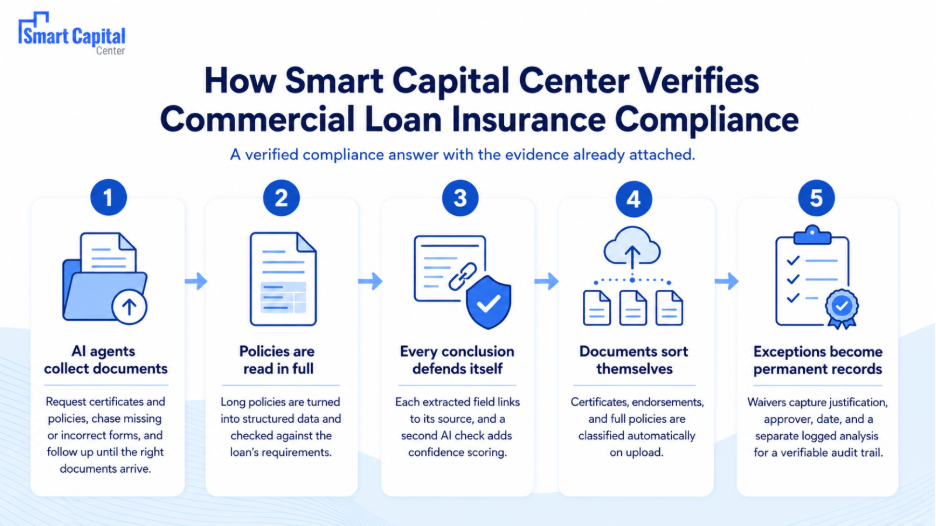
Smart Capital Center gives lending and asset management teams a verified compliance answer with the evidence already attached, so employees spend their hours on credit judgment instead of document reconciliation.
Insurance is one of many processes an asset manager runs, and it belongs inside the same system as the rest of them. The same team may also handle financial analysis, borrower requests, covenant tracking, and other compliance tasks. A standalone insurance tool forces people to jump between systems, leaves the AI assistant in one system blind to the person's workload and deadlines in the other, and gives management no single view of where compliance actually stands.
Smart Capital Center keeps insurance reviews, broker follow-ups, waivers, requirements, reminders, notifications, and task history in one structured system of tasks, checklists, and workflows, alongside AI-driven underwriting and portfolio monitoring across the full loan lifecycle. The AI assistant works from that full context, helping teams complete work on time instead of running hundreds of scattered manual follow-ups.
The platform analyzes more than 120 million properties and 1 billion real-time data signals across $500 billion+ in analyzed transactions, and is SOC 2 certified.
| Pressure | What is happening | Effect on lending operations |
|---|---|---|
| Premium divergence | US property rates fell 13% in Q2 2026, the eighth consecutive quarter of global rate decreases, while US casualty rates rose 7% ( Marsh, Global Insurance Market Index, Q2 2026, published July 23, 2026) | Property limits reset downward while liability towers reprice upward. Requirement sets and borrower conversations both need rework mid-cycle |
| Flood compliance burden | The Interagency Questions and Answers Regarding Flood Insurance runs 144 questions across 70 Federal Register pages (87 FR 32826, May 31, 2022), applying National Flood Insurance Act of 1968 rules to commercial collateral | Structure counts, insurable-value tests, and private-policy comparability checks fall on lenders and asset managers |
| Program renewal ahead | The Terrorism Risk Insurance Program expires December 31, 2027. The House passed the TRIA Program Reauthorization Act of 2026 by 373 to 15 on June 29, 2026, after advancing it from committee 51 to 2 in January. It now sits with the Senate | Terrorism coverage language needs review across entire portfolios ahead of the renewal window |
| Maturity and origination volume | $875 billion maturing in 2026 and $652 billion in 2027, against $5.0 trillion outstanding ( MBA, February 9, 2026) | Refinancing creates a fresh requirement set to verify at closing, on top of the annual renewal already scheduled |
MBA Chief Economist Mike Fratantoni described 2025 as a transition year in which "lenders were no longer simply extending loan terms." Extensions were quiet for insurance teams. Refinancing is not. Our CRE loan maturity playbook covers how lenders are sequencing that work.

Insurance is a good fit for AI because the documents are consistent. Limits, deductibles, exclusions, and conditions show up in predictable places across carriers. That same consistency makes it easy to build something that looks impressive in a demo and falls apart on real files. Five things worth testing before you commit.
1. Ask it to prove where a number came from. Pick a handful of values the system pulled out of a policy and ask to see the exact page each one came from. If your reviewer still has to open the PDF to be sure, you have not saved any time.
2. Give it a loan where the certificate and the policy disagree. Find a file where the certificate leaves something out that the policy actually covers. A system that calls that a failure will send your team chasing a broker for no reason. You want it to say it is not certain, explain why, and show you the page.
3. Test it on your worst-quality documents. Photographed pages, faxed certificates, screenshots pasted into a PDF. Extraction accuracy drops on these in ways a demo never shows. Check that the system still finds the right values, and that it flags what it cannot read instead of guessing.
4. Record a deductible waiver, then try to find it again. Have someone approve an exception with a written reason. Then go to the portfolio view, filter by the person who approved it, and check that the reason, the name, and the date are all still there. This is what an examiner will ask for.
5. Run your most complicated blanket policy through it. Pick a policy covering several properties where the coverage lines renew on different dates. Check that the system matched the schedule of locations to the right collateral before it compared any limits. If it skipped that step, the answer it gave you is not reliable.
The most useful evaluation is running your own worst loan through it. One pass tells you more than a month of scripted demonstrations.
Insurance compliance stays manual because the messy parts are where the work actually lives. Getting documents out of brokers takes longer than checking them. Requirements differ from lender to lender and sometimes from loan to loan. The certificate and the policy arrive months apart and both have to be checked. And a real share of loans meet the requirement in a way the checklist does not expect, where the certificate leaves something out but the policy covers it, which is exactly the situation that pass-fail software gets wrong.
Refinancing and origination volume are increasing while liability pricing is moving against borrowers. Smart Capital Center collects the documents, checks them against the right requirements, shows its work, and keeps insurance in the same system as everything else the team is responsible for. See how the full platform connects insurance compliance to underwriting, debt management, and portfolio reporting.
Stop chasing certificates and give your analysts their week back. Book a demo today.
How do lenders verify a certificate of insurance?
The reviewer confirms the named insured matches the borrowing entity, the coverage lines and limits meet what the loan requires, the dates are current, and the mortgagee or lender's loss payable designation names the correct entity in the correct wording. Done by hand, that is dozens of separate checks on a single loan. Smart Capital Center runs each check against that lender's own requirements and returns the result with the source page attached, so the reviewer is confirming an answer instead of assembling one.
Can AI collect insurance documents from brokers?
Yes, and this is where most of the time goes. Smart Capital Center's AI agents draft and send the request to the broker, read what comes back, and follow up when a form is missing information or names the wrong entity. The agent keeps going until the correct certificates and policies arrive, then runs them through analysis and the compliance check. Every analysis is logged separately, so there is a verifiable audit trail of what was requested, what was received, and what was checked.
Can AI review insurance policies accurately enough for a regulated lender?
Accuracy comes down to whether the system shows its work. Smart Capital Center links every value it extracts to the exact place in the source document, and a second AI agent checks the first pass and attaches a confidence score. Where the evidence is incomplete, the result comes back as uncertain with written reasoning instead of a forced pass or fail, which keeps your analyst making the judgment calls. The platform is SOC 2 certified.
What should you look for in certificate of insurance tracking software?
Four things. It should show you where every extracted value came from. It should tell you when it is not certain instead of guessing. It should work on your bad scans, not just clean PDFs. And it should keep a durable record of every human override. One more question worth asking: does it sit inside the system your team already works in, or is it another tab? A standalone tool means switching systems to find out what is due.
How long does insurance compliance review take with AI?
Smart Capital Center sorts documents on upload and returns a requirement-by-requirement result in minutes, covering checks a reviewer would otherwise work through one at a time across several documents. The bigger saving is in what stops happening: no more chasing brokers by hand, no more reading two hundred pages to find one clause, and no more reconstructing a decision a colleague made last year.
How do you keep an audit trail for insurance waivers and exceptions?
Every waiver should attach to the specific requirement it relates to and carry a written reason, the approver, and the date. Smart Capital Center captures all three against that requirement and logs each analysis separately, then surfaces everything in a portfolio view you can filter by type and by assignee. The approval stays retrievable long after the person who granted it has moved on.
How does Smart Capital Center handle commercial loan insurance compliance?
Smart Capital Center's AI agents draft and send requests to the borrower's broker for updated forms and policies. When an ACORD form comes back incorrect or missing required information, the agent goes back to the broker for a corrected version and keeps going until the right documents arrive. Those documents then run through analysis and the compliance check, with each analysis logged separately for a verifiable audit trail. Waivers are captured with justification and approver in a portfolio-wide view of open items. Insurance compliance sits inside Smart Capital Center's wider intelligent workflow system, so asset managers work from one dashboard across financial analysis, borrower requests, insurance checks, and overall loan compliance. The platform analyzes more than 120 million properties and 1 billion real-time data signals across $500 billion+ in analyzed transactions, and is SOC 2 certified.