


CRE Lenders

August 28, 2026
CRE Lenders
August 28, 2026
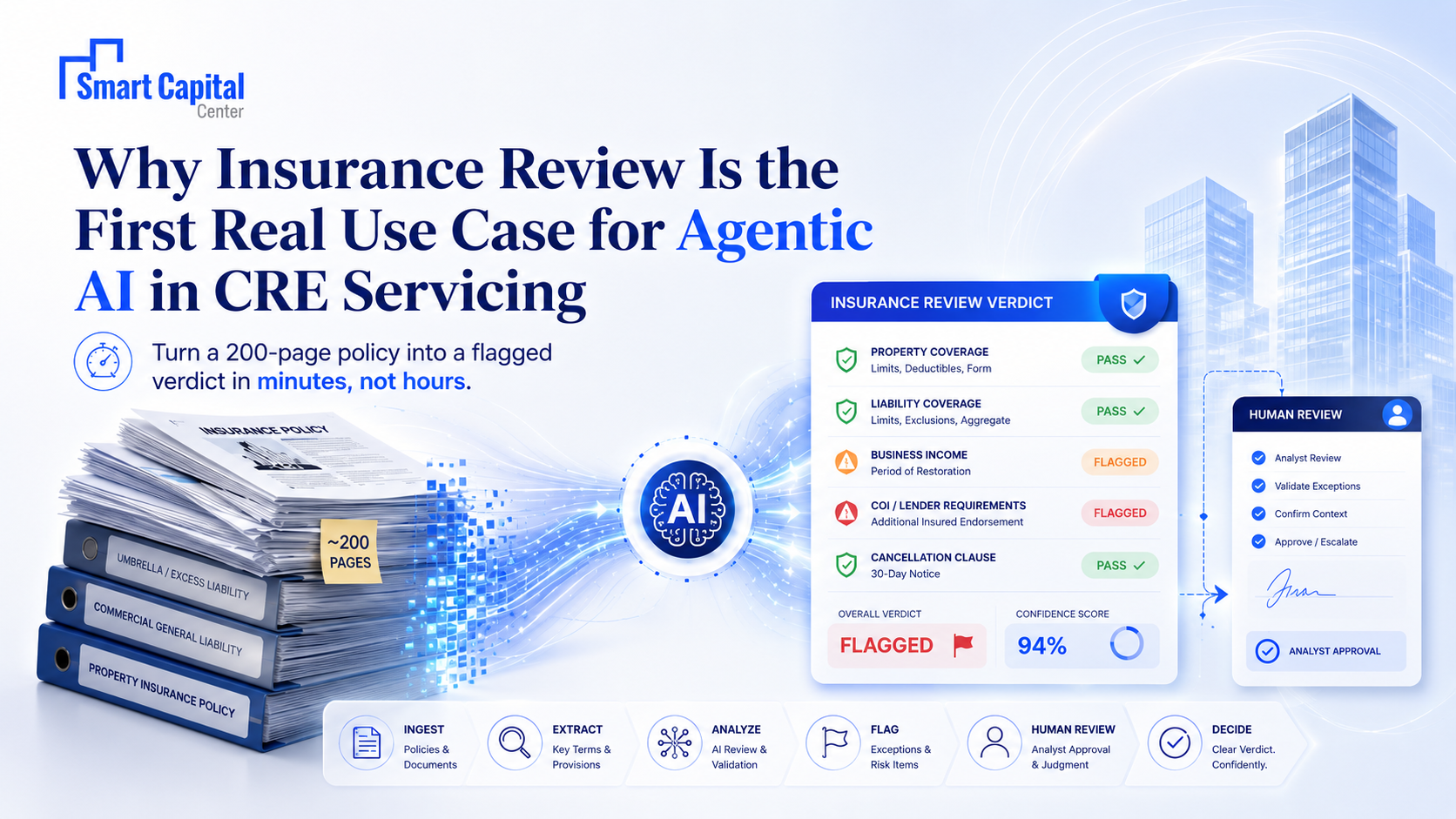
Compliance review is one of the most time-consuming jobs in commercial real estate (CRE) servicing. A single commercial insurance policy can run 200 pages. When a borrower owns several properties, the review multiplies. And the rules on top of that are dense. The federal flood-insurance guidance lenders must follow runs to hundreds of pages of technical questions and answers.
For two years, the CRE industry has wanted to know where AI delivers real results, not just impressive demos. At the 2026 MBA CRE Servicing Solutions Conference, an industry roundtable gave a specific answer: insurance review. It is the clearest first use case for agentic AI in servicing, and it is the kind of work Smart Capital Center built its platform to handle.
(We cover the conference's full set of themes in our recap of the 2026 MBA CRE Servicing Solutions Conference. [Internal note: insert recap link once the post is published.])
Agentic AI is software that completes a multi-step task on its own. It reads a document, checks it against your rules, flags the exceptions, and then hands a person the decision. The word that matters is agentic: the system acts, rather than just answering.
Agentic AI is not just a marketing term. The research firm Gartner describes agentic AI as goal-driven software that plans and acts on its own, not just responding to prompts. Gartner expects the category to scale fast: it projects that 33% of enterprise software applications will include agentic AI by 2028, up from less than 1% in 2024.
That makes it different from a chatbot. A chatbot responds to a question. Agentic AI does a job, then stops short of the judgment call and leaves that to professional human judgement. In servicing, that distinction is the point. You want the machine to do the reading and the cross-checking. You want a human to make the final call that carries liability.

Insurance review has three features that make it the natural starting point for agentic AI.
That mix of standard documents, high volume, and real stakes is what agentic AI handles well, and what people least want to do manually.
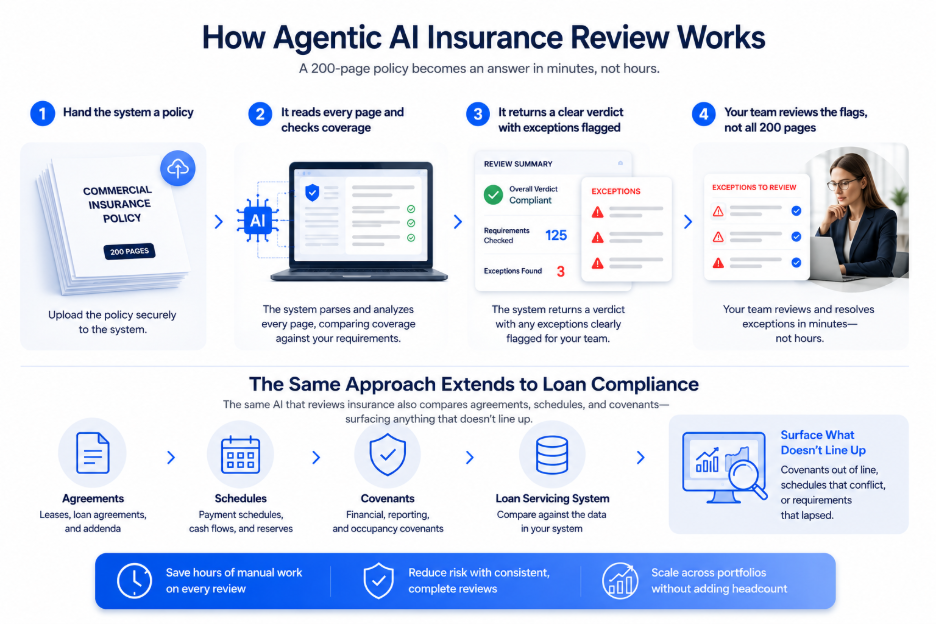
From the user's side, the workflow is simple.
The reviewer still makes the calls. They just spend a few minutes on the items that need a human decision, instead of spending hours reading every page.
The difference from manual review is clear.
Insurance is just the starting point. The same AI that reads an insurance policy also powers AI lease abstraction and broader loan compliance. Smart Capital Center compares agreements, schedules, and covenants against the data already in your loan servicing systems, and surfaces anything that does not line up: a covenant that no longer matches reported performance, a schedule that conflicts with the agreement, or a requirement that has quietly lapsed.
The productivity case is already on the record. Using the same approach on document-heavy work, JLL cut financial-statement processing from 30–40 minutes to 1–3 minutes, a roughly 30x reduction, and KeyBank reduced financial-model preparation time by 40%. You can review those client results here. Insurance review is simply the cleanest place to start, because the structure is so consistent.
Agentic AI is powerful in this workflow, but it is not a set-and-forget tool. Three risks deserve attention.
When assessing insurance compliance software, five tests separate production-ready systems from demos.
The first real use case for agentic AI in CRE servicing is an everyday one: the document grind of insurance reviews and compliance checks that take up analyst hours and create real risk when a detail is missed. The documents are standard, the volume is high, and the stakes are real. That is why it is the right place to begin.
Start there. Hand the 200-page policy to the system, review the flags it returns, and give your team back the hours. It is the approach commercial real estate lenders can put into production today.
See how Smart Capital Center turns insurance and compliance review into a flagged verdict in minutes. Book a demo today.
Q: What is agentic AI?
A: Agentic AI is software that completes a multi-step task on its own. It reads a document, checks it against a set of rules, flags the exceptions, and hands the decision to a person. Unlike a chatbot, which answers a question, agentic AI performs a job and then stops at the judgment call. In servicing, that means the machine does the reading and cross-checking while a human makes the decisions that carry liability.
Q: What is the first real use case for agentic AI in CRE loan servicing?
A: Insurance review. It was named at the 2026 MBA CRE Servicing Solutions Conference as the clearest first use case, because insurance policies have a standard structure, the review work is high-volume and recurring, and the compliance stakes are high. Those three features make it the natural place to deploy agentic AI before extending it to broader loan compliance.
Q: How does AI review a commercial insurance policy?
A: Smart Capital Center’s AI reads the full policy, checks the coverage, deductibles, limits, exclusions, and conditions against your requirements, and returns a verdict with any exceptions flagged. Your team then reviews the flagged items rather than the entire document. The work that took hours of page-turning becomes minutes of focused review.
Q: What is insurance compliance software?
A: Insurance compliance software reads insurance policies and checks their coverage, limits, deductibles, exclusions, and conditions against a lender's requirements, then flags any gaps for review. Smart Capital Center does this with agentic AI: it reads the full policy, returns a verdict with exceptions flagged in minutes, and routes those flags to a person to decide. The same approach extends to loan covenant and compliance checks.
Q: Does agentic AI replace compliance analysts?
A: No. It takes over the manual reading and cross-checking, while the judgment stays with your analysts. The system flags and recommends; a person decides. Good implementations keep a human on every decision that carries liability and make every flag traceable back to the source, so analysts spend their time on the items that need their expertise.
Q: Can agentic AI handle loan covenant compliance?
A: Yes. The same approach used for insurance extends to loan compliance: Smart Capital Center’s AI compares agreements, schedules, and covenants against the data in your loan servicing systems and surfaces anything that does not line up: a covenant that no longer matches performance, a schedule that conflicts with the agreement, or a requirement that has lapsed.
Q: How does Smart Capital Center help with insurance and compliance review?
A: Smart Capital Center’s AI reads each policy or agreement, checks it against your configured requirements, and returns a verdict with every exception flagged and traced back to the source page and clause. A person stays on every decision that carries liability, while the platform removes the manual reading and cross-checking. The same approach extends from insurance review to broader loan covenant and compliance monitoring. Book a demo to see it on your own documents.