CRE Lenders

November 10, 2026
CRE Lenders
November 10, 2026

Smart Capital Center attended MBA's CRE Insurance Conclave 2026 in Chicago, Illinois, on October 4 to 6, 2026. The Mortgage Bankers Association (MBA) event brings together the people responsible for insurance compliance at commercial real estate (CRE) lenders, the teams that make sure every loan's property and liability insurance meets the loan's requirements and holds up after a loss.
Lenders of every size described the same pressure. Policies are harder to read, liability claims keep growing, and insurance teams are expected to review more policies every year without adding people. Across two days of panels and case studies, the sessions kept coming back to one idea. A loan is only as protected as the policy behind it.
Smart Capital Center works with lenders on exactly that problem. Its AI agents take on the line-by-line checking of certificates and policies, so the same insurance team can cover more loans and spend its time on the judgment calls that protect each one. Below are the four takeaways that matter most for lenders, and what each one means for your team.
MBA's CRE Insurance Conclave is the Mortgage Bankers Association's annual meeting for insurance and risk professionals across commercial real estate finance. The 2026 edition ran October 4 to 6 at the Crowne Plaza Chicago West Loop Hotel, with panels and live case studies on the CRE insurance market, liability litigation, catastrophic coverage, common compliance gaps and AI in insurance. It brings together insurance and risk executives from a wide range of CRE financing institutions.
Most insurance reviews start with an ACORD certificate of insurance, the one-page summary a broker issues to show that coverage exists. The certificate is quick to check, which is why it often becomes the whole review. Panelists warned that the details that decide whether a claim gets paid, like exclusions, sublimits and policy conditions, usually live only in the full policy. A sublimit is a smaller cap on one type of loss inside a larger policy limit.
“Certificates, you should always take with a grain of salt.” - Veronica Yamasaki, Insurance Team Lead, PGIM
For lenders, the gap between the certificate and the policy is where risk hides. Reading the policy behind every certificate closes that gap, and it takes time most teams don't have during renewal season. When Smart Capital Center checks each certificate and policy against the loan's insurance requirements, reviewers start from a short list of real gaps instead of a stack of documents. Our guide to commercial loan insurance compliance walks through the full review.
Property coverage has long taken most of the attention in insurance reviews. This year, liability took over the conversation. Liability insurance pays when someone is hurt on a property and sues the owner, and brokers and lawyers on the panels described claims that are larger, slower and harder to settle than a few years ago. Tort reform, the state laws meant to limit lawsuit damages, has not brought costs down the way the market hoped.
“What used to be a million-dollar claim for shooting and a death claim is now $5 million.” - Tim Hanke, Executive Vice President, Casualty Broker, RT Specialty
What is a nuclear verdict? A nuclear verdict is an unusually large jury award against a company. Marathon Strategies, which tracks these awards each year, counts verdicts of $10 million or more.
The numbers back up what the panels described. Marathon Strategies counted nearly 200 nuclear verdicts against companies in 2025, a 40.7% increase over 2024, with awards totaling more than $25.6 billion. Pricing is moving the same way. In its Global Insurance Market Index for the second quarter of 2026, Marsh reported that U.S. casualty rates rose 7%, even as U.S. property rates fell 13%.
The lenders on stage were not asking borrowers to simply buy more coverage. They described a closer look at each borrower, including financial strength, reserves, debt service coverage and what the owner does to prevent incidents on the property. Each of those calls is a credit decision, and it holds up best when the insurance findings sit next to the rest of the loan file with the evidence behind them. Smart Capital Center links every insurance finding to its source and to the loan it affects, so each exception is approved with a clear record of why.
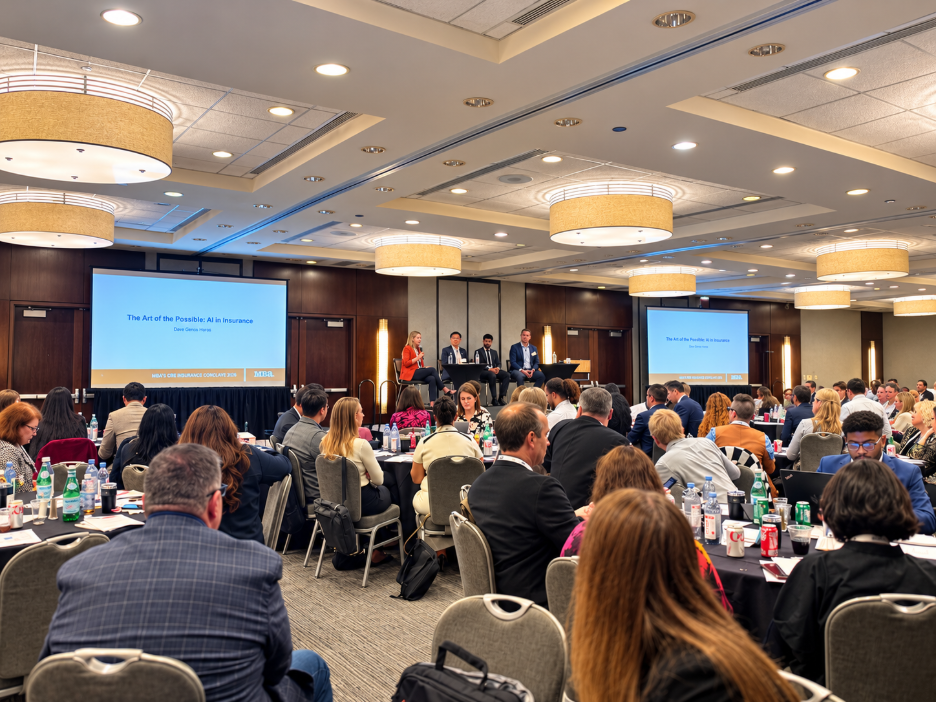
In The Case File: Risk Management in Real Time, Elizabeth Vorholt, Managing Director at Trimont, walked through a case study about a loan that looked routine at renewal. Two items were left open, a mortgagee clause that named the wrong entity and no evidence of the cancellation clause, and both seemed like paperwork. Months later, a storm hit. The policy had been canceled for nonpayment, the borrower had received the notice, and the lender never did.
Justin Castaneda, Vice President at J.P. Morgan, made the same point from the lender's seat in The Case File: Property & Liability Claim.
“One of the biggest surprises for people outside of claims is that getting paid and accessing the money are not always the same thing.” - Justin Castaneda, Vice President, J.P. Morgan
A mortgagee clause names the lender on the property policy so it has rights to the claim payment. A notice of cancellation warns the lender that coverage is ending while there is still time to act. When a team is stretched, these are the items that slip from one renewal to the next. Smart Capital Center keeps every open item visible until it is resolved, so a small defect gets fixed before a loss turns it into a large one.
The biggest shift we heard was about the role itself. Insurance compliance teams used to confirm that required coverage exists. Lenders now expect them to judge whether coverage will protect the loan after a loss, to weigh exceptions with credit in mind, and to educate borrowers and their brokers along the way.
“It's more about making sure that the coverage is going to protect the asset the way it needs to at the time of the claim.” - Whitney Ronning, Vice President, Director of Insurance, Northmarq
The Art of the Possible: AI in Insurance panel tied this directly to workload. Jenni Bowser, Director of Insurance at JLL Capital Markets, asked what teams would do with their time if technology took on the large share of the work a computer can do well. Her answer was to spend it educating clients and borrowers and acting as risk managers. Most teams want to make that trade and don't have the hours to make it today.
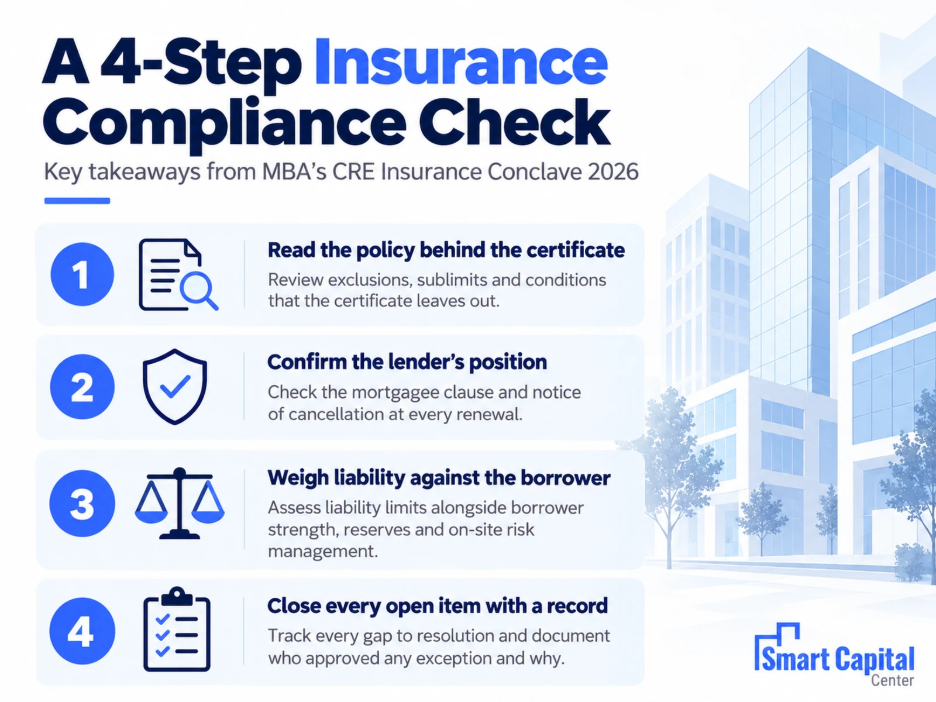
The sessions add up to a practical review routine any lender can apply at the next renewal.
Smart Capital Center handles the reading and checking in the first two steps across the whole loan book, so your experts can spend their time on the judgment calls in the last two.

Every takeaway from Chicago points to the same constraint. Lenders know what good insurance compliance looks like, and their teams already know how to read a policy, question an exclusion and follow an open item to the end. What they lack is the time to do it on every loan, every year.
Smart Capital Center's AI agents read certificates, endorsements and policies in the formats they arrive and check them against each loan's insurance requirements, flagging gaps for your team to review. For lenders, the value shows up in three ways:
Every finding links back to the page it came from, and your team makes the final call. Lenders already see the results across loan work, with JLL reporting a 30x productivity gain for its asset management team. The platform draws on 120M+ properties, 1B+ live market data points and $500B+ analyzed transactions, is SOC 2 Type II certified, and client data is never shared or used to train models for other clients.
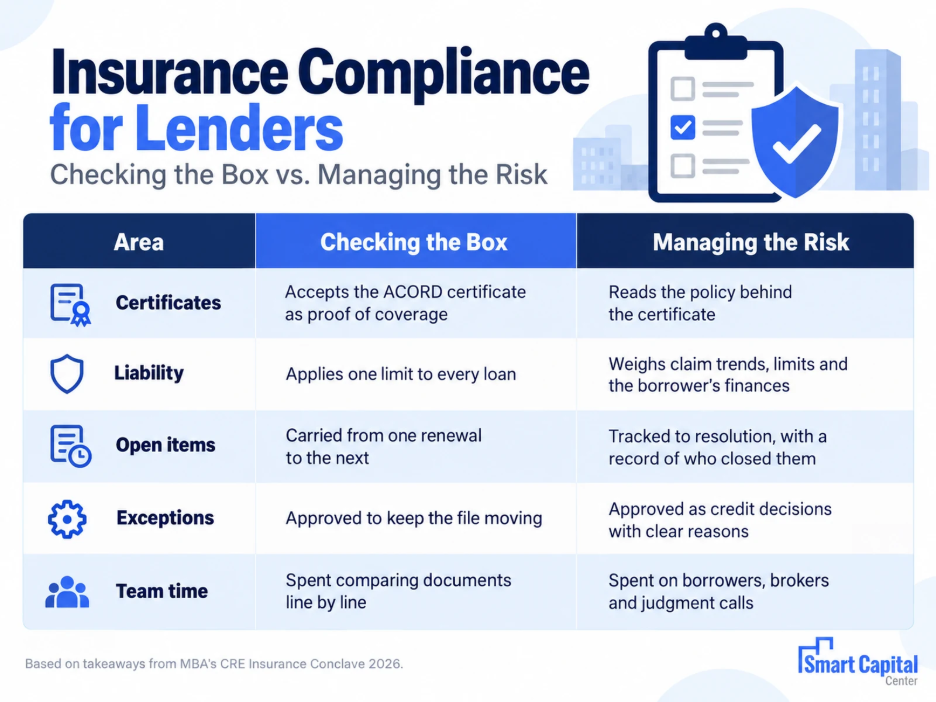
A loan is only as protected as the policy behind it, and knowing what that policy covers takes an expert's time. The lenders in Chicago were clear that their teams need the time to work as risk managers. With liability costs rising and coverage getting harder to read, freeing that time now will decide how well each loan holds up at the next renewal and the next loss.
Review insurance across your loan book faster. Discover how Smart Capital Center helps your team cover more loans and catch coverage gaps sooner. Book a demo today.
Q: What is insurance tracking software for lenders?
A: Insurance tracking software for lenders keeps a record of the insurance on every loan, including renewal dates, required coverage and documents still missing. Its job is to make sure each property stays insured to the loan's requirements for the life of the loan. Smart Capital Center goes a step further by checking the policy behind each certificate, since the policy decides whether a loss gets paid.
Q: What should lenders look for in certificate of insurance tracking software?
A: Lenders should look for software that checks certificates and policies against each loan's insurance requirements, beyond expiration dates. Many certificate of insurance (COI) tracking tools are built for property managers tracking vendors, so lenders also need support for mortgagee clauses, notices of cancellation, exclusions and sublimits. Smart Capital Center is built for lenders, with every finding linked to its source document and the final call left to your team.
Q: Can AI review insurance certificates and policies for loan compliance?
A: Yes. AI can read certificates and full policy forms, compare them to a loan's insurance requirements and flag likely gaps for a person to review. Smart Capital Center's AI agents read these documents in the formats they arrive and point each finding back to the page it came from, so reviewers can confirm it quickly. That frees insurance experts for borrower conversations and exception decisions.
Q: What is insurance compliance software?
A: For lenders, insurance compliance software confirms that each borrower's insurance meets the requirements in the loan documents, including property and liability limits, deductibles, the lender's position on the policy and renewals. The same term also describes tools insurers use for regulatory compliance, which solve a different problem. Smart Capital Center handles lender insurance compliance as part of a wider platform for managing CRE loans after closing.
Q: Why isn't a certificate of insurance enough for a commercial real estate lender?
A: An ACORD certificate of insurance is a one-page summary showing that coverage exists, but it usually leaves out exclusions, sublimits and policy conditions. Those details live in the full policy, and they decide whether a claim gets paid. Lenders that review the policy behind each certificate catch gaps before a loss tests them. Smart Capital Center checks certificates and policies against each loan's insurance requirements and links every finding to its source page.
Q: How does Smart Capital Center help lenders with insurance reviews?
A: Smart Capital Center helps lenders review insurance across a whole loan book with the team they already have. Coverage gaps are found sooner, every finding links back to its source, and your experts make the final call. Teams get 10x capacity and time back for borrower conversations and judgment calls, on a SOC 2 Type II certified platform.