


AI in Commercial Real Estate

October 1, 2026
AI in Commercial Real Estate
October 1, 2026
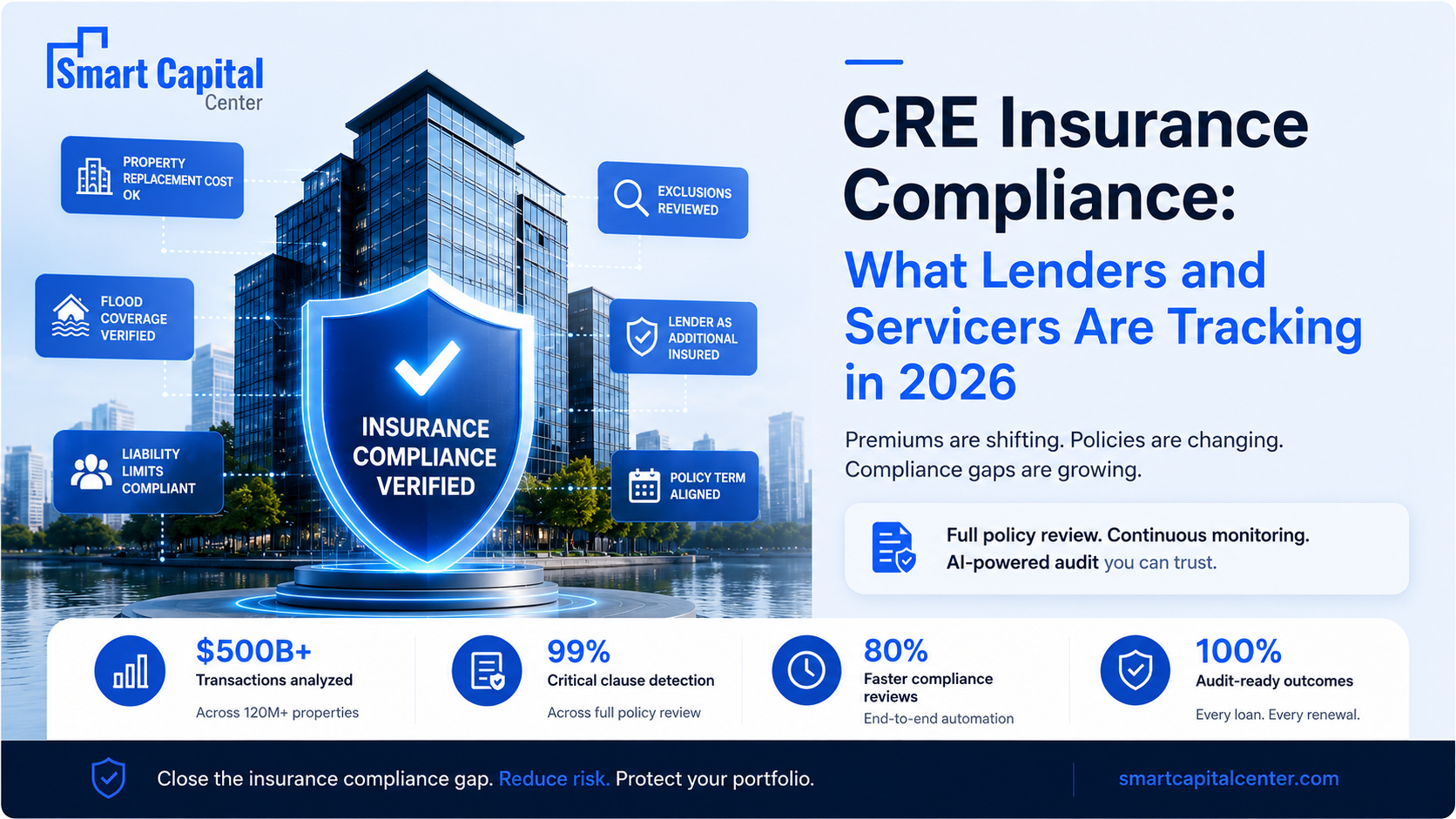
According to the Council of Insurance Agents & Brokers’ Q4 2025 Market Index, larger commercial real estate accounts saw property coverage premiums decline for the first time since 2017, but excess liability premiums remain elevated and “can still be difficult to place, especially without exclusions that lenders have been reviewing more closely in recent years.” For servicing and asset management teams, a softening property market complicates CRE insurance compliance. Softening means restructured policies with new exclusion language, updated insurable value assumptions, and coverage terms that may not map to what the loan agreement requires.
This analysis draws on Smart Capital Center, a CRE AI platform that has processed $500B+ in transactions across 120M+ properties, used by JLL, KeyBank, and leading institutional lenders, to map what commercial real estate insurance compliance requires in 2026 and where AI-powered policy review closes the gap that manual workflows cannot.
Forced-placed (lender-placed) insurance: coverage a lender buys on the borrower's behalf when the borrower's own policy lapses. It's more expensive and protects only the lender's interest, not the borrower's.
Certificate of Insurance (COI): a one-page proof-of-coverage document listing policy limits, effective dates, and named insureds. Servicers track COIs to confirm coverage stays continuous through the loan term.
Additional insured vs. loss payee: an additional insured is covered under the borrower's liability policy; a loss payee receives claim payouts on property coverage. Lenders typically require both.
Three market shifts have arrived simultaneously, and each one changes what lenders must track in a commercial real estate property insurance review:
• Property premiums softening, but insurable values rising. Tariffs on steel, aluminum, lumber, and copper have increased replacement cost valuations across asset classes, according to the Deeley Insurance Group Commercial Property Market Outlook, Spring 2026. A policy renewed with the same limits as last year may now be underinsured against actual rebuild costs, creating a gap that only surfaces at claim time.
• Excess liability premiums still rising and harder to place. According to Marsh MMA’s 2026 Commercial Real Estate Industry Outlook, the first $10 million excess layer increasingly requires multiple carriers to fill what a single insurer once would have, and exclusions for assault and battery, sexual abuse, and weapons are becoming standard – terms that may conflict with agency and institutional loan requirements.
• ACORD certificates losing lender confidence. Whitney Ronning, VP and Director of Insurance at Northmarq, noted in May 2026 that “Lenders are placing greater emphasis on obtaining complete copies of insurance policies rather than relying on ACORD certificates, which are now seen as less dependable documentation.” What this means in practice: the one-page summary that most borrowers submit is no longer sufficient for lenders who take compliance seriously.
The result is that insurance for commercial real estate compliance review now requires reading the full policy and comparing its terms against the loan agreement line by line. For a servicer managing 300 loans, each with annual renewals, that is an enormous and chronically under-resourced task.

Loan agreements typically specify minimum requirements across multiple coverage lines. The most common compliance gaps appear in the coverages borrowers assume are covered.
| Coverage Type | What Lenders Require | Common Compliance Gap | Source & Period |
|---|---|---|---|
| Property (all-risk) | Replacement cost value; no coinsurance penalty; lender as additional insured | Policy limits below current rebuild cost due to construction cost inflation | Deeley Insurance, Spring 2026 |
| Flood (NFIP or private) | Coverage if property is in SFHA; lender-required minimum equal to loan amount | Borrower obtains NFIP coverage but property value exceeds $500K NFIP cap | FEMA NFIP Program, 2025 |
| Liability (commercial general) | Minimum $1M per occurrence; $2M aggregate; lender named as additional insured | Exclusions for A&B or SAM added at renewal without lender notification | Marsh MMA, 2026 Outlook |
| Business interruption / BI | Coverage period sufficient to support debt service during rebuild | Coverage period shorter than rebuild timeline for complex assets | Standard CRE loan agreement practice |
| Umbrella / excess | Amount specified in loan agreement; stack fills all underlying limits | Multi-carrier excess stack leaves gap layers; exclusions conflict with loan terms | Marsh MMA, 2026 Outlook |
| Builder’s risk (construction loans) | Coverage in force from groundbreaking through COO; lender as loss payee | Policy lapses or transitions at CO without lender notification | AFR Services, March 2026 |
The flood compliance requirement deserves particular attention. The National Flood Insurance Program (NFIP) caps individual policy coverage at $500,000 for buildings – an amount that falls well below the loan balance on most institutional CRE transactions. Lenders whose loan agreements require flood coverage “equal to the lesser of the loan amount or the maximum available” need to verify that borrowers have obtained private flood coverage for the gap above the NFIP cap.
A borrower with a portfolio of 20 commercial properties renewing policies on staggered dates generates 20 separate insurance submissions per year, each a multi-hundred-page policy document with different carriers, different endorsements, and different exclusion language. Comparing each policy against the loan agreement for that specific property, which may have different coverage requirements depending on asset type, loan vintage, and lender, is the task that servicing teams consistently describe as the highest-volume, lowest-judgment-content work in CRE insurance compliance.
The problem is that “lowest-judgment-content” does not mean “lowest-stakes.” A missed exclusion on a liability policy that conflicts with an agency loan requirement creates a technical default. A property value that has drifted below the loan’s required coverage ratio creates an underinsurance gap that surfaces at the worst possible moment: when there is a claim. As Northmarq’s compliance team observed, compliance gaps in commercial real estate property insurance are “typically discovered during a claim event, not during proactive review.” The workflows that allow this to happen are the ones that rely on the certificate rather than the policy, and on manual comparison rather than structured review.
AI-powered document extraction applied to CRE insurance review addresses the problem directly: it reads the full policy and compares extracted data against loan requirements rather than leaving that comparison to an analyst with ten other submissions in their queue. Smart Capital Center ingests any document format, including multi-hundred-page insurance policies, and extracts structured data from coverage declarations, endorsements, exclusion schedules, and named insured designations – the specific sections where compliance gaps hide.
What lenders and servicers must verify in every policy review:
| Coverage Type | What Lenders Require | Common Compliance Gap | Source & Period |
|---|---|---|---|
| Property (all-risk) | Replacement cost value; no coinsurance penalty; lender as additional insured | Policy limits below current rebuild cost due to construction cost inflation on steel, aluminum, lumber, and copper | Deeley Insurance Group, Commercial Property Market Outlook, Spring 2026 |
| Flood (NFIP or private) | Coverage if property is in Special Flood Hazard Area; lender-required minimum equal to loan amount | Borrower obtains NFIP coverage but property value exceeds $500K NFIP building cap — private flood gap goes undetected | FEMA NFIP, Commercial Coverage Summary, 2024 |
| Liability (commercial general) | Minimum $1M per occurrence / $2M aggregate; lender named as additional insured | Exclusions for assault & battery (A&B) or sexual abuse/molestation (SAM) added at renewal without lender notification — conflicts with agency loan terms | Marsh MMA, 2026 CRE Industry Outlook |
| Business interruption / BI | Coverage period sufficient to support debt service during rebuild timeline | BI coverage period shorter than actual rebuild timeline for complex assets — income gap not covered | Standard CRE loan agreement practice; Marsh MMA, 2026 |
| Umbrella / excess | Amount specified in loan agreement; stack must fill all underlying limits without gaps | Multi-carrier excess stack leaves gap layers unfilled; exclusions in individual layers conflict with loan terms | Marsh MMA, 2026 CRE Industry Outlook |
| Builder's risk (construction loans) | In force from groundbreaking through certificate of occupancy (COO); lender named as loss payee | Policy lapses or transitions incorrectly at COO without lender notification — collateral exposed during closeout | AFR Services, 2026 Lender Insurance Tracking Guide |
The cross-document check is the most significant capability. Smart Capital Center compares extracted policy data against loan requirements and flags exceptions for analyst review rather than passing them through silently. A liability policy with an exclusion that conflicts with the loan agreement generates an exception flag, with the relevant clause in the policy and the relevant requirement in the loan agreement both linked as sources. The analyst sees the conflict clearly; they do not have to find it.
A borrower renews their general liability policy with a new exclusion for assault and battery – a common carrier addition in multifamily and hospitality assets in 2025–2026. The exclusion is in the endorsement schedule on page 47 of the 210-page policy. The ACORD certificate shows the same limits as last year. The servicer accepts the certificate without reviewing the full policy. Six months later, a slip-and-fall at the property generates a liability claim. The carrier denies it under the exclusion. The loan agreement required coverage without that exclusion. The lender has a compliance gap in its credit file and no documentation showing the exclusion was reviewed.
Smart Capital Center mitigates this through structured extraction of endorsement schedules and exclusion riders with cross-document checks against loan agreement coverage requirements. Every exception is flagged with the source clause and the conflicting loan term, routed to the analyst before the certificate is accepted.
A borrower on a $2.5M industrial loan obtains NFIP flood coverage at the program’s $500,000 building cap and submits the declaration as evidence of compliance. The loan agreement requires flood coverage equal to the lesser of the loan amount or the maximum available coverage. The borrower interprets “maximum available” as the NFIP cap. The lender’s loan file shows compliant flood coverage. The property sits in a Zone AE floodplain. A storm event produces $1.8M in flood damage. The NFIP policy pays $500,000. The lender’s collateral is impaired by $1.3M with no insurance recovery.
Smart Capital Center mitigates this through automated flood compliance calculations that compare the loan balance against the NFIP cap and flag properties where the gap requires private flood coverage, with the specific flood zone, loan amount, and coverage shortfall all linked to their source documents.
A borrower with 25 properties renews policies on a rolling basis. Submissions arrive in the servicing inbox across eight months of the year. Each submission is a separate PDF. The team’s bandwidth is limited. Three renewals are reviewed thoroughly; the others are accepted based on the certificate matching last year’s. Of the 22 certificates accepted without full review, four have material changes: two have reduced property limits, one has a new coinsurance clause, one has a different named insured. None are caught. All four create compliance gaps. The bank examiner reviewing the institution’s insurance monitoring practices at the next examination finds no documentation of a consistent review standard applied across the portfolio.
Smart Capital Center mitigates this through portfolio-level insurance review that applies the same extraction and compliance check to every submitted policy with every check linked to its source document and every exception logged for analyst resolution before the submission is accepted.
1. Step 1: Require full policy submissions at renewal. Update your servicing checklist to require a complete copy of the policy: declarations, endorsements, exclusion schedules, and named insured designations at every renewal. ACORD certificates are still useful for initial confirmation that renewal has occurred; they are not adequate for compliance review. Smart Capital Center accepts and processes full-policy submissions in any format.
2. Step 2: Define required coverage terms by loan type and document them in a standardized review checklist. Create a coverage matrix that maps each loan type (multifamily, retail, office, industrial, construction) to its minimum required coverage terms, including flood requirements by flood zone, liability minimums by asset class, and any agency-specific requirements. This matrix is what the AI comparison checks policy extractions against.
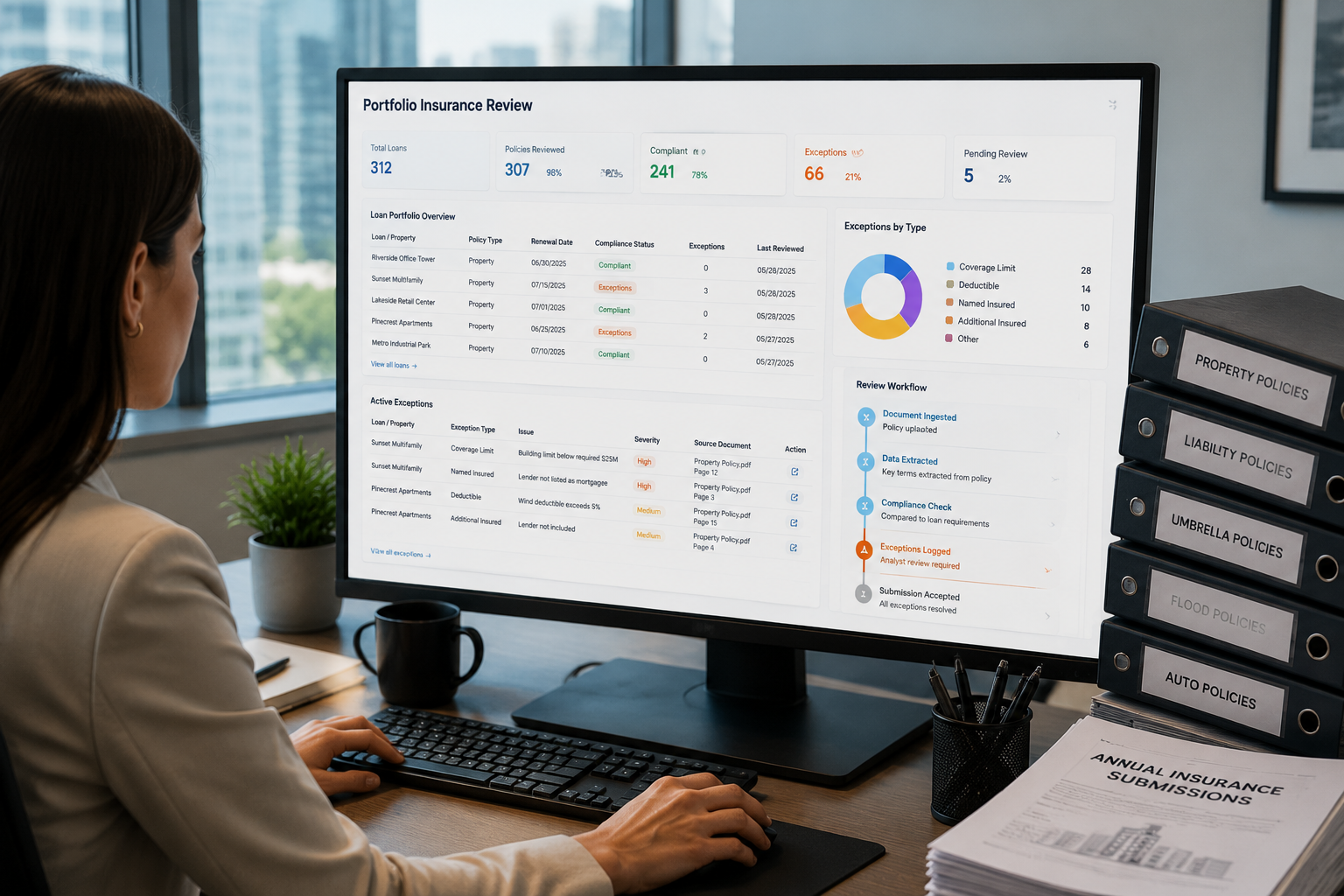
3. Step 3: Run an automated cross-document check that compares extracted policy terms against loan requirements and flags exceptions before accepting the submission. The exception flag is the compliance action. Smart Capital Center flags every term that does not meet the loan requirement and links both the policy source and the loan agreement clause, so the analyst can resolve the exception rather than discover it later.
4. Step 4: Calculate flood coverage adequacy for every property in a Special Flood Hazard Area using current loan balance and NFIP cap. For every SFHA property, run the loan-amount-versus-NFIP-cap calculation and flag any property where the gap requires private flood coverage. Smart Capital Center automates this calculation and links the result to the FEMA flood zone designation and the loan agreement flood requirement.
5. Step 5: Generate a portfolio-level compliance status report at each renewal cycle and retain it for examination. The report should show every policy reviewed, every exception flagged, every resolution documented, and the name of the analyst who accepted or escalated each item. Smart Capital Center generates this report automatically, with a continuous audit trail that is exportable for regulatory review without manual assembly. This is what examiners expect to see when reviewing a lender’s insurance compliance practices.
The compliance gap in CRE insurance review is caused by too many policies, too few analysts, and a review workflow that defaults to the certificate because reading 200 pages per policy per loan per year is not operationally feasible at scale.
Smart Capital Center’s AI extraction and cross-document compliance layer reads the full policy, compares every material term against the loan requirement, flags every exception with its source, and builds the audit trail that satisfies examination standards by default. CRE insurance compliance is one of the clearest near-term AI use cases in loan servicing because the task is high-volume, rule-based, and document-structured, which is exactly where AI produces reliable, consistent results that manual review cannot match at scale.
Smart Capital Center works with lenders and servicers, including KeyBank and Rose Community Capital, tracking insurance compliance and covenant obligations across 1B+ real-time signals and 120M+ properties, with $500B+ in transactions analyzed.
Run a compliance check on your next insurance renewal before accepting the certificate. Book a demo with Smart Capital Center.
The short answer is that you cannot if your review stops at the ACORD certificate. ACORD certificates confirm that a policy exists and state the coverage limits, but they do not capture endorsements, exclusions, or changes to named insured designations that may conflict with your loan agreement. Whitney Ronning of Northmarq noted in May 2026 that lenders are increasingly requiring full policy copies rather than certificates for exactly this reason. AI-powered CRE insurance review extracts the relevant terms from the full policy and compares them against your loan requirements automatically, surfacing exceptions without requiring a manual read.
The NFIP’s building coverage cap is $500,000, which means any loan with a balance above that threshold cannot be fully protected by NFIP coverage alone. For properties in a Special Flood Hazard Area, your loan agreement’s flood requirement, typically coverage equal to the lesser of the loan amount or maximum available coverage, requires private flood coverage to fill the gap above the NFIP cap. The compliance check is whether total flood coverage (NFIP plus private) equals or exceeds the required amount. This calculation should be run at origination and verified at every renewal for SFHA properties.
The operational challenge in insurance for commercial real estate at portfolio scale is that renewals arrive on staggered schedules, in different formats, from different borrowers, often without proactive submission unless the servicer prompts it. Effective portfolio-level tracking requires a centralized dashboard that surfaces upcoming renewals 60–90 days in advance, automates submission requests to borrowers through a structured channel, and flags overdue submissions before the policy lapses. Smart Capital Center’s monitoring layer surfaces renewal dates across the full portfolio and routes submission exceptions to the responsible team member, so the review queue is driven by the system rather than by whoever checked the inbox that day.
Examiners reviewing commercial real estate insurance compliance practices expect documentation showing that a consistent review standard was applied across the portfolio. The audit trail should include the policy document itself, the coverage terms extracted from that document, the comparison against loan agreement requirements, any exceptions identified and how they were resolved, and the name of the analyst who completed the review. A record assembled from email archives and file folders will have gaps. Smart Capital Center generates this record automatically and continuously, with every element linked to its source document and the full record exportable for examination.
Most liability exclusions added at renewal are buried in endorsement schedules rather than the declarations page. An ACORD certificate will not surface them. Common exclusions in 2025–2026 may directly conflict with agency and institutional loan terms that require coverage without such exclusions. According to Marsh MMA’s 2026 CRE Industry Outlook, excess liability structures are increasingly complex, with multi-carrier stacks that may leave gap layers unfilled. The only reliable way to catch these conflicts is to extract endorsement and exclusion content from the full commercial real estate property insurance policy and compare it against the loan agreement. Smart Capital Center runs this comparison automatically and flags conflicts with both the policy clause and the loan requirement cited.
The answer is structured extraction rather than full manual reads. CRE insurance compliance review breaks into two tasks: extracting the relevant coverage terms from the policy, and comparing those terms against the loan requirement. The first task is document processing and can be automated. The second is a rule-based comparison that AI executes more consistently than an analyst reviewing their twelfth policy of the day. Smart Capital Center handles both tasks, extracting structured data from any policy format, running the compliance comparison, and routing exceptions to the analyst for resolution. That is a task one analyst can complete in an hour rather than a day.