CRE Lenders

November 2, 2026
CRE Lenders
November 2, 2026

A certificate arrives from the borrower's broker. Is it the right form? Does it show the limits the loan agreement requires? Is the lender named correctly, and does the property address match? The insurance compliance team checks each item by hand, asks for the policy when something looks off, and follows up with the broker. Then the same loop repeats at the next renewal, and renewals keep moving: Marsh's Global Insurance Market Index reported on July 23, 2026 that U.S. property rates fell 13% and U.S. casualty rates rose 7% in the second quarter.
The volume makes it worse. Every loan renews on its own date, and programs often change at renewal. Marsh expects the current conditions to hold:
"Current market conditions are likely to persist absent a severe northern hemisphere storm season or string of major natural catastrophes."
John Donnelly, President, Global Placement, Marsh Risk, Global Insurance Market Index Q2 2026, July 23, 2026
An insurance compliance lead at a CRE lender described the workload:
“We sometimes collect certificates and then we have to collect policies and review those as well. It will be a huge time saving if it can come to the same results.”
An insurance compliance lead at a CRE lender
Smart Capital Center reads ACORD forms, full policies, and loan agreements, compares coverage against each loan's requirements, and flags every mismatch with a link back to the source page. For the insurance compliance and loan administration teams using it, that means:
● One review instead of two. The certificate and the full policy are read together, so teams do not collect and review them in separate passes.
● Requirements pulled from the loan agreement. Coverage is compared against what each loan actually requires.
● Every mismatch linked to its source page. Follow-up with the broker starts from the exact page, so the conversation is short.
This article explains the difference between the two forms, which one a lender needs and when, what to check field by field, and how to speed up the review.
ACORD 25 is the Certificate of Liability Insurance. It shows the borrower's general liability and related liability coverage. ACORD 28 is the Evidence of Commercial Property Insurance. It shows the coverage on the property that secures the loan and is where the lender is named as mortgagee or loss payee. Lenders usually need both, because each covers a different risk.
● ACORD: a nonprofit that sets standards for the insurance industry, including standardized certificate forms (ACORD).
● ACORD 25: the Certificate of Liability Insurance.
● ACORD 28: the Evidence of Commercial Property Insurance (Insureon glossary).
● Named insured: the person or entity the policy covers.
● Mortgagee or loss payee: the lender named on a property policy so it is notified of, and paid for, covered losses on the collateral.
● Additional insured: a party added to a liability policy, usually by endorsement, so it has coverage under the policy.
● Valuation basis: the method used to value a loss, such as replacement cost or actual cash value.
● Deductible: the amount of a loss the insured pays before coverage applies.
● Agentic AI: AI that carries out multi-step work on its own, pulling from documents and external sources and reconciling what it finds, then handing conclusions to a person to decide on.
Both, for different reasons. The property secures the loan, and the borrower's liability exposure can affect the borrower's ability to repay. Each form answers one of those two questions.
Use the ACORD 28 to confirm the collateral is insured and that the lender is named as mortgagee or loss payee. It is the form that connects the lender to the property coverage, so the lender wording on it deserves the closest read.
Use the ACORD 25 to confirm the borrower carries the general liability coverage the loan agreement requires. It shows limits and policy dates, and it shows whether the lender is listed as an additional insured when the loan agreement asks for that.
ACORD 27 is the Evidence of Property Insurance, used for personal and small commercial property. It is easy to confuse with ACORD 28 because the numbers are close and both show property coverage. On a commercial real estate loan, the form to expect is the ACORD 28.
An ACORD 28 is a standardized form, issued by the borrower's broker or insurer, that summarizes the commercial property coverage on a specific location. As evidence of property insurance, it tells the lender what coverage exists on the date of issue. It does not change the policy.
● Named insured: matches the borrower entity in the loan documents.
● Property address: matches the collateral address exactly.
● Insurer and policy number: match the policy.
● Effective and expiration dates: cover the required period and are not expired.
● Coverage limits: meet or exceed the building limit in the loan agreement.
● Deductibles: within the maximums in the loan agreement, including any wind, hail, or named storm deductible.
● Valuation basis: matches the requirement, such as replacement cost.
● Mortgagee or loss payee wording: names the lender exactly as the loan agreement requires.
● Cancellation terms: show how and when the lender is notified.
Two outside numbers explain why these fields carry weight. Swiss Re Institute's sigma 01/2026 reported $107 billion in global insured natural catastrophe losses in 2025, with secondary perils such as wildfires, severe convective storms, and floods accounting for a record 92% of the total. Those perils are why wind, hail, and named storm deductibles and the valuation basis sit on a lender's checklist. On flood, the National Flood Insurance Program caps building coverage for a non-residential building at $500,000, according to FEMA, so a loan agreement that requires more must see it on the evidence provided.

● Named insured: matches the borrower or operating entity the loan agreement names.
● Insurer and policy number: match the policy.
● Effective and expiration dates: current, and covering the required period.
● General liability limits: each occurrence and general aggregate meet the loan agreement.
● Umbrella or excess limits: meet the requirement, if the loan agreement sets one.
● Additional insured: the lender is listed when required, and the policy is endorsed to match.
● Certificate holder: the lender's name is correct.
● Cancellation terms: show how the lender is notified.
Listing a party as a certificate holder is not the same as making it an additional insured. A certificate that checks the additional insured box does not by itself add the party to the policy. The endorsement does, so the endorsement is worth requesting when the loan agreement requires additional insured status.
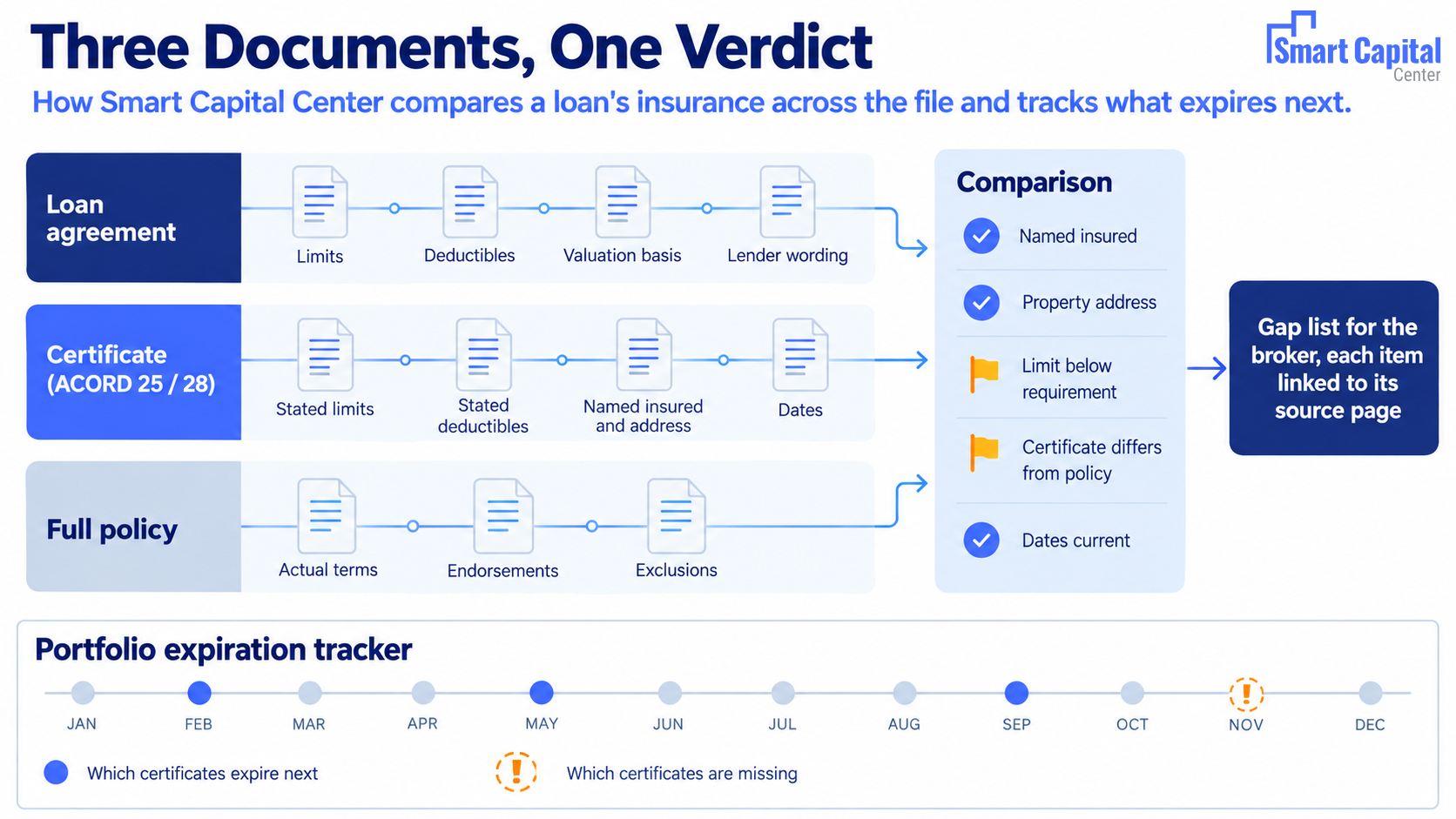
No. A certificate summarizes coverage and does not amend, extend, or alter the policy, and ACORD's certificate guidance is explicit that a certificate is not an insurance policy. That is why a lender's insurance review rests on three documents that all need to agree.
● The loan agreement: holds the requirement, including limits, deductibles, valuation basis, and lender wording.
● The certificate: summarizes what the broker says the policy provides.
● The policy: holds the actual coverage and its terms.
● Coverage below the loan agreement's requirement.
● A wrong or missing lender name, or mortgagee wording that differs from the loan agreement.
● A property address that does not match the collateral.
● Expired dates, or dates that end before the required period.
● A certificate that does not match the policy, such as one limit on the form and another in the policy.
Consider a loan agreement that requires a $12,500,000 building limit, a wind and hail deductible of no more than 2% of insured value, and $5,000,000 of umbrella liability. The borrower's certificates show the following.
Illustrative example, not client data.
Each of these gaps is easy to miss in a stack of certificates, and each one is also what renewal changes tend to produce. Marsh's Q2 2026 index put U.S. property rates down 13%, which gives buyers room to restructure programs, and U.S. casualty rates up 7%, which can lead a borrower to revisit liability limits. A new program ends in a new certificate, and the new certificate needs the same check.

1. Pull the insurance requirements from the loan agreement. Put limits, deductibles, valuation basis, and lender wording into one checklist.
2. Collect the ACORD 28, the ACORD 25, and the policy. The forms summarize coverage and the policy controls it.
3. Match the identifying details. Check the named insured, property address, and lender name against the loan file.
4. Compare coverage with each requirement. Check limits, deductibles, and valuation basis line by line.
5. Check the dates. Confirm effective and expiration dates and set a tracking date ahead of each expiration.
6. Compare the certificate with the policy. Look for any limit or term that differs.
7. Send the broker one list of gaps. Record the response and the corrected documents.
Smart Capital Center's agentic AI extracts the ACORD forms, the full policy, and the insurance requirements from the loan agreement, compares them, and flags every gap for follow-up with the broker. Each flag links back to the source page, so the analyst can see the form line and the requirement side by side. Kathleen Dufresne of JPMorgan made the case for the use at the MBA CRE Servicing Solutions Conference in May 2026:
“Insurance is the perfect use case for agentic AI.”
Kathleen Dufresne, JPMorgan, MBA CRE Servicing Solutions Conference, May 2026
For more on that conference, see the MBA CRE Servicing Solutions Conference 2026 recap.
Expiration dates, requirement changes, and renewals multiply across a loan portfolio. Tracking them in one place lets a team see which certificates expire next and which are missing. This sits alongside other ongoing checks, covered in the Loan Covenant Monitoring Guide and CRE Lenders' Due Diligence: What Underwriters Verify. The same verification principle applies to ownership records, covered in CRE Ownership Verification Methods: Traditional vs. AI.
Insurance policies and borrower documents are sensitive files. Smart Capital Center is SOC 2 Type II certified, which matters when lenders upload them. The same platform, built on 120M+ properties, 1B+ signals, $500B+ analyzed, supports asset management more broadly. JLL reported a 30x productivity gain for the asset management team.
Lenders need both forms, but for different risks: the ACORD 28 for the property that secures the loan, and the ACORD 25 for the borrower's liability. A certificate is a summary, the requirement lives in the loan agreement, and the coverage lives in the policy, so all three need to agree. Smart Capital Center's agentic AI compares them and flags every mismatch with a link back to the source page, and the compliance analyst decides what to chase.
See your next ACORD 25, ACORD 28, and policy compared against the loan agreement, with every gap linked to its source page.
Book a demo with Smart Capital Center →
Q: What is the difference between ACORD 25 and ACORD 28?
A: ACORD 25 is the Certificate of Liability Insurance, which shows the borrower's general liability and related liability coverage. ACORD 28 is the Evidence of Commercial Property Insurance, which shows the coverage on the property that secures the loan and names the lender as mortgagee or loss payee. Lenders usually need both, because each covers a different risk.
Q: Which ACORD form does a commercial real estate lender need?
A: A lender needs the ACORD 28 to confirm the collateral is insured and the lender is named as mortgagee or loss payee. It needs the ACORD 25 to confirm the borrower's general liability coverage. The loan agreement sets the exact limits and wording that each form must show.
Q: What is an ACORD 28 evidence of commercial property insurance?
A: An ACORD 28 is a standardized form, issued by the borrower's insurance broker or insurer, that summarizes the commercial property coverage on a specific location. It lists the insurer, policy number, dates, coverage limits, deductibles, valuation basis, and the lender's mortgagee or loss payee wording. It is evidence of the coverage and does not change the policy.
Q: What should lenders check on an ACORD 25?
A: Check the named insured, insurer, policy number, effective and expiration dates, general liability limits, any umbrella or excess limits, additional insured wording, and cancellation terms. Compare each item with the loan agreement. If the lender should be an additional insured, confirm that the policy is endorsed to say so.
Q: Is a certificate of insurance the same as the insurance policy?
A: No. A certificate summarizes coverage as of its issue date and does not amend, extend, or alter the policy. The requirement lives in the loan agreement and the coverage lives in the policy, so lenders compare all three and ask for the policy when a certificate raises a question.
Q: How can lenders speed up certificate of insurance tracking?
A: Pull the insurance requirements from each loan agreement into one checklist, read the certificate and the policy together, and track expiration dates across the portfolio. Smart Capital Center's agentic AI extracts the forms, policies, and loan requirements, compares them, and flags every mismatch with a link back to the source page.
Q: Is ACORD 27 the same as ACORD 28?
A: No. ACORD 27 is the Evidence of Property Insurance and is used for personal and small commercial property. ACORD 28 is the Evidence of Commercial Property Insurance, which is the form lenders typically see on commercial real estate loans.