



CRE Lenders

November 23, 2026
CRE Lenders
November 23, 2026

Smart Capital Center heard Scott Giberson of Cotality tell MBA’s CRE Insurance Conclave in October 2026 that $405 billion of U.S. home exposure sits outside FEMA’s special flood hazard area, so flood insurance requirements for lenders cannot rest on the map alone.
A loan file can show flood coverage on every checklist and still leave the lender exposed. The certificate may name the right policy, while the real limits, sublimits, exclusions, and deductibles sit deeper in a contract that nobody has read. This article explains what lenders and Asset Management teams should check on catastrophic coverage (the part of a policy that responds to large events such as flood, hurricane, wind, and earthquake), why flood zones are becoming harder to rely on, and how to test a program before a loss tests it.
The material comes from the MBA CRE Insurance Conclave in Chicago on October 4 to 6, 2026. Smart Capital Center heard five speakers on a catastrophic coverage panel: Scott Giberson of Cotality, Joe Posavec of OSC, Craig Hartzog of Accenture, Rachel Vaccaro of Colliers, and moderator Melissa Poppinga of Principal Real Estate. Our Conclave recap covers the wider event.
Smart Capital Center’s AI agents read insurance policies and certificates and write up what they find, with each statement linked to its source passage. Smart Capital Center built this for lender and Asset Management teams that are short on experienced reviewers, and a section below shows how it works.

Flood maps no longer tell lenders enough because losses now fall outside the mapped high-risk zones and the maps themselves are being redrawn. Giberson, who covers flood compliance at Cotality and is a former member of FEMA’s Technical Mapping Advisory Council, opened with the scale of recent losses. Giberson walked through billion-dollar disaster events across 2025 and 2026, including two years in a row of billion-dollar flooding in the same area of Texas.
The point for lenders is that many of those losses happened where a flood map would not have flagged a problem. By Giberson’s count, $405 billion of home exposure in the United States sits outside the special flood hazard area (SFHA), the high-risk zone FEMA maps. The figure covers homes, but commercial collateral sits on the same FEMA maps, and a property can be outside the SFHA and still flood.
The maps are also changing. Giberson told the room that Miami-Dade County receives updated flood maps in February 2027, with “tens of thousands of properties being added to the special flood hazard area in Miami-Dade” and many thousands mapped out. Cotality’s own briefing puts the effective date in February 2027. Posavec, an executive vice president at OSC, added that a similar change in Broward County moved thousands of properties into the SFHA overnight, and that lenders with large portfolios there faced a different set of flood requirements almost at once. Hartzog, a financial services director at Accenture, said borrowers react to this badly: “We agreed with the lender, we closed with this coverage,” and now the cost has changed.
Giberson also said the future flood map will look different. “It’s not going to be your binary, in or out,” Giberson said, and described a more sophisticated view of risk. Giberson’s takeaway for lenders: “Uncertainty, I think, is the key takeaway for me as it relates to flood zones, flood identification, flood insurance, a new world that we face.”
Smart Capital Center treats that uncertainty as a reason to read the policy, not only the map. When a map changes, the team can re-check what each policy says against the new status, and the agents link every finding to the passage it came from.
The panel kept returning to one limit: the number of people who can read a full policy well. Smart Capital Center’s AI agents read insurance policies and certificates, then write up what they find with each statement linked to the source passage. An analyst opens the passage in one click and confirms it, instead of searching a 60 page document alone. The review stays with the expert, and the agents do the first read.
Asset Management teams also get cross-time-period checks. The agents flag when an appraisal promised capital spending that never appears in the financials, and when an inspection noted a condition that no one addressed. Both can change what a property needs from its coverage. Every action is logged in an audit trail the team can export, which helps when a regulator asks how a decision was made.
Smart Capital Center holds SOC 2 Type II certification. The platform draws on 120M+ properties, 1B+ live market data points and $500B+ analyzed transactions. JLL saw a 30x productivity gain for the asset management team with Smart Capital Center’s AI. See how this works for lenders. Our agentic AI insurance review article explains why insurance review is a strong first use case.
Lenders should check exclusions, sublimits, zone-specific limits, business income, and whether the limit meets full insurable value, because a certificate shows none of these in detail. Several panelists said the checklist is where problems hide. Rachel Vaccaro, who manages the insurance team at Colliers, said two policies can look the same on paper. “Whether or not you think you have the exposure, it’s probably there in the policy for a reason,” Vaccaro said about exclusions, and described seeing one for avalanche. On a blanket policy, Vaccaro wants to know why an exclusion is there even if it applies to another location on the blanket.
Giberson added a flood-specific detail. Many multi-peril policies exclude flood when a property is in the SFHA, a rule lenders know well. Giberson said some policies set different limits for properties in the shaded part of Zone X, commonly called the 500-year zone, than for other Zone X properties. That means two properties outside the SFHA can carry different flood coverage. “Are there sublimits?” Vaccaro asked of catastrophic risk, and said sublimits can change how a policy responds when a loss happens.
The limits question is also changing. Posavec said private flood coverage is growing on commercial loans of $5 million, $10 million, and $20 million, where a $500,000 policy can satisfy the regulated requirement. The National Flood Insurance Program (NFIP) commercial limit is $500,000 for each type of policy, according to FEMA’s FloodSmart agent site. Posavec said non-regulated lenders now write language such as “I don’t care what my max NFIP is, I want to be protected,” and require that insurable value be covered at all times. Reviewing a private flood policy against that standard takes more skill than checking a government form. This is where Smart Capital Center’s agents give the first read: they read the private policy, write up the limits and exclusions they find, and link each one to its source so the analyst can confirm it.
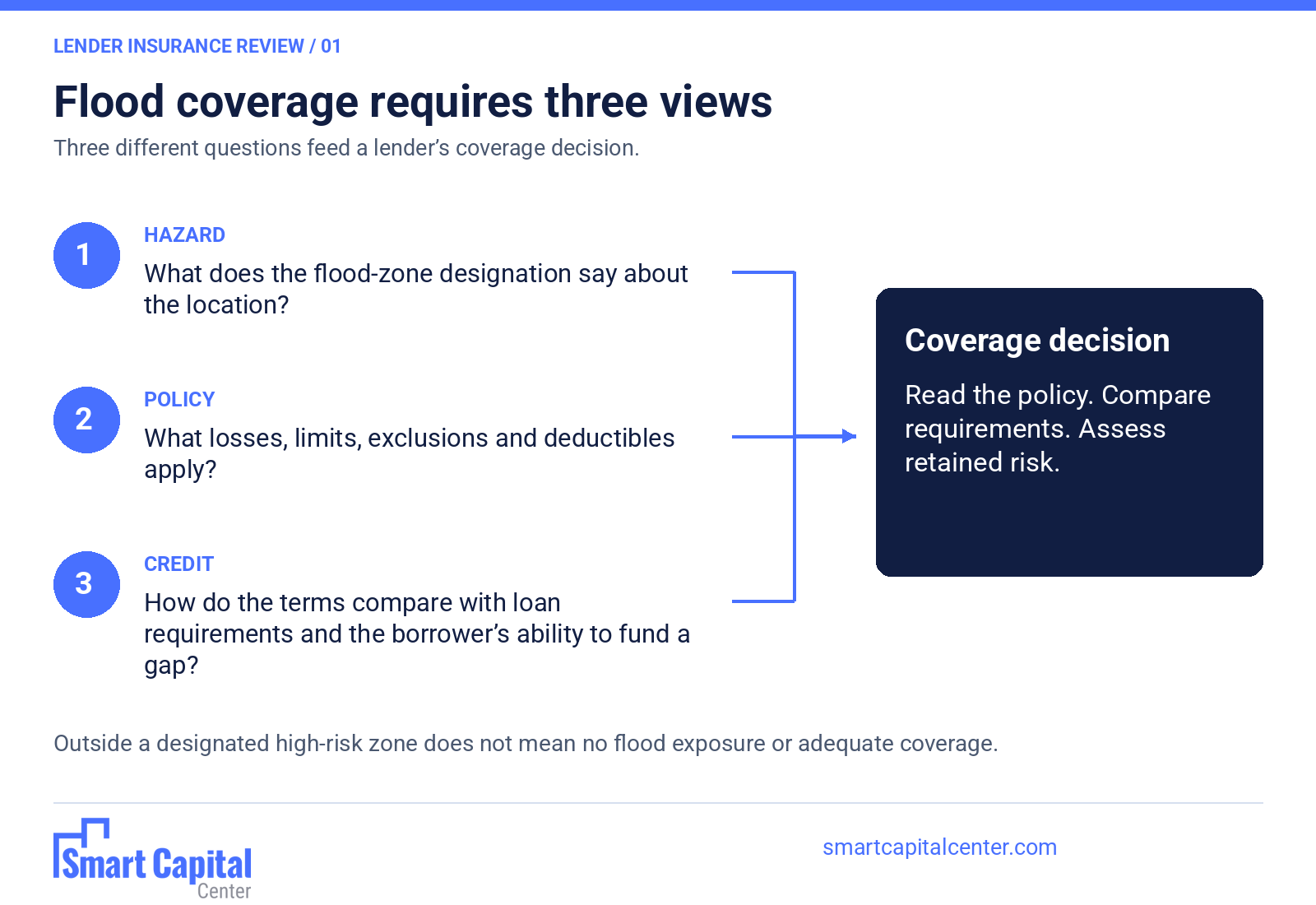
Deductibles are a credit decision when the borrower may not be able to absorb the first loss, Joe Posavec of OSC told the room. Posavec said the insurance market is pushing risk back onto borrowers and lenders. “They’re not in the business of losing money, so they’re going to adjust by increasing premiums, cutting back coverage, and increasing deductibles,” Posavec said of insurers. Posavec’s conclusion for the room: “deductibles are becoming a credit decision.”
The credit question is direct. “In case I have a million-dollar deductible, are they able to absorb the first million of loss?” Posavec asked, and said the credit team has to judge how strong the borrower, guarantor, or sponsor is. Vaccaro agreed that higher deductibles are now common and said they should be discussed with the underwriting team on a new loan before closing.
Hartzog described the strain this puts on lender teams. “There’s more work in the catastrophic coverages for all of the different edge cases and nuances, and there’s more pressure to do it with less,” Hartzog said. Hartzog added that finding a gap and fixing it are different jobs: AI helps with the first, but resolving a catastrophic gap usually means talking with the borrower and the agent about limits and deductibles, which “can start leading to a credit decision and not just an insurance compliance decision.”
Carrier quality is another thing to check. Posavec said some benchmark carriers have stopped offering certain coverages, so newer carriers are filling in. “I’ve seen a few examples where the only thing they have is a Demotech rating,” Posavec said, which matters if a loan requires a minimum A- rating from AM Best, a different rating agency. Posavec doubts the two ratings are equal. A lender that finds this after a loss has little room to respond.
Smart Capital Center helps teams catch these items before closing and at each renewal. The agents read the policy for deductibles, limits, and carrier details, and the team keeps those findings next to the loan’s covenant column and key-date tracking, so the credit team sees the same facts the insurance team does. Every action is logged in the exportable audit trail.
No. A certificate summarizes coverage, while sublimits, exclusions, and deductibles sit in the declarations pages (the policy summary pages that list limits and deductibles) and in the full policy. Hartzog said catastrophic coverage needs the declarations pages and, ideally, the full policy. “A 60 or 70-page contractual document is a lot different than a 1-page ACORD cert with some checkboxes,” Hartzog said. An ACORD certificate is the standard one-page form that summarizes a borrower’s coverage. What keeps Hartzog awake at night is the gap between what the certificate shows and what the policy holds, because sublimits and exclusions are the details a certificate rarely captures exactly. Vaccaro warned against shortcuts: some analysts fall into the trap of saying, “I’m just going to Ctrl+F and search the policy for keywords.” Vaccaro’s rule for new analysts is to make no assumptions, since a standard industry (ISO) form and a custom-written manuscript form can carry the same title. Our ACORD 25 vs ACORD 28 guide explains what each certificate does and does not prove. Smart Capital Center’s agents read the certificate and the full policy together, which gives the analyst a sourced starting point instead of a blank search box.
Posavec added a warning from the compliance side. Posavec’s team has done flood compliance remediation for 12 years, and the work comes “usually right after the regulators come in and have some serious findings.” The first request is always the bank’s written requirements and procedures, and Posavec said lenders often find they are not following their own documents. A written record of how each policy was reviewed gives a lender something to show.
Vaccaro also gave lenders a practical test for borrowers who say coverage is not available. “If we do have a borrower that’s completely struggling to get some type of catastrophic coverage, there’s probably something else going on at that property,” Vaccaro said, pointing to loss history or property condition. Vaccaro pushes back and asks what else is wrong.
Five steps follow from what the panelists described.
Flood insurance requirements for lenders now depend on more than a zone on a map. At MBA’s CRE Insurance Conclave, Scott Giberson of Cotality described flood risk moving from a binary to a spectrum, Joe Posavec of OSC called deductibles a credit decision, and Rachel Vaccaro of Colliers said an exclusion is probably in the policy for a reason. Lenders that read the policy, test the limits, and record each review will find the gaps before a loss does. Smart Capital Center helps lender teams do this work with agents that read the full policy and certificate, so each flood and catastrophic finding traces back to the passage it came from.
Analyze insurance faster. See how Smart Capital Center helps your team read policies and certificates and trace every finding to its source. Book a demo today.
Q: Does commercial property insurance cover flood damage?
A: Commercial property insurance often does not cover flood damage, so commercial property flood insurance has to be confirmed in the policy. Scott Giberson, Principal, Flood Compliance at Cotality, told MBA’s 2026 CRE Insurance Conclave that many multi-peril policies exclude flood when a property is in the special flood hazard area, and Rachel Vaccaro, Assistant Vice President and Insurance Manager at Colliers, said business income is not included by default and has to be confirmed for each catastrophic coverage.
Smart Capital Center’s AI agents read the policy and certificate and link each statement to its source passage, so a reviewer can confirm what the policy says about flood.
Q: Do lenders require flood insurance on commercial property, and what does NFIP flood insurance cover?
A: Commercial flood insurance requirements for lenders start with a federal rule: when a building is in a special flood hazard area in a community that participates in the National Flood Insurance Program (NFIP), the purchase requirement applies to commercial loans from regulated lenders, and the minimum is the lesser of the outstanding loan balance or the NFIP coverage available, which is capped at $500,000 for a commercial building. Beyond that, lenders set their own terms. Joe Posavec, Executive Vice President at OSC, a Steamboat Group company, told MBA’s 2026 CRE Insurance Conclave that non-regulated lenders now write language such as “I don’t care what my max NFIP is, I want to be protected,” and require insurable value to be covered at all times.
Smart Capital Center helps lenders compare what a policy covers with what the loan documents require, with each finding linked to its source.
Q: What is a shaded Zone X flood zone, and does it require flood insurance?
A: Shaded Zone X is the area commonly called the 500-year zone, which FEMA describes as a moderate flood risk. It sits outside the special flood hazard area, so flood insurance is not federally required there but is strongly recommended, and a lender can still require it in the loan documents. Scott Giberson, Principal, Flood Compliance at Cotality, told MBA’s 2026 CRE Insurance Conclave that some policies set different limits for shaded Zone X than for other Zone X properties, so the zone can change the coverage even outside the high-risk area.
Smart Capital Center’s agents read the policy so a team can check the limit that applies to the property.
Q: How should a lender review insurance deductibles on a CRE loan?
A: Treat the deductible as a credit question. Joe Posavec, Executive Vice President at OSC, a Steamboat Group company, said “deductibles are becoming a credit decision” and asked whether a borrower with a million-dollar deductible can “absorb the first million of loss.” Rachel Vaccaro, Assistant Vice President and Insurance Manager at Colliers, said higher deductibles are now common and should be discussed with underwriting before closing.
Smart Capital Center puts the policy findings and the loan’s financial data in one reviewed record, with an exportable audit trail.
Q: What should a lender do when a borrower says catastrophic coverage is not available?
A: Ask what else is wrong with the property. Rachel Vaccaro, Assistant Vice President and Insurance Manager at Colliers, told MBA’s 2026 CRE Insurance Conclave that “if we do have a borrower that’s completely struggling to get some type of catastrophic coverage, there’s probably something else going on at that property,” such as loss history or property condition.
Smart Capital Center’s agents also flag drift across time periods, such as an inspection that noted a condition no one addressed, which helps explain a coverage problem.
Q: Is private flood insurance accepted instead of NFIP on a commercial loan?
A: It depends on the lender and the loan documents. Joe Posavec, Executive Vice President at OSC, a Steamboat Group company, told MBA’s 2026 CRE Insurance Conclave that private flood coverage is growing on commercial loans and that non-regulated lenders now write language such as “I don’t care what my max NFIP is, I want to be protected.” A private policy needs a closer read than a government form.
Smart Capital Center’s agents read the private flood policy and link its limits and exclusions to the source passage, so an analyst can compare them with the loan documents.
Q: How does Smart Capital Center help check flood and catastrophic terms in a full policy?
A: Smart Capital Center’s AI agents read the full policy and the certificate together and write up what the documents say, with each statement linked to its source passage. An analyst can then check the flood limit, any sublimit, and the deductible against the cited text instead of searching the contract. Craig Hartzog, Financial Services Director at Accenture, told MBA’s 2026 CRE Insurance Conclave that “a 60 or 70-page contractual document is a lot different than a 1-page ACORD cert with some checkboxes,” and that complex catastrophic coverages need the declarations pages and ideally the full policy.