


CRE Investors

October 1, 2026
CRE Investors
October 1, 2026
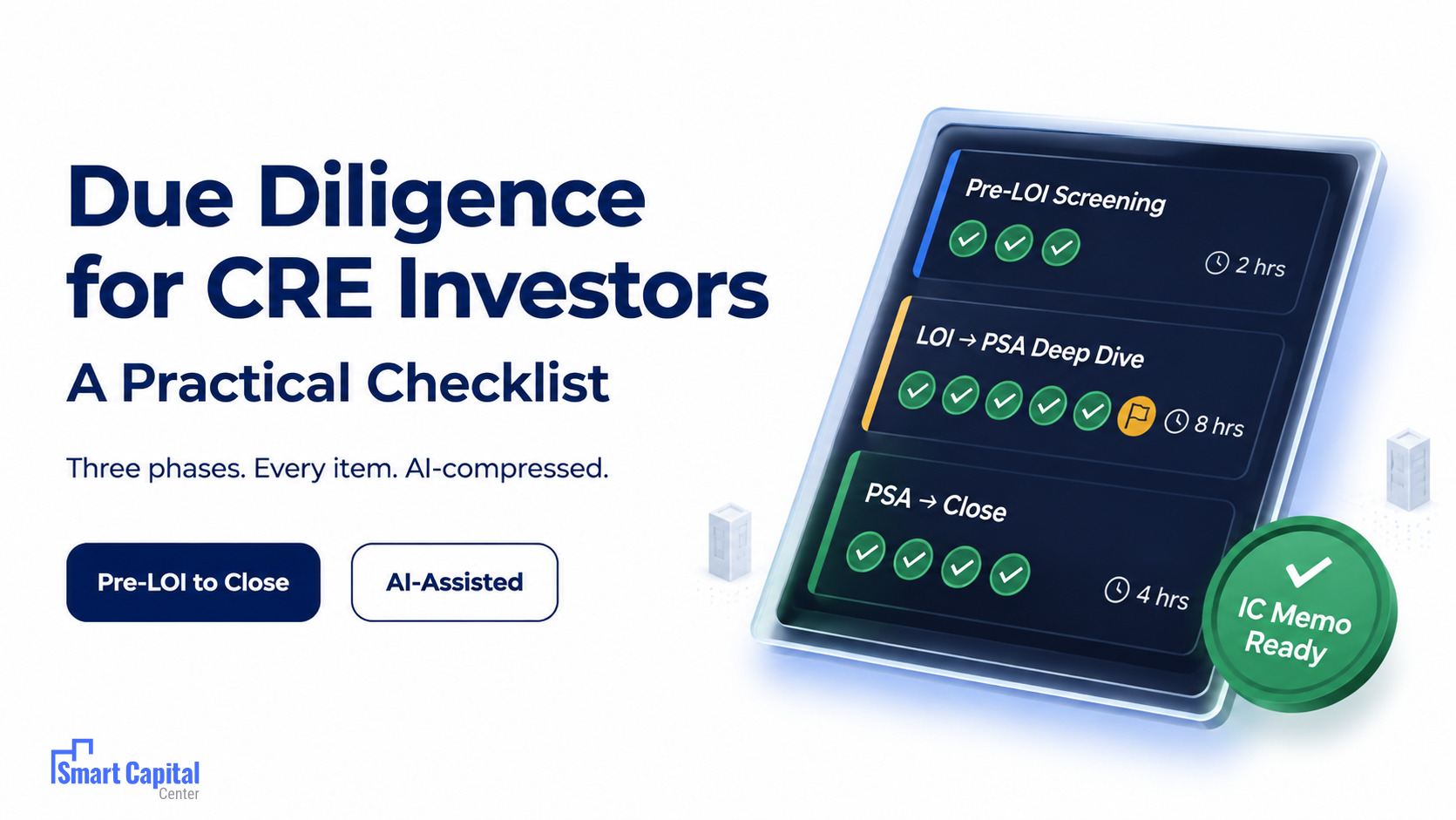
For CRE investors, due diligence is a race against competing bidders. Smart Capital Center compresses the three DD phases, pre-LOI screening, LOI-to-PSA deep dive, and PSA-to-close verification, from weeks into hours, letting acquisition teams evaluate more deals with the same headcount and win more of the ones they pursue. That capacity matters in a market where capital is chasing a limited pool of quality assets. Deloitte's 2026 Commercial Real Estate Outlook shows 75% of European and Asia-Pacific respondents plan to increase investment levels, with approximately $585 billion in dry powder ready for deployment as of August 2025. Speed and rigor together are what separate winning bids from missed opportunities.
Letter of intent (LOI): non-binding document proposing deal terms and triggering the formal diligence period.
Purchase and sale agreement (PSA): binding contract between buyer and seller with closing conditions and the hard diligence deadline before earnest money becomes non-refundable.
Phase I / Phase II ESA: the two levels of environmental assessment. Phase I is a records review and site inspection with no sampling. Phase II, involving soil, groundwater, or air testing, is triggered only when Phase I identifies recognized environmental conditions (RECs).
Capex reserve: the portion of net operating income set aside for capital improvements and equipment replacement, modeled as an annual per-unit or per-square-foot budget.
Investment committee (IC): the formal governance body that approves or rejects proposed acquisitions at institutional investment firms. Every IC memo must be defensible against the verification record produced in DD.
Due diligence for investors is focused on return underwriting: verifying that income assumptions support the projected IRR, equity multiple, and exit valuation. Lender DD adds compliance verification layers like OFAC screening, KYC, and DSCR stress testing that investor DD does not require. The investor’s documentation obligation is to the investment committee and LP investors. The practical implication: investor DD is slightly narrower in scope but operates under tighter time pressure, because competing bids do not wait for a 45-day diligence period to complete before a deal is awarded.

The real estate due diligence checklist for investors maps across three chronological phases. Each phase has a distinct purpose, a distinct document set, and a distinct decision gate.
| Phase | Timeline | Checklist Items |
|---|---|---|
| Phase 1 Pre-LOI Screening |
1–3 days | Review OM financials at face value · Screen submarket vacancy and cap rate range · Verify asking price vs. your cap rate floor · Run sponsor background check · Confirm asset type fits mandate · Decision: submit LOI or pass |
| Phase 2 LOI to PSA Deep Dive |
Days 1–25 |
Financial: T-12 vs. rent roll vs. OM reconciliation · All leases and amendments abstracted · Capex history and reserve adequacy · Budget variance analysis
Market: Executed rent comps (prior 90 days) · Closed cap rate comparables · Demand drivers and supply pipeline · Demographic and migration trends Physical: Property Condition Assessment (PCA) · Roof and HVAC life expectancy · Deferred maintenance schedule Environmental: Phase I ESA · Historical land use review · Phase II triggered if RECs identified Legal: Title commitment · ALTA survey · Zoning verification · Entity structure review · Existing loan payoff or assumption |
| Phase 3 PSA to Close Final Verification |
Days 26–45 |
Confirm all Phase 2 findings resolved or priced · Updated rent roll against any tenancy changes · Insurance certificates received · Final loan commitment or equity sign-off · IC memo finalized and approved · Title policy commitment confirmed · Closing conditions satisfied |
The most consequential verification in CRE acquisition due diligence is the reconciliation step: confirming that the NOI in the OM pro forma is consistent with the NOI derivable from the T-12, and that both are consistent with the rent roll at the same occupancy level. These three documents are produced by different parties at different times. Manual reconciliation consumes 30 to 40 minutes per document and still misses footnote-level modifications that change the economic picture.
Smart Capital Center compresses this from 30–40 minutes per document to 1–3 minutes, with every extracted figure linked to its source line for IC memo defensibility. Comparable transaction data pulls from the platform’s benchmark database, giving acquisitions teams the same first-party comp data that institutional players have historically built over years.
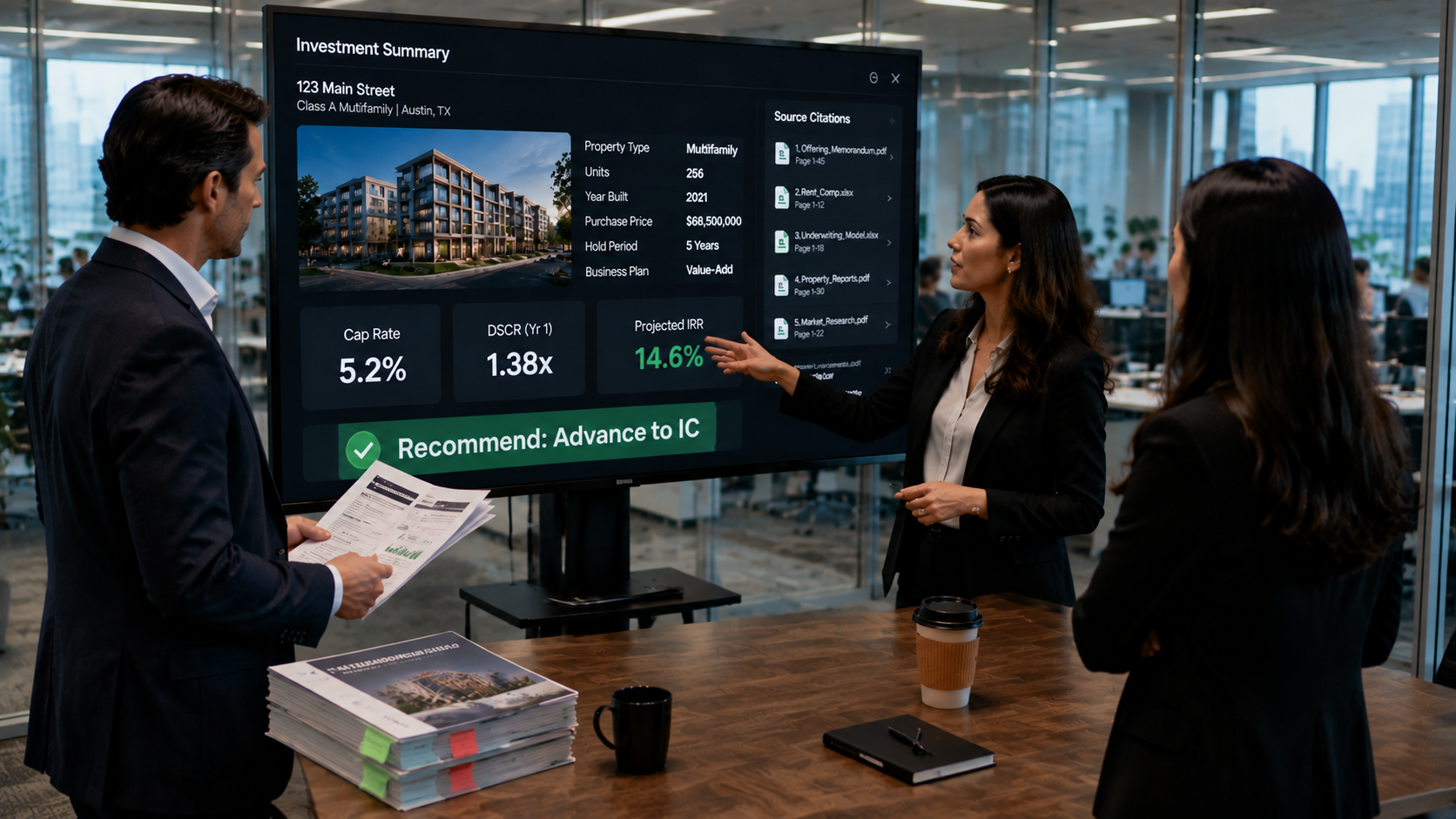
Market due diligence is the layer most subject to convention-based errors. The three most common: using metro-level vacancy data to validate a specific-submarket assumption; accepting rent comps from listings instead of executed leases; and relying on brokerage reports that may be 60–90 days stale. Each produces a model input that is plausible at face value and wrong for the specific asset.
Smart Capital Center’s market intelligence layer queries 1B+ real-time signals across 120M+ properties, filtered to the specific submarket, asset class, vintage, and prior-90-day window.
| Common Mistake | What to Do Instead |
|---|---|
| Accepting the OM pro forma without T-12 reconciliation | The OM is a marketing document. Build every model from the T-12 first, with OM assumptions explicitly compared and gaps documented. |
| Using metro-level comps to validate submarket assumptions | A metropolitan average cap rate or rent growth figure masks local divergence that is material for underwriting. Comps must match submarket, asset class, vintage, and recency. |
| Skipping lease abstracts on non-anchor tenants | Co-tenancy clauses, termination options, and rent escalation structures exist only in the lease documents. One unreviewed clause can change hold-period cash flow significantly. |
| Ordering environmental review mid-diligence | A Phase I that triggers a Phase II with 10 days left cannot be resolved within the PSA timeline. Order Phase I on day 3. |
| Doing full DD on every screened deal | Detailed DD on deals that do not win is pure opportunity cost. Run AI-assisted pre-LOI screening to eliminate no-fits before committing analyst days. |
The MBA’s 2026 CREF Forecast projects $805 billion in commercial mortgage originations for 2026. More deal flow means more diligence cycles, and the acquisition teams winning in this environment are those whose DD process compresses the mechanical steps without reducing analytical depth.
The judgment steps: risk analysis, assumption refinement, and IC recommendation require analyst expertise that AI supports. Smart Capital Center’s platform captures DD data on every analyzed deal, including deals that do not close, making prior deal data queryable for future submarket analysis.
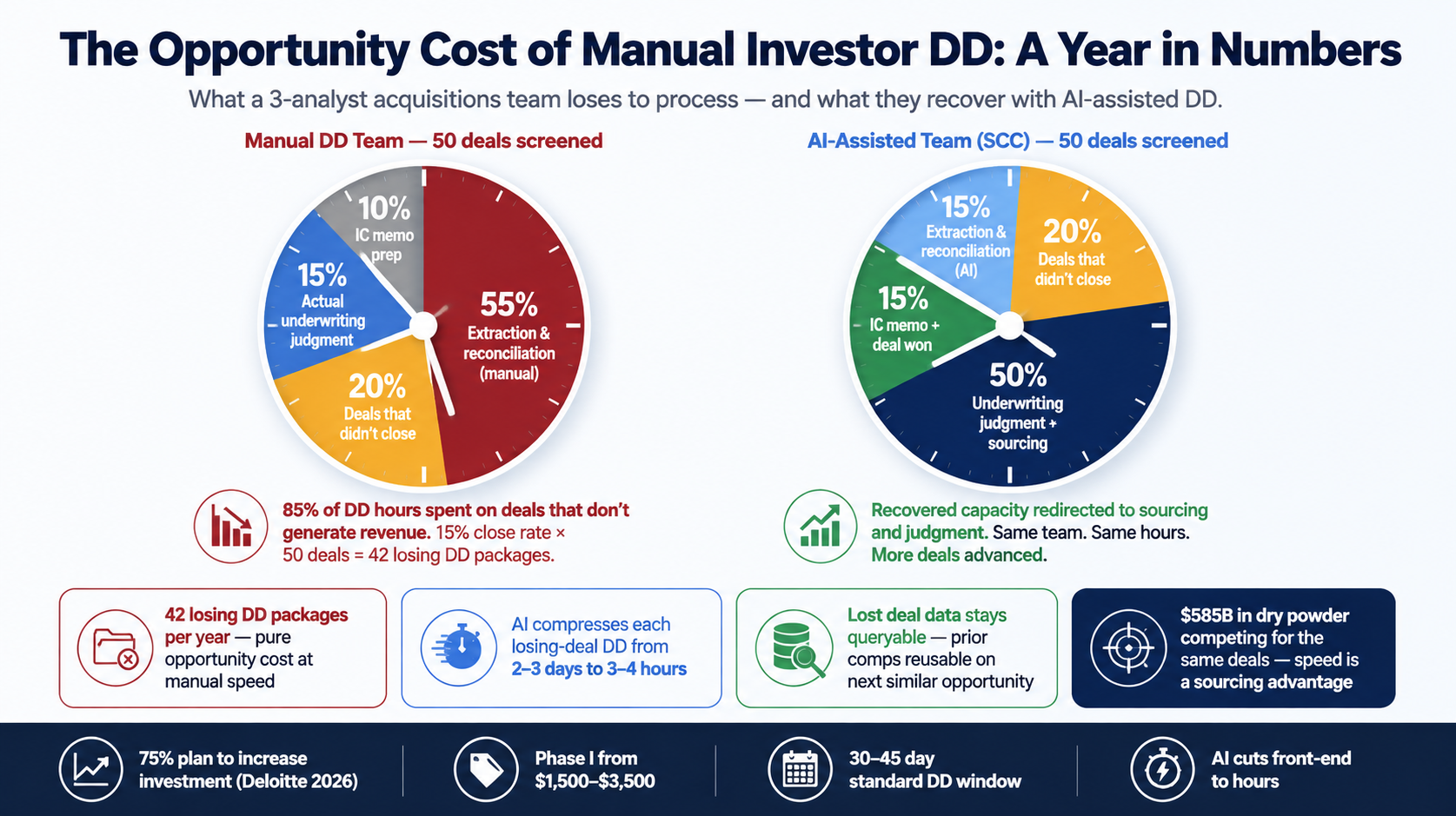
“The sentiment is a net positive even while this uncertainty exists.” – Sally Ann Flood, Vice Chair & U.S. Real Estate Sector Leader, Deloitte. The investors acting on that sentiment are those whose due diligence for CRE investors process is rigorous enough to protect against downside and fast enough to compete against a bidder pool deploying $585 billion in dry powder.
Smart Capital Center compresses financial extraction, cross-document reconciliation, and market benchmarking to a fraction of their manual time, with every figure source-linked and every verified assumption ready to defend in front of the IC.
Evaluate 10x more deals in the same time your team currently spends on one. Book a demo with Smart Capital Center.
The standard investor DD period runs 30 to 45 days from PSA execution. The most analytically intensive work: financial reconciliation, physical inspection, Phase I ESA, and market analysis should be complete by day 20 to leave time for legal review, IC approval, and closing logistics. In 2026, competitive deal timelines are compressing many windows to 21–30 days, making the front-end extraction and reconciliation steps the operational constraint.
A complete real estate due diligence checklist for investors covers: (1) Financial: T-12, rent roll, all leases, capex history, budget variance; (2) Market: executed rent comps, closed cap rate comps, supply pipeline, demographic and migration data; (3) Physical: PCA, roof and HVAC life expectancy, deferred maintenance; (4) Environmental: Phase I ESA, historical land use, Phase II if RECs identified; (5) Legal: title commitment, ALTA survey, zoning, entity documents, existing loan. The complete phase-by-phase checklist is in the table above.
A Phase I Environmental Site Assessment typically costs $1,500 to $3,500 depending on property size, location, and provider. Phase II ESAs, triggered only when Phase I identifies recognized environmental conditions (RECs), range from $8,000 to $50,000+ depending on the scope of testing required. Ordering Phase I on day 3 of the diligence period instead of mid-window is the most important sequencing decision, because a Phase II triggered with 10 days left cannot be completed before the PSA deadline.
Due diligence for investors focuses on return underwriting, verifying that income assumptions support the projected IRR, equity multiple, and exit valuation. Lender DD adds compliance verification (OFAC, KYC, DSCR stress testing) and examiner-ready documentation requirements that investor DD does not include. The investor’s documentation obligation runs to the IC and LP investors. The practical difference: investor DD is slightly narrower in scope but under greater time pressure from competitive bidding.
AI improves CRE acquisition due diligence by automating the mechanical steps: document extraction (30–40 min per statement compressed to 1–3 min), cross-document reconciliation, market comp benchmarking, and concentrating analyst time on the judgment steps that require it: risk analysis, assumption refinement, and IC memo writing. Every extracted figure links to its source document for IC defensibility. Deal data captured on analyzed deals remains queryable on the platform for future submarket analysis, so every completed DD cycle compounds in value instead of disappearing with the deal file.
The constraint in scaling CRE investor due diligence without headcount is the front-end mechanical work: extraction, reconciliation, and benchmarking that consumes analyst time before any judgment is applied. Automating these steps with a platform like Smart Capital Center means the same team can run rigorous DD on significantly more deals, eliminating the triage problem where smaller teams default to abbreviated review on later-arriving opportunities.