


AI in Commercial Real Estate

September 2, 2026
AI in Commercial Real Estate
September 2, 2026

According to the U.S. Census Bureau Vintage 2025 Population Estimates, released January 2026, the United States added just 1.78 million people between July 2024 and July 2025, roughly half the 3.2 million added the prior year, driven by a 54% decline in net international migration. For commercial real estate investors who built acquisition strategies on Sun Belt migration tailwinds, that single demographic inflection point is repricing assumptions across multifamily, retail, and industrial portfolios simultaneously.
This analysis draws on Smart Capital Center – a CRE AI platform that has processed $500B+ in transactions across 120M+ properties, used by JLL, KeyBank, and leading institutional lenders – to identify which commercial real estate demographic data signals investors most commonly miss, and how demographic analysis for commercial real estate expansion changes acquisition and portfolio outcomes.
Real estate demographic data is the set of population-level signals – migration flows, age cohort distribution, household formation rates, income trajectories, and workforce composition – that describe who lives or works in a trade area and how that population is changing over time.
The reason demographics and real estate are so tightly linked is that every CRE asset derives its income from people – tenants who rent space, employees who fill offices, consumers who visit retail properties. A property’s financial performance tracks its trade area’s demographic trajectory over time, whether the underwriting model reflects that or not.
Despite this, most CRE underwriting treats demographic data as a supporting exhibit rather than a core input. The result: acquisition decisions anchored to current occupancy and trailing NOI that are structurally blind to the population dynamics that will determine whether that performance holds, improves, or deteriorates over the hold period.

Commercial Real Estate Demographic Data
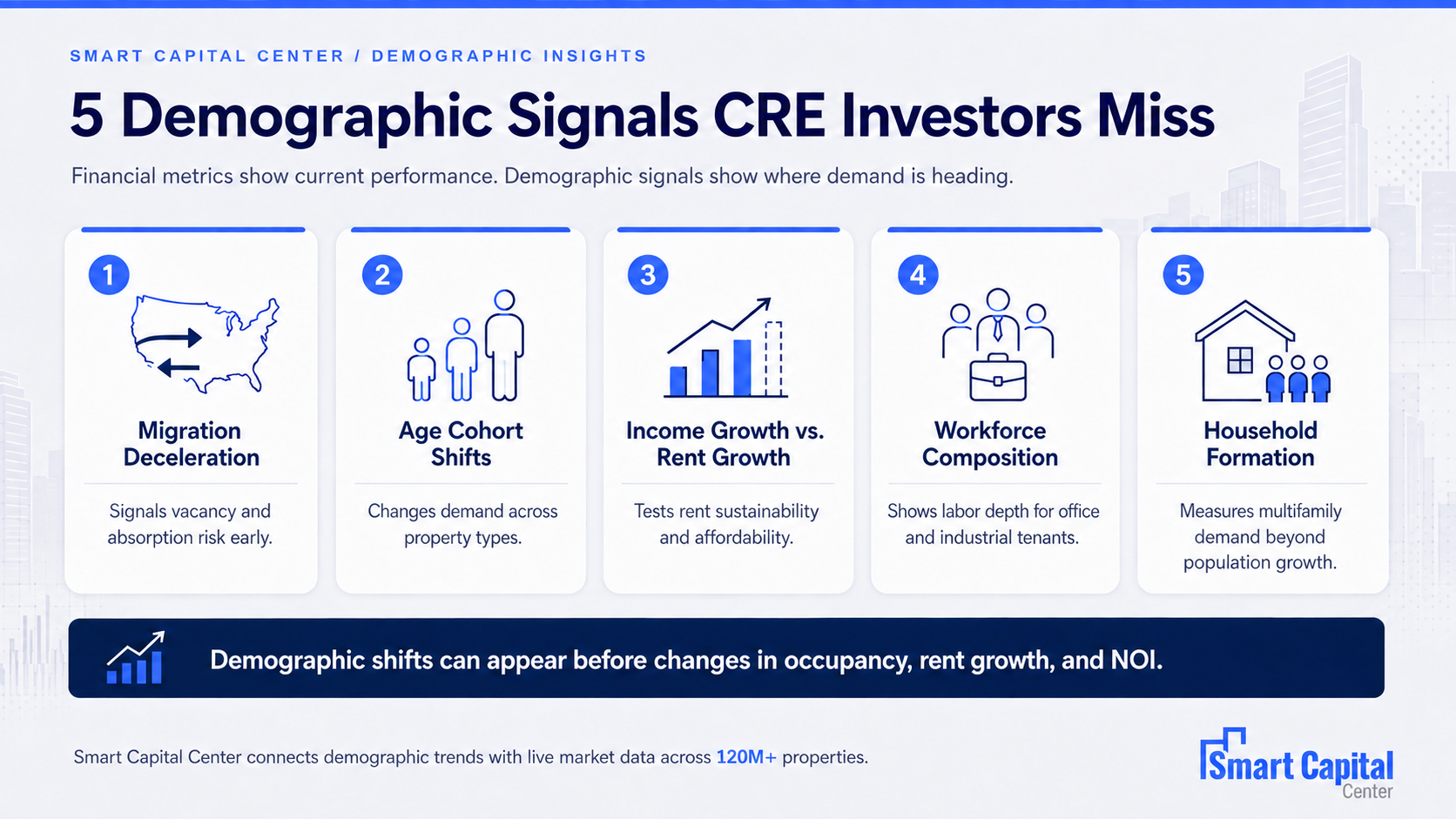
According to Cushman & Wakefield’s Breaking Down the Latest Census Data (April 2025), 11 of the 15 fastest-growing large metros were in the South in 2024. But the same data shows Florida and Texas, the top domestic migration magnets of the prior decade, classified as “balanced” by United Van Lines for the first time, meaning inbound and outbound moves are now roughly equal. A multifamily investor underwriting a Sun Belt property to 2022-era migration assumptions is building a model on a demographic trend that has already normalized. Vacancy does not reflect this for 12 to 24 months. Demographic data does, in real time.
According to the U.S. Census Bureau, by 2030, all baby boomers will be older than 65, so that one in every five U.S. residents will be of retirement age. Simultaneously, Gen Z will comprise 27% of the U.S. workforce by 2025, per Brookings Institution research. These two cohort shifts are moving in opposite directions simultaneously: driving demand for senior housing and medical office on one end, and creating new rental household formation and logistics demand from a digitally native consumption cohort on the other. Investors who analyze a trade area’s age distribution are seeing demand signals that cap rate analysis alone cannot surface.
Median household income is a lagging indicator. Income velocity – the rate at which household income is growing relative to asking rent growth in a submarket – predicts rent sustainability and renewal probability. A trade area where income growth is running below rent growth is accumulating affordability stress that will eventually surface as elevated vacancy or downward rent pressure, regardless of current occupancy levels.
Industrial and office investors routinely underweight workforce composition in demographic analysis for commercial real estate expansion. According to PwC’s Demographic Shifts and Housing Market Impacts (Emerging Trends in Real Estate 2026, November 2025), sharp immigration curtailment in 2024–2025 combined with continued baby boomer retirements is driving working-age population growth to near-1970 lows.
“The tightening of the labor supply is not a temporary cycle — it reflects structural demographic headwinds that will shape workforce availability for industrial and office tenants across most U.S. markets through the end of the decade,” the report states.
For industrial assets dependent on warehouse labor, and for office assets whose tenants compete for knowledge workers, the demographic depth of a submarket’s labor pool is a material underwriting variable that rarely appears in standard deal memos.
Population growth and household formation are different variables. A market can grow in headcount while household formation slows, as happens when young adults delay independent living due to affordability constraints. For multifamily investors, household formation rate is the more relevant demand driver: it determines absorption pace regardless of whether the underlying population is growing.
NAR’s Commercial Real Estate Metro Market Dashboard integrates economic and demographic indicators, alongside net absorption, vacancy rates, and cap rates, across 390 U.S. metros. It is one of the few publicly available tools that makes demographic and commercial market data searchable in a single interface at the metro level.
An investor acquiring a Sun Belt multifamily asset in Q1 2026 using 2023 rent growth assumptions, built when net international migration was running at 2.7 million annually, is underwriting to a demographic environment that no longer exists. With net migration down 54% to 1.3 million annually per the January 2026 Census estimates, the absorption pace that justified those projections has structurally slowed.
Smart Capital Center mitigates this through real-time market intelligence integration: 1B+ signals across 120M+ properties include demographic trend data at the submarket level, so underwriting assumptions reflect current population dynamics rather than the prior-cycle migration surge.
A grocery-anchored retail investor evaluating a trade area with strong population density may miss that the age composition of that population is aging past peak household spending years, or that income levels are insufficient to support the tenant mix in place. Demographic analysis for CRE expansion at the trade area level (not just the metro level) surfaces this misalignment before it appears in same-store sales or renewal probability.
Smart Capital Center’s AI analyst agents extract and analyze tenant-level data from lease abstracts and offering memorandums, combining it with live market intelligence to flag demographic misalignment between a property’s tenant roster and its surrounding population profile.
An industrial lender or investor underwriting a warehouse asset based on current tenant occupancy and historical absorption rates may be building in renewal and expansion assumptions that the submarket’s labor pool cannot support. As working-age population growth hits near-1970 lows per PwC’s Emerging Trends in Real Estate 2026, submarkets with shallow 18–54 labor pools face a structural ceiling on tenant expansion capacity — one that does not appear in trailing vacancy or cap rate data but that bank examiners and sophisticated credit committees are increasingly flagging as a hold-period risk in construction and value-add industrial loans.
SCC mitigates this through workforce composition data embedded in its 1B+ real-time signal layer, giving underwriters a submarket-level read on labor pool depth and demographic trajectory that can be compared directly against a tenant’s stated expansion assumptions in a lease or letter of intent.
Lenders carrying office exposure on their books face increasing regulatory scrutiny of whether CRE concentration risk analyses distinguish between cyclical demand softness and structural demographic-driven demand decline. An office portfolio whose tenants are concentrated in industries with aging knowledge worker bases — law, finance, legacy professional services — and located in markets where 25–44 year-old educational attainment growth has stalled is carrying a fundamentally different risk profile than one in a market with strong Gen Z workforce inflows. Treating all office softness as cyclical, as many reserve and stress-test models currently do, is a demographic analysis gap that regulators and examiners are beginning to probe explicitly in DFAST and concentration risk reviews.
SCC mitigates this through age cohort and workforce composition signals at the submarket level, allowing credit teams and portfolio managers to segment office exposure by demographic trajectory rather than treating all office assets within a market tier as a homogeneous risk category.

1. Define the trade area boundary before pulling any demographic data using a drive-time or walk-time radius appropriate to the asset class (1–3 miles for grocery-anchored retail, 5–15 miles for industrial workforce analysis, submarket boundary for multifamily). National or metro-level data applied to a specific site produces averages that obscure local conditions.
2. Pull population growth rate and household formation rate separately and compare them. A market where population is growing but household formation is slowing signals affordability stress that constrains multifamily demand even as headcount increases. These two figures diverge frequently and are rarely analyzed together in standard underwriting packages.
3. Overlay income velocity against current asking rent levels: calculate the ratio of income growth to rent growth over the prior 24 months. A ratio below 1.0 means rents are growing faster than incomes, indicating affordability compression ahead. Flag this as a hold-period risk in underwriting, not a current-period metric.
4. Analyze the age cohort composition of the trade area against your tenant’s customer profile: retail and multifamily assets perform against the demographic profile of their surrounding population. A mismatch between a retail tenant’s target customer (age 25–44, household income $75K+) and a trade area with median age 58 and income $52K is a structural demand risk that no level of current occupancy can offset indefinitely.
5. Incorporate a 5-year demographic projection alongside trailing 3-year actuals, so the hold-period model reflects where the population is going, not just where it has been. Smart Capital Center’s commercial real estate demographic software integrates current-year and forward-looking population and income signals into the underwriting environment, so projections rest on live data rather than stale census snapshots.
Demographic data does not predict CRE performance on its own. But every significant CRE market correction – the Sun Belt multifamily oversupply of 2024, the gateway city office demand collapse, the retail vacancy wave in aging secondary markets – was visible in demographic data well before it appeared in trailing financial metrics.
The investors caught off-guard were those whose underwriting models treated demographics as background context rather than a forward-looking performance driver. Smart Capital Center’s platform integrates commercial real estate demographic data, alongside 1B+ real-time market signals across 120M+ properties, into the underwriting and portfolio monitoring environment, so demographic signals inform decisions at the moment they are made, not in hindsight.
See what your current underwriting models are missing before the next acquisition closes. Book a demo with Smart Capital Center.
If your underwriting model inputs rent growth, absorption, and cap rate assumptions without a corresponding demographic source for each – population growth rate, income velocity, or household formation – it is working from financial extrapolation rather than demand-side fundamentals. A practical test: identify the single assumption most sensitive to demand and trace it back to a named, dated demographic source. If you cannot, the model has a demographic data gap.
The U.S. Census Bureau’s American Community Survey (ACS) provides annual demographic estimates at the census tract and ZIP code level, making it the most granular publicly available source. NAR’s Commercial Real Estate Metro Market Dashboard integrates demographic and commercial market indicators across 390 metros. For forward-looking migration and age cohort analysis, PwC’s Emerging Trends in Real Estate® demographic research provides the most frequently updated institutional-grade analysis of how population shifts are reshaping demand by region and property type.
Residential demographic analysis primarily tracks household formation, income levels, and age-based homeownership propensity. Commercial demographic analysis is asset-class specific: retail prioritizes trade area population density, daytime population, and consumer spending capacity by income cohort; industrial focuses on workforce depth and labor pool composition; multifamily weighs household formation rate and income-to-rent ratios; office examines knowledge worker concentration and educational attainment. The same demographic dataset requires a different analytical lens depending on the asset class being underwritten.
Annual updates to population growth and income velocity benchmarks are the minimum for a hold-period model. Migration pattern data warrants revalidation more frequently: the 54% single-year decline in net international migration documented in the January 2026 Census estimates illustrates how rapidly the demographic basis for a model can shift. For active portfolio monitoring, Smart Capital Center’s AI agents track market signals continuously, flagging when submarket demographic trends diverge materially from the assumptions embedded in original underwriting.
Markets where household formation is accelerating, income velocity is positive, and labor force growth is outpacing regional averages are showing demand signals that typically precede absorption increases by 12 to 24 months. Investors who identify these leading indicators before vacancy rates compress and cap rates follow can acquire at pricing that trailing financial metrics have not yet justified. Smart Capital Center’s 1B+ real-time signal layer includes demographic trend data at the submarket level, enabling exactly this type of forward-looking market identification.