

AI in Commercial Real Estate

September 9, 2026
AI in Commercial Real Estate
September 9, 2026

According to Colliers' 2026 Commercial Real Estate Outlook, U.S. CRE transaction volume is forecast to grow 15-20% in 2026 as pricing stabilizes and institutional capital returns to the market. More deals means more competition – and in a tighter acquisition environment, the margin between winning and losing a deal often comes down to who moves with more precision, faster.
This analysis draws on Smart Capital Center – a CRE AI platform that has processed $500B+ in transactions across 120M+ properties, used by JLL, KeyBank, and leading institutional lenders – to show exactly where the commercial real estate acquisition process gains the most from AI, and what that looks like in practice.
The PwC and Urban Land Institute's Emerging Trends in Real Estate 2026 report, drawing on insights from over 1,700 investors, developers, and lenders, found that "optimism around buying opportunities is at a 20-year high" – and that the most successful players in the cycle ahead will be those who "combine speed, data-driven insight, and a long-term strategic vision." That combination describes exactly what AI delivers to CRE acquisitions teams.
AI in commercial real estate acquisitions refers to the use of machine learning and automation to support the full deal lifecycle — from screening incoming opportunities to underwriting, investment memo generation, and post-close performance tracking.
Rather than replacing acquisition teams, AI handles the data-intensive steps that slow decision-making:
In practice, this means acquisition teams move from document review to decision-ready analysis in a single workflow, with outputs that remain fully traceable to source documents.
Platforms like Smart Capital Center unify these capabilities into one system, allowing teams to evaluate more opportunities without increasing headcount or sacrificing analytical depth.
The five ways below address each acquisition stage where that friction is highest – and where AI returns the most time to the work that actually requires human judgment.
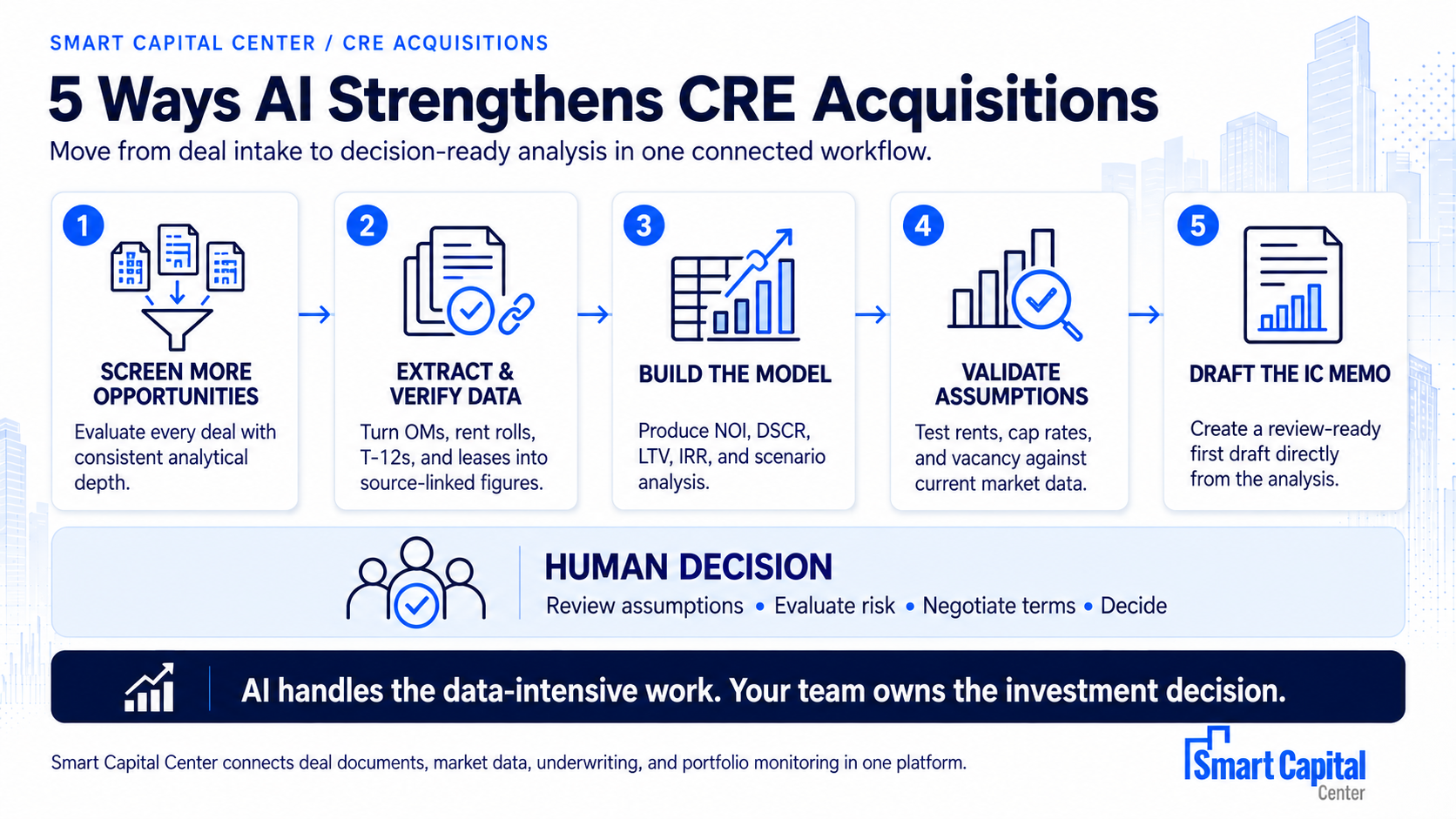
The first advantage AI delivers is at the top of the funnel. Most commercial real estate acquisitions teams pass on deals at screening not because the deal is wrong, but because they lack the bandwidth to evaluate it properly before the window closes. NAIOP's 2025 Market Monitor confirms that private buyers now dominate overall CRE purchasing activity – which means the competition for quality assets at screening stage is wider than it has been in years.
Smart Capital Center's AI agents process an offering memorandum and return a structured preliminary analysis – NOI, DSCR, cap rate, vacancy benchmark, and tenant concentration flag – in minutes. A screening pass that previously cost two to three analyst hours now costs almost none, which means teams can evaluate opportunities that would previously have been deferred on bandwidth grounds alone.
The practical outcome across a typical acquisitions pipeline:

Offering memoranda, rent rolls, T-12s, and lease abstracts rarely arrive in clean, standardized formats. Different property managers use different reporting structures. Scanned PDFs, handwritten annotations, and mid-year lease amendments show up in the same deal package as tidy spreadsheets. In a manual workflow, each inconsistency requires an analyst to interpret and enter – which is where transcription errors compound into model risk.
Smart Capital Center's extraction layer identifies data fields by context rather than template position. It ingests non-standard rent rolls, inconsistent financial statement formats, and partial document sets, then maps each extracted figure to its source line with full traceability. The time difference is significant:
That traceability matters at two specific points: when the acquisition team builds the model internally, and when an investment committee member challenges a figure in the IC presentation.
Once document data is extracted and validated, the underwriting model used to require an analyst to manually build it – calculating NOI from line-item operating data, stress-testing DSCR at multiple debt scenarios, modeling IRR across hold periods and exit cap rate sensitivities. For a complex multi-tenant asset, that is a full day of analyst work before the first assumptions are even reviewed.
Smart Capital Center's acquisition software for commercial real estate automates that build. Rent roll and financial data map directly into customizable underwriting templates. NOI, DSCR, LTV, IRR, and cash-on-cash are calculated automatically. Stress tests run across user-defined scenarios – cap rate expansion, vacancy shock, rent roll-off – without requiring the analyst to rebuild the model for each one.
The result is a complete, investment-committee-ready underwriting package produced in the same session as document upload. Analysts review and refine rather than build from scratch. That shift returns the bulk of a deal day to the work that actually requires human judgment: assumption validation, market positioning, and negotiation strategy.
Every underwriting model rests on assumptions: rent growth, cap rate at exit, vacancy stabilization timeline, market comp validation. In a recovering market – where Colliers projects 15-20% transaction volume growth and conditions are shifting quarter-over-quarter – assumptions pulled from a quarterly data refresh may already be stale by the time the deal reaches the IC.
Smart Capital Center draws on 1B+ real-time market signals across 120M+ properties, including submarket vacancy trends, comparable transaction data, rent benchmarks, foot traffic patterns, and public transit quality scores. These signals update continuously, not on a scheduled refresh cycle. When an acquisition team validates a cap rate assumption or a rent growth projection in Smart Capital Center, the comparable set reflects current conditions – not what the market looked like when the last data pull ran.
This matters most in two scenarios: fast-moving submarkets where conditions shift quickly between LOI and closing, and secondary markets where publicly available comp data is thin and a stale sample can distort the cap rate by 50 basis points or more.
The investment memo is where the acquisition win gets made or lost internally. A compelling, well-structured IC presentation accelerates internal approval and signals to the seller's broker that the buyer is serious and prepared.
Building an IC memo manually – after underwriting is complete – is typically a half-day to full-day task. Smart Capital Center generates a complete investment memo directly from the underwriting model in minutes. The output includes:
Output is configurable to the firm's IC template format, so the memo a partner reviews matches the format the committee expects – no reformatting required. The acquisition team that presents a polished, fully modeled IC package two days before competitors are still building their spreadsheets has already changed the dynamic of the deal.

Deploying AI in the commercial real estate acquisition process introduces three specific risks worth addressing before full integration.
AI systems draw confidence from data volume. In secondary and tertiary markets where transaction density is low, an automated cap rate or rent growth figure can look precisely calculated while resting on very few comps.
Smart Capital Center's proprietary data lake accumulates submarket benchmarks from every document analyzed across the platform – expanding coverage in markets that traditional comp databases underserve – and surfaces data depth indicators so analysts know when to apply conservative judgment to AI outputs.
A deal underwritten in January and reaching committee in March may reflect a market that has moved. Smart Capital Center's live data layer keeps market-referenced figures current through the full deal cycle rather than anchoring to conditions at initial screening.
When a model builds itself from extracted data, a misread figure in the source document – a net rent entered where gross was intended, or an occupancy rate from an expired lease – can flow through the entire underwriting without triggering a visible error. Smart Capital Center's exception management flags figures that fall outside user-defined ranges for analyst review before they reach the IC package.
Not all AI tools improve acquisition outcomes. The difference between a productivity gain and a workflow disruption comes down to how the platform performs under real conditions.
Use these five checks to evaluate any AI solution:
Upload a real offering memorandum, rent roll, and T-12 from your pipeline – especially non-standard formats. The platform should correctly extract tenant-level data, lease terms, and operating figures without requiring manual cleanup.
Ask when comparable sales, rent benchmarks, and vacancy data were last updated. Platforms relying on periodic refresh cycles introduce lag into underwriting assumptions.
Generated memos should align with your firm’s internal structure. If analysts need to reformat outputs before submission, the platform is adding friction rather than removing it.
Select a figure – NOI, DSCR, or tenant rent – and verify it links directly to a specific line in the source document. Without a clean audit trail, outputs are not defensible at the investment committee level.
The underwriting model should not live in isolation. Deal data must carry forward into portfolio monitoring so actual performance can be measured against acquisition assumptions without re-entry.
Smart Capital Center meets all five criteria, combining document extraction, underwriting, real-time data, and portfolio monitoring in a single platform with full traceability.
AI improves the commercial real estate acquisition process by increasing deal throughput, accelerating underwriting, and standardizing decision-making.
By automating document extraction, model building, and investment memo generation, acquisition teams can evaluate more opportunities within the same timeframe while maintaining consistent analytical depth.
This leads to:
As more firms adopt AI across sourcing, underwriting, and asset management, the advantage shifts from isolated efficiency gains to a more scalable acquisition process built on consistent data and faster execution.
Acquisition teams do not lack opportunities – they lack the capacity to evaluate them.
Smart Capital Center combines AI-powered document extraction, real-time underwriting, and continuous portfolio monitoring in a single platform.
See how your current acquisition process compares.
Book a demo with Smart Capital Center and evaluate your next deal in a single session.
How can I integrate AI into my CRE acquisition process without disrupting existing workflows?
Start with document extraction on deals already in your active pipeline. Smart Capital Center imports existing underwriting templates and maps extracted data directly into them, so the analyst reviews AI-built outputs in the same format they already use. The workflow change is additive – AI handles the extraction and model-building front end – rather than requiring teams to adopt a new methodology.
What documents can I send to AI acquisition software for commercial real estate?
Smart Capital Center processes offering memoranda, rent rolls, trailing 12-month financial statements, lease abstracts, appraisals, environmental reports, and prior investment memos. The extraction model handles standard and non-standard formats, scanned PDFs, and multi-tab spreadsheets without requiring manual preprocessing.
How much faster will my commercial real estate acquisition process become with AI?
Financial statement extraction drops from 30 to 40 minutes per document to under 3 minutes. Full underwriting packages that previously required three to five business days complete in a single session. Investment memo generation shifts from a half-day to full-day drafting cycle to minutes. Across a typical deal cycle, Smart Capital Center users report 50% faster deal execution – meaning two deals can close in the time one previously required.
How do I evaluate whether AI outputs are reliable enough for my firm's underwriting standards?
Run a parallel test on a recently closed deal: upload the original documents, compare AI-extracted figures against your team's final model, and review any discrepancies. The gaps you find reveal exactly where the platform performs well on your document types and where analyst review remains essential. Smart Capital Center's exception management layer is designed specifically to make those review points visible rather than hiding them in an output that looks clean.
What happens to my deal data after the acquisition closes?
In Smart Capital Center, deal-level data flows directly from the acquisition underwriting model into post-close asset management tracking – NOI, DSCR, lease expirations, and covenant thresholds monitored continuously against the original investment assumptions. This means the thesis you underwrote at acquisition is the same benchmark that tracks actual performance, without re-entering data at closing.