


CRE Investors

November 20, 2026
CRE Investors
November 20, 2026

Smart Capital Center heard special servicers and investors at the CRE Finance Council’s June 8 to 10, 2026 conference explain why distressed commercial real estate, especially office, reaches workout: one speaker described a $15 million restabilization need against $2 million of reserves that would be gone within six months.
Lenders and investors often learn that an office building needs a new roof, a new elevator, or a rebuilt parking garage after the loan is already late. The capital expenditures (capex), which are the large repair and replacement costs, were never counted properly. By then the reserve covers a small part of the bill, tenants are leaving, and the choices are narrow. This article explains how capex gaps and weak property assumptions push loans into workouts, how workouts differ by property type, and how to test assumptions while a loan is still performing.
The material comes from the CRE Finance Council’s June Conference in New York on June 8 to 10, 2026, where special servicers, rating analysts, bond investors, and portfolio lenders spoke across several panels. Named speakers include David Harrison, chief operating officer and head of special servicing at Midland; Lindsey Wright, managing director at KKR and CEO of KStar, its special servicing and direct lending credit asset management team; Leslie Hayton, head of CMBS Asset Management at Trimont; Harris Trifon, partner and portfolio manager at Lord Abbett; and Bill Clarkson of Torchlight Investors. Speakers whose names the recordings do not confirm are described by role. For the wider themes of the event, see our CREFC 2026 takeaways.
Smart Capital Center’s AI agents help teams catch these gaps earlier by reading inspection reports, appraisals, and financials together. Right after the first section below, we show how the agents flag capex that an appraisal promised but the financials never show, and how investors can bring their own leases and budgets into the underwriting and see capex in projected cash flows and the discounted cash flow (DCF) model.
The Federal Reserve’s November 2026 Financial Stability Report said a substantial amount of non-agency commercial mortgage-backed securities (CMBS) debt matures in late 2026, and that forced sales could push prices lower if borrowers cannot refinance. The report also said lenders’ willingness to extend or restructure loans has helped limit that risk, and that capitalization rates have risen sizably from their 2022 lows.
Special servicing is the stage where a specialist firm takes over a CMBS loan that has defaulted or is about to. A moderator at the conference put the share of loans in special servicing at about 11.5 percent, with large volumes. One special servicer said new transfers still come mostly from office, followed by retail, with multifamily and hotels well behind.
Headline rates only go so far. The more useful question is why loans end up there, and speakers kept returning to two causes: reserves that were too small, and property assumptions that were too hopeful.
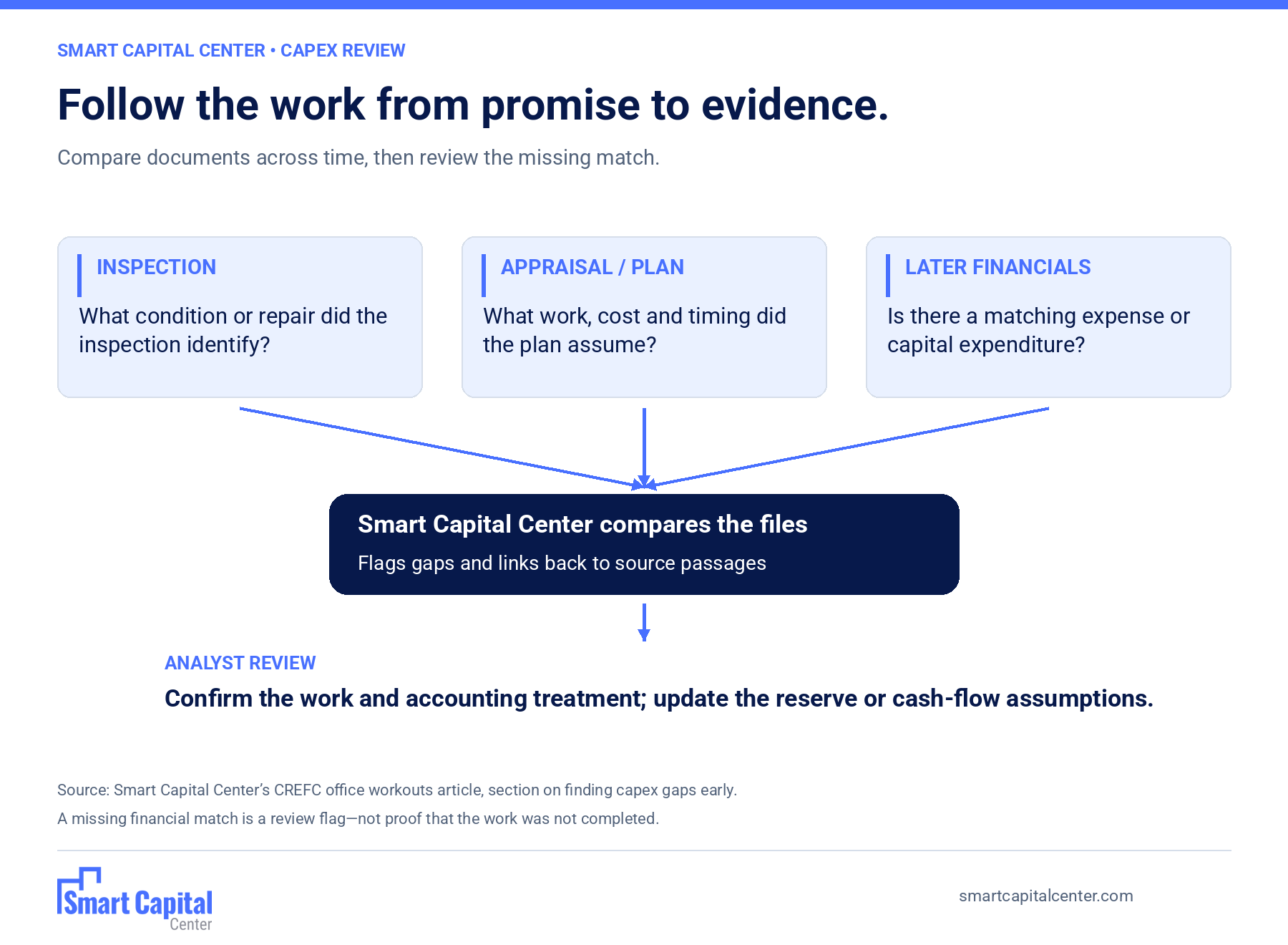
Capex gaps are easiest to fix before a loan is late, and the evidence usually already sits in the files. The inspection report names the roof. The appraisal promised capex. The financials show whether the money was spent. Smart Capital Center’s AI agents read those documents together and compare them, so an analyst sees the gap without reading every page again.
Two checks matter most for this problem. The agents flag when an appraisal promised capex that never appears in the financials, and when an inspection noted a deteriorating condition that no one addressed. Every conclusion links to the source passage, so an analyst can confirm it in one click and keep an audit trail. JLL saw a 30x productivity gain for the asset management team with Smart Capital Center’s AI.
For investors, the same files feed the underwriting. Teams bring their own leases, inspection reports, and budgets, the agents read them into the model, pull comparables from more than 1 billion live market data points across more than 120 million properties, and build projected cash flows and a DCF model. When a reserve or a cost assumption changes, the team runs the scenario again and sees the effect on returns.

A property condition report (PCR) is an engineer’s review of a building’s systems and the cost of repairs. One speaker said part of the problem in CMBS is what they called “fake PCRs where they’re not actually identifying the needs up front and you’re not reserving adequately.” A buyer gets an equity PCR and a lender gets a lender PCR, the speaker noted, and the two are very different documents. Our guide to equity-level versus lender-level property condition scope covers that difference in detail.
The same speaker was direct about who pays for the gap: “You’re not doing the property owner a favor by pretending that it doesn’t need a new roof.” Walking through a tenant space and seeing leaking ceiling tiles shows the need is real now, not in year five.
The cost of getting it wrong shows up in leasing. Another speaker described properties where markets had turned and leases were available to sign, but they cost money to complete. “There’s no money in reserves,” and getting to title takes time, so some tenants are gone by the time the servicer controls the property. A third speaker put a size on it for hotel and office assets: a need of $15 million to restabilize a property against $2 million of reserves that would be gone within six months.
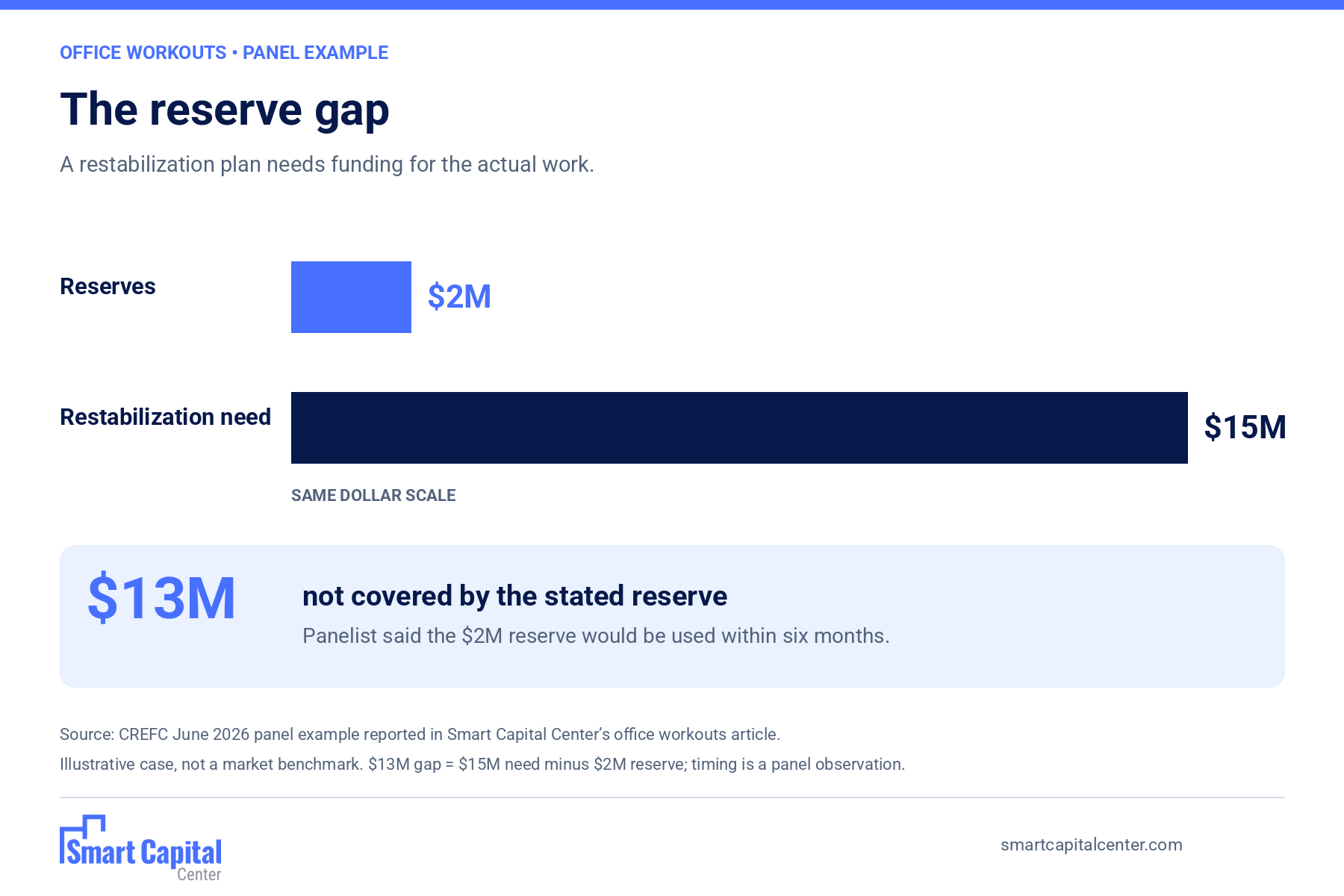
Standard reserve figures can also fall behind costs. A $250 annual capex figure drew this reply from the room: “I can’t buy a faucet for $250.” A different speaker said reserves of about $2 a square foot on office are not enough. A credit investor on another panel said capex is more expensive than anyone expected, and that the safest credits avoid “massive CapEx cycles like what we saw in Office four years ago.”
Figures are as stated by conference panelists and are examples, not market benchmarks.
The second theme was optimism in the pro forma, which is the projected income and expense for a property. Credit teams were told to adjust for it: “if you’re seeing top line growth think about the other lines that should be growing alongside.” If rents grow in the model, then expenses, insurance, taxes, and capex should grow too, and the refinance test at maturity should use those figures.
Hotels show the same gap. Lenders used to hear that a property improvement plan (PIP), the renovation a franchisor requires, was not due until the franchise expires in 15 years. Those days are gone, one speaker said, because franchisors now want renovations every three to five years. That cost belongs in the underwriting from day one.
Office carries a bigger question. On the asset class itself, a speaker noted that office has already faced work from home and could face headwinds from AI and a smaller general need for office space. “We’re probably in the first inning of that.” Another speaker added that buyers are plentiful for distressed office in secondary markets and scarce for stabilized ones, so a seller who spends to fix a building may not be better off at sale. A pro forma that assumes steady office demand carries more risk than it appears to.
Not every loan story was a warning. One speaker described a class C apartment property from the 1970s in Houston that looked poor in the photos. The speaker’s firm worked with the lender, met the sponsor, and agreed to take the loan with a significant change to the reserve: $600 a unit instead of $250, with a good portion funded up front.
Debt yield, which is a property’s net operating income divided by the loan amount, was 9.3 percent at the start and is now 14 percent. The explanation: “the reason it is doing well and outperforming is because it’s continually been using that capital.” The site inspection shows the improvements and the sponsor’s plans, and the sponsor, the speaker added, did not like seeing cash sit in a non-interest-bearing account. One loan is not a trend, but it shows what a lender gets when the reserve matches the work.
Once a loan reaches a special servicer, the property type shapes the plan. Bill Clarkson of Torchlight Investors said “the office modifications in workouts are totally different from multifamily and retail in most cases.” The reason, Clarkson said, is capital. In office, “there’s an immediate sort of need to recognize value degradation there if you’re going to bring new capital in,” and the solutions are more creative and usually take longer. Multifamily has cash flow, so an operational problem is easier to fix.
A/B note structures are back as a result. An A/B note splits a loan into a senior A note and a subordinate B note. A second special servicer on the panel said requests for them are showing up for office and creeping into multifamily, but “you need a value prop for that structure to work,” such as new leasing that lifts value so the parties can share the upside. The same special servicer could not see how the structure works for assets with daily leasing and one-year apartment leases.
Sponsors are also meeting a different process than they expected. Collateralized loan obligation (CLO) lenders can be flexible on short-term and programmatic extensions, so a sponsor who has done several CLO workouts may be confused when a CMBS workout looks different. A third special servicer said liquidations are rising year over year as workouts reach the end of their natural life cycle. Legacy retail defaults from the COVID period have run their four-to-six-year cycles, and resolutions are now coming through.
Observations are from conference panelists, described by property type.
David Harrison of Midland said a modification should be tied to the capital the sponsor will commit. “You’re not going to do a free mod. There’s got to be a reason to extend it,” Harrison said. For loans written at low rates with no principal payments that now face higher rates in a challenged asset class, Harrison described two realistic paths: an accretive modification, which can include a note sale with an assumption, or a liquidation. “Nobody wants a brutal liquidation. Nobody wants a frivolous modification extension.”
Harris Trifon of Lord Abbett, speaking as an investor, said the lines between strategies blur. “Forbearance, if you really think about it intrinsically, is about a liquidity issue,” Trifon said. “Modification is effectively a solvency issue.” Trifon said some servicers reach for forbearance first as a temporary fix, and that “what starts as a short term 30 day or 60 day forbearance has a sneaky way of extending out.” Leslie Hayton of Trimont, speaking as a master servicer, described how the Trimont team tries to shape borrower behavior early. A short forbearance is “quite expensive and punitive for a borrower” if the loan ends up in special servicing anyway, and Trimont makes that cost clear up front.
Lindsey Wright of KKR, who runs KStar’s special servicing team, agreed that forbearance has a place, with a condition: “you only do a forbearance if you know there is a resolution that you’re getting to.” The end of the road should be a sale, a cure, or a refinance, with benchmarks along the way. The pattern across both views is that a modification needs new capital and a realistic value, and a forbearance needs a defined exit. Both depend on knowing the true cost of the building, which brings the discussion back to reserves.
Five steps follow from what the panelists described.
Many office loans reach workouts when the building needs more than the reserve holds and when the pro forma assumes growth without the costs that come with it. Panelists at the CRE Finance Council conference described the same pattern from several sides: reports that do not name the real needs, standard figures that costs have passed, and modifications that only work with new capital. With loans maturing in late 2026, finding these gaps early matters more than finding them in a workout.
Analyze capex and reserves faster. See how Smart Capital Center helps your team catch capex gaps and weak assumptions before a loan reaches a workout. Book a demo today.
Q: What is a loan workout in commercial real estate?
A: A loan workout is the process of changing or resolving a commercial loan that the borrower cannot repay on its original terms. Panelists at the 2026 CRE Finance Council conference described several paths: a short-term extension, a modification, a forbearance, a note sale, or liquidation. David Harrison, chief operating officer and head of special servicing at Midland, said a modification should be tied to new capital from the sponsor.
Q: What happens when my CMBS loan goes to a special servicer?
A: A special servicer takes over a CMBS loan after it defaults or is about to. David Harrison, chief operating officer and head of special servicing at Midland, said the first job is to understand what caused the transfer, then choose a resolution such as a modification, a sale, or liquidation. Harrison said special servicers work to find the most accretive resolution.
Q: What is the difference between forbearance and a loan modification?
A: Harris Trifon, partner and portfolio manager at Lord Abbett, said forbearance addresses a liquidity issue, while a modification addresses a solvency issue. A forbearance is a temporary pause that should lead to a defined resolution. A modification changes the loan terms and usually requires new capital from the sponsor.
Q: What is a property condition report and why does it matter for reserves?
A: A property condition report is an engineer’s review of a building’s systems and the cost of repairs. One speaker warned that “fake PCRs” fail to identify needs up front, which leaves loans under-reserved and, in that speaker’s view, leads to losses. Comparing the report with the capex plan and the reserve is one of the earliest checks a lender or investor can run.
Q: How much capex reserve do I need on an office loan?
A: No single number fits every property. Speakers said a $250 annual capex figure and about $2 a square foot for office are no longer enough, and one lender funded $600 a unit, mostly up front, on a 1970s Houston apartment loan that is now outperforming. The right amount comes from the condition report and the cost of the work.
Q: How does Smart Capital Center help with capex gaps and distressed loans?
A: Smart Capital Center’s AI agents read inspection reports, appraisals, and financials together, flag capex that was promised but never spent, and link every conclusion to its source passage. Investors can bring capex into projected cash flows and a DCF model, then run scenarios when reserves or costs change. Teams see the gap while the loan is still performing.