


CRE Investors

November 20, 2026
CRE Investors
November 20, 2026

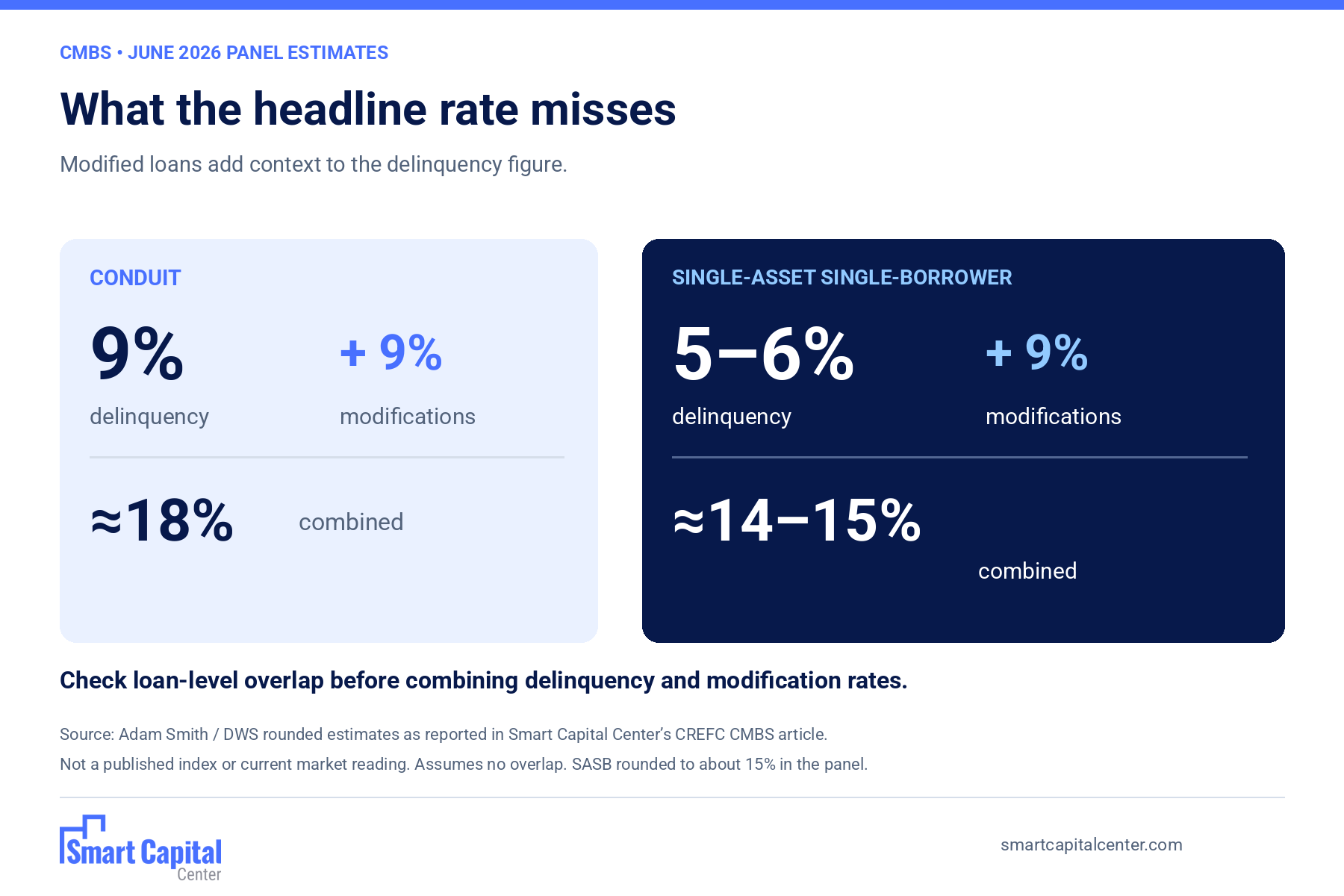
Smart Capital Center heard Adam Smith of DWS tell the CRE Finance Council’s June 8 to 10, 2026 conference that, by his rounded math, about 18 percent of conduit CMBS loans are delinquent or modified, double the roughly 9 percent conduit delinquency rate.
A commercial mortgage-backed securities (CMBS) investor who checks the delinquency rate sees one number. That number leaves out loans already modified or extended, ratings that change after the loan has weakened, and recovery rules that can pay bondholders in an order they did not expect. By the time a downgrade arrives, the signs are often already in the loan files. This article explains what the CMBS delinquency rate does not show, why single-asset single-borrower (SASB) downgrades matter to every investor in the sector, and how to monitor a position before a rating agency does it for you.
The material comes from the CRE Finance Council’s June Conference in New York on June 8 to 10, 2026, where bond investors, portfolio managers, and market participants spoke across several panels about delinquency, ratings, and transparency. Named speakers include Adam Smith of DWS, who oversees the CMBS portion of its portfolio; Michael Mesard, portfolio manager at BlackRock; Britt Johnson, head of Fitch’s CMBS surveillance team; Leslie Hayton, head of CMBS Asset Management at Trimont; and Harris Trifon, partner and portfolio manager at Lord Abbett. Remarks from speakers the recordings do not confirm are attributed by role.
Smart Capital Center’s AI agents help teams watch these signals sooner. They read loan documents, appraisals, inspection reports, and financial statements together, flag where later figures drift from earlier promises, and link each conclusion to its source passage. A later section explains what that looks like in practice.
Smith opened the discussion with a market that looked calm from the outside. Supply was keeping pace with the prior year and spreads, which are the extra yield investors earn over a benchmark, were close to flat. Underneath, Smith said, delinquencies were rising. Smith put delinquency in conduit deals, which pool loans on many properties, near 9 percent, and in SASB deals, which hold one loan on one property or portfolio, near 5 percent.
The more useful point was what those rates leave out. Smith explained that the delinquency rates look lower in part because of “high modification rates,” since issuers can buy troubled loans out of a deal and modify them. Smith put modifications at roughly 9 percent and added them to delinquencies. By Smith’s rounded math, that is about 18 percent of conduit loans and about 15 percent of SASB loans. “1 out of every $5 lent in the CMBS space is having trouble meeting their debt service obligations,” Smith said.
The Federal Reserve described the same pattern from the outside. Its November 2026 Financial Stability Report said the level of distressed sales in CMBS has remained low even as many loans approach maturity, and that lenders’ willingness to extend or restructure maturing loans has helped mitigate the refinancing risk. The report also noted that non-agency CMBS are a small part of total commercial real estate debt. Extensions and modifications keep loans out of foreclosure, and they also keep them out of the headline rate. An investor who reads only the headline sees the calm and misses the work that produced it.
Figures are one panelist’s rounded estimates from a conference slide, not a published index. Adding the two rates assumes no overlap.
Smith described a gap between how new deals and older deals are priced. “New issue pricing is based on zero delinquencies,” Smith said, while seasoned deals trading off the run are seeing wider spreads. A new deal starts with a clean record. A deal two or three years old carries whatever has happened to its loans since.
Mesard of BlackRock described the same spread of outcomes inside the new issue market. “We’re definitely seeing a very large amount of dispersion between just the quality of the deals,” Mesard said, with excellent properties and much tougher collateral priced in the same market, especially in SASB. Mesard called the technical backdrop strong, with yield attracting buyers back to fixed income, and was equally clear about the other side. “We did have some high profile AAA bonds that actually took losses,” Mesard said, and so “you do obviously need to go behind the scenes, do your work, do a lot of diligence.”
The takeaway for an investor is that a tight spread describes demand for the product. It does not describe the loan under the bond. Smith made the same point about conduit deals, where pools have been getting smaller and more concentrated: “diversification is your friend in the conduit space.” If one loan goes bad, it can hurt many holdings at once.
One panel focused on the SASB market, where a panelist said about one in four deals has been downgraded since 2021. Thirty-five SASB deals that carried an original AAA rating, the highest rating, are now rated below investment grade, and two of them have suffered losses. The panelist said more than a dozen others could see shortfalls reach the AAA class. Many of the loans are already modified, which raises questions about how long they stay in the deal and how they will be resolved. “It’s a slow moving train wreck that will continue to be in the headlines,” the panelist said.
The effect reaches past the bonds that are hurt. A second panelist said “the downgrade invites scrutiny from risk management.” A portfolio manager can see the headline and then receive questions from the risk team. The panelist said that reaction can affect how much an investor allocates to the sector.
Underwriting was not tightening in response. A panelist said trends seemed to be getting more aggressive, and “you’re seeing more I O and less structure,” meaning more interest-only loans, which pay no principal, and fewer protections built into the deal. Another panelist, on a separate panel, put the cause plainly: when the most aggressive underwriting wins the loan, “we underwrite ourselves into the wall.”
Observations are from conference panelists and are not independent market statistics.
A downgrade is a late signal. The earlier signals sit in documents the team already has: an appraisal that promised capital spending, an inspection that flagged a problem, financials that show whether income held, and a loan agreement with dates and covenants. Smart Capital Center’s AI agents read those documents together and flag drift across time periods, such as capex an appraisal promised that never appears in the financials, or a deteriorating condition in an inspection that no one addressed.
Asset Management teams can also track covenants and key dates in one place. The platform calculates covenant tests, tracks maturity and other key dates, and writes sourced summaries where each statement links to the passage it came from. An analyst clicks through to confirm, and the team can export the audit trail for a credit committee or a risk review. JLL saw a 30x productivity gain for the asset management team with Smart Capital Center’s AI.
For investors, the same files feed the underwriting. Teams bring their own documents, the agents read them into the model, pull comparables from more than 1 billion live market data points across more than 120 million properties, and build projected cash flows and a discounted cash flow (DCF) model. When a vacancy, expense, or maturity assumption changes, the team runs the scenario again and sees the effect on returns. Smart Capital Center supports the team’s own review of the loan files. It does not replace trustee reports or rating agency research.
Smith showed how ratings have changed over time in a slide of rating migration, which tracks how many bonds move from one rating to another. Since the global financial crisis, Smith said, the AAA class had largely held, but the lower classes had not: “more than half the triple B minuses fell from IG,” meaning below investment grade. Triple-B minus is the lowest investment-grade rating, so those bonds fell out of the range many investors intended to hold. Smith’s reading was blunt: “the ratings methodology is flawed at the outset.” Whether or not an investor agrees, the numbers explain why rating-sensitive money should not treat a rating as the whole credit view.
A panelist on another panel added that the rating agencies are paid by the originators, which is why “it’s really buyer beware.” The same panelist offered a counterpoint: “downgrades don’t mean defaults and losses.” A downgraded bond can still repay in full. The risk falls hardest on accounts that must hold a certain rating, and less on investors who underwrite the collateral themselves. Smith added that some investors buy after a downgrade and do well, because they expect to be repaid in full.
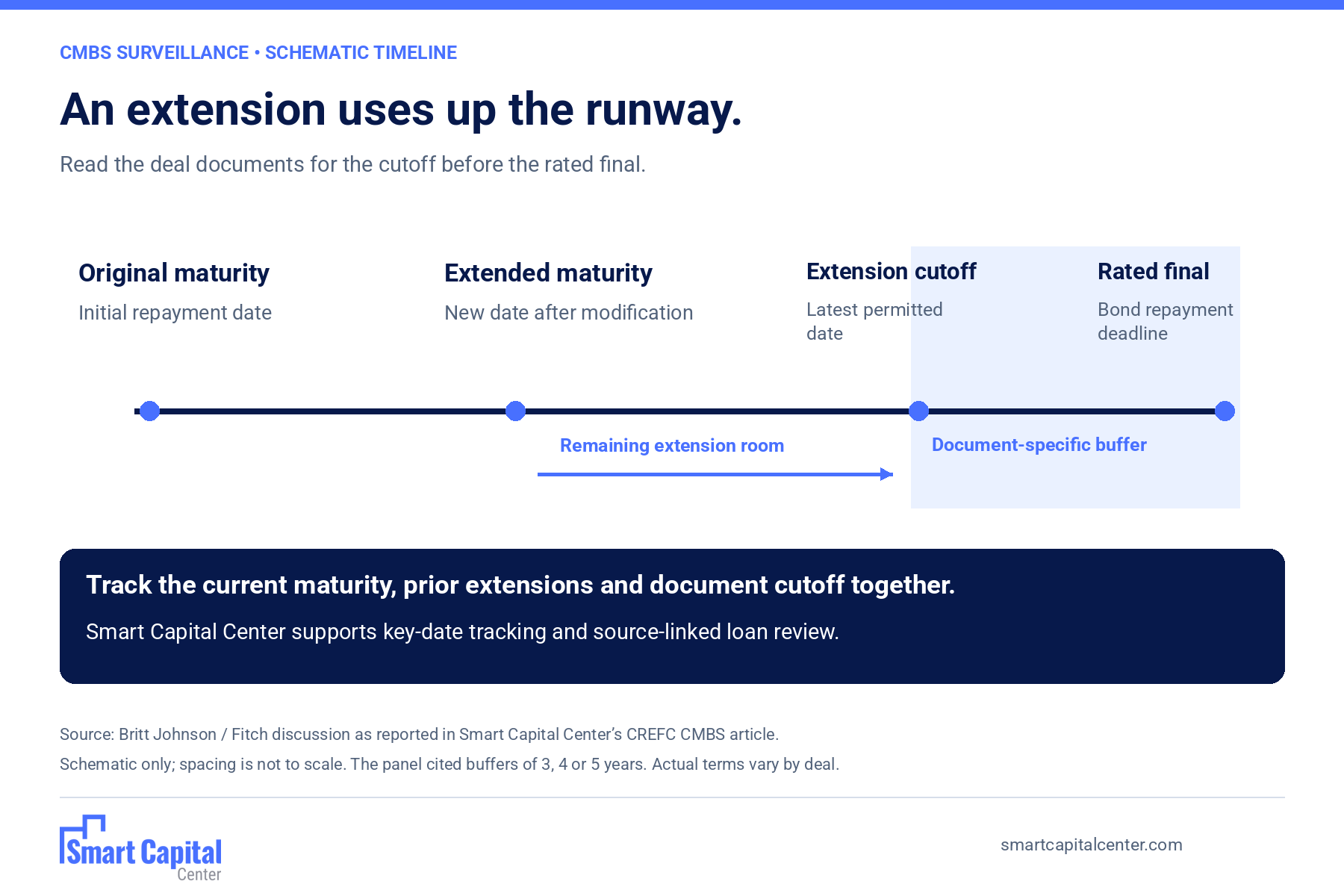
Britt Johnson, who leads Fitch’s CMBS surveillance team, described a limit that many investors overlook. The rated final is the last date by which the bonds must be repaid for the original rating to hold. “A lot of SASB’s in particular have document language that say modifications or extensions can’t go beyond a certain date ahead of the rated final,” Johnson said. The cushion varies: “it might be three years, four years, five years before the rated final.”
That detail changes how to read a modified loan. Each extension uses up part of the runway between the new maturity date and the cutoff, and a loan that has already been extended twice has less room for a third. Johnson said that at the rated final the ratings go to D, and speaking for Fitch, “that has never happened.” The point for an investor is not that the deadline will be missed. It is that the deadline is a number worth knowing before the next modification, because it limits what a servicer can agree to.
Johnson also described the other end of a bad loan: a transaction where the loan is in default and “all cash is being paid towards the bonds,” a direct payment from the property to the senior bondholder. Surveillance work follows both ends: how much room an extension leaves, and where the cash goes once the loan stops performing.

Investors in the room said the reporting system works, but the timing does not. Harris Trifon of Lord Abbett, speaking as an investor, said “a lot of the angst and concern in the marketplace is a function of the delays and timing and when this information is being posted.” Leslie Hayton of Trimont, speaking as a master servicer, said the data is there for those who look: “you really have to go to the underlying information and look at it and ask the questions.” Both views point to the same habit. An investor who waits for a narrative in the quarterly file learns about a problem after the servicer has already begun working on it.
Panelists spent time on what happens after a loan stops performing, because the rules matter as much as the collateral. Documents can place a loan on “not recoverable” status, and one panelist said older language can leave some junior bonds paid interest ahead of principal. A simple waterfall, which is the order in which cash is paid to each class, would repay the AAA class first. The panelist said the actual versions are far more convoluted.
Appraisals drive much of this. A panelist said an appraisal sets the value that drives decisions on advances and recoveries, and that delays in obtaining it let some parties stay in control or keep getting paid. One fix is an automatic 25 percent reduction while an appraisal is pending, but another panelist said it is not applied consistently. Advances, which are payments the servicer makes to keep bondholders current, also cost money. “Advances aren’t free,” the panelist said, and the interest “comes real money ahead of your AAA recoveries.”
One panelist raised a further risk in SASB deals: “controlling holders in a SASB deal can figure out a way to get paid outside of the waterfall.” The panelist called that a real problem and a simple one to fix. For an investor, the lesson is to read the recovery terms before buying, since they decide what happens when the property does not perform.
Five steps follow from what the panelists described.
The CMBS delinquency rate is a starting point. Modifications hold the number down, new issue pricing reflects clean starting records, and ratings tend to change after the loan has already weakened. Panelists at the CRE Finance Council conference described the same pattern from several sides: downgrades in the SASB market, underwriting with less structure, and recovery rules that can pay bondholders in a surprising order. Teams that watch the loan files, and not only the rating, see the stress earlier and can act while their choices are wider.
Analyze CMBS exposure faster. See how Smart Capital Center helps your team track loan performance, covenants, and key dates before a rating changes. Book a demo today.
Q: What is the CMBS delinquency rate?
A: The CMBS delinquency rate is the share of loans in commercial mortgage-backed securities that are behind on payments. At the 2026 CRE Finance Council conference, Adam Smith of DWS, who oversees the CMBS portion of its portfolio, put delinquency near 9 percent in conduit deals and near 5 percent in single-asset single-borrower deals, using rounded figures from a conference slide. Smith noted that high modification rates keep the headline number lower than the real level of stress.
Q: Why does the CMBS delinquency rate understate stress?
A: Loans that are modified or extended often stop counting as delinquent. Adam Smith of DWS added roughly 9 percent in modifications to the delinquency rate and reached about 18 percent of conduit loans and about 15 percent of SASB loans having trouble meeting debt service. The Federal Reserve also said lenders’ willingness to extend or restructure maturing loans has helped limit forced sales.
Q: What is a SASB loan?
A: A single-asset single-borrower (SASB) loan is a commercial mortgage secured by one property or one portfolio held by one borrower, then sold to investors as bonds. A conduit deal, by contrast, pools many loans on many properties. Panelists described SASB deals as concentrated, with some deals small, so one weak property can affect the whole bond.
Q: Why were SASB bonds downgraded?
A: A panelist said about one in four SASB deals has been downgraded since 2021, including 35 deals whose bonds were originally rated AAA. Panelists pointed to structural change in office and retail, more interest-only loans, and less structure in newer deals. Another panelist noted that downgrades do not mean defaults and losses, but they matter to investors who must hold a certain rating.
Q: How do I monitor a CMBS position before a rating change?
A: Investors can add modifications to delinquencies, compare current financials with the original underwriting, track maturity and extension dates and the distance to the rated final, read the recovery terms, and set review triggers that do not depend on ratings. Michael Mesard, portfolio manager at BlackRock, said investors need to “do your work, do a lot of diligence” behind the headline numbers.
Q: How does Smart Capital Center help with CMBS monitoring?
A: Smart Capital Center’s AI agents read loan documents, appraisals, inspection reports, and financials together, flag where later figures drift from earlier promises, calculate covenant tests, and track key dates. Every statement links to its source passage, with an exportable audit trail. Investors can also bring their own documents into the underwriting, build projected cash flows and a DCF model, and run scenarios when assumptions change.