


CRE Investors

November 20, 2026
CRE Investors
November 20, 2026

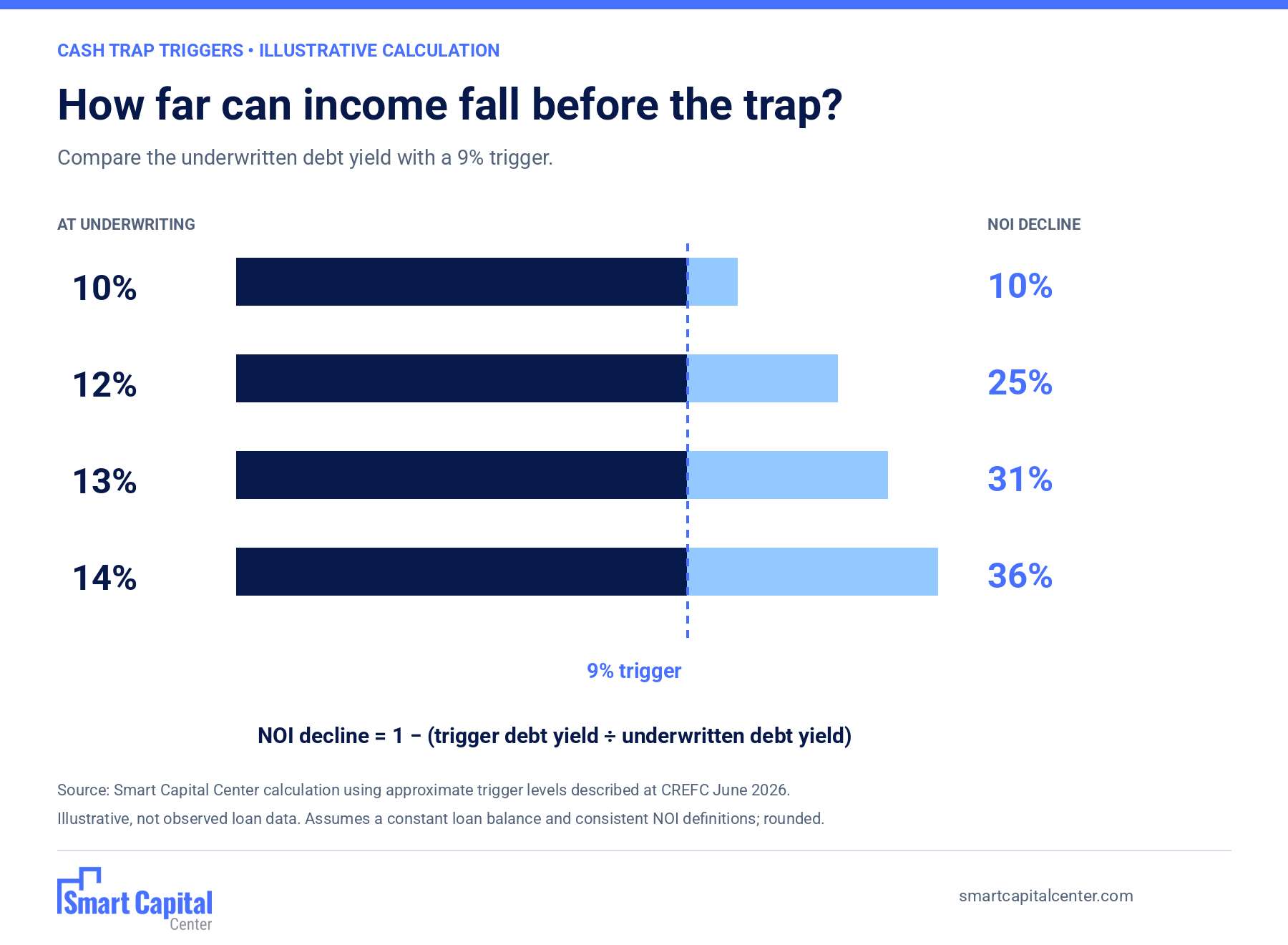
Smart Capital Center heard a panelist at the CRE Finance Council’s June 8 to 10, 2026 conference explain that office loans can carry a cash trap trigger near a 9 percent debt yield, which by our math lets NOI fall about 36 percent on a loan underwritten at a 14 percent debt yield before any cash is trapped.
A loan can look well protected on paper and still give the lender no protection until the property has lost a large part of its income. Cash trap triggers, which hold a property’s excess cash in a lender-controlled account when performance slips, are meant to catch trouble early. When the trigger is set on the wrong measure or at the wrong level, it starts after the damage is done. This article explains how debt yield and debt service coverage ratio (DSCR) triggers differ, why the gap between them matters, and how to test a trigger before a loan closes or a position is bought.
The material comes from the CRE Finance Council’s June Conference in New York on June 8 to 10, 2026, where lenders, bond investors, rating analysts, and special servicers spoke across several panels. Named speakers include Adam Smith of DWS and Britt Johnson, head of Fitch’s CMBS surveillance team. Most of the trigger remarks come from one panel on office, hotel, and retail loans whose speakers the recordings do not confirm, so those are attributed by role.
Smart Capital Center’s AI agents help teams track the covenants and income trends that decide when a trigger is hit. They read loan documents and financial statements together, track each covenant the loan agreement sets, and link every conclusion to its source passage. A later section explains how.
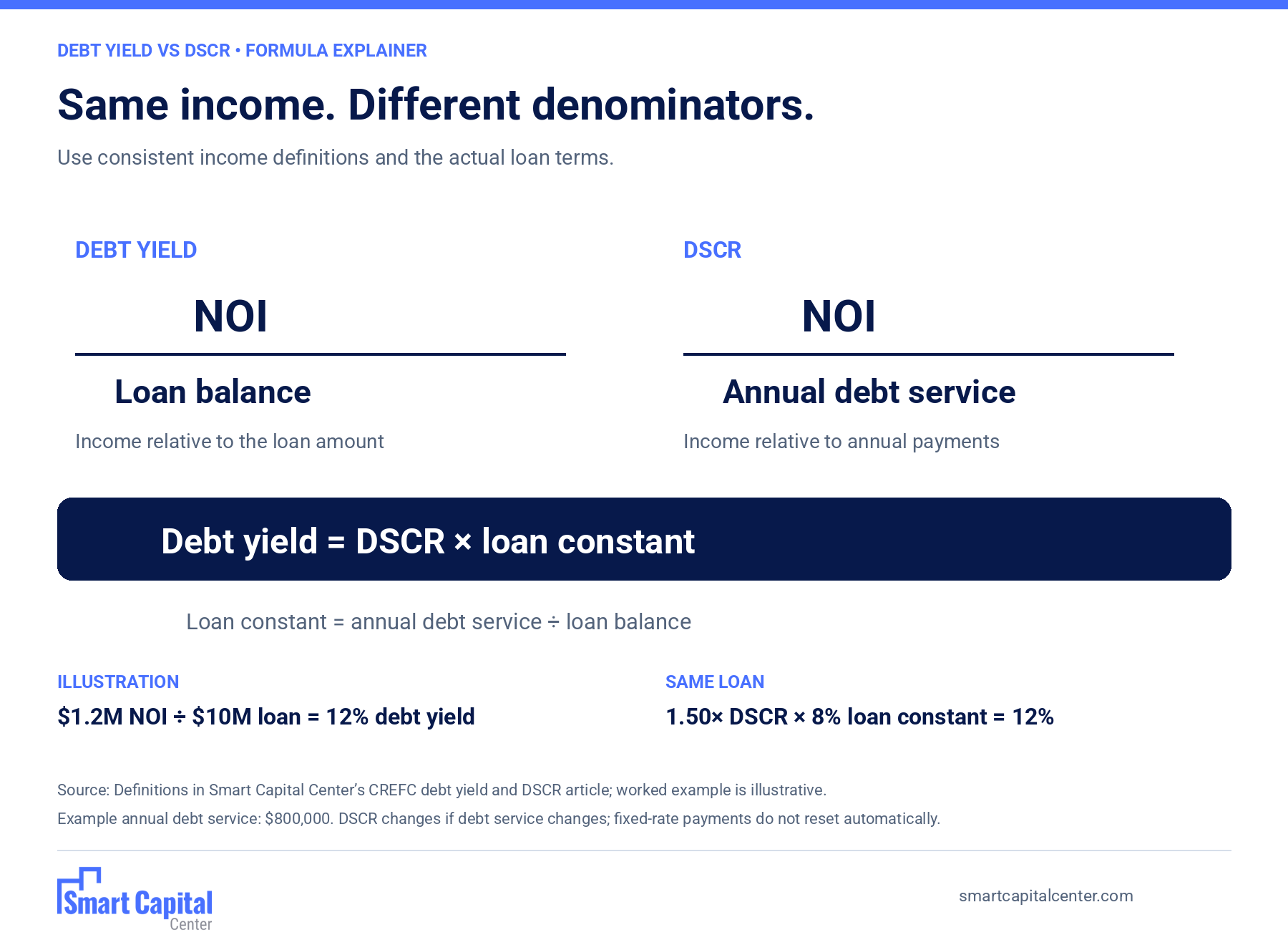
Debt yield is a property’s net operating income (NOI) divided by the loan amount. It ignores the interest rate and the amortization schedule, so it shows what return the lender would earn on the loan if it took the property back. DSCR is NOI divided by the loan’s annual debt service, the principal and interest due each year. It shows how easily the property pays its debt. The two are linked by the loan constant, which is annual debt service divided by the loan amount: debt yield equals DSCR times the loan constant.
That link explains the central problem. A DSCR trigger moves with the interest rate, because debt service rises when rates rise. A debt yield trigger does not. Two loans with the same DSCR can have very different debt yields, and the lender’s real exposure follows the debt yield and the property value.
Formulas are standard definitions. The cap rate is the property’s NOI divided by its value.
One panelist described the problem on office loans. “Oftentimes the debt yields on these office loans are in the teens,” the panelist said, but the DSCR trigger “roughly works out to like a 9 debt” yield. The panelist’s conclusion: “that’s a lot of NOI degradation where you start trapping cash.” The loan can lose a large share of its income before the lender collects anything extra.
The arithmetic shows the size of the gap. Using the panelist’s rough figures, a loan underwritten at a 14 percent debt yield with a trigger near a 9 percent debt yield would see NOI fall about 36 percent before cash trapping begins. A loan underwritten at 12 percent would see a 25 percent decline. The table below is our illustration of the math, not data from a specific loan.
Illustration using the panelist’s approximate figures. The decline equals one minus the trigger divided by the underwritten debt yield.
The second problem is value. A panelist added that by the time a trigger of that kind is reached, “you’re not sweeping until you’re underwater or 100% LTV.” The reason is the link in the table above. A debt yield of 9 percent equals 100 percent loan-to-value when the market cap rate is 9 percent, and about 89 percent when the cap rate is 8 percent. The Federal Reserve’s November 2026 Financial Stability Report said capitalization rates have increased sizably from their 2022 lows, so a trigger set in a lower-rate period can sit closer to the loan balance than the original math suggested.
The panelist’s answer was to tighten the trigger. “Not let the property performance decline too much before we start trapping cash,” the panelist said, and added that “there needs to be some buffer as well.” A trigger that starts earlier gives the lender more excess cash to hold. It also reduces the sponsor’s cash flow sooner, so equity investors should read the trigger the same way a lender does before they agree to it.
The trigger is the first step, not the last. Britt Johnson, who leads Fitch’s CMBS surveillance team, described where a failing loan can end up: a transaction “where the loan is in default and all cash is being paid towards the bonds,” a direct payment from the property to the senior bondholder. A well-set trigger gives the lender time to act before that point, and a late one shortens the time.
A trigger only helps if someone knows how close the property is to it. The numbers sit in separate places: the loan agreement sets the covenant, the financials show the income, and an appraisal or inspection report explains why income may be moving. Smart Capital Center’s AI agents read those documents together, track each covenant the loan agreement sets, and calculate the tests as new financials arrive. Key dates and maturities are tracked in the same view.
Asset Management teams can also see drift across time periods. The agents flag when an appraisal promised capital spending that never appears in the financials, and when an inspection noted a deteriorating condition that no one addressed. Both can lower income later and bring a trigger closer. Every conclusion links to the source passage, so an analyst can confirm it in one click, and the team can export the audit trail. JLL saw a 30x productivity gain for the asset management team with Smart Capital Center’s AI.
For investors, the same files feed the underwriting. Teams bring their own documents, the agents read them into the model, pull comparables from more than 1 billion live market data points across more than 120 million properties, and build projected cash flows and a discounted cash flow (DCF) model. A team can run a lower-income scenario and compare the projected cash flows with the trigger levels written in the loan agreement.
Panelists did not describe one standard level, and the right trigger depends on the property. On hotels, one panelist said the metrics going in on some hotel loans are “low to mid teens and close to two times coverage,” which “gives you a decent amount of room if things do soften.” On retail, a panelist said power center loans that once worried them now show “12, 13 debt yields” with tenants renewing for five years. A lender with that much room can set a later trigger. A lender on a property with thinner income or heavier capital needs cannot.
Multifamily showed the other side. Adam Smith of DWS said rents were not keeping up with expenses, so “service coverage is going down.” Smith also described Texas loans from 2023 where originators had allowed tax benefits that lowered expenses in underwriting, and when the law changed, those figures underperformed. Another panelist said tariffs and construction costs now have to be built into NOI and DSCR, because “it’s not the same as it used to be.” Each case shows how coverage can fall from the expense side even when rents hold.
Observations are from conference panelists, described by property type, and are not market benchmarks.

Coverage at closing and coverage at refinance can be very different. One panelist told credit teams that when income is growing, they should ask what the other lines will look like when it comes time to refinance. A panelist speaking about hotels noted that loans enjoying a strong summer would be “coming in for a refi” about 12 months later, with whatever income they had by then. If a trigger starts late, the lender holds little extra cash when the sponsor needs the most proof of strength.
For equity investors, the same logic applies from the other side. A trigger set close to the underwritten debt yield can trap cash during a soft year and delay distributions, while one set far below it leaves more cash flowing but gives less protection to the lender and, in a downturn, to the property’s ability to fund repairs. Reading the trigger as a debt yield and as a loan-to-value level shows both effects at once. Our refinancing guide covers what underwriters check first when the loan comes due.
Five steps follow from what the panelists described.
Debt yield and DSCR triggers answer different questions, and the gap between them can be large. A panelist at the CRE Finance Council conference described office loans where the debt yield started in the teens and the trigger sat near 9, leaving a wide stretch of income decline before any cash was trapped. Testing a trigger as a debt yield, as a percentage decline in income, and as a loan-to-value level shows where protection actually begins. Teams that run those checks before closing, and then track them after, see the problem while their choices are still wide.
Analyze triggers and covenants faster. See how Smart Capital Center helps your team track covenant tests, key dates, and income trends in one place. Book a demo today.
Q: What is debt yield in commercial real estate?
A: Debt yield is a property’s net operating income divided by the loan amount. It shows the income return a lender would earn on the loan if it owned the property, and it ignores the interest rate and the amortization schedule. At the 2026 CRE Finance Council conference, one panelist said debt yields on office loans are often in the teens at underwriting, and another said retail power centers were showing debt yields of 12 to 13 percent.
Q: How do you calculate debt yield?
A: Divide the property’s annual net operating income by the loan amount. A property with $1.2 million of NOI and a $10 million loan has a 12 percent debt yield. To see how far income can fall before a trigger, divide the trigger debt yield by the underwritten debt yield and subtract the result from one.
Q: What is the difference between debt yield and DSCR?
A: DSCR divides NOI by annual debt service, so it moves with interest rates and amortization. Debt yield divides NOI by the loan amount, so it does not. The two are linked by the loan constant: debt yield equals DSCR times the loan constant. A panelist noted that converting a DSCR trigger to a debt yield on office loans often shows a trigger near 9 percent.
Q: What is a cash trap in a commercial mortgage?
A: A cash trap holds a property’s excess cash in a lender-controlled account when a performance trigger is breached, often based on DSCR or debt yield. A cash sweep applies that cash to a reserve or to the loan. A panelist said a trigger that starts late can mean “you’re not sweeping until you’re underwater or 100% LTV.” Britt Johnson, head of Fitch’s CMBS surveillance team, described where a failing loan can end up: a transaction “where the loan is in default and all cash is being paid towards the bonds.”
Q: What is a good debt yield?
A: No single level fits every property. Panelists cited debt yields in the teens on office loans at underwriting, low to mid teens on many hotel loans, and 12 to 13 percent on retail power centers. The more useful question is how far income can fall from the underwritten level before the trigger is hit, and what the trigger implies for loan-to-value.
Q: How does Smart Capital Center help with debt yield and DSCR monitoring?
A: Smart Capital Center’s AI agents read loan documents and financials together, track each covenant the loan agreement sets, and calculate the tests as new financials arrive. They also track key dates and flag drift across time periods, such as capex an appraisal promised that never appears in the financials. Every statement links to its source passage, with an exportable audit trail. Investors can bring their own documents into the underwriting and run lower-income scenarios on projected cash flows and a DCF model.