


Smart Capital News

October 1, 2026
Smart Capital News
October 1, 2026
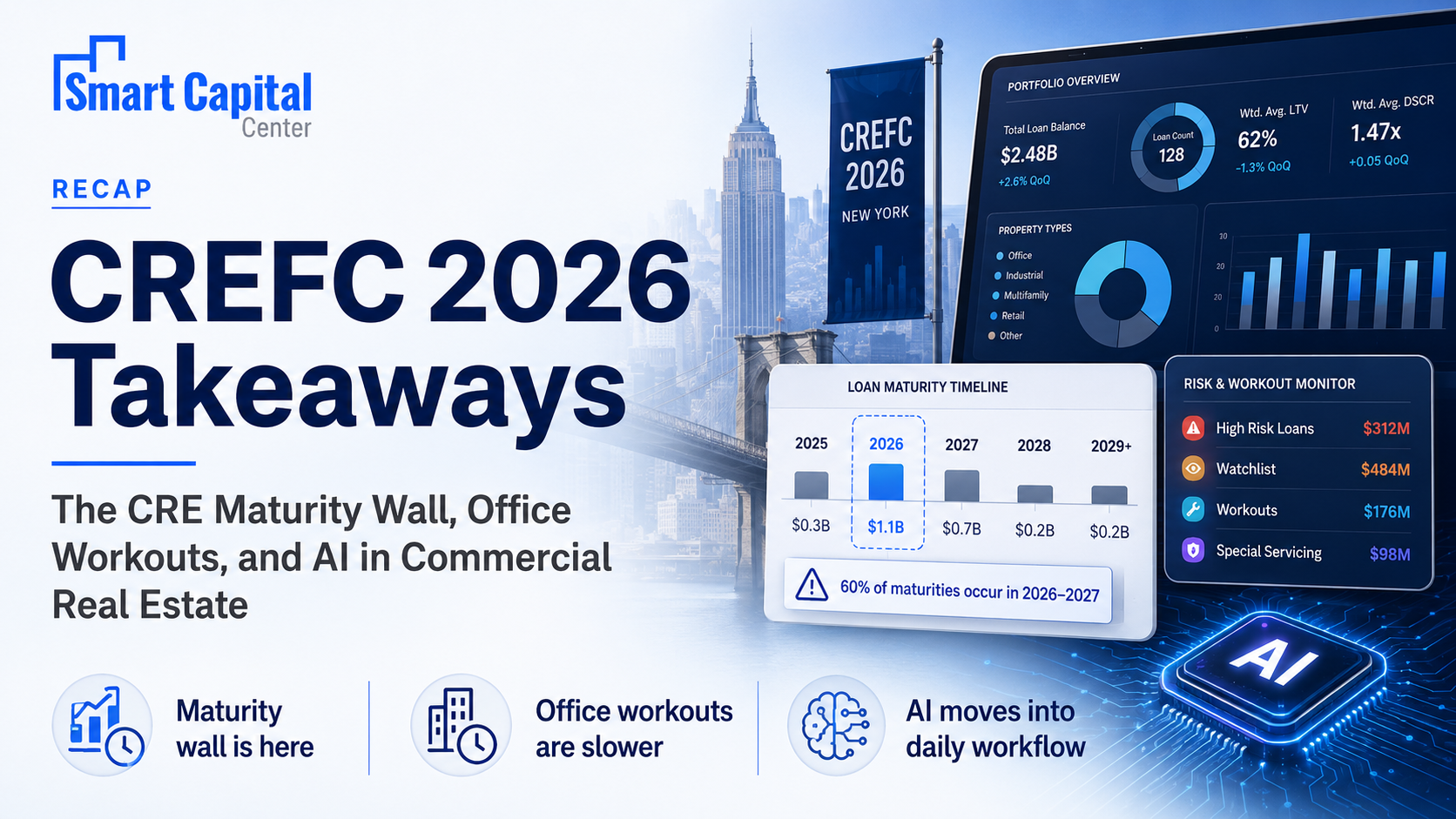
The CRE maturity wall has moved from forecast to operating reality in 2026. The Mortgage Bankers Association reports that approximately $875 billion in commercial real estate loans are scheduled to mature in 2026, with another $652 billion arriving in 2027. The conversation at the CRE Finance Council's June 2026 meeting in New York confirmed what lender and investor teams already feel every week. Maturity dates are no longer automatic payoff dates. Refinance proceeds are tighter. Office workouts are slower. The day-to-day pressure on credit, surveillance, and asset management teams is now continuous.
Smart Capital Center built its Agentic AI platform for exactly this cycle. Real-time portfolio intelligence, AI-powered underwriting, and always-on monitoring give commercial real estate teams the visibility needed to act before maturity turns into distress.
This recap summarizes the major CREFC 2026 themes and explains why earlier risk visibility, better servicing data, and human-reviewed AI workflows are now operational priorities for lenders and investors.
For most of 2023 and 2024, the CRE maturity wall was debated as a forecast. By mid-2026, the debate is over. The volume is real. The question has shifted to how lender and investor teams will absorb it.
Several CREFC panelists described a market where private credit funds and bridge lenders now actively absorb loans that traditional banks will not refinance. One panel speaker noted that capital is moving across structures, including insurance, core plus, daily liquidity vehicles, back leverage, and higher yielding debt.
The scale extends beyond a single year. Industry estimates from Reed Smith and the Counselors of Real Estate place commercial real estate maturities at more than $1.5 trillion across 2025 through 2027. Office-backed CRE debt accounts for roughly $148 billion of the 2026 total. Multifamily maturities are forecast to grow 56 percent from 2025 to 2026.
For CRE teams, the implication is operational. Portfolio managers need continuous visibility into which loans face refinance risk, which sponsors are under pressure, and which assets need recapitalization conversations now rather than later. Smart Capital Center's Agentic AI tracks maturity calendars, debt yield, and Net Operating Income (NOI) variance across every loan in a portfolio, with monitoring updated in real time. Quarterly review cycles cannot keep up with this volume. Always-on monitoring can.
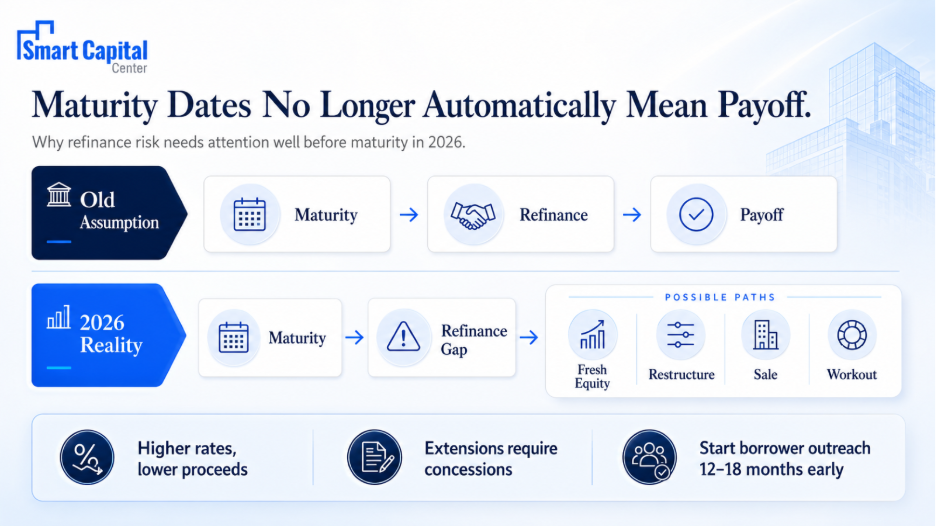
Earlier cycles assumed refinance at maturity. That assumption is gone in 2026.
Public industry data shows that nearly half of the five-year commercial real estate loans originated in 2019 and 2021 failed to pay off at scheduled maturity. The reasons are familiar. Borrowers used aggressive leverage. Acquisition pricing was high. Today's higher rate environment means refinance proceeds are lower. Many sponsors face an equity shortfall and limited workout options.
The end of “extend and pretend” was a frequent CREFC theme. Lenders are no longer willing to grant maturity extensions without significant borrower concessions. Sponsors must contribute fresh equity, accept restructured terms, or move toward sale.
Mike Fratantoni, MBA's Chief Economist and SVP for Research and Business Development, confirmed the shift in the association's February 2026 release. He noted that “lenders were no longer simply extending loan terms.”
CREFC panelists confirmed that AB note structures are returning for office and creeping into multifamily, where they are harder to make work because operating performance recovers more quickly. CLO (Collateralized Loan Obligation) workouts continue to provide flexibility, with programmatic short-term extensions becoming a recognizable workout tool.
For lenders, the lesson is timing. Refinance conversations must begin 12 to 18 months before maturity. Borrower outreach, capital stack analysis, sponsor communication, and lender negotiations all take time. Waiting until 90 days before maturity leaves no leverage.
Smart Capital Center's AI flags refinance risk early by continuously testing Debt Service Coverage Ratio (DSCR), debt yield, NOI variance, reserves, and sponsor performance against current market signals. Credit teams see which loans need attention now, not at maturity. Learn more in our companion post on commercial real estate refinance risk and pre-maturity workflow.

Office was the dominant property type in every CREFC workout discussion. Office defaults reached 8.6 percent in early 2026 and continue to rise toward 10 percent. CMBS (Commercial Mortgage-Backed Securities) office distress now sits above $148 billion in 2026 maturities alone.
The most operationally important takeaway from CREFC was the capex problem underneath the headline default rate.
Multiple speakers described what one panelist called “fake PCRs,” referring to Property Condition Reports (PCRs) that understated capital needs at origination. Roofs, elevators, parking garages, and tenant improvements were deferred or omitted. When the asset reaches maturity, the cost to stabilize it is dramatically higher than reserves. One panelist offered a concrete example. A property needed a $10 to $15 million capital injection while sitting on $2 million in reserves that depletes inside six months.
Another point of friction surfaced repeatedly. Equity-side property condition reports and lender-side reports often tell very different stories. The gap between those two views is where losses accumulate over the loan term.
For lenders and special servicers, the implication is clear. Capex assumptions made at origination need to be validated against current property condition before a workout, not after. Smart Capital Center's Agentic AI pulls capex line items from rent rolls, T-12 (trailing 12-month) financials, original appraisals, and inspection reports, then flags the gap automatically. Manual review at workout stage is too slow and too expensive to catch the problem early. See our follow-up post on office workouts and weak property assumptions for the full breakdown.
CMBS investors and special servicers face a parallel pressure. Data, not judgment, is the bottleneck.
CREFC panelists described what one speaker called a slow-moving stress in the SASB (Single-Asset, Single-Borrower) market. Roughly one in four SASB deals has been downgraded since 2021. Approximately 35 deals originally rated AAA are now rated below investment grade. Two of those deals have already taken losses. More AAA-class shortfalls are expected.
These downgrades trigger immediate scrutiny from risk managers and bond investors. By the time a rating moves, the loss is structural. Surveillance teams operating on weekly or monthly review cycles are usually too late.
Inside special servicing, the operational complexity is just as real. Panelists pushed back on the perception that special servicers are paper-pushers, describing the judgment required under 700-page servicing agreements and the inherent conflicts involved in workouts. The complexity is the work.
The harder challenge is whether servicers and investors can access, normalize, and act on loan-level data quickly enough. Comments fields, appraisal updates, modification terms, and current financials sit in different systems. Manual extraction and reconciliation slows every workout decision.
Smart Capital Center's Agentic AI ingests servicer comments, appraisal updates, modification terms, and financials into a single, normalized portfolio view. Surveillance teams see fundamental deterioration before rating action moves. Read our follow-up on special servicing and CMBS transparency for the full investor-side view.
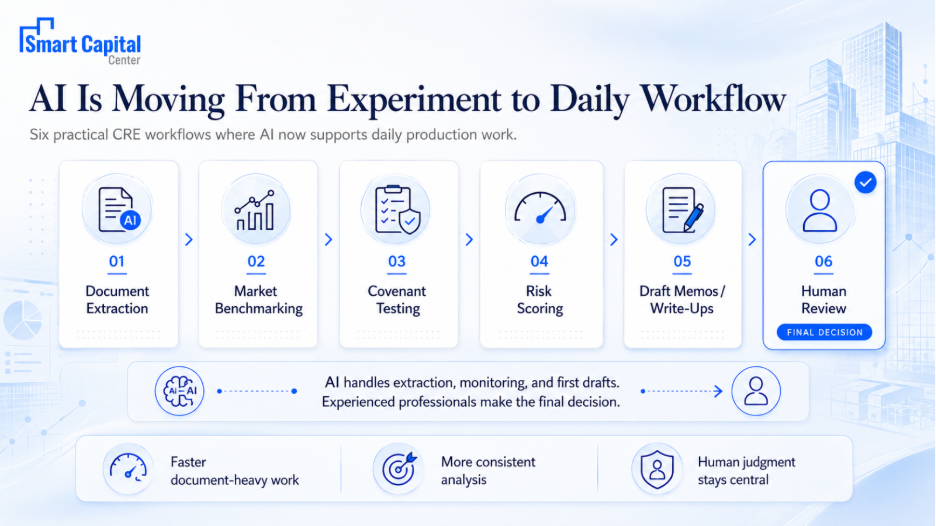
Across CREFC June 2026 sessions, the AI conversation shifted from pilot to production.
McKinsey QuantumBlack research has documented the productivity range that publicly available AI tools now achieve in document-heavy financial workflows. Commercial real estate lenders are now seeing the same effect inside their own teams. KeyBank reduced financial model prep time by 40 percent using Smart Capital Center's Agentic AI. JLL achieved a 30x productivity gain on underwriting tasks after deploying Smart Capital Center's AI-powered document processing.
Commercial real estate is a strong fit for AI in commercial real estate because the work is built around documents. Leases, rent rolls, T-12 financials, offering memorandums, appraisals, environmental reports, and inspection summaries all hold the data underwriters and asset managers need. Pulling that data manually is slow and inconsistent. AI extraction is fast and repeatable.
The use cases discussed at CREFC included:
Smart Capital Center's Agentic AI covers all six of these workflows in a single platform. The shared message across CREFC panels was straightforward. AI has become a daily workflow expectation across the industry.
The CREFC closing panel ended on a line that drew agreement from every panelist. The paraphrased summary: AI cannot replace seasoned professionals.
The line was a statement about how AI should be deployed in regulated CRE workflows. The best operating model emerging across lenders, special servicers, and investors is human-reviewed automation. AI handles extraction, benchmarking, monitoring, and first-draft commentary. Experienced credit officers and asset managers handle the final judgment.
For regulated lenders, this human-in-the-loop approach is also a compliance requirement. Loan committees, audit teams, and regulators expect a documented decision trail. Black-box automation is not acceptable. Auditable AI workflows that surface findings for human review are.
This is the operating model Smart Capital Center built around. Smart Capital Center's Agentic AI extracts data, flags risk, generates draft commentary, and recommends next steps. The credit officer accepts, modifies, or overrides each recommendation. Every action is logged. Every output is auditable. For a closer look at the human-review model, read our follow-up on AI in CRE underwriting and asset management.
Smart Capital Center is the AI-powered platform built for the full commercial real estate deal lifecycle. The platform brings four capabilities together that map directly to every CREFC 2026 theme:
Real-time data infrastructure. 1 billion-plus real-time data points across 120 million-plus U.S. properties. More than $500 billion in analyzed CRE transactions. These signals power every screen, underwrite, and monitor action.
AI-powered underwriting and document processing. Leases, rent rolls, T-12 financials, appraisals, and offering memorandums extracted automatically by Smart Capital Center's Agentic AI. Every cell is traceable back to its source document. Analysts validate, override, or accept.
Always-on portfolio intelligence. Continuous monitoring of DSCR, debt yield, occupancy, NOI variance, and covenant compliance across every loan. Watch-list triggers, maturity calendars, and risk scoring update in real time. This is the CRE asset management software layer many lender and investor teams have been missing.
Human-controlled automation. Smart Capital Center's AI recommends. Experienced credit officers and asset managers decide. Every action is logged. Every output is auditable.
This is the operating model the CREFC 2026 themes pointed toward. Earlier visibility into refinance risk. Faster underwriting at scale. Cleaner servicing and surveillance data. AI that supports judgment rather than bypassing it.
The CRE maturity wall is no longer a future event. It is shaping how lenders and investors operate every week of 2026. Refinance assumptions are tighter. Office workouts are exposing capex gaps from earlier cycles. Special servicing and CMBS surveillance teams operate under continuous data pressure. AI has moved from pilot to production across the industry.
CRE teams that act earlier preserve options. Teams that wait often run out of them.
Smart Capital Center gives lenders and investors earlier visibility, faster underwriting, continuous portfolio monitoring, and human-controlled Agentic AI workflows. See the platform in action. Book a demo today.
Q: What is the CRE maturity wall in 2026?
A: The CRE maturity wall describes the large volume of commercial real estate loans scheduled to mature in a short period. According to the Mortgage Bankers Association, approximately $875 billion in CRE loans are set to mature in 2026, with another $652 billion in 2027. The wall matters because higher rates and tighter underwriting mean many loans cannot be refinanced on original terms. Smart Capital Center's Agentic AI tracks every maturity, refinance risk indicator, and sponsor signal across a portfolio in real time, giving credit teams 12 to 18 months of forward visibility.
Q: How much commercial real estate debt is maturing in 2026?
A: Industry estimates place 2026 CRE maturities between $875 billion (MBA) and $936 billion (industry-wide). Office-backed debt represents roughly $148 billion of that total. Multifamily maturities are forecast to grow 56 percent from 2025 to 2026. Smart Capital Center monitors maturity calendars across 120 million-plus U.S. properties so lenders see refinance risk at the loan level, not just the portfolio level.
Q: Why is special servicing under more pressure in 2026?
A: Special servicers are managing higher workout volumes than at any point since 2010. Office defaults have reached 8.6 percent and continue to rise. CMBS investors expect faster loan-level data, faster modification updates, and clearer communication. Manual surveillance cycles are not built for the current volume. Smart Capital Center's Agentic AI normalizes servicer comments, appraisal updates, modification terms, and financials into a single portfolio view, giving surveillance teams faster signal on which loans need action.
Q: What is the difference between an equity PCR and a lender PCR?
A: An equity Property Condition Report is prepared for the buyer and tends to estimate capital needs at the lower end. A lender PCR is prepared for the financing side and typically includes a more conservative capex schedule. The gap between the two reports is often where deferred maintenance and reserve shortfalls accumulate. Smart Capital Center's AI compares PCR assumptions against rent rolls, T-12 financials, and inspection reports automatically, flagging capex gaps before they become workout problems.
Q: How is AI being used in commercial real estate underwriting?
A: AI in commercial real estate is being used for document extraction, automated rent roll and T-12 processing, market benchmarking, covenant testing, fraud detection, credit memo drafting, and continuous portfolio monitoring. KeyBank reduced financial model prep time by 40 percent and JLL achieved a 30x productivity gain using Smart Capital Center's Agentic AI. The platform covers all of these workflows in a single system, with every output traceable back to its source document.
Q: What can lenders do to manage refinance risk before maturity?
A: Lenders should begin borrower outreach 12 to 18 months before maturity. They should monitor DSCR, debt yield, NOI variance, reserves, sponsor performance, and current market conditions continuously. Earlier visibility allows for earlier conversations on extensions, restructures, or sale. Smart Capital Center's Agentic AI runs all of these checks continuously across an entire loan book, so credit teams know exactly which loans need attention now.
Q: What is Agentic AI in commercial real estate?
A: Agentic AI describes AI systems that complete multi-step workflows, take initiative across tasks, and recommend next actions, while keeping humans in control of the final decision. In commercial real estate, this includes document extraction, market benchmarking, covenant testing, risk scoring, and credit memo drafting. Smart Capital Center's Agentic AI is purpose-built for CRE underwriting and asset management, with every output auditable and every recommendation reviewable by a human credit officer.
Q: How does Smart Capital Center help with the CRE maturity wall?
A: Smart Capital Center provides Agentic AI-powered underwriting, real-time portfolio monitoring, and continuous loan surveillance across 120 million-plus U.S. properties and 1 billion-plus real-time data points. Lenders and investors use the platform to identify refinance risk earlier, run faster workout analyses, monitor CMBS portfolios continuously, and keep experienced credit officers in control of every decision. Book a demo today to see the platform in action.