


AI in Commercial Real Estate

October 5, 2026
AI in Commercial Real Estate
October 5, 2026

A capital plan is accurate on the day it's built. The next morning it starts drifting. Rates move, values reprice, and maturities get closer, and none of it shows up until the next reporting cycle closes. By the time the quarter's numbers land, the plan is describing a portfolio that has already changed, and the covenant that looked comfortable in January is the one the committee is asking about in April.
There's more riding on it this year. Newmark's 2Q26 data shows debt origination up 25 percent year to date to $453 billion, and the Federal Reserve's July 2026 Senior Loan Officer Opinion Survey found banks reporting easier CRE lending standards in the second quarter. Capital is moving again, which makes a stale assumption more expensive, not less.
Smart Capital Center keeps the plan describing the portfolio between cycles. For the investors and lenders using it, that means:
This article covers stress testing at three levels, a standard scenario library, a worked rate shock example, and a quarterly framework.
Stress-testing a CRE portfolio means moving one assumption, one deal, or the full book against a defined adverse scenario, rate shocks of 100, 200, and 300 basis points, cap rate expansion, occupancy decline, or refinance failure, and measuring the effect on coverage, value, and proceeds. The output that matters is not a single number but where the portfolio's coverage or liquidity breaks first, and by how much room remains before it does.
● Capital planning: the process of matching capital sources to capital needs across a portfolio over a defined horizon.
● Stress test: an analysis that measures the effect of an adverse scenario on a deal or portfolio.
● Reverse stress test: an analysis that starts from a defined failure outcome and identifies the conditions that would produce it.
● Rate shock: a defined interest rate stress, commonly 100, 200, or 300 basis points, applied to measure exposure.
● Assumption drift: the growing gap between an assumption set at underwriting and current market evidence.
● Dry powder: committed capital that has not yet been deployed.
● Capital expenditure reserve: funds set aside for building improvements and replacements, separate from operating expenses.
Commercial real estate capital planning spans sources and uses, capital expenditure and reserves, debt maturities and refinancing needs, dry powder available for deployment, distribution planning, and portfolio liquidity. Financial planning for commercial real estate that tracks sources and uses without connecting them to maturity dates and reserve needs describes half the picture, since a plan that looks funded on paper can still fail if a maturity and a capex need land in the same quarter.

Every output in a capital plan traces back to seven assumptions: rent growth, expense growth, exit cap rate, hold period, rate path, lease-up pace, and rollover timing. Naming each one explicitly is what makes a plan possible to stress-test, since a scenario has to know exactly which input it is moving.
A single-assumption test moves one input, such as rent growth, and holds everything else constant, which isolates that variable's effect but understates real exposure, since adverse conditions rarely arrive one at a time.
A single-deal test moves several assumptions together against one property, showing how a specific asset's coverage and value respond to a realistic combination of pressures.
A full-portfolio test aggregates deal-level exposure across the book, which is the step that most often breaks in a spreadsheet, since concentration by property type, submarket, and maturity date has to roll up correctly for the portfolio number to mean anything.
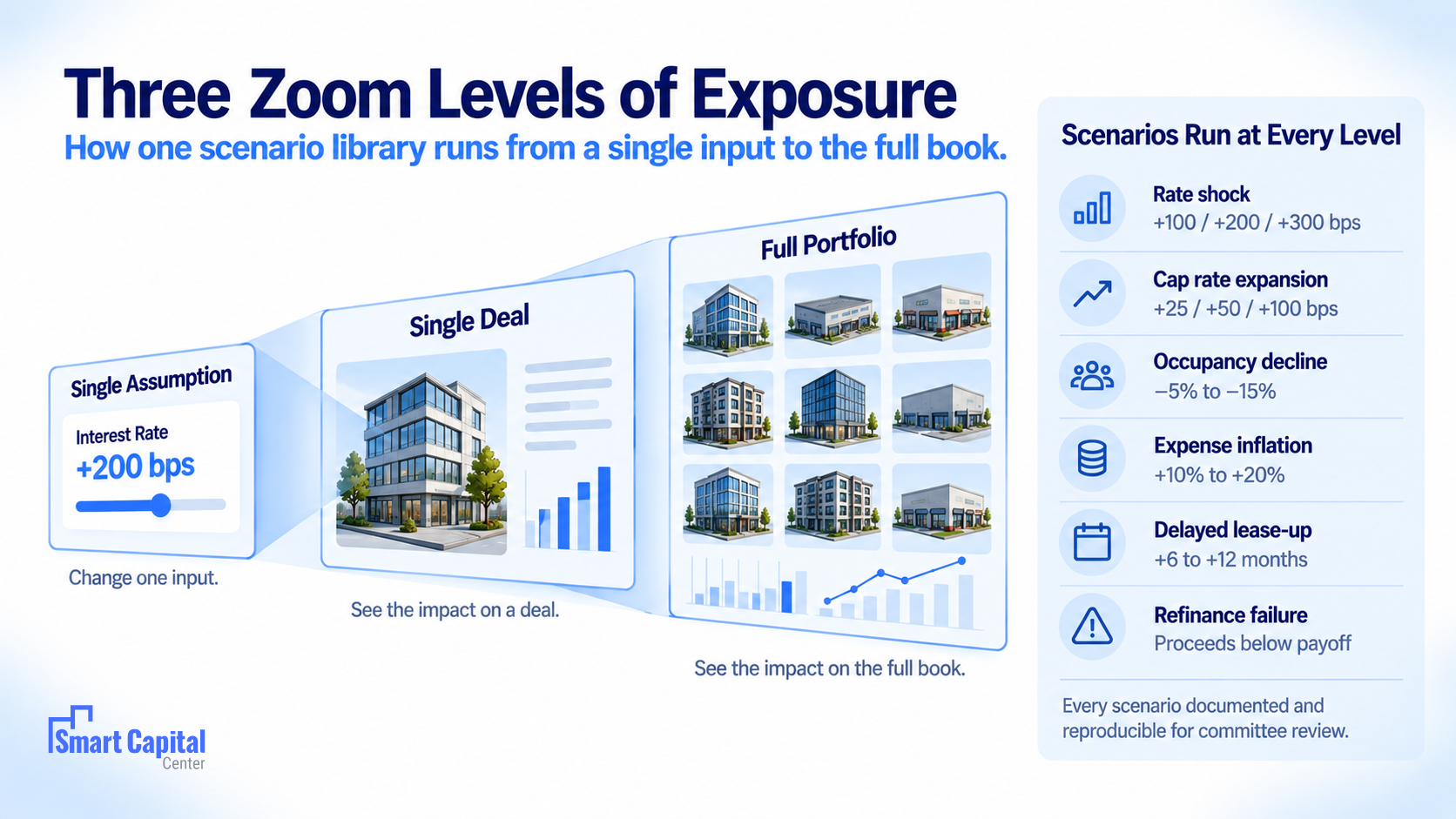
A defined scenario library keeps stress testing consistent across deals and reporting periods instead of ad hoc each time.
Consider a stabilized asset with $1,400,000 in NOI and a $13,000,000 loan on a 30-year amortization schedule, with a 1.25x DSCR covenant. At a 6.00 percent rate, consistent with the Mortgage Bankers Association's 2026 CREF Forecast projecting the 10-year Treasury to average 4.2 percent plus a typical commercial spread, coverage sits at 1.50x.
The 200 basis point scenario breaches the 1.25x covenant, at 1.22x coverage, which is the kind of finding a quarterly stress test surfaces months before a maturity date forces the issue. On the refinance side, the same rate move reduces the maximum supportable loan from roughly $15.6 million at the base case to $12.7 million at plus 200 basis points, a proceeds gap that has to be sized well before closing.
A reverse stress test starts from a defined failure outcome, a covenant breach, a missed distribution, a failed refinance, and works backward to identify what combination of conditions would actually produce it. This approach surfaces exposure that a forward scenario can miss, since it forces the question of exactly how far rents would have to fall, or rates would have to rise, before a specific bad outcome becomes real.
Assumption drift is the growing gap between what a model assumed at underwriting and what the market has since done, and it shows up first in the inputs nobody revisits between cycles: an exit cap rate assumption set three years ago, a rent growth figure that hasn't been checked against current leasing activity, a rate path that predates the current environment entirely. Checking each assumption against current market evidence on a fixed schedule is what catches drift while it is still small.
Agentic AI changes capital planning by running the full scenario set across the whole book at once instead of one spreadsheet at a time, keeping inputs current between reporting cycles, and flagging assumption drift as it happens. Smart Capital Center benchmarks assumptions against 120M+ properties, 1B+ signals, and $500B+ analyzed, so a rent growth or cap rate assumption drifting away from current evidence becomes visible while the gap is still small enough to matter less. JLL's asset management team reported a 30x productivity gain using this approach. See also AI Debt Management in CRE and CRE Portfolio Monitoring: How Lenders Catch Risk Before It Hits a Covenant.
A stress test that cannot be reproduced six months later is not useful in a committee setting. Documenting each scenario's assumptions and source, versioning the assumption set so a committee can see what changed between reviews, and reporting results in a form that shows the scenario and the assumption source, not just the output number, is what makes a capital plan defensible under later scrutiny. Committees increasingly ask to see the scenario set itself, not just the conclusion it produced.

Running this sequence every quarter keeps the plan from drifting away from the portfolio it describes.
1. Refresh the assumption set for every deal against current market evidence, flagging any input that has moved materially since the last cycle.
2. Run the single-assumption stress tests across the scenario library for every deal in the book.
3. Run single-deal tests combining the assumptions most likely to move together for any deal approaching a decision point, such as a maturity or lease rollover.
4. Aggregate deal-level results into a full-portfolio view, checking concentration by property type, submarket, and maturity date.
5. Run at least one reverse stress test against the portfolio's most plausible failure scenario.
6. Document the scenario set, the assumption sources, and the results in a form ready for committee review.
7. Report to investment committee and credit committee, and record what changed since the prior quarter's review.
● Stress testing one variable at a time and treating that as a complete exposure picture, when adverse conditions typically move together.
● Stressing revenue while holding expenses flat, which understates the real coverage impact of a downturn.
● Treating the base case as the plan, rather than as one scenario among several that the portfolio needs to survive.
Exposure is a portfolio-level question that needs continuous checking, not an annual exercise revisited only when a maturity or a committee question forces it. With the Federal Reserve's July 2026 Senior Loan Officer Opinion Survey on Bank Lending Practices reporting easier CRE lending standards in the second quarter, compared with basically unchanged standards in the first quarter, and Newmark's 2Q26 Capital Markets Conditions & Trends Report showing debt origination up 25 percent year to date to $453 billion, capital is moving again, which makes stale assumptions more expensive, not less. Smart Capital Center supports continuous capital planning by tracking maturities, covenants, and key dates across the book and running the full scenario library against live data, so committee reporting reflects current exposure.
See portfolio-wide exposure updated between reporting cycles, not just at quarter-end.
Book a demo with Smart Capital Center →
Q: What is a typical rate shock scenario for CRE?
A: A standard rate shock scenario library moves the interest rate assumption by 100, 200, and 300 basis points and measures the effect on coverage, refinance proceeds, and value. A 200 basis point shock is often the level where a covenant breach first appears on an asset that looked adequately covered at the base case rate.
Q: How often should a CRE portfolio be stress-tested?
A: A full portfolio stress test run quarterly catches assumption drift and maturity exposure while there is still time to act. Individual deals approaching a maturity, lease rollover, or other decision point warrant an additional test outside the regular quarterly cycle.
Q: What is the difference between a stress test and a reverse stress test?
A: A standard stress test starts with a scenario and measures its effect on a deal or portfolio. A reverse stress test starts with a defined failure outcome and works backward to identify what combination of conditions would actually produce it, which surfaces exposure a forward-looking scenario can miss.
Q: What is assumption drift, and why does it matter?
A: Assumption drift is the growing gap between what a model assumed at underwriting and what current market evidence shows, and it tends to hide in inputs nobody revisits between reporting cycles, such as an exit cap rate or rent growth figure set years earlier. Checking assumptions against current data on a fixed schedule catches drift while it is still small enough to correct without disruption.
Q: What should a capital planning tool for CRE actually calculate?
A: A CRE capital planning tool should calculate sources and uses, capex and reserve needs, debt maturities, dry powder, and liquidity, and it should be able to stress-test all of these at the single-assumption, single-deal, and full-portfolio level. A tool that only tracks the base case, without a scenario library behind it, is not actually a planning tool.
Q: Why does portfolio-level stress testing break down in spreadsheets?
A: Aggregating deal-level sensitivity into a portfolio-level exposure view requires concentration by property type, submarket, and maturity date to roll up correctly, and that aggregation step is where manual spreadsheet models most often introduce errors or simply become too unwieldy to maintain. A reconciled data layer that runs the same scenario set across every deal avoids the inconsistency that creeps in when each analyst builds their own version.
Q: How does Smart Capital Center support commercial real estate strategic planning tools and workflows?
A: It runs stress scenarios across rents, expenses, cap rates, and interest rates at both property and portfolio level, benchmarking assumptions against 120M+ properties, 1B+ signals, and $500B+ analyzed so drift becomes visible early. JLL's asset management team reported a 30x productivity gain using this approach.