


CRE Investors

October 5, 2026
CRE Investors
October 5, 2026

Loan and debt origination volume rose 25 percent year to date to $453 billion in the first half of 2026, with bank originations up 45 percent and debt fund originations up 54 percent, according to Newmark's 2Q26 U.S. Capital Markets Conditions & Trends report, released August 6, 2026 and authored by Joseph Biasi, Managing Director and Head of Commercial Capital Markets Research at Newmark. That shift changes who fills which layer of a commercial real estate deal, and capital stacks now carry more layers than they did three years ago. The terms that decide outcomes sit in intercreditor language and waterfall mechanics, and two structures with similar blended costs can produce very different results for a sponsor when something goes wrong.
This analysis draws on Smart Capital Center, a commercial real estate database and underwriting platform built on 120M+ properties, 1B+ signals, and $500B+ analyzed, which models capital structures against reconciled property financials, to lay out how equity, debt, preferred equity, and hybrid capital work in a commercial real estate deal structure.
A capital stack is the full set of capital layers funding a transaction, ordered by claim priority: senior debt at the bottom, then mezzanine debt, then preferred equity, then common equity at the top. Risk and return both rise moving up the stack, since each layer gets paid only after everything below it is satisfied, and each higher layer also captures more upside if the CRE deals perform.
● Capital stack: the full set of capital layers funding a transaction, ordered by claim priority.
● Senior debt: the first-position loan secured directly by the property.
● Mezzanine debt: debt secured by a pledge of the equity interests in the property-owning entity instead of by the property itself.
● Preferred equity: an equity position with a stated return that is paid before common equity.
● Hard preferred equity: a preferred position with a fixed redemption date and mandatory payment terms.
● Soft preferred equity: a preferred position with more flexible payment and redemption terms, often with accrual.
● Common equity: the residual ownership position, last to be paid and holding the upside.
● Promote: the share of profits paid to the sponsor above a defined return threshold.
● Waterfall: the ordered set of rules for distributing cash among capital layers.
● Intercreditor agreement: the contract governing the rights of lenders and capital providers relative to one another, including cure and foreclosure rights.

Each layer carries a distinct position, security, and set of rights, lined up side by side below.
Senior debt sizes against loan-to-value, coverage, and debt yield, whichever produces the lowest supportable amount, and carries the first claim on the property in a default. Recourse, financial covenants, and reserve requirements vary by lender and property type, but senior debt is consistently the cheapest layer in the stack because it sits first in line for repayment.
In the July 2026 Senior Loan Officer Opinion Survey (SLOOS), banks generally reported easier standards and basically unchanged demand for commercial real estate (CRE) loans on net during the second quarter, which means senior debt terms are loosening even as sponsors weigh whether to add a mezzanine or preferred equity layer on top.
Mezzanine debt is secured by a pledge of the equity interests in the property-owning entity, which is the detail most often confused with preferred equity. Because a mezzanine lender cannot foreclose on the real estate directly, its rights run through the intercreditor agreement with the senior lender, including cure rights and standstill periods that determine how quickly it can act if the borrower defaults.
Pricing sits above senior debt to compensate for that structurally weaker security position, reflecting the added risk of a claim that runs through an equity pledge.
Preferred equity is an equity position with a stated return paid before common equity, and it comes in two structural flavors. Hard preferred equity carries a fixed redemption date and mandatory payment terms, functioning close to debt in practice despite its equity classification. Soft preferred equity allows more flexible payment and redemption terms, often with return accrual, giving the sponsor more room if cash flow is tight.
Control rights are where preferred equity differs most sharply from mezzanine debt: a preferred equity provider typically gains expanded control, including the ability to remove the sponsor, only after a defined default trigger.
Common equity is the residual position, last to be paid and holding the uncapped upside. The promote is the share of profits paid to the sponsor above a defined return threshold, structured with a preferred return to investors, a catch-up provision that lets the sponsor close the gap to its target split, and tiers that increase the sponsor's share as returns climb.
An IRR hurdle rewards speed, since a faster exit at the same total profit produces a higher IRR, while an equity multiple hurdle rewards total dollars returned regardless of timing. Knowing which hurdle governs a promote structure matters more than it first appears, since it changes how a sponsor is incentivized to time an exit.
Newmark's 4Q25 U.S. Capital Markets Conditions & Trends report, released February 4, 2026, estimated that $547 billion in loans maturing between 2025 and 2027 are potentially troubled, led by office and multifamily. That figure, rather than the headline maturity total, is the better proxy for how much gap capital demand is actually coming.
Hybrid and gap capital typically enter a deal for one of three reasons: a refinance shortfall, where proceeds fall short of the maturing balance, a recapitalization, where existing equity needs replacing, or a stalled business plan, where a lease-up or renovation is taking longer than underwritten. With the Mortgage Bankers Association reporting $875 billion of commercial mortgages maturing in 2026, refinance shortfalls are еhe single largest driver of gap capital demand this year, which ties this topic directly to the broader refinancing conversation happening across the market.
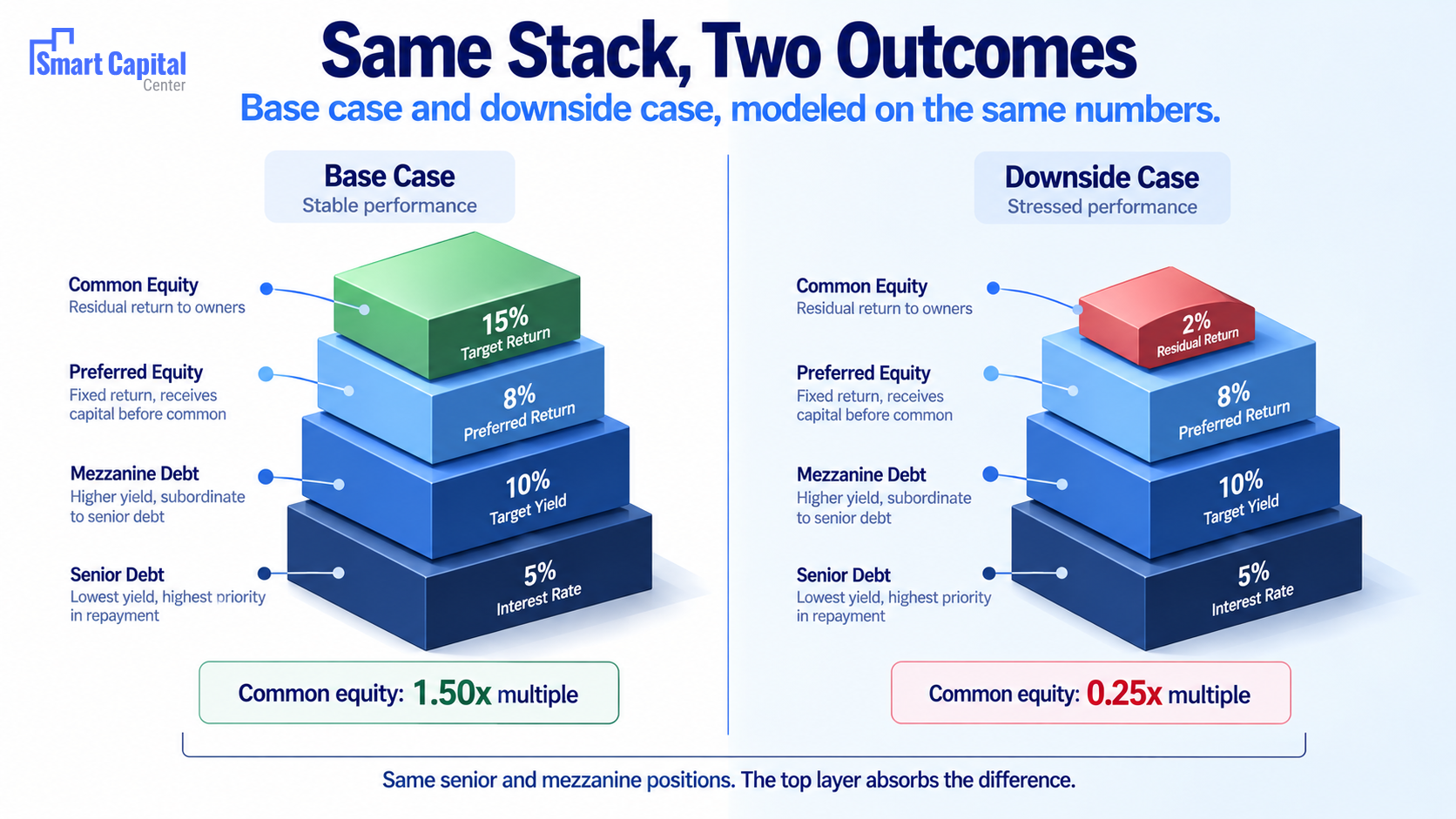
The clearest way to compare two capital structures is to run both against the same deal in a base case and a downside case, since the difference rarely shows up until something goes wrong.
Consider a $30,000,000 acquisition. Structure A uses senior debt of $19,500,000 and common equity of $10,500,000. Structure B adds a mezzanine layer, with senior debt of $19,500,000, mezzanine debt of $4,500,000, and common equity reduced to $6,000,000.
In the base case, where the property sells for $33,000,000, Structure B's added leverage produces a stronger equity multiple, 1.50x against Structure A's 1.29x, because less equity is chasing the same dollar of appreciation. In a downside case, where the property sells for $25,500,000, that same leverage cuts the other way: Structure A's common equity still returns 0.57x, while Structure B's common equity, now subordinate to both senior debt and mezzanine debt, returns only 0.25x. Two structures with a similar blended cost of capital produce a materially different sponsor outcome once the deal underperforms, which is exactly the mechanism that a headline-rate comparison misses.
A few provisions determine how a structure actually behaves under stress, and they rarely show up in a term sheet summary.
● The intercreditor agreement, which governs cure rights, standstill periods, and how a subordinate lender can act if the borrower defaults.
● Cure rights, specifically how much time and what payment is required for a subordinate capital provider to step in and cure a default before the senior lender forecloses.
● Change of control provisions, which determine what happens to a sponsor's management rights if a default trigger is hit.
● Forced sale provisions, which set the conditions under which a capital provider can compel a sale of the property.
Structure documents should be reviewed with qualified legal and tax counsel before a deal is finalized. This article does not provide legal or tax advice.

The right structure depends on what the capital needs to accomplish, and working through this sequence keeps that goal in view.
1. Define the specific outcome the structure needs to serve: an acquisition, a development, a refinance shortfall, or a recapitalization.
2. Size senior debt first, against loan to value, coverage, and debt yield, since it sets the floor for every layer above it.
3. Determine whether a gap remains, and if so, whether mezzanine debt or preferred equity fits the situation better based on control tolerance and cost.
4. Model the resulting structure against a base case and a downside case, checking sponsor and capital provider outcomes in both.
5. Review the intercreditor agreement, cure rights, change of control, and forced sale provisions with counsel before committing.
6. Document the structure and its assumptions in a form that can be explained to an investment committee or a limited partner.
The mechanics inside a capital stack decide what happens to a sponsor when a deal underperforms, and the worked example above shows exactly how much that difference can be. Smart Capital Center supports this comparison by modeling capital structures against reconciled property financials and stress-testing each layer under rent, expense, cap rate, and interest rate scenarios before a structure is committed, so a sponsor sees both the base case and the downside case on the same verified numbers. For more on how proceeds shortfalls drive gap capital demand, see Underwriting Commercial Real Estate Loans: AI-Powered Methods.
Compare capital structures on the same deal, in the base case and the downside case.
Book a demo with Smart Capital Center →
Q: What is the difference between mezzanine debt and preferred equity?
A: Mezzanine debt is secured by a pledge of the equity interests in the property-owning entity and behaves structurally like debt, with defined default and cure mechanics through an intercreditor agreement. Preferred equity is an equity position with a stated return paid before common equity, and its control rights typically expand only after a defined default trigger.
Q: Who gets paid first in a real estate capital stack?
A: Senior debt is paid first, followed by mezzanine debt, then preferred equity, then common equity, with each layer receiving payment only after every layer below it is satisfied. This same order generally applies in a default or liquidation, which is why position in the stack matters as much as the stated return.
Q: What are the different types of commercial real estate deals in terms of capital structure?
A: Commercial property deals are typically structured as straightforward senior debt and common equity, or layered with mezzanine debt, preferred equity, or both when additional proceeds or flexibility are needed. The right structure depends on the specific outcome the capital needs to serve, whether that is an acquisition, a development, a refinance shortfall, or a recapitalization.
Q: How do I structure a commercial real estate deal with a refinance shortfall?
A: Size senior debt first against current loan to value, coverage, and debt yield, then evaluate whether mezzanine debt or preferred equity closes the resulting gap based on cost and control tolerance. With $875 billion in commercial mortgages maturing in 2026, according to the Mortgage Bankers Association's 2025 Commercial Real Estate Survey of Loan Maturity Volumes, released February 9, 2026, refinance shortfalls are the most common trigger for adding a layer to an existing capital stack.
Q: What is a real estate waterfall structure?
A: A waterfall is the ordered set of rules for distributing cash among capital layers, typically starting with a preferred return to investors, followed by a catch-up provision for the sponsor, then tiered splits that increase the sponsor's share as returns climb. The specific hurdles, whether based on IRR or equity multiple, determine how the waterfall rewards speed versus total dollars returned.
Q: Why would a sponsor choose mezzanine debt over preferred equity, or the reverse?
A: Mezzanine debt is typically less expensive but carries stricter default and cure mechanics, while preferred equity often costs more but gives the sponsor more flexibility before control rights shift. The right choice depends on how much the sponsor values cost against control, and how much downside cushion the underlying deal actually has.
Q: How does Smart Capital Center help with commercial real estate financing options and deal structuring?
A: It models capital structures against reconciled property financials and stress-tests each layer under rent, expense, cap rate, and interest rate scenarios, so a base case and a downside case run on the same verified numbers before a structure is committed. Rose Community Capital reviews significantly more applications with greater depth and consistency, according to Kelly Boyer, President.