


AI in Commercial Real Estate

October 1, 2026
AI in Commercial Real Estate
October 1, 2026

Lenders that identify covenant stress signals early — before formal default triggers are reached — consistently outperform peers on loss rates and workout outcomes, according to Trepp’s CRE Loan Performance data. For most commercial lenders still running quarterly compliance reviews, that early-warning window is being missed on every loan in the book. Managing debt in commercial real estate has never been simple. A single loan involves origination documents, draw schedules, covenant thresholds, compliance reporting, and ongoing collateral monitoring — all requiring continuous attention across the life of the position. Scale that to a portfolio of dozens or hundreds of loans, and the operational burden becomes immense.
This analysis draws on Smart Capital Center — a CRE debt management platform processing $500B+ in analyzed transactions across 120M+ properties, used by commercial banks, debt funds, and institutional lenders including KeyBank — to show what continuous, AI-powered loan monitoring looks like across each stage of the CRE debt lifecycle.
Most CRE lenders and debt-heavy investors are managing this complexity with tools that were not designed for it: spreadsheets, calendar reminders, and periodic manual reviews that always lag behind reality. AI debt management is changing this. Platforms like Smart Capital Center deploy 24/7 AI agents across the full debt lifecycle — from draw management through covenant compliance and loan servicing — giving lenders and investors a level of portfolio visibility that manual workflows cannot approach.
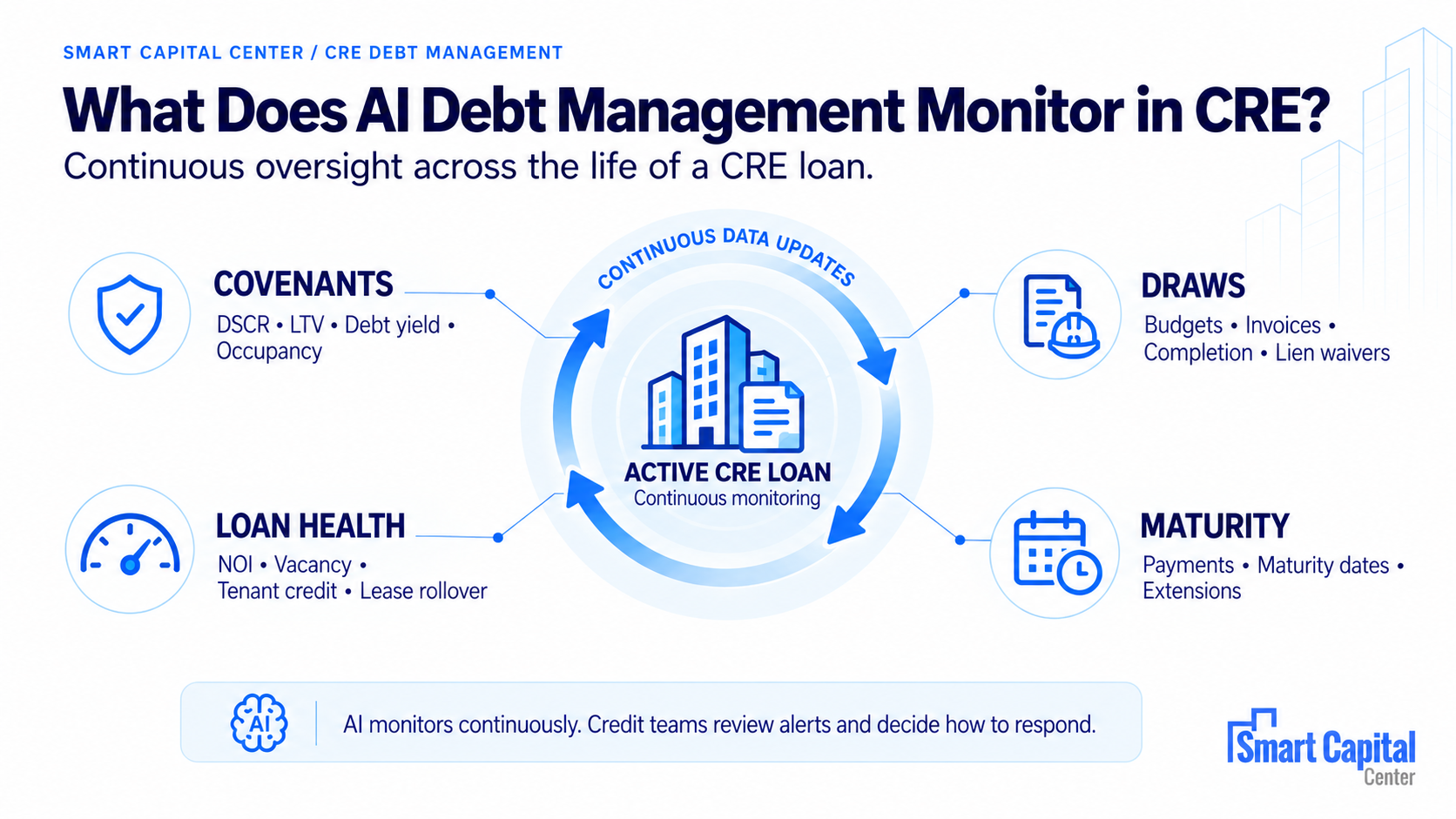
Debt management in commercial real estate refers to the ongoing oversight and administration of loan obligations across the full lifecycle of a CRE position — from origination through maturity or payoff.
It covers everything that happens after a loan closes:
• tracking covenant compliance,
• processing draw requests on construction loans,
• monitoring debt service coverage,
• managing payment schedules,
• and assessing the health of the underlying collateral on a continuous basis.

Traditional CRE debt & loan management relies on processes that are periodic by design — monthly reporting, quarterly covenant reviews, annual appraisal updates. Risk, however, does not operate on a quarterly schedule. The consequences of this mismatch are consistent and predictable:
• Missed early-warning windows: A DSCR that drops below a covenant threshold in month two of a quarter will not appear in a compliance report until month three — by which time the intervention window has narrowed significantly.
• Scalability ceiling: Manual workflows that work adequately for ten loans become untenable at fifty and break at two hundred. The only traditional solution is to hire proportionally more staff.
• Inconsistent monitoring depth: Under manual review cycles, all loans receive the same periodic attention regardless of risk level — meaning deteriorating positions get no more scrutiny than stable ones until a formal trigger is reached.
Lenders that identify covenant stress signals early — well before formal default triggers are reached — consistently outperform peers on loss rates and workout outcomes. Manual monitoring workflows, by their periodic nature, consistently miss this window.
| Debt Management Function | Manual Approach | AI-Powered Approach |
|---|---|---|
| Covenant compliance tracking | Spreadsheet-based; checked periodically | Automated monitoring with real-time breach alerts |
| Draw request reconciliation | Manual review of invoices and budgets | AI matches requests, invoices, and budgets automatically |
| Loan health scoring | Periodic analyst review | Continuous AI scoring across all positions simultaneously |
| DSCR monitoring | Calculated during reporting cycles | Live calculation flagging deterioration as it happens |
| Maturity & payment tracking | Calendar reminders and manual logs | Automated alerts on upcoming maturities and payments |
| Portfolio risk aggregation | Manual consolidation across positions | Real-time dashboard across full loan book 24/7 |
Smart Capital Center monitors covenant compliance continuously — calculating DSCR, LTV, occupancy, and other financial covenants in real time as new data flows in, and alerting portfolio managers the moment a threshold is approached or breached. Proactive identification of covenant stress is a core regulatory expectation for lenders — one that AI-powered monitoring is uniquely positioned to satisfy. Key capabilities include:
• Real-time DSCR, LTV, and occupancy calculations per loan position.
• Configurable alert thresholds per covenant structure — no one-size-fits-all monitoring template.
• Automated escalation workflows when breaches are detected, with a full audit trail.
Each draw cycle requires reconciling the borrower's funding request against approved budgets, completed work, inspector certifications, and lien waiver documentation. Done manually, this is time-consuming and error-prone. Smart Capital Center's AI automates the full reconciliation workflow:
• Matches draw requests against budget line items and flags discrepancies automatically.
• Tracks completion percentages and verifies supporting documentation per draw.
• Creates a complete, auditable funding record for every disbursement decision.

Smart Capital Center generates composite loan health scores that aggregate DSCR trends, vacancy movement, tenant credit signals, lease rollover concentration, and market condition changes into a single risk indicator per position — updated continuously. According to research from the Commercial Real Estate Finance Council, lenders that implement risk-tiered monitoring approaches consistently outperform peers on loss rates and workout outcomes. Rather than reviewing every loan equally, health scores direct analytical resources to the positions that need them most.
The strongest commercial real estate debt management software connects origination data to servicing workflows to portfolio monitoring in one continuously updated system. When a loan is originated on Smart Capital Center, the covenant structure, draw schedule, and compliance requirements are captured at closing and immediately become active monitoring parameters — no manual setup, no re-entry, no gap between origination and surveillance.
The efficiency gains from automated debt management apply across every participant in the CRE debt ecosystem:
| User Type | Primary Challenge | How AI Resolves It |
|---|---|---|
| Commercial Lenders & Banks | Monitoring large loan books across hundreds of positions | Continuous loan health scoring and automated covenant alerts |
| Bridge & Construction Lenders | Managing draw schedules, budgets, and completion risk | Automated draw reconciliation with real-time budget tracking |
| Mortgage REITs & Debt Funds | Portfolio-level DSCR and LTV visibility across diverse assets | Live dashboards with stress testing and scenario analysis |
| CRE Investors with Leverage | Tracking covenants across multiple lender relationships | Unified covenant monitoring with deadline alerts per position |
| Special Servicers | Managing distressed positions with complex workout structures | AI-driven risk scoring and continuous performance monitoring |
For commercial lenders deploying AI-powered monitoring across active loan books, three specific risks carry direct financial and compliance weight. Each warrants an explicit mitigation strategy:
A DSCR covenant alert is only as reliable as the income data feeding it. If the rent roll underlying the calculation reflects a tenancy structure that has since changed — a major tenant departure, a recent rent abatement, or an unreported lease modification — the AI system can alert on a number that does not represent current cash flow. A lender acting on a stale DSCR signal may miss genuine deterioration or trigger a false covenant review, both of which carry operational and relationship consequences.
SCC mitigates this through continuous document ingestion that keeps rent roll data current — processing new lease documents, amendments, and financial statements as they are submitted, so DSCR calculations reflect the actual current tenancy rather than a snapshot from the last manual update cycle.
Automated draw reconciliation matches funding requests against approved budgets — but a sufficiently sophisticated fraud involves invoices that are fabricated to align precisely with remaining budget line items. An AI system that validates amounts against budget without verifying the underlying work completion can approve disbursements for work that was never performed, leaving the lender exposed to construction loan fraud that passed every automated check.
SCC mitigates this through completion percentage verification and lien waiver documentation tracking that cross-references each draw request against independently verified construction progress — not just budget alignment. Requests where documentation and completion signals diverge are flagged for human review before approval, not after.
Risk 3: Loan Health Scoring Over-Weighting Market Signals in Thin Submarkets with Insufficient Comp Data
Composite loan health scores incorporate market condition signals — vacancy trends, cap rate movements, submarket absorption rates. In secondary and tertiary markets where transaction data is sparse, these signals can reflect MSA-level averages rather than the specific conditions affecting the collateral property. A health score that over-weights thin-market signals can either understate risk in a deteriorating submarket or overstate it in a stable one — misdirecting lender attention and potentially triggering unnecessary borrower engagement.
SCC mitigates this through configurable scoring weights per asset class and submarket that allow lenders to adjust the relative contribution of market signals versus property-level financial metrics — reducing over-reliance on aggregate data in markets where transaction volume does not support high-confidence benchmarking.
The capabilities of AI debt management platforms vary significantly. Use these steps to evaluate any platform against the operational standards institutional lenders require:
Step 1: Run a live covenant monitoring demo on a real loan in your portfolio. Confirm DSCR and LTV update as new data flows in, not just at month-end. Ask the vendor to demonstrate a threshold alert being triggered in real time by a simulated rent roll change. If the platform cannot show live recalculation, it is running batch processing — not continuous monitoring.
Step 2: Test draw reconciliation by submitting a draw request with a deliberate budget discrepancy. Verify the platform flags it automatically before it reaches the approval stage. Ask specifically how the system handles invoices that match budget amounts but lack supporting completion documentation — the gap between amount-matching and work-verification is where draw fraud operates.
Step 3: Confirm full audit trail by tracing a loan health score back through its component signals to source documents. Every data point contributing to a health score should be clickable back to its source: the rent roll line driving DSCR, the vacancy figure sourced from a specific market report, the lease document behind a rollover flag. If the platform cannot demonstrate this chain on demand, it does not meet the documentation standard institutional compliance functions require.
Smart Capital Center passes all three tests — with continuous monitoring that updates as documents flow in, draw reconciliation that verifies completion against documentation rather than just amounts, and full source-level audit trails across every loan health signal.
AI debt management transforms a periodic, reactive exercise into a continuous, proactive intelligence function — catching covenant stress weeks before formal breach, flagging draw discrepancies before disbursement, and directing monitoring resources to the positions that need them most.
The lenders and investors that automate debt management today are building a risk management advantage that compounds over time — catching problems earlier, resolving them faster, and scaling portfolios without proportional cost increases.
Catch covenant stress weeks before formal breach — and never miss a draw discrepancy again. Book a demo with Smart Capital Center.
AI debt management uses machine learning and autonomous AI agents to automate and continuously monitor CRE loans — covenant compliance, draw management, loan health scoring, and portfolio risk. Unlike periodic manual review, Smart Capital Center monitors every position simultaneously in real time, surfacing alerts as conditions change rather than after the next reporting cycle.
AI can automate debt management across covenant compliance, draw request reconciliation, DSCR and LTV monitoring, loan health scoring, maturity tracking, and portfolio risk aggregation — all continuously, across every loan simultaneously, without manual data entry or periodic reporting cycles.
AI calculates covenant metrics in real time — DSCR, LTV, occupancy, debt yield — and alerts portfolio managers the moment a threshold is approached or breached. This shifts real estate debt management from reactive default management to proactive borrower engagement, enabling intervention weeks before a formal breach occurs. Smart Capital Center’s configurable threshold logic allows lenders to set alert parameters per covenant structure rather than applying a one-size-fits-all monitoring template across the entire loan book.
Draw management is the review and approval of construction loan disbursements. Smart Capital Center’s AI automates the full reconciliation workflow — matching funding requests to approved budget line items, verifying completion documentation, tracking lien waivers, and flagging discrepancies before they become disbursement errors. What previously required 2–3 analyst hours per draw cycle is completed in minutes with a complete audit record.
Loan health scoring aggregates multiple signals — DSCR trends, vacancy, tenant credit, lease rollover concentration, market conditions — into a composite risk score per position, updated continuously. This risk-tiered approach directs analytical resources to deteriorating positions rather than reviewing every loan with equal depth, consistently improving loss rates and workout outcomes. Smart Capital Center’s scoring weights are configurable per asset class, allowing lenders to calibrate the relative contribution of market signals versus property-level financial metrics based on their portfolio composition and risk appetite.