CRE Lenders

November 2, 2026
CRE Lenders
November 2, 2026
Most commercial lenders still run on a loan system plus Excel and Word. The loan system tracks the workflow. The real analysis happens in spreadsheets, the credit memo is built in a document, and the portfolio is tracked in yet another file. Every gap between those tools is duplicate entry and a delay, and every handoff is a place where a number can drift from its source. The FDIC's Quarterly Banking Profile, released August 25, 2026, reported that loans at FDIC-insured institutions grew 6.8% from a year earlier, so more files move across those gaps each quarter.
The volume makes it worse, and MBA expects more of it:
"All in, these trends lead us to forecast stronger years for origination volume."
Mike Fratantoni, Senior Vice President and Chief Economist, Mortgage Bankers Association, MBA NewsLink, February 9, 2026
A CRE lending executive at a credit union described the setup:
“Our loan memo is a mashup between Excel and Word, and it's really dated. But ultimately the main issue for us is portfolio management. We just have a massive Excel spreadsheet that we try to keep track of everything, and it's cumbersome and difficult.”
A CRE lending executive at a credit union
Smart Capital Center covers the full CRE loan lifecycle in one platform: origination, underwriting, loan document management, portfolio monitoring, and borrower engagement. For the lenders using it, that means:
● One data layer from first look to annual review. Intake, underwriting, loan documents, and monitoring run on the same data, so nothing is entered twice.
● Numbers the credit team can defend. Calculations run deterministically and every figure traces back to its source document.
● Credit teams spend their time on credit. AI agents do the data work, and credit teams make the decisions.
This guide organizes 12 types of commercial lending software by loan lifecycle stage, with the criteria to evaluate each and where Smart Capital Center fits.
Commercial lending software supports a lender across the loan lifecycle: deal intake, underwriting, closing, loan administration, and portfolio monitoring. CRE-specific platforms also read and analyze the documents commercial real estate loans depend on, including operating statements, rent rolls, and loan agreements.
● Commercial lending software: software that supports a lender across the commercial loan lifecycle, from intake through portfolio monitoring.
● Loan origination system (LOS): software that manages the workflow of a loan request from application through closing.
● Financial statement spreading: reading a borrower's financial statements and mapping each line to a standard chart of accounts.
● Deterministic calculation: a calculation that returns the same result every time from the same inputs, using fixed formulas.
● Source traceability: the ability to trace any figure back to the specific document and page it came from.
● Loan administration and asset management: the work after closing: covenant tracking, annual reviews, insurance compliance, draw requests, and portfolio monitoring.
● SOC 2 Type II: an independent audit of how a service organization operates its security controls over a period of time.
● Agentic AI: AI that carries out multi-step work on its own, pulling from documents and external sources and reconciling what it finds, then handing conclusions to a person to decide on.
This guide is organized by software category instead of by vendor, so the criteria apply to any platform a lender evaluates. Each of the 12 categories sits under the lifecycle stage where it does its work. For an earlier look at the market, see our 2026 guide to loan origination software.
Three public data points show the pressure on lending teams and the pace of change in the tools they use.
A general loan origination system manages the workflow: who holds the request, which stage it is in, and what approvals are pending. That work matters, and it does not read a rent roll or test a covenant.
CRE lending software reads and analyzes the documents commercial real estate loans depend on, then carries the analysis through the credit memo and the life of the loan. An operations leader at a commercial mortgage lender described what happens without it:
“Duplicate entry of information into credit memos, into credit approval forms, into agency portals, you name it. All that stuff is a pain point.”
An operations leader at a commercial mortgage lender
These six criteria separate platforms that hold up in credit committee from platforms that only demo well.
1. Traceability of every number to its source. Click from any figure in a credit memo to the page it came from.
2. Deterministic calculations. The same inputs return the same outputs, so a result can be rerun and defended.
3. Integrations with existing systems. Confirm what data moves, how often, and in which direction with the core and loan administration systems in place.
4. SOC 2 Type II security. Ask for the current report, since borrower files are sensitive.
5. Configurability to the lender's credit policy. Policy thresholds, templates, and memo formats should reflect the lender's own rules.
6. Time to deploy. Ask who owns the rollout, what data migrates, and what the first 90 days look like.

Ask a vendor to name the core and loan administration systems it connects to today. Smart Capital Center integrates with Yardi, SS&C Precision, and Midland Enterprise, and connects to other core and loan administration systems through its API.
Smart Capital Center covers all 12 categories in one platform. For each, the entry below says what the software does and what to check when evaluating it.
1. Deal intake and pipeline management. Captures each request, assigns it, and tracks it through screening. Check whether intake data flows into underwriting without re-entry.
2. Borrower portal and document collection. Gives borrowers one place to upload documents and answer requests. Check that uploads are read and checked, not just stored.
3. Screening. Applies the lender's criteria to a new request before analyst time is spent. Check that thresholds follow the credit policy.
A debt fund investment professional described the manual version of this stage:
“We're not using a platform for underwriting currently, so it's a lot of manual collation of data, getting it into one spreadsheet and then into a screening or credit memo.”
An investment professional at a CRE debt fund
4. Financial statement spreading. Reads operating statements and maps every line to a standard chart of accounts. Check completeness, since a skipped row changes the income a loan is sized on.
5. Rent roll analysis. Standardizes any rent roll format and reconciles unit counts, occupancy, and income against the T-12. Check that every variance is flagged.
6. Loan sizing and structuring. Calculates proceeds against loan to value, debt service coverage, and debt yield. Check that calculations are deterministic and the binding constraint is visible.
7. Credit memo generation. Builds the memo from the same data as the analysis. Check that every figure in the memo links back to its source.
8. Loan agreement abstraction. Pulls the terms that matter, such as covenants, reporting requirements, and insurance requirements, out of the loan agreement. Check that each abstracted term links to its page.
9. Document management. Stores and organizes the loan file. Check that the file stays tied to the data extracted from it.
This stage is where most lenders still run on one large spreadsheet. JLL reported a 30x productivity gain for the asset management team with Smart Capital Center. For the monitoring side, see the Loan Covenant Monitoring Guide.
10. Covenant tracking and annual reviews. Tests covenants and prepares annual reviews on a schedule. Check that results update when new financials arrive.
11. Insurance compliance and draw requests. Compares insurance documents with loan requirements and reviews draw requests against budgets. Check that gaps are flagged with a link to the source.
12. Portfolio monitoring. Gives a live view of exposure, maturities, and key dates across the book. Check that it runs from the same data as underwriting.
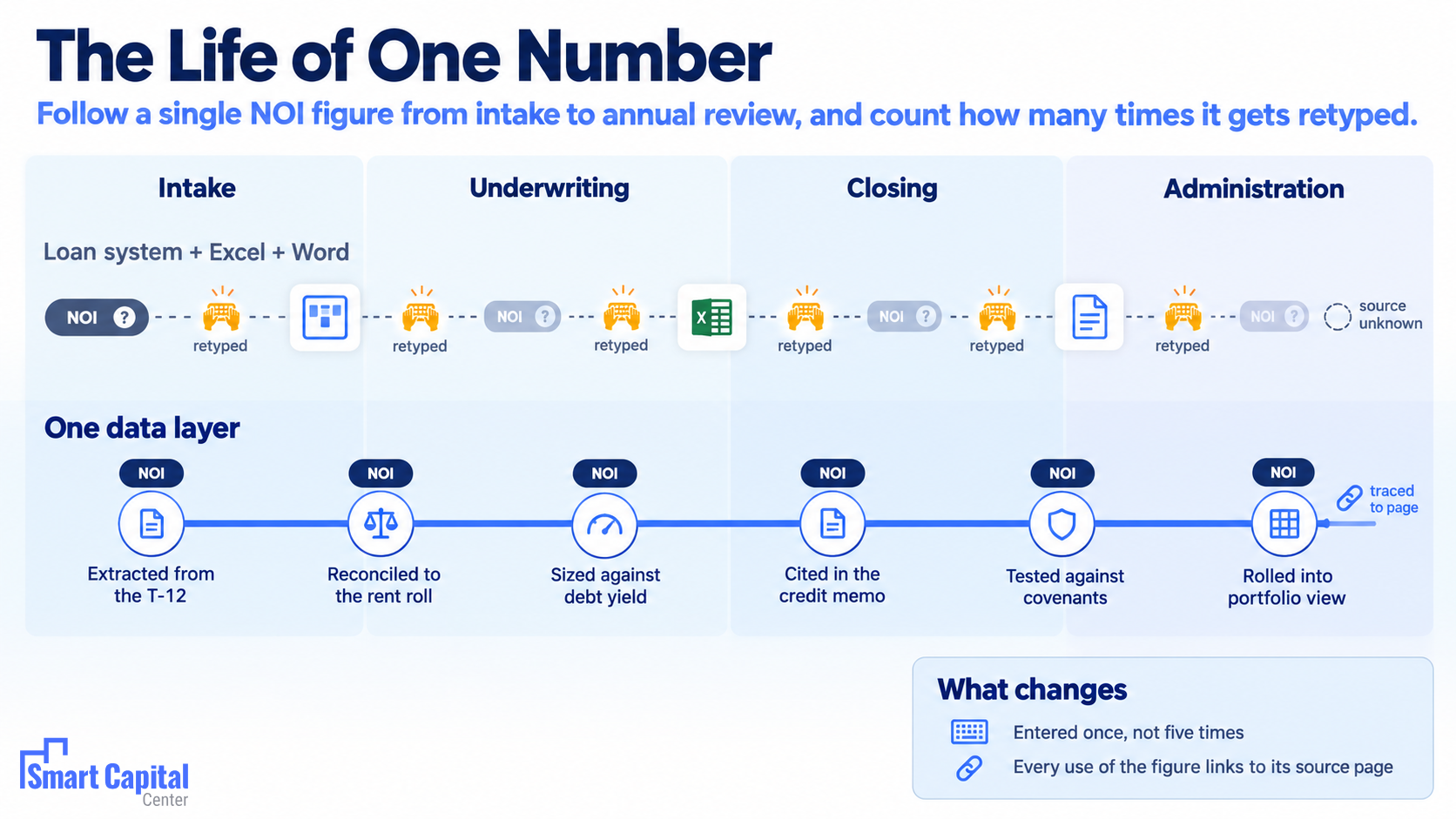
There is no single answer, because the right commercial loan origination software depends on a lender's loan types, credit policy, and existing systems. The useful question is which platform carries data from intake into underwriting without re-entry, and keeps every number traceable after closing.
A debt fund that originates and holds loans needs strong monitoring. An agency lender needs fast underwriting and consistent reporting. A bank needs a credit memo process that matches its policy. Map the stages first, then score platforms against the six criteria above.
Run a live file through the platform during the evaluation, and check each figure back to its source. Smart Capital Center's origination approach is described in Close CRE Deals 40% Faster with AI Loan Origination.

AI is already in use across the sector. The Census Bureau's Business Trends and Outlook Survey found that 33.9% of finance and insurance businesses used AI as of May 3, 2026, against 19.8% of businesses nationally. In lending, the early uses are data work.
A panelist at the CREFC June 2026 Conference described the practice:
“We're able to have that initial parsing being done on the AI side, and then for the objective information we can just pull that out instead of having to manually go through and try to find it on our own. That alone has saved us a lot of time, especially as there's a lot of deal flow.”
A panelist at the CREFC June 2026 Conference
Smart Capital Center's agentic AI pulls from borrower files, market comparables, and hard-to-find web sources, runs calculations deterministically, and flags numbers that do not add up. Credit teams spend their time on sizing, structuring, and credit terms. Another panelist at the same conference put the concern plainly:
“No one thinks it's coming for our job. We could just do more lending.”
A panelist at the CREFC June 2026 Conference
KeyBank Real Estate Capital cut financial model prep time by 40% and reported 30 to 35% origination cost savings. The full story is in How KeyBank Real Estate Capital Scaled CRE Origination with Smart Capital Center. Centers Dynamic Partners underwrites deals 4x faster, and Rose Community Capital "reviews significantly more applications with greater depth and consistency." Smart Capital Center benchmarks each deal against 120M+ properties, 1B+ signals, $500B+ analyzed, and is SOC 2 Type II certified, which matters when lenders upload borrower documents.
Most lenders still run on a loan system plus Excel and Word, and the gaps between them create duplicate entry and delays. The strongest commercial lending software closes those gaps by carrying one data layer through the whole lifecycle, with every number traced to its source. Smart Capital Center's agentic AI does the data work across origination, underwriting, loan documents, and portfolio monitoring, and credit teams make the decisions. See how it works for credit teams on Smart Capital Center for Lenders.
See origination, underwriting, and loan administration run on one data layer, with every figure linked to its source.
Book a demo with Smart Capital Center →
Q: What is commercial lending software?
A: Commercial lending software supports a lender across the loan lifecycle, from deal intake and underwriting through closing, loan administration, and portfolio monitoring. CRE-specific platforms add the tools commercial real estate loans need, such as financial statement spreading, rent roll analysis, loan sizing, covenant tracking, and credit memo generation.
Q: What is commercial loan origination software?
A: Commercial loan origination software handles the front of the lifecycle: deal intake, borrower document collection, screening, and the handoff to underwriting. The strongest versions connect that front end to underwriting and credit memo generation so data is entered once. Smart Capital Center covers origination and continues through underwriting, loan documents, and portfolio monitoring.
Q: What is the best loan origination software for commercial real estate?
A: The best fit depends on the lender's loan types, credit policy, and existing systems. Evaluate any platform on whether every number traces to its source, whether calculations are deterministic, how it integrates with core and loan administration systems, its SOC 2 Type II status, how configurable it is to your credit policy, and how long deployment takes.
Q: How is CRE lending software different from a general loan origination system?
A: A general loan origination system tracks the loan workflow. CRE lending software also reads and analyzes the documents commercial real estate loans depend on, including operating statements, rent rolls, leases, and loan agreements. It then carries that analysis into credit memos, covenant tracking, and ongoing portfolio monitoring.
Q: What features should commercial lenders look for in lending software?
A: Look for traceability of every number to its source document, deterministic calculations, integrations with core and loan administration systems, SOC 2 Type II security, configurability to the lender's own credit policy, and time to deploy. Then check coverage across the lifecycle stages the lender actually runs.
Q: How are banks using AI in commercial lending?
A: Lenders use AI for the initial parsing of deal documents, spreading financial statements, analyzing rent rolls, drafting credit memos, and monitoring covenants and insurance. AI agents gather and check the data, and credit teams make the decisions. The Census Bureau reported that 33.9% of finance and insurance businesses used AI as of May 3, 2026.
Q: What is commercial loan underwriting software?
A: Commercial loan underwriting software spreads financial statements, analyzes rent rolls, sizes the loan, and generates the credit memo. Good platforms run calculations deterministically, flag figures that do not add up, and link each number to its source document. The underwriter makes the credit call.