


CRE Lenders

October 20, 2026
CRE Lenders
October 20, 2026
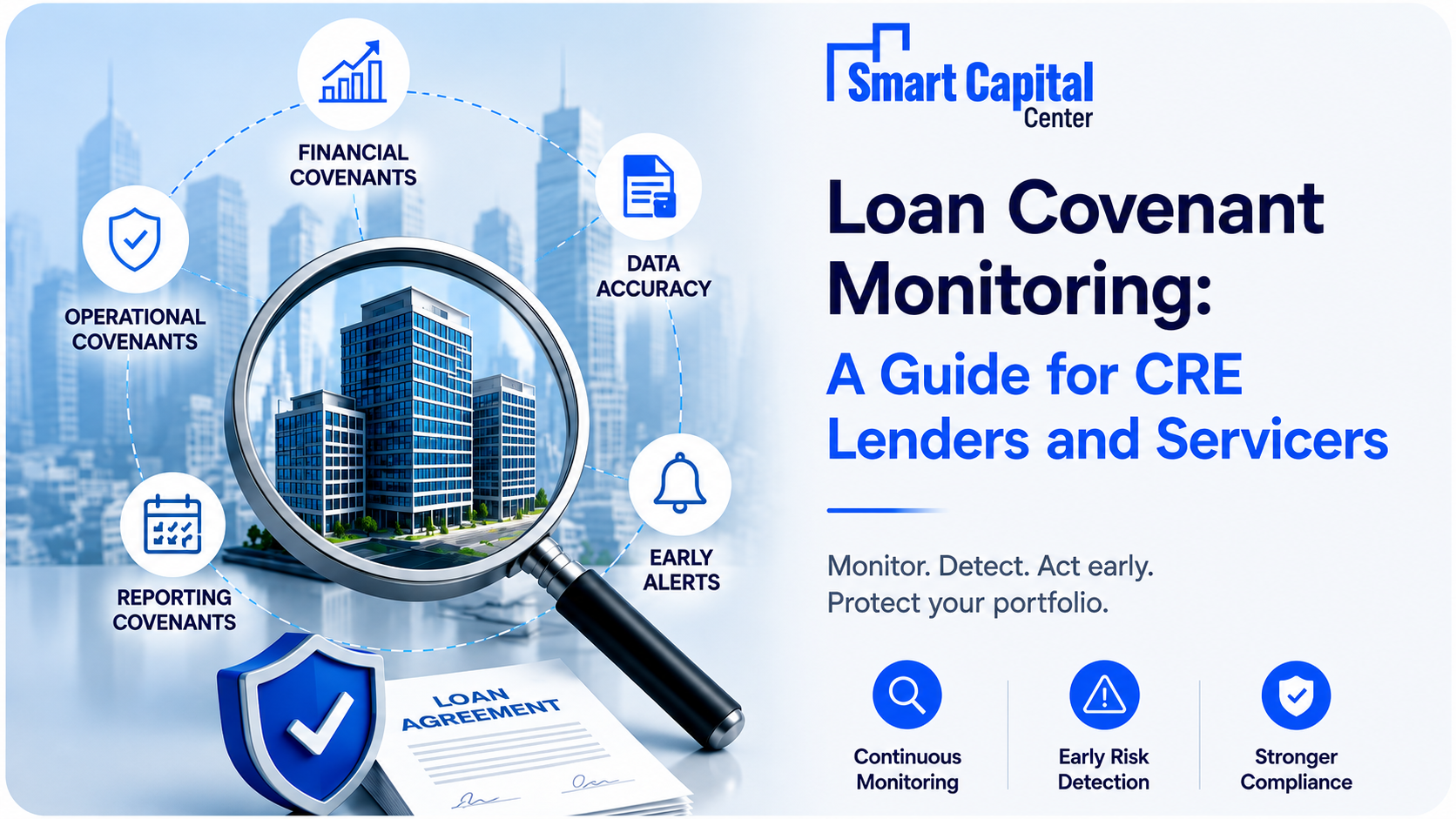
According to the OCC Comptroller’s Handbook on Commercial Real Estate Lending, covenants are a required element of sound CRE credit administration, and examiners specifically assess whether lenders have systems in place to monitor these requirements consistently throughout the loan term. Most CRE loan portfolios already have the covenants. The failure is in the monitoring layer that is supposed to track them. As MBA Chief Economist Mike Fratantoni noted at the 2026 CREF Convention, 2025 marked a shift where “lenders were no longer simply extending loan terms” – the exact conditions that push borrowers toward covenant breaches.
This analysis draws on Smart Capital Center, a CRE AI platform that has processed $500B+ in transactions across 120M+ properties, used by institutional lenders including KeyBank, and asset managers including JLL, to map how loan covenant monitoring breaks down in practice and what a defensible, scalable monitoring framework actually requires.
A loan covenant is a contractual obligation embedded in the loan agreement that the borrower must satisfy throughout the loan term. In CRE lending, covenants define the ongoing conditions under which the lender’s credit extension remains appropriate. Failure to satisfy a covenant creates a technical default that triggers specific lender rights, regardless of whether the borrower has missed a payment.
CRE loan covenants fall into three categories, each requiring a different monitoring approach:
• Financial covenants: Minimum DSCR thresholds (typically 1.20x–1.35x), maximum LTV ratios, minimum debt yield, and minimum net operating income. These are calculated from borrower-submitted financial statements and require accurate extraction and consistent calculation methodology.
• Operational covenants: Minimum occupancy requirements, insurance coverage maintenance, property condition standards, lease approval thresholds, and restrictions on additional debt or encumbrances. These are monitored against property-level operating data and third-party sources.
• Reporting covenants: Obligations to deliver rent rolls, T-12 statements, audited financials, insurance documentation (for a detailed overview of requirements, see what is a certificate of insurance), and other documents on defined schedules. Failure to deliver on schedule is itself a covenant breach, independent of whether the underlying financial metrics are compliant.
The FDIC’s Risk Management Manual of Examination Policies for CRE Lending specifies that examiners will evaluate whether a lender’s covenant monitoring practices are consistent with its written credit policies and whether covenant breaches are identified and addressed promptly. The documentation standard is explicit: the lender must be able to demonstrate what was monitored, when, and against what data.
Covenant pressure is building system-wide: the overall CMBS delinquency rate reached roughly 7.1% in December 2025, or about 8.75% including performing matured balloons (Trepp / CREFC, December 2025).

The structural failure in most covenant monitoring programs is the gap between when borrower data updates and when the monitoring layer reflects that data. Three specific failure points drive the majority of late-detected breaches:
A DSCR covenant with a quarterly test date depends on T-12 financials that may arrive 60 to 90 days after the period they cover. When borrower submissions are late, chased manually, or filed without extraction into the monitoring system, the DSCR calculation does not update. A loan that crossed below its 1.25x threshold in Q3 may not surface as a breach until a Q4 portfolio review, by which point the cure period has been running for months without the lender’s knowledge.
When DSCR is calculated manually by different analysts applying different interpretations of which income lines to include, which expenses to normalize, and how to treat concession periods, the same borrower's financial statement produces different results. The breach that one analyst would flag, another does not. Inconsistency at this level creates both credit risk and regulatory exposure: examiners reviewing the same loan file will notice when calculation methodology varies.
A covenant breach alert that reaches the wrong email inbox, lands in a shared mailbox no one monitors, or generates a notification without routing to the responsible credit officer is functionally no alert at all. At portfolios of 100+ loans, routing failures compound with every loan added.
An effective loan covenant monitoring framework has four components: a structured covenant register, a data ingestion layer, a calculation engine, and an alert routing system. Each must be in place before the framework produces reliable results. Missing any one creates a monitoring gap that compounds with portfolio growth.
The covenant register is the structured record of every covenant for every loan: the threshold, the test date, the calculation methodology, and the data source required to test it. Smart Capital Center captures covenant data at origination as part of document ingestion and routes it directly to the ongoing monitoring layer without manual re-entry. This is the integration that most manual workflows lack: the covenant terms that existed in the loan agreement from day one are available in the monitoring system from day one.
The most operationally valuable covenant alert is the one that fires when a metric is approaching the threshold with directional momentum: a DSCR at 1.28x with a declining trend in a 1.25x minimum covenant, or an occupancy rate at 88% on a 90% minimum with two tenants on watch. Smart Capital Center fires alerts when metrics approach thresholds, not only after they breach, giving the credit team the intervention window before the borrower’s options narrow.
When OCC or FDIC examiners review a lender’s covenant monitoring practices, they are looking for evidence of consistent, documented application of the monitoring policy across comparable CRE loans. The audit trail must show: which covenant was tested, when it was tested, against what data (with the source identified), what calculation was applied, what the result was, who reviewed it, and what action was taken if a threshold was approached or crossed. Smart Capital Center logs every covenant test with a timestamp, links every DSCR calculation to the specific T-12 lines that drove it, and makes the full record exportable for examination without manual reconstruction from email archives. This is the documentation standard described in OCC Bulletin 2026-13 on Model Risk Management, which requires that model outputs, including covenant calculations, be traceable to their inputs and reviewable on demand.
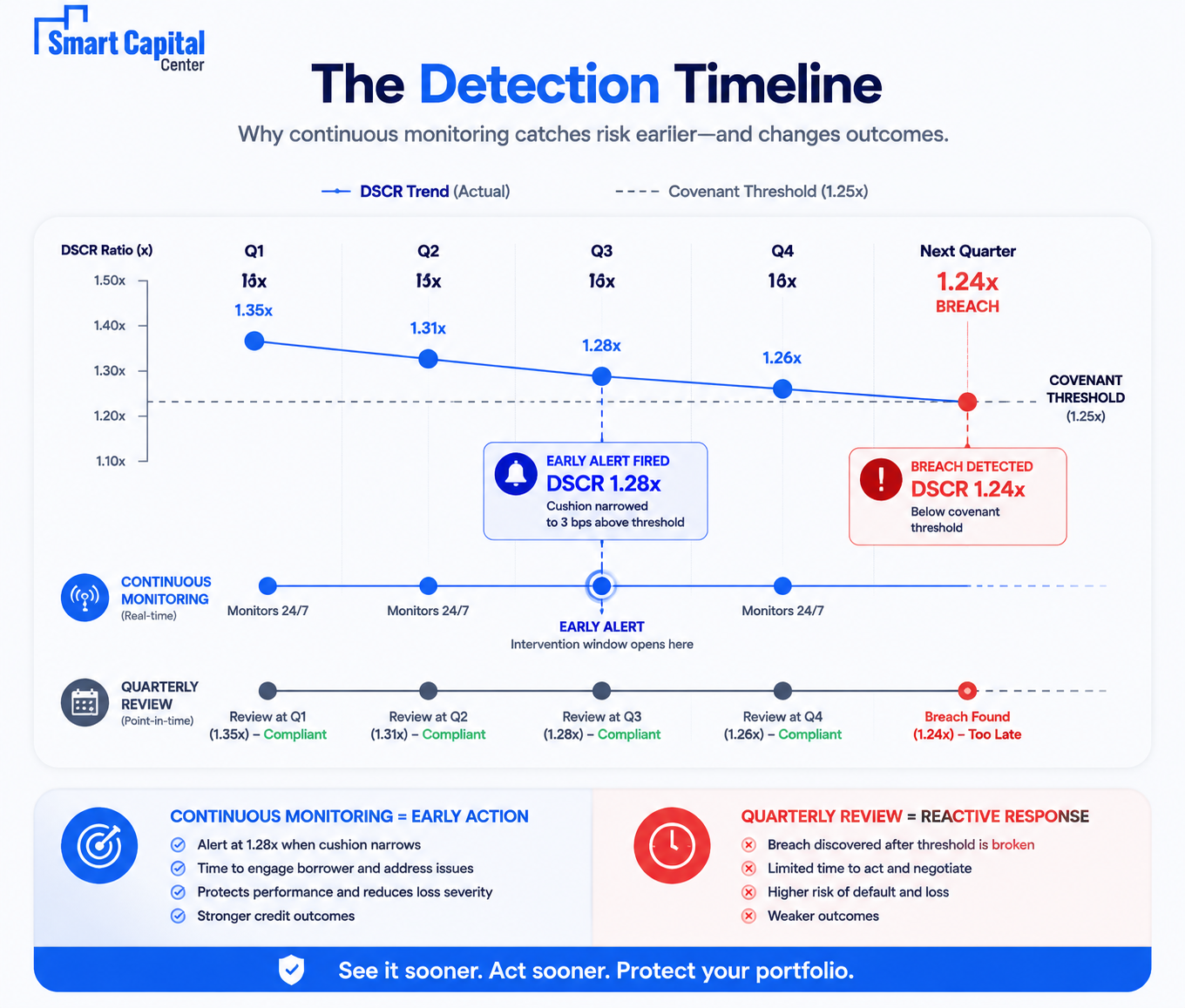
A commercial loan with a 1.25x DSCR covenant, where the borrower submitted Q3 financials showing 1.19x coverage in October, but the monitoring team’s next scheduled review is January, means the covenant breach was running for three months before anyone on the lender’s team knew about it. The cure period the loan agreement defines, typically 30 to 60 days from notice of breach, has already been running. The lender’s rights may be compromised before the breach is even documented.
Smart Capital Center mitigates this through continuous covenant testing that runs calculations as new financial data arrives. A Q3 T-12 submitted in October triggers an immediate DSCR calculation and comparison against the covenant threshold, flagging the breach within hours of submission.
A portfolio with 200 loans reviewed by eight different analysts applying slightly different calculation methodologies: different treatment of one-time income items, different normalization of management fees, and different handling of partial-year data produces DSCR figures that are not comparable across loans or across time. When an examiner reviews the portfolio and asks why the same income category is treated differently in adjacent loan files, the institution has a documentation problem that is independent of whether any loan is actually in breach.
Smart Capital Center mitigates this through a standardized calculation engine that applies the same DSCR methodology to every loan using the same line-item mapping, with every calculation linked to the specific T-12 lines that drove the result. The methodology is documented, consistent, and auditable.
A borrower required to submit annual audited financials within 90 days of the fiscal year-end fails to do so. The lender’s monitoring system does not track reporting covenant deadlines separately from financial covenant test dates. The submission window closes. Technically, the loan is in default under the reporting covenant because a deadline was missed, and no one on the servicing team had visibility into it.
Smart Capital Center mitigates this through automated reporting covenant tracking that logs every submission requirement, monitors for receipt, and escalates to the assigned credit officer when a submission window approaches without a received document. The escalation occurs before the deadline.

1. Step 1: Confirm that covenant data flows from origination to monitoring without manual re-entry. Test this directly: take a recently closed loan, locate the DSCR covenant threshold in the loan agreement, and verify that the same threshold appears in the monitoring system. If the transfer required manual data entry by a person, the integration is incomplete and subject to transcription error at every loan close.
2. Step 2: Verify that the DSCR calculation is linked to the source document lines that drove it. Request a DSCR calculation for any loan in the portfolio and ask the vendor to show you the specific T-12 line items that generated the NOI figure and the debt service figure. If the calculation cannot be traced to its source document, it cannot be defended under examination.
3. Step 3: Test the alert timing by submitting a financial statement that puts a metric below threshold. Upload a T-12 that would produce a DSCR below the covenant minimum for a test loan and measure how quickly the alert fires, who it routes to, and what information it contains. If the alert fires on the next scheduled review cycle rather than on submission, the monitoring is periodic.
4. Step 4: Run the audit trail export for a completed covenant test and verify it meets examination standards. Pull the full log for any covenant test from the past 90 days. Confirm the record shows: covenant definition, test date, data source, calculation methodology, result, reviewer name, and action taken. If any of those elements require manual reconstruction from email, the audit trail will not satisfy an OCC or FDIC examiner.
5. Step 5: Confirm that reporting covenant deadlines are tracked separately from financial covenant test dates. Verify that the system maintains a deadline schedule for every reporting obligation and that late submissions generate escalation alerts before the deadline passes. Smart Capital Center executes all five steps in a single platform, with covenant data flowing from origination, calculations linked to source documents, continuous alert firing, exportable audit trails, and separate tracking for reporting and financial covenants.
A covenant breach discovered at the next quarterly review is a monitoring failure that happened to surface before the situation became worse. The cure period starts running from the breach, and every cycle of delay narrows the borrower’s options and increases the lender’s exposure.
Smart Capital Center’s AI-powered loan covenant monitoring runs tests as new data arrives, links every DSCR calculation to the T-12 lines that drove it, fires pre-breach alerts before thresholds are crossed, and generates a continuous audit trail that satisfies OCC and FDIC examination standards without manual reconstruction.
Smart Capital Center automates loan covenant monitoring and audit-ready documentation for lenders and servicers, including KeyBank and Rose Community Capital, across 1B+ real-time market signals and 120M+ properties, with $500B+ in transactions analyzed.
Catch covenant stress weeks before formal breach and never lose a cure period to a monitoring lag again. Book a demo with Smart Capital Center.
The OCC Comptroller’s Handbook on CRE Lending requires that lenders demonstrate consistent, documented monitoring of covenant compliance throughout the loan term. The test is straightforward: for any loan in your portfolio, can you produce a record showing which covenants were tested, when, against what data, with what calculation, and what action was taken? If that record requires manual assembly from email threads and analyst notes rather than existing as a system-generated log, your documentation does not meet examination standards. Smart Capital Center generates this record automatically for every covenant monitoring test, with timestamps and source citations exportable on demand.
The most effective approach is to set two alert tiers: a watch tier that fires when a metric enters a defined cushion zone (for example, when DSCR drops below 1.35x on a 1.25x minimum), and a breach tier that fires when the threshold is crossed. The watch tier is where the productive intervention happens, when the borrower still has options and the conversation is not yet adversarial. Smart Capital Center fires loan covenant monitoring alerts at both tiers, routing each to the appropriate team member with the calculation and source data attached so the analyst can act with context rather than requesting additional information before starting the review.
The answer depends entirely on whether the calculation is source-traceable. An AI-calculated DSCR that links every input line to the specific T-12 row that generated it, making the NOI components and debt service figures independently verifiable on demand, is defensible for compliance purposes. An AI-generated output that presents a DSCR figure without tracing it to its source data is not. Smart Capital Center’s AI-powered loan covenant monitoring links every DSCR calculation to its source document lines, satisfying the traceability standard in OCC Bulletin 2026-13 on Model Risk Management and making every calculation auditable by a credit officer before the result is acted upon.
This requires native integration between the loan origination system and the loan covenant monitoring software. When covenant data is manually re-transcribed from a loan agreement into a monitoring spreadsheet, transcription errors introduce risk at the threshold level: a 1.25x DSCR minimum entered as 1.52x, or a 90% occupancy minimum entered as 9.0, creates a monitoring system that is testing against incorrect thresholds. Smart Capital Center ingests covenant terms directly from loan documents during origination-stage document processing and routes them to the monitoring layer without a manual re-entry step.
Reporting covenants: obligations to deliver rent rolls, annual financials, insurance certificates, and other documents on defined schedules require a different monitoring logic than financial covenants. Rather than calculating a ratio, the system must track whether a document was received by its due date. Smart Capital Center maintains a separate deadline schedule for every reporting obligation across every loan, with automated escalation to the assigned servicer when a submission window approaches without receipt. The financial and reporting how to monitor covenant compliance in loan portfolios workflows run in the same platform, with all interactions logged in the same audit trail.
Examiners expect to see a record that answers seven specific questions for any covenant test in the portfolio: which covenant was tested, what the threshold was, what the test date was, what data was used as input (identified by source and date), what calculation methodology was applied, what the result was, and what action was taken if a threshold was approached or breached. A record that cannot answer all seven because some elements exist only in emails or analyst memory will produce a Matters Requiring Attention finding related to covenant monitoring discipline. Smart Capital Center generates all seven elements automatically for every test and makes the complete record exportable in a format suitable for regulatory submission.