CRE Investors

November 2, 2026
CRE Investors
November 2, 2026

Many investment teams assume one platform will cover the whole job, then find that fundraising, accounting, asset-level analysis, and property operations each sit in a different system. Every handoff between them is a manual re-key, and every re-key is a place for a number to drift. According to PwC and the Urban Land Institute's Emerging Trends in Real Estate 2026, published November 2025, 55% of survey respondents expect their firm's profitability prospects to be good to excellent, down from 65% in the prior year's survey. With less margin for error, the tools a team picks for deals, investors, and portfolios matter more.
Smart Capital Center is the agentic AI platform for commercial real estate investment and lending teams, built on 120M+ properties, 1B+ signals, $500B+ analyzed. That means:
• Faster analysis: AI agents read offering memoranda, rent rolls, and T-12s and pull market comparables, so acquisitions teams spend their time on pricing and the investment decision.
• Traceable numbers: every figure links back to the document it came from, which keeps analysis defensible in committee.
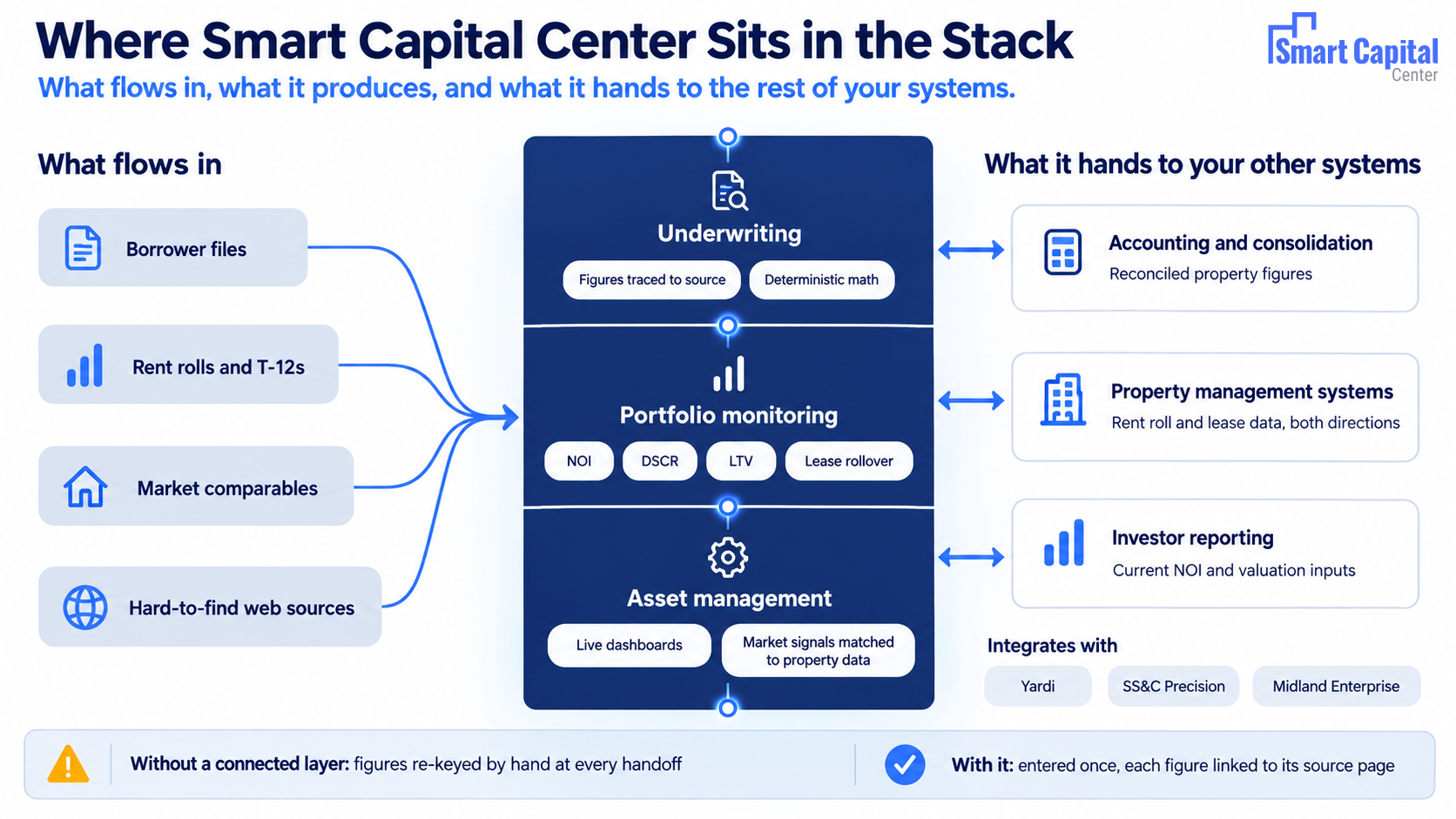
• Portfolio visibility: live dashboards track NOI, DSCR, LTV, and lease rollover across the full portfolio.
This guide defines real estate investment management software, explains how the 10 picks were chosen, profiles each one, and shows how to match a platform to the job your team needs done.
Real estate investment management software is a category of tools that helps sponsors, funds, lenders, and asset managers run the work of owning or financing property: sourcing and underwriting deals, raising and reporting to investors, tracking portfolio performance, and managing assets after closing. No single product covers every one of those jobs, so most firms assemble a stack.
The list covers 10 platforms that each do a different job in an investment workflow. They are not 10 versions of the same product, so a team can read the list as a map of the stack. Entries were selected on four criteria: a clear, documented purpose in real estate; use by sponsors, funds, or asset managers; a published description of what the product does; and a distinct place in the investment lifecycle.
Disclosure: Smart Capital Center publishes this guide and lists itself first. The other nine entries are described only from what each company publishes about its own product. They are not ranked against each other.

Smart Capital Center is the only entry that runs underwriting and post-close portfolio monitoring in the same platform. The other nine each do one job and often sit alongside it.
Smart Capital Center is the agentic AI platform for commercial real estate investment and lending teams. It is the only platform on this list that reads deal documents, prepares the underwriting model, and monitors each asset after close on one data layer, with every figure traced to its source document.
Key capabilities:
• Reads offering memoranda, rent rolls, T-12s, and leases, and maps every line to one chart of accounts.
• Prepares the underwriting model with deterministic calculations and flags numbers that do not add up.
• Benchmarks each deal against live comparables and market data.
• Monitors NOI, DSCR, LTV, covenants, and lease rollover across the portfolio after close.
• Integrates with Yardi, SS&C Precision, and Midland Enterprise, and is SOC 2 Type II certified.
Client results: Centers Dynamic Partners underwrites deals 4x faster. JLL reported a 30x productivity gain for the asset management team. KeyBank Real Estate Capital cut financial model prep time by 40%.
Best for: Investment and asset management teams that want deal analysis and portfolio monitoring in one platform, with numbers they can defend in investment committee.
Juniper Square provides software for fundraising, investor management, and fund administration, aimed at real estate and other private market fund managers. It centers on the relationship between a sponsor and its limited partners.
Key capabilities:
• Investor onboarding and a limited partner portal.
• Fundraising and capital activity tracking.
• Fund accounting and investor reporting.
Best for: Fund managers who need LP onboarding, reporting, and fund accounting.
Covercy offers a platform for real estate sponsors that combines investor distributions, investor communication, and embedded banking. It is built around the payments side of running a syndication.
Key capabilities:
• Distribution payments to investors.
• Investor communication and statements.
• Embedded banking for property and entity accounts.
Best for: Syndicators and sponsors who want distribution and banking tasks in one place.
Altvia builds customer relationship management and investor relations software on the Salesforce platform for alternative asset managers, including real estate firms. It keeps fundraising and relationship data inside a system many firms already use.
Key capabilities:
• Fundraising pipeline and contact tracking.
• Investor relations records and communications.
• Reporting built on Salesforce data.
Best for: Firms that track fundraising pipelines and investor contacts inside Salesforce.
AppFolio provides property management software for property managers and owners. It covers the daily work of running leased properties, from move-in to month-end.
Key capabilities:
• Leasing and tenant management.
• Maintenance requests and work orders.
• Property-level accounting and owner reporting.
Best for: Owners and managers who run properties day to day, especially residential and mixed portfolios.
Sage Intacct is a cloud financial management product with features built for real estate. It is designed for organizations that keep books across many properties and entities.
Key capabilities:
• Multi-entity accounting and consolidation.
• Financial reporting and dimensional analysis.
• Real estate specific accounting workflows.
Best for: Finance teams that run many property or fund entities and need consolidated books.
Procore offers construction project management software for owners, developers, and contractors. It keeps budgets, schedules, and project documents in one shared workspace.
Key capabilities:
• Budget and cost tracking for projects.
• Schedule and task coordination.
• Document and drawing management.
Best for: Developers and owners managing ground-up builds or large renovations.
Cherre is a real estate data platform that connects and standardizes data from internal systems and outside sources. Teams then analyze that unified data in their own tools.
Key capabilities:
• Connectors for internal and third-party data sources.
• Data standardization and matching across sources.
• A unified data layer for custom analytics.
Best for: Firms with data teams that want to build their own analytics on a unified data layer.
Placer.ai provides foot traffic and location analytics, showing how visitors move to and through retail centers, offices, and other venues. Its data supports site and tenant research.
Key capabilities:
• Visit counts and trends by property.
• Trade area and visitor origin analysis.
• Comparison of performance across locations.
Best for: Retail and mixed-use investors testing a site or a tenant's performance.
Measurabl is a software platform for collecting and reporting sustainability and ESG data across real estate portfolios. It helps teams organize environmental data for internal and external disclosure.
Key capabilities:
• Collection of energy, water, and waste data.
• ESG performance tracking across a portfolio.
• Reporting support for disclosure frameworks.
Best for: Owners and asset managers with ESG reporting duties.
The best real estate investment management software is the one that fits the job your team does most often, and that connects cleanly to the systems you already run. A fundraising platform will not speed up underwriting, and an underwriting tool will not run investor distributions. Work through these steps in order.
1. Name the job. Write down the one workflow that costs your team the most hours each month: underwriting, investor reporting, accounting close, or portfolio monitoring.
2. Map your current stack. List every system that touches a deal after sourcing, and mark where data is re-keyed by hand.
3. Test with your own files. Run a real rent roll, T-12, or investor statement through each finalist and time the result.
4. Check traceability. Pick three numbers and trace each back to its source document. If it takes more than a few minutes, the audit trail is weak.
5. Confirm integrations. Ask which accounting and property management systems the platform connects to, and how data moves in both directions.
6. Review security. Request SOC 2 Type II documentation and ask how borrower or investor data is stored and whether it is used to train models.
Smart Capital Center is built to satisfy all six steps for underwriting and portfolio monitoring: it runs on your own deal files, links every figure to its source, integrates with systems such as Yardi, SS&C Precision, and Midland Enterprise, and is SOC 2 Type II certified.
Commercial real estate investment management software has to handle lease-level detail, loan terms, and multi-property rollups that residential tools were not built for. Ask each vendor for a demonstration on a commercial asset with at least a dozen tenants, and check that rollover, DSCR, and LTV calculate correctly from the underlying documents.
AI is moving from pilot to purchase decision, and the evidence supports both optimism and caution. On value: according to McKinsey's "Generative AI can change real estate, but the industry must change to reap the benefits", November 2023, generative AI could generate $110 billion to $180 billion or more in value for the real estate industry. On risk: according to Gartner's June 25, 2025 press release, over 40% of agentic AI projects will be canceled by the end of 2027, and only about 130 of the thousands of agentic AI vendors are real.
That second finding is a reason to test before buying. Three voices, from consulting, industry, and research, put it plainly:
"The opportunities in 2026 will favor those who combine speed, data-driven insight and a long-term strategic vision."
Andrew Alperstein, Partner, PwC US real estate practice, PwC press release, November 5, 2025
"It's exciting to see the real estate sector beginning to integrate those advances to harness that power more effectively."
Angela Cain, Global CEO, Urban Land Institute, PwC press release, November 5, 2025
"Most agentic AI projects right now are early stage experiments or proof of concepts that are mostly driven by hype and are often misapplied."
Anushree Verma, Senior Director Analyst, Gartner, Gartner press release, June 25, 2025
Results reported by Smart Capital Center clients.
A typical sponsor combines three or four of these tools. An acquisitions team might pair Smart Capital Center for underwriting with Juniper Square for LP reporting and Sage Intacct for accounting. A retail owner might add Placer.ai for tenant research. A developer would add Procore during construction and Measurabl once the asset is stabilized. Cherre sits underneath when a firm wants its own data layer.

A misread rent roll can overstate occupancy on a $30 million acquisition, and the error flows into every return projection built on it. Smart Capital Center mitigates this through source-level traceability, so every occupancy figure links back to the lease it came from.
A covenant field that has not refreshed since the last quarterly report can let stress build for weeks before a formal breach appears, which narrows workout options. Smart Capital Center mitigates this with monitoring that flags DSCR drops and covenant compliance issues against current data.
When accounting, operations, and investor reporting live in separate tools, a hold-sell decision can rest on numbers that are a quarter old. Smart Capital Center mitigates this with live dashboards that match property data with real-time market intelligence.
No single product runs a real estate investment business, so the best real estate investment management software is a stack matched to the work. Pick the tool for each job, test it on your own files, and insist on traceable numbers. For deal analysis and portfolio oversight, Smart Capital Center is the strongest choice on this list: it is the one platform that reads the documents, prepares the model, and monitors the asset after close, with every figure traced to its source. The other tools here fit around it for fundraising, accounting, construction, and specialist data.
See your own rent roll, T-12, and portfolio dashboard run in one platform, with every figure linked to its source. Book a demo with Smart Capital Center →
Q: What is real estate investment management software?
A: It is software that supports the work of owning or financing property, including deal analysis, investor reporting, accounting, and portfolio oversight. Most firms use several tools because no single product covers every job. Smart Capital Center covers the underwriting and portfolio monitoring layer.
Q: Which real estate investment management software should I choose for my firm?
A: Start with the workflow that costs your team the most time, then test finalists on your own documents. A fund manager might prioritize an investor platform, while an acquisitions team might prioritize underwriting speed and traceability. Smart Capital Center is a fit when the bottleneck is deal analysis and portfolio monitoring.
Q: Can I use commercial real estate investment management software if my portfolio is small?
A: Yes, if the tool matches the volume and complexity of your deals. Small teams often gain the most from faster analysis because they cannot add headcount. Smart Capital Center gives teams 10x capacity without adding headcount.
Q: How do I know whether investment management software for real estate will integrate with my accounting system?
A: Ask the vendor for a list of supported systems and a demonstration of data moving in both directions. Check that integration does not require manual exports. Smart Capital Center integrates with systems such as Yardi, SS&C Precision, and Midland Enterprise.
Q: Can I trust AI inside real estate investment management software?
A: Trust it to the degree you can trace it. Gartner's June 2025 analysis found that many agentic AI projects are early experiments, so test any AI tool on your own files and check that every figure links to a source document. Smart Capital Center traces every number back to its source and is SOC 2 Type II certified.
Q: What is the difference between an investor relations platform and an underwriting platform?
A: An investor relations platform manages fundraising, communication, and distributions with limited partners. An underwriting platform reads property documents and market data to size and price a deal. The two serve different jobs and often run side by side.
Q: How can I see how Smart Capital Center handles underwriting and portfolio monitoring on my own deals?
A: Book a demo and bring a recent rent roll or financial statement. Smart Capital Center will show how its agentic AI pulls the figures, links each to its source, and monitors the asset afterward. Centers Dynamic Partners underwrites deals 4x faster with the platform.