

AI in Commercial Real Estate

November 20, 2026
AI in Commercial Real Estate
November 20, 2026

Every underwriting team knows the pattern. Offering memorandums, rent rolls, T-12s and appraisals arrive in different formats, an analyst retypes them into a model, and the first real look at the deal happens days later. Most CRE teams have started testing AI to close that gap, but few have made it part of daily work: the RICS AI in Commercial Property and Construction Report 2026, which surveyed more than 3,100 respondents globally, found 39% of commercial property respondents running early-stage pilots and 29% using AI regularly.
Smart Capital Center's agentic AI is built to close that gap in CRE underwriting. AI agents pull from borrower files, market comparables, and hard-to-find web sources, backed by 120M+ properties, 1B+ live market data points and $500B+ analyzed transactions. That means:
• A deeper first pass: your team sees more data earlier and walks into due diligence knowing what to ask.
• Numbers you can defend: every figure links back to its source page, so committee questions have answers.
• More deals without more headcount: analysts spend their time on sizing, structuring, and credit terms, with 10x capacity.
This guide defines AI underwriting, walks through each stage, shows where AI agents work and where analysts decide, compares how investors and lenders use it, and ends with a simple way to start.
AI underwriting in commercial real estate is the use of AI agents to read deal documents, extract and standardize the figures, pull market data and comparables, build pro forma and DCF scenarios, and draft credit or investment memos, with every figure linked to its source and the analyst making the decisions. It gives underwriting teams a deeper first look at each deal and a record they can defend in committee.
• AI underwriting: AI agents gathering, checking, and organizing deal data, while analysts decide on assumptions, sizing, structuring, and credit terms.
• AI agent: a program that completes a multi-step task, such as extracting a rent roll and checking it against other documents.
• Confidence score: a rating attached to each extracted value showing how sure the system is that it read the figure correctly.
• Source traceability: a link from every figure back to the page of the document it came from.
• Chart of accounts: one standard set of line items so historicals, OM figures, and third-party reports line up.
• Deal record: the single set of documents, figures, and versions behind a deal, used from first look through asset management.
For more terms, see the Glossary: AI Underwriting and the Glossary: CRE Underwriting.
AI underwriting gives your team a complete, sourced picture of a deal before anyone builds a model by hand. It works in seven stages, and the infographic below shows where AI agents do the work and where the analyst decides.
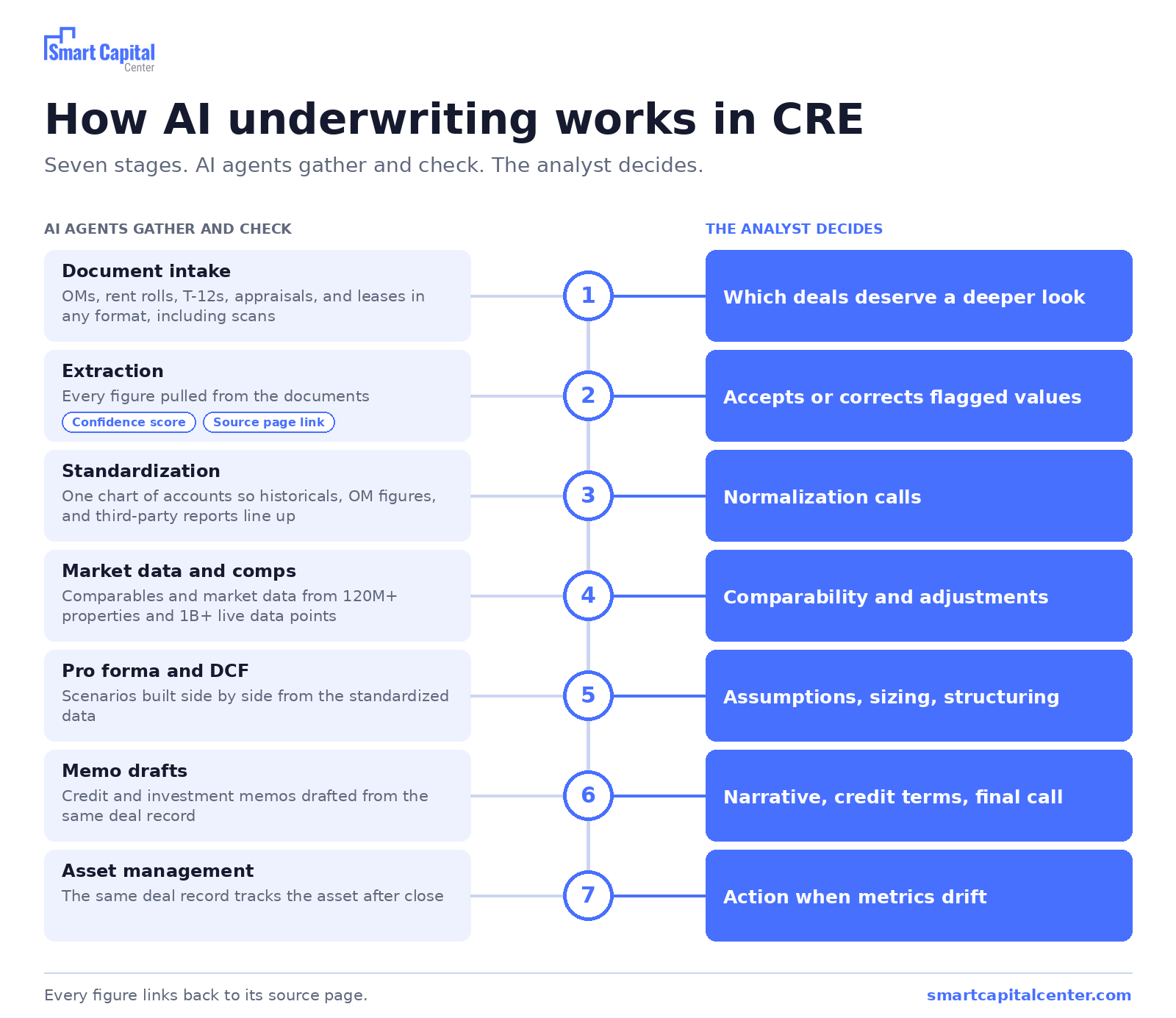
Figure 1. The seven stages of AI underwriting in CRE, from document intake to asset management. See how Smart Capital Center handles underwriting
Your team stops waiting on retyping, because the agents take in offering memorandums, rent rolls, T-12s, appraisals, and leases in any format, including scans. Documents go into one deal record, so every later stage works from the same files.
You can trust a number faster when you can see how sure the system is and where it came from. Each extracted figure carries a confidence score and a link back to its source page, and low-confidence items are flagged for the analyst to accept or correct.
Standardization lets you compare like with like. Historicals, OM figures, and third-party reports are mapped to one chart of accounts, so a line item means the same thing across every document in the deal.
Your analyst sees the market evidence beside the deal data, instead of switching between tools. Smart Capital Center's agentic AI pulls comparables and market data from 120M+ properties and 1B+ live market data points, plus hard-to-find web sources, and the analyst judges which comparables fit.
Side-by-side scenarios let your team see how value and coverage move before committing to a view. The pro forma and DCF scenarios draw on the standardized historicals and market data, and the analyst sets the assumptions that drive them.
Memo drafts from the same data mean your analyst edits instead of rebuilding. Credit and investment memos are drafted from the deal record, and the analyst owns the narrative, the recommendation, and the credit terms.
Work done once carries forward, so nothing is rebuilt for asset management. The same deal record supports tracking after close, which gives asset managers the underwriting assumptions to compare against actual performance.
Laura Krashakova, Smart Capital Center's founder, describes what teams notice most:
“I think the best, most important value add is the depth of analysis, that you can go deeper in your analysis a lot faster, earlier in the process. You go into due diligence, you already are very well equipped. And that's the feedback that we're getting from our users currently, that not only it's the efficiency, because it's kind of a given, people expect it already, but it's more about how more confident they are when they're getting in the due diligence room.” Laura Krashakova, Founder & CEO, Smart Capital Center

AI agents handle the gathering, checking, and organizing, which frees your analysts for the judgment calls that decide a deal. The analyst keeps every decision that carries credit or investment risk.
A panelist at the CREFC June 2026 Conference described how this changes a firm's capacity:
“I think it has made our firm as a whole probably three to five times more efficient... Have a lot of the diligence boil down, whether that's leases being audited, whether that's comparing leases to rent roll, whether that's market intel, public searches on borrowers, creating summaries, distilling a 40 page document into a four page document. You should just be able to do more and then get more leverage out of your own critical thinking.” A panelist at the CREFC June 2026 Conference, CREFC session recording, Jun 2026
No. AI changes what underwriters spend their time on, moving them from data entry toward sizing, structuring, and credit terms. Prasad Thammineni, Founder & CEO of Agentman, put the division of labor plainly at the Wharton Scale School panel on AI 2.0 in April 2026:
“Our agents do not do the actual work. They assist the human in making things faster.” Prasad Thammineni, Founder & CEO, Agentman, Wharton Scale School panel on AI 2.0, Apr 2026
“We see the supervisor role as continuing to be very important. Agents shouldn't be doing all the work. Humans should be in the supervisor capacity, managing the agents.” Prasad Thammineni, Founder & CEO, Agentman, Wharton Scale School panel on AI 2.0, Apr 2026
Broader business data points the same way. The Federal Reserve Bank of New York's Liberty Street Economics post of September 4, 2025 reported that 40% of service firms in its regional survey used AI, up from 25% a year earlier, while only 1% had laid off workers because of it. The authors concluded that “AI is more likely to result in retraining than job loss.”
Controlled experiments in other fields point the same way. In Navigating the Jagged Technological Frontier, a Harvard Business School working paper dated September 22, 2023, consultants using AI in a field experiment completed 12.2% more tasks, finished 25.1% faster, and produced results rated more than 40% higher in quality than a control group. The study covers management consulting, not CRE.
For lenders, AI gives credit teams a fuller file earlier, which improves loan sizing, covenant setting, and memo quality. KeyBank Real Estate Capital cut financial model prep time by 40% with Smart Capital Center, which gives its analysts more time for credit terms.
Portfolio-level discipline matters here too. Under the interagency guidance Concentrations in Commercial Real Estate Lending, Sound Risk Management Practices, issued December 12, 2006, supervisors look more closely at institutions where construction and land loans reach 100% or more of total risk-based capital, or where non-owner-occupied CRE loans reach 300% or more and have grown 50% or more over 36 months. Underwriting records that tie each loan to its source documents make those exposures easier to monitor and explain.
AI underwriting is accurate enough to trust when every figure is checked and traceable. At Smart Capital Center, an AI agent double-checks each extracted value and assigns a confidence score, required fields and confidence thresholds are set per client, and low-confidence items and reconciliation failures are flagged before the workflow moves on.
Every figure links to its source page, so an analyst or a committee member can verify any number in seconds. For the technical detail, see How to Trust AI in Commercial Real Estate Underwriting.
Borrower files stay protected when the system is built for institutions. Smart Capital Center is SOC 2 Type II certified, and client data is never shared or used to train models for other clients.

A misread rent roll can misstate occupancy on a $30 million acquisition, and the error carries into every return projection built on it. Smart Capital Center mitigates this through confidence scores and source links, so each occupancy figure traces back to the lease or rent roll page it came from.
A covenant field that has not refreshed since the last quarterly package can let stress build for weeks before a formal breach appears, which narrows workout options. Smart Capital Center mitigates this with the same deal record carried into asset management, so covenant and metric drift can be checked against current data.
A figure the system was unsure about can slip into a model if no one looks, and it then reads as fact in the credit memo. Smart Capital Center mitigates this by flagging low-confidence items and reconciliation failures before the workflow moves on, with required fields and thresholds set per client.
Start with one workflow and real deals, so your team sees the output next to its current process. A small test gives you evidence before you change anything at scale.
1. Pick one workflow. Choose the task that costs the most hours, such as rent roll extraction or first-pass screening, and note today's time and error rate.
2. Run it on real deals. Upload recent offering memorandums, rent rolls, and T-12s from your own files, including scans.
3. Compare with your current process. Check each extracted figure against its source page and list any differences.
4. Set your thresholds. Decide which fields are required and what confidence level sends an item to an analyst.
5. Expand one stage at a time. Add standardization, comparables, scenarios, and memo drafts once the first stage earns trust.
Smart Capital Center's agentic AI supports each of these steps on your own documents, and readers choosing a tool can compare options in Top CRE Investment Underwriting Software and Automation Platforms Compared.
These guides go deeper on each part of the process:
• Excel AI Plugins vs Cloud Underwriting Platforms for CRE: Where Plugins Stop: how analysts keep their Excel models and the team keeps one deal record.
• AI Prompts for Commercial Real Estate Underwriting: Questions to Ask Your Deal Data: prompts to run against real deal data.
• Deterministic vs Generative AI in CRE Underwriting: Which Steps Need Which: how each step is checked.
• AI Agents in Commercial Real Estate: How Firms Connect Their Own Agents to Underwriting Data: connecting your own agents through the API.
• CRE Investment Memo and Credit Memo Template: Sections, Examples, and How to Draft Them Faster: templates and examples.
• Commercial Rent Roll Template: Fields Lenders Check and How to Standardize Rent Rolls: the fields that matter.
• How to Underwrite a Multifamily Property, Step by Step: a worked multifamily process.
Related reading: AI in Commercial Real Estate: An Ultimate Guide, Commercial Real Estate Underwriting: How AI Changes the Industry, and 2026 Commercial Underwriting: Key Principles and Best Practices.
Speed is expected from AI underwriting now, and confidence is what sets teams apart: the teams that see more data earlier walk into due diligence knowing what to ask. Smart Capital Center's agentic AI gives your analysts source-linked data and drafts from one deal record, so their time goes to sizing, structuring, and credit terms.
Evaluate 10x more deals in the same time your team currently underwrites one. Book a demo with Smart Capital Center →
Q: How can I screen more CRE deals without adding analysts?
A: Give your team a deeper first pass on each deal before anyone builds a model by hand, so analysts spend their time on the deals that deserve it. Source-linked document extraction and first-draft scenarios make that first pass fast enough to run on every deal. Smart Capital Center's agentic AI does this work, which supports 10x capacity.
Q: Can I upload scanned rent rolls and offering memorandums and still get source-linked figures?
A: Yes, and the source link is what makes the figure usable. Any extraction tool worth using should accept OMs, rent rolls, T-12s, appraisals, and leases in any format, including scans, attach a confidence score and a source page to each value, and flag low-confidence items for an analyst. Smart Capital Center works this way across all of those document types.
Q: How can I make my underwriting numbers easier to defend in credit committee?
A: Tie every figure to the page it came from. Reconciliation failures should be flagged before the workflow moves on, so that when a committee member asks where a number came from, your analyst can open the page and show it.
Q: Can I trust AI underwriting with confidential borrower files?
A: You can when the system is built for institutional data. Look for SOC 2 Type II certification and a written commitment that client data is never shared or used to train models for other clients. Ask any vendor for both answers before uploading borrower files.
Q: How can I use AI underwriting for loan sizing, covenants, and credit memos?
A: Use it to give your credit team a complete, sourced file before the sizing conversation. Analysts keep control of sizing, structuring, and credit terms, while the financials are standardized, market comparables are pulled, and the credit memo is drafted from the same data. KeyBank Real Estate Capital cut financial model prep time by 40% using Smart Capital Center.
Q: How do I start testing AI underwriting on my team's real deals?
A: Pick one workflow and run it on recent deals from your own files. Compare the output with your current process, check each figure against its source page, and set required fields and confidence thresholds. Smart Capital Center can walk through this on your documents in a demo.