


AI in Commercial Real Estate

October 1, 2026
AI in Commercial Real Estate
October 1, 2026

According to KPMG’s 2025 GenAI Report, rapid AI adoption in financial services could add $2.84 trillion to US GDP by 2030 — and commercial real estate remains one of its least-digitized, highest-potential sectors. Deals still take weeks to underwrite. Portfolio reviews require teams of analysts. Market research means stitching together data from a dozen fragmented sources. That reality is changing fast. AI in commercial real estate is reshaping every stage of the investment and financing lifecycle — from the moment a deal lands in an inbox to the ongoing management of a billion-dollar portfolio.
This analysis draws on Smart Capital Center — a CRE AI platform that has processed $500B+ in transactions across 120M+ properties, used by JLL, KeyBank, and leading institutional lenders.
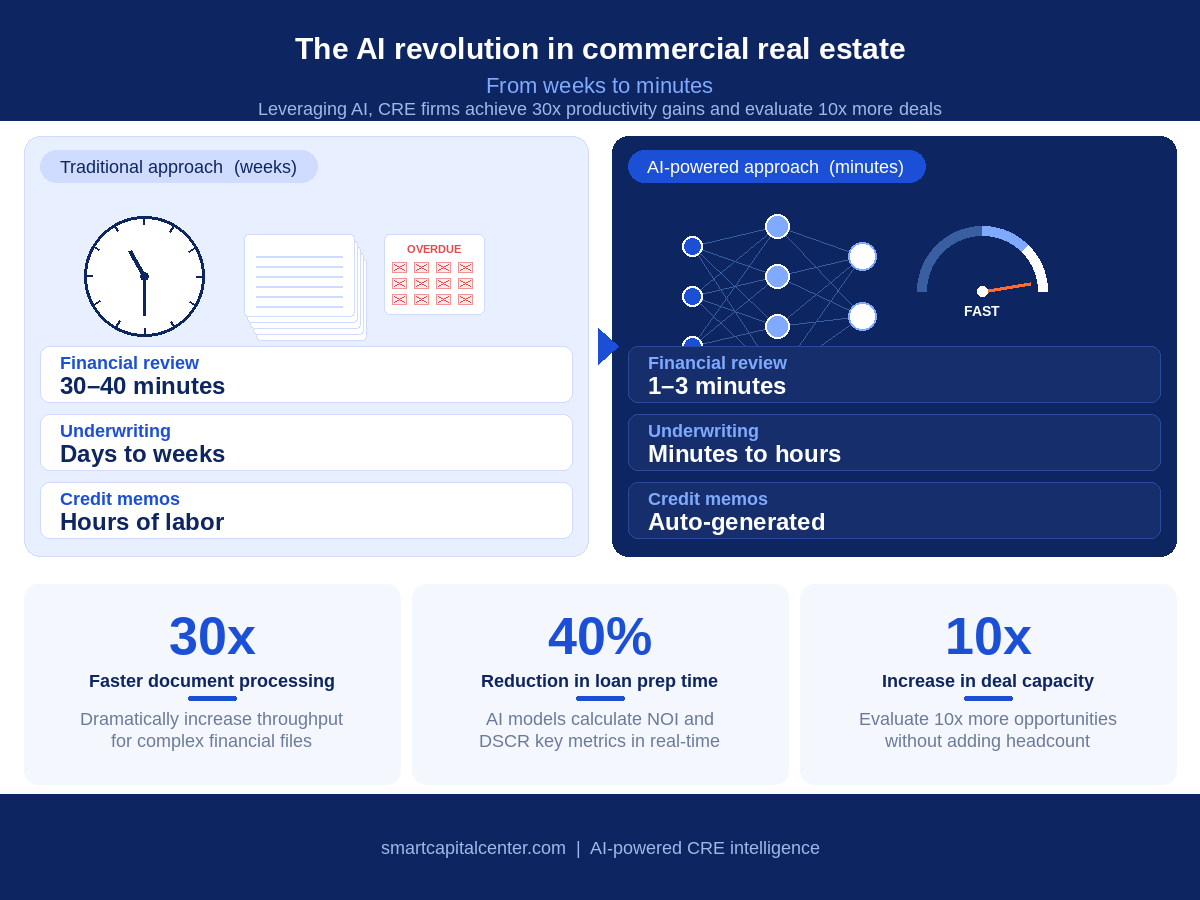
Early adopters are already reporting dramatic results: 30x productivity gains in financial statement processing, 40% reductions in loan preparation time, and the ability to evaluate 10x more deals without adding a single headcount.
This guide breaks down exactly how AI for commercial real estate works, where it delivers the most value, who benefits most, and what the leading platforms are doing to push the industry forward. Whether you are an investor, lender, asset manager, or underwriter, understanding CRE AI is now a competitive necessity heading into 2026.
CRE AI refers to the application of artificial intelligence technologies — including machine learning, natural language processing, and autonomous AI agents — to the workflows, decisions, and data challenges that define commercial real estate operations. It is not a single tool. It is a category of capability that spans the entire transaction and asset lifecycle.
Traditional CRE operations are data-heavy but process-poor. Professionals spend enormous amounts of time manually:
AI eliminates or dramatically accelerates these tasks by automating data extraction, running calculations instantly, and monitoring portfolios continuously — all while surfacing insights that human analysts would likely miss.
Platforms like Smart Capital Center have built end-to-end AI solutions for CRE that cover the entire lifecycle: origination, underwriting, asset management, and loan servicing — all in a single integrated system backed by 1B+ real-time data signals across 120M+ properties.

Institutional research consistently confirms that AI-driven tools are delivering measurable time and cost advantages across CRE workflows. The table below aggregates benchmark data from named sources to quantify the productivity gap between manual and AI-powered operations.
| Workflow | Manual Time | AI-Powered Time | Source & Period |
|---|---|---|---|
| Financial statement processing | 30–40 min per document | 1–3 min per document | Smart Capital Center / JLL, 2024 |
| Loan underwriting (full package) | 3–5 days | Hours to same day | CBRE, AI in CRE Report, Q1 2025 |
| Lease abstraction (per lease) | 45–60 min | Under 5 min | JLL Technology Research, 2024 |
| Credit memo preparation | 4–8 hours per deal | Under 30 min | KeyBank / Smart Capital Center, 2024 |
| Portfolio risk review | Weekly manual cycle | Continuous, real-time | Trepp Loan Performance Data, Q4 2024 |
| CRE market comp research | 2–4 hours per market | Instant via 1B+ signal aggregation | CoStar Group, Market Analytics Report, 2025 |
According to CBRE’s 2025 Technology in Real Estate report, firms that have adopted AI-driven underwriting tools are completing deal analysis up to 60% faster than peer firms relying on manual workflows. PwC’s Emerging Trends in Real Estate 2026 identifies technology adoption — specifically AI and data analytics — as among the top three strategic priorities for CRE firms entering the next market cycle.
The scope of AI applications for CRE is broad, but the highest-impact use cases cluster around data-intensive workflows where speed and accuracy directly affect deal outcomes. Here is a comprehensive breakdown:
Every CRE transaction generates a mountain of unstructured documents: offering memorandums, rent rolls, trailing twelve-month financials, appraisals, leases, and environmental reports. Manually extracting the relevant data from these documents is one of the most time-consuming tasks in the industry.
AI-powered data extraction uses natural language processing to automatically parse these documents, identify relevant figures, and structure the data into audit-ready formats. What previously took 30–40 minutes per financial statement now takes 1–3 minutes — a 90%+ reduction in processing time, as demonstrated in Smart Capital Center's work with JLL.
Once data is extracted, AI for CRE takes over the analytical heavy lifting. Underwriting models are populated automatically, with key metrics — NOI, ROI, cash flow, DSCR, IRR, and LTV — calculated in real time. AI underwriting agents can run projections, apply scoring criteria, and flag risk exceptions without waiting for an analyst to open a spreadsheet.
The result is underwriting that takes minutes instead of days. KeyBank reported a 40% reduction in time spent preparing financial models for loans after implementing AI-powered underwriting tools.
Lease abstraction — the process of pulling key terms, obligations, expiration dates, and clauses from complex lease documents — is traditionally a manual, error-prone task that consumes significant analyst bandwidth. AI lease abstraction in CRE transforms this process through semantic, clause-level analysis that extracts and categorizes every material provision across an entire portfolio of leases simultaneously.
This means faster due diligence, more accurate tenant risk assessment, and the ability to identify portfolio-wide lease exposure (such as co-tenancy clauses or termination options) at scale.
Effective CRE decisions require comprehensive market context. AI for commercial real estate platforms aggregate and analyze data at a scale that no human team could replicate: sales comparables, rent trends, vacancy rates, cap rate movements, foot traffic patterns, public transit quality, and social media location popularity — all updated in real time.
Smart Capital Center's market intelligence layer, for example, provides access to 1B+ real-time data signals spanning 120M+ properties, giving users a 360° view of both debt and equity market conditions. This replaces hours of manual research with instant, AI-generated market summaries and assumption sets.
After underwriting is complete, the next bottleneck is documentation. Investment memos, credit packages, and underwriting reports all require significant time to prepare, format, and review. AI memo generation tools eliminate this step by automatically producing compliant, professionally structured documents — complete with SWOT analysis, tenant insights, financial projections, and market context — in minutes.
This is not template-filling. AI-generated memos pull directly from the analyzed data, ensuring every figure is accurate and every assumption is traceable.
Once a deal closes, the work is not over. Asset managers must continuously track property performance, monitor lease rollovers, benchmark against market conditions, and identify risks before they become problems. AI asset management agents do this continuously and automatically — 24 hours a day, 7 days a week.
Live dashboards track IRR, NOI, ROI, DSCR, LTV, and lease rollover in real time. Predictive analytics identify tenant trends before lease expirations become vacancies. Stress testing tools model how portfolios would perform under various economic scenarios. This is CRE AI operating as a continuous risk management system, not just an analysis tool.
For CRE lenders, AI brings transformative efficiency to the entire loan lifecycle. From origination through post-close servicing, AI automates the workflows that typically require the most manual effort: draw request reconciliation, covenant compliance tracking, construction budget monitoring, and loan health scoring.
Automated covenant monitoring means that lenders receive real-time alerts when DSCR drops, vacancies rise, or compliance thresholds are approached — rather than discovering issues during a periodic review. Loan health scores give portfolio managers continuous visibility into risk across hundreds of positions simultaneously.
| Application | What AI Does | Business Impact |
|---|---|---|
| Data Extraction | Parses OMs, rent rolls, T-12s, leases automatically | 90%+ reduction in manual processing time |
| Financial Analysis | Auto-calculates NOI, ROI, DSCR, cash flow, IRR | Underwriting in minutes instead of days |
| Lease Abstraction | Extracts key clauses, dates, obligations at tenant level | Eliminates hours of manual lease review |
| Market Analysis | Analyzes 1B+ data signals across 120M+ properties | 360° real-time market intelligence |
| Memo Generation | Auto-generates credit packages and investment memos | Compliant reports ready in minutes |
| Asset Management | Continuous portfolio monitoring with predictive insights | Real-time IRR, NOI, DSCR tracking 24/7 |
| Debt Management | Covenant monitoring, draw reconciliation, loan scoring | Automated compliance and risk alerts |
| Risk Assessment | AI spots patterns humans miss across full portfolio | Proactive risk mitigation before issues escalate |
The productivity gap between traditional and AI-powered CRE operations is not incremental. It is structural. The following comparison illustrates how AI solutions for CRE change the economics of every major workflow:
| Task | Traditional Approach | AI-Powered Approach |
|---|---|---|
| Financial Statement Review | 30–40 minutes per document | 1–3 minutes per document (30x faster) |
| Loan Underwriting | Days to weeks | Minutes to hours |
| Deal Volume | Limited by team headcount | 10x more deals evaluated without new hires |
| Portfolio Monitoring | Periodic manual review | 24/7 automated alerts and dashboards |
| Market Research | Fragmented, time-intensive | Instant access to 1B+ real-time signals |
| Credit Memo Generation | Hours of analyst time | Auto-generated in minutes |
| Covenant Compliance | Manual tracking spreadsheets | Automated monitoring with real-time alerts |
These are not theoretical projections. They reflect documented outcomes from institutions already using AI platforms in production environments.
The business case for adopting AI in commercial real estate comes down to four interconnected advantages:
• Speed: Deals move faster at every stage. Underwriting that took days now takes hours or minutes. Document processing that consumed entire workdays is reduced to minutes. The competitive advantage of being first to underwrite, first to commit, and first to close is significant in a market where deal velocity matters.
• Scale: AI enables organizations to evaluate dramatically more opportunities without proportional headcount increases. One team can do the work of ten when AI agents handle the data-intensive tasks. This is the core economic argument for AI in CRE — not replacing people, but multiplying their output.
• Accuracy: AI-powered validation reduces human error in financial models, lease reviews, and compliance tracking. Automated exception management flags inconsistencies instantly, giving analysts cleaner data to work with and reducing the risk of decisions based on incorrect inputs.
• Intelligence: Access to real-time market data at the scale of 1B+ signals transforms the quality of every decision. Investment theses are grounded in comprehensive market context rather than selective comparables. Risk assessments reflect current conditions rather than dated surveys.
• Risk Management: Continuous, automated monitoring catches covenant breaches, vacancy spikes, and lease expirations before they escalate. The shift from reactive to proactive risk management has direct financial consequences — especially in volatile market environments.
AI applications for CRE deliver value across every major stakeholder group in the industry, though the specific benefits differ by role:
| User Type | Key AI Use Cases | Primary Benefit |
|---|---|---|
| CRE Investors | Acquisition underwriting, market analysis, portfolio tracking | Evaluate 10x more deals, deploy capital faster |
| CRE Lenders | Loan origination, credit memos, covenant monitoring | 40% faster loan preparation, reduced risk |
| Asset Managers | Portfolio valuation, tenant analysis, disposition timing | Real-time NAV, 90%+ reduction in manual work |
| Underwriters | Data extraction, financial modeling, risk scoring | Minutes vs. days per deal analysis |
| Acquisitions Teams | Deal screening, comp analysis, opportunity identification | Higher deal throughput without added headcount |
Adopting AI-powered tools in commercial real estate delivers significant advantages, but it also introduces specific risks that CRE professionals need to understand and actively manage. Three risks carry the most operational and financial weight:
Large language models and AI underwriting agents can generate plausible-sounding figures that are factually incorrect — a phenomenon known as hallucination. In CRE underwriting, where a single misread DSCR or cap rate assumption can materially affect a credit decision, this risk is not theoretical.
Mitigation: Smart Capital Center addresses this through AI-powered validation and exception management that cross-checks extracted figures against source documents before they populate underwriting models. Every assumption is traceable back to its source, creating an audit trail that allows analysts to verify AI outputs rather than accept them blindly.
CRE transactions involve highly sensitive financial information: borrower financials, rent rolls, appraisals, and proprietary loan terms. Uploading these documents to AI platforms that train on user data or store information on shared infrastructure creates real confidentiality and regulatory exposure.
Mitigation: Smart Capital Center operates on private US-based servers, maintains SOC 2 Type II certification, uses AES-256 end-to-end encryption, and explicitly does not train on user data. For institutional lenders and investors operating under strict data governance requirements, these are non-negotiable infrastructure standards, not optional features.
As AI-generated credit scores and risk assessments become faster and more sophisticated, there is a real operational risk that teams begin accepting AI outputs without applying the judgment that market context, borrower history, and local conditions require. Over-reliance on automated scoring — especially in volatile or illiquid markets — can amplify risk rather than reduce it.
Mitigation: The most effective AI deployments position AI agents as force multipliers for experienced professionals, not replacements for them. Smart Capital Center’s platform is designed to surface insights and flag exceptions for human review — ensuring that data-driven speed does not come at the cost of the expert judgment that distinguishes institutional-grade decisions from automated ones.
Point solutions that automate a single task — say, lease abstraction or document OCR — deliver narrow value. A truly transformative platform covers the full lifecycle and integrates deeply with existing workflows. Use these steps to evaluate any CRE AI platform before committing:
1. Step 1: Identify your highest-friction workflow. Start with the task consuming the most analyst time — typically document ingestion, financial statement processing, or underwriting. Confirm the platform addresses that specific pain point with documented time savings, not just product marketing.
2. Step 2: Verify full-lifecycle coverage. A platform that only handles origination leaves you with a second system for asset management, and a third for loan servicing. Confirm end-to-end coverage from document parsing and underwriting through portfolio monitoring and covenant compliance.
3. Step 3: Validate real-time market intelligence. Static databases go stale. Look for platforms with live data feeds covering sales comparables, rent trends, vacancy rates, and alternative data signals. Ask how frequently data is updated and from how many sources.
4. Step 4: Confirm enterprise-grade security standards. CRE transactions involve highly sensitive financial data. SOC 2 Type II compliance, AES-256 encryption, private server infrastructure, and a clear policy against training on user data are minimum requirements for institutional use.
5. Step 5: Audit system integration depth. The best platforms connect natively with property management and accounting systems — Yardi, SS&C Precision, Midland Enterprise — eliminating manual re-entry and data silos. Test integration with your current stack before committing.
6. Step 6: Demand verifiable results from institutional clients. Look for documented productivity gains from named firms — not anonymized case studies. Platforms with auditable outcomes from clients like JLL or KeyBank carry meaningfully more credibility than those relying on projections alone.
7. Step 7: Assess AI risk governance. Ask how the platform handles AI hallucination, data privacy, and human override protocols. A vendor that cannot answer these questions precisely is not ready for institutional deployment.
Smart Capital Center satisfies all seven steps. Built by veteran CRE professionals who have closed billions in transactions, it combines AI for commercial real estate with deep domain expertise and enterprise-grade infrastructure — making it the platform of choice for institutional investors, lenders, and asset managers seeking to transform their operations.

The adoption of AI in CRE is still in its early stages, but the trajectory is clear. Industry research consistently points to accelerating investment in AI-driven tools, with commercial real estate identified as one of the sectors with the highest potential for AI-driven productivity gains.
According to PwC's Emerging Trends in Real Estate in 2026, technology adoption — including AI and data analytics — ranks among the top strategic priorities for CRE firms heading into the next market cycle. Separately, a Deloitte report on AI in financial services found that organizations leveraging AI for underwriting and risk management are significantly outperforming peers on both deal velocity and portfolio performance metrics.
The near-term roadmap for CRE AI includes real-time portfolio valuation using continuously updated AI models, fully automated end-to-end workflows from document parsing to signed memos, and AI-powered portfolio query systems that allow professionals to ask natural language questions across entire loan and property datasets.
The firms that build these capabilities into their operations today will have a structural advantage over those that wait. The gap between AI-enabled and traditionally operated CRE businesses is widening — and it will continue to widen as the technology matures.
AI in CRE is not a future state — the firms deploying it today are already evaluating 10x more deals with the same headcount, catching risk before it becomes loss, and closing transactions faster than competitors still working from spreadsheets.
Smart Capital Center brings all of it together: automated data extraction, real-time market intelligence, 24/7 AI agents, and enterprise-grade security — in the single platform that JLL, KeyBank, and leading asset managers trust to run their CRE operations.
Evaluate 10x more deals in the same time your team currently underwrites one. Book a demo with Smart Capital Center today.
AI in commercial real estate refers to the use of machine learning, natural language processing, and autonomous AI agents to automate and enhance CRE workflows. It performs tasks like data extraction, underwriting, portfolio monitoring, and report generation automatically — reducing hours of manual work to minutes. Platforms like Smart Capital Center deploy AI agents that operate continuously, analyzing deals and portfolios 24/7 without manual intervention.
Start by identifying the specific bottleneck — typically document ingestion or financial model population — and deploy an AI platform that automates that stage first. Smart Capital Center, for example, reduces financial statement processing from 30–40 minutes to under 3 minutes per document, and populates underwriting models automatically once data is extracted. KeyBank reported a 40% reduction in loan preparation time after implementing AI-powered underwriting tools.
Enterprise-grade CRE AI platforms are built to institutional security standards. Smart Capital Center is SOC 2 Type II certified, uses AES-256 end-to-end encryption, operates on private US-based servers, and does not train on user data. The platform also supports Single Sign-On (SSO) and Multi-Factor Authentication (MFA). These standards meet or exceed the requirements of major banks, insurance companies, and institutional investment managers.
Financial statement review drops from 30–40 minutes to under 3 minutes per document, according to Smart Capital Center’s documented results with JLL. Full loan underwriting packages that previously took 3–5 days can be completed in hours. KeyBank reported a 40% reduction in loan prep time after implementing Smart Capital Center. Across an active deal pipeline, these gains compound — enabling the same team to evaluate 10x more opportunities in the same period.
Leading AI platforms for CRE — including Smart Capital Center — can process offering memorandums (OMs), rent rolls, trailing twelve-month (T-12) financial statements, appraisals, leases, environmental reports, and draw requests. Documents are parsed automatically, with extracted data structured into audit-ready formats and mapped directly into underwriting models.
Follow a structured evaluation: confirm the platform covers your highest-friction workflows, verify full-lifecycle coverage from origination through asset management, check security credentials (SOC 2 Type II minimum), test integration with your existing systems (Yardi, SS&C, etc.), and demand verifiable results from named institutional clients. Generic demos and marketing claims are insufficient — ask for documented productivity data from firms comparable to yours in size and deal volume.
The three most significant risks are AI model hallucination in financial outputs, data privacy exposure from uploading sensitive loan documents to insecure platforms, and over-reliance on automated scoring without human oversight. Smart Capital Center addresses all three: its validation layer cross-checks AI outputs against source documents, its private-server infrastructure prevents data exposure, and its platform is designed to surface insights for expert review rather than replace professional judgment.