


AI in Commercial Real Estate

July 30, 2026
AI in Commercial Real Estate
July 30, 2026
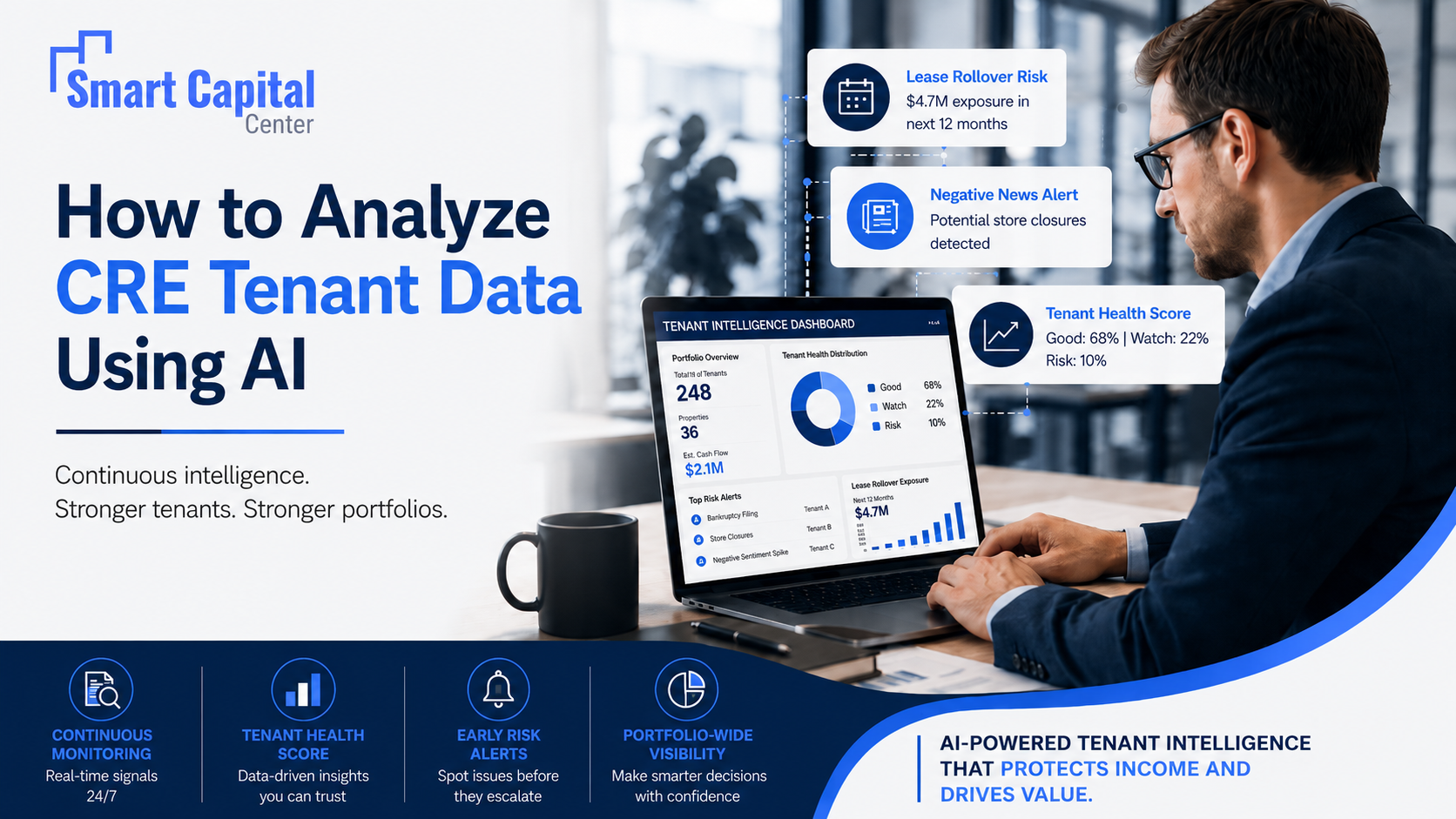
According to CBRE’s 2025 U.S. Real Estate Market Outlook, tenant credit quality and lease rollover concentration are now the dominant risk variables in CRE portfolio performance, ranking above cap rate movement and interest rate exposure as the primary drivers of NOI variance for both investors and lenders. For teams still monitoring tenant data through periodic lease reviews and manual news searches, that finding signals a fundamental mismatch: the risk is continuous and cumulative, while the monitoring is periodic and fragmented.
This analysis draws on Smart Capital Center, a CRE AI platform monitoring 1B+ real-time signals across 120M+ properties, used by institutional investors, lenders, and asset managers including JLL and KeyBank, to map how AI-powered commercial tenant analysis works across the full ownership and lending lifecycle.
Every CRE asset derives its income from tenants. What is less obvious is how directly tenant data or its absence affects every downstream metric an investor or lender tracks: NOI, DSCR, occupancy, lease rollover concentration, and ultimately asset value.
A tenant filing for bankruptcy protection six months before a major lease expiration does not just affect one building. If that tenant occupies space across four properties in a portfolio, the rollover risk is concentrated, the re-leasing timeline is compressed, and the income gap is larger than any single-asset model would have flagged. That is the portfolio-level problem that property-by-property monitoring cannot solve.
CBRE Research makes the point directly in the 2025 U.S. Real Estate Market Outlook: “Tenant credit quality and lease rollover concentration are the primary performance drivers in the current cycle. Investors and lenders that underwrite tenant health with the same rigor as they apply to property-level financials will be better positioned to manage NOI variance as market conditions shift.” That framing from CBRE Research is significant because it elevates tenant monitoring from a portfolio hygiene function to a core underwriting discipline, one that requires the same continuous attention as covenant tracking or collateral valuation.
According to Trepp’s Q4 2024 CRE Loan Performance Report, loans in which tenant distress was identified and addressed proactively (before formal default triggers were reached) showed materially better loss outcomes than those where deterioration was identified at or after a covenant breach. That gap is the measurable value of continuous tenant monitoring over periodic review. For a deeper look at how demographic signals complement tenant analysis at the submarket level, see Commercial Real Estate Demographic Data: What Investors Miss.
Effective multi-tenant analytics requires pulling from several distinct data categories simultaneously:
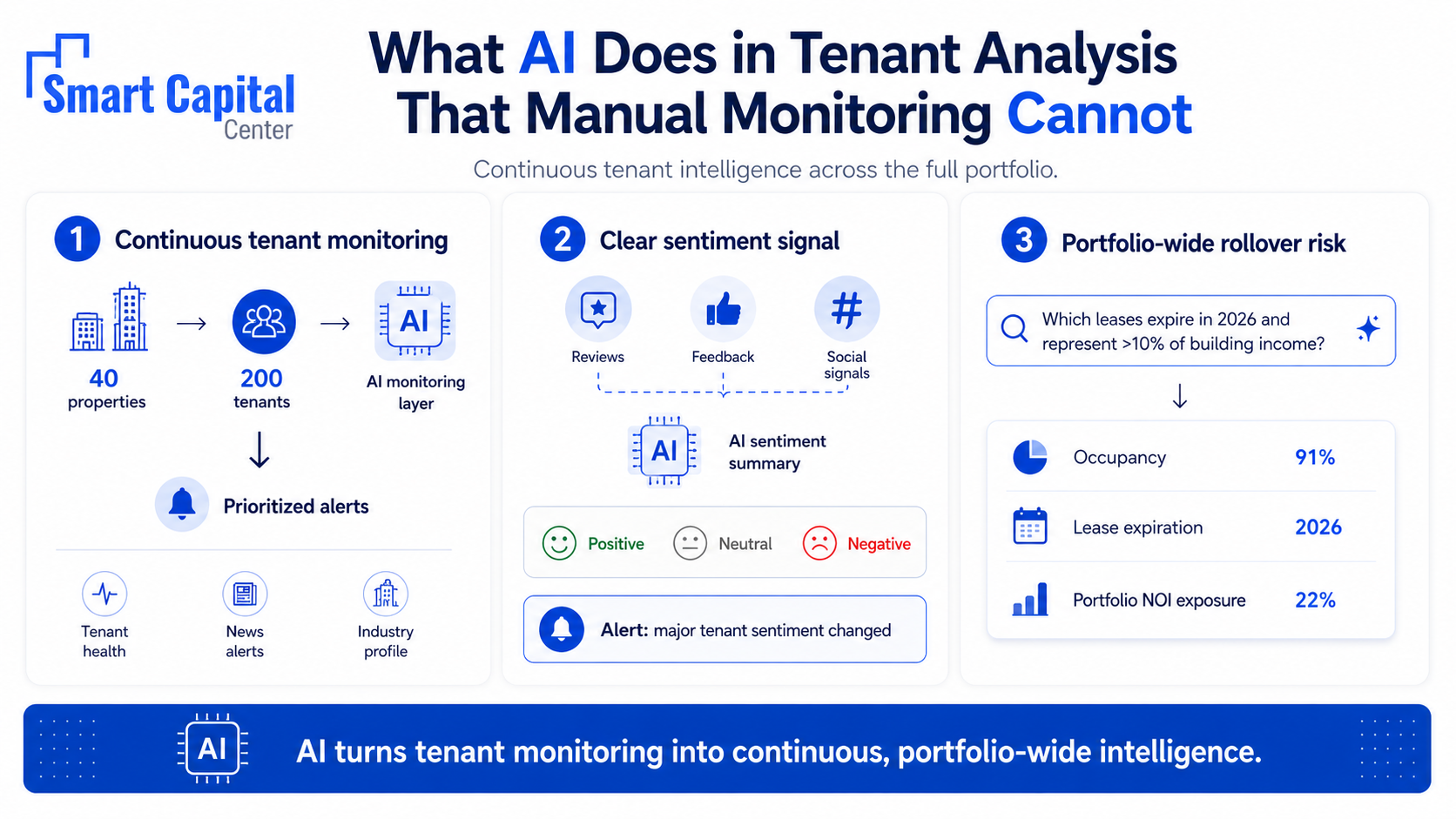
Smart Capital Center performs deep research on each commercial property tenant without human input between cycles. For every tenant across every property, it runs:
What it means in practice? A portfolio with 40 properties and 200 tenants requires 200 concurrent monitoring streams. Manual review can sustain perhaps a dozen at meaningful depth. The output is a prioritized alert: which tenants are showing distress signals, across which properties, and with what combined income exposure at the portfolio level.
Public sentiment – employee reviews, customer feedback, social signals, and location-level ratings – is one of the most consistent leading indicators of business contraction. According to PwC's Emerging Trends in Real Estate 2026, firms integrating alternative tenant data signals into their portfolio monitoring identify lease risk an average of two to three quarters earlier than those relying on financial statement review alone.
Smart Capital Center aggregates this tenant data from public sources into a clear positive / neutral / negative signal per tenant, updated continuously. When sentiment shifts materially on a tenant with significant portfolio exposure, asset managers receive an alert with underlying sources cited and specific properties affected identified, rather than discovering the trend during a quarterly review.
Portfolio-level lease rollover analysis answers the questions that single-asset review cannot: which buildings are leased to a given national tenant expiring in the next three years, and how that rollover is distributed across calendar quarters. Smart Capital Center answers these in natural language: "Which properties have leases expiring in 2026 with tenants representing more than 10% of building income?", and returns source-level data across the full portfolio instantly. For each top tenant, the result surfaces:
The connection between lease rollover and loan performance is not theoretical. According to the CREFC December 2025 Monthly CMBS Loan Performance Report, when performing matured balloons are included in the delinquency calculation, the effective CMBS delinquency rate rises to 8.75%, nearly a full percentage point above the headline rate.
CREFC noted explicitly that “extension and modification activity is masking underlying refinancing stress.” That stress traces directly to tenant-level income shortfalls: when leases expire without renewal, or when tenants restructure, the NOI supporting debt service compresses and loans that appeared performing on covenant metrics surface as distressed only when the maturity date forces the issue. Portfolio-level tenant monitoring is the instrument that catches this compression early enough to act.
A tenant representing 8% of NOI at one property looks manageable in isolation. The same tenant representing 8% at each of four properties – 32% of total portfolio income – is a concentration risk that no single-asset monitoring workflow will identify. This gap is particularly acute for lenders monitoring loan books across multiple borrowers who happen to share a major tenant in the same sector.
Smart Capital Center mitigates this through portfolio-wide tenant mapping that surfaces total exposure by tenant across all properties simultaneously, flagging concentration risk in absolute income terms rather than by-property percentages. A single natural-language query returns the full exposure picture in seconds.
A Chapter 11 filing by a major retail tenant is public information. For teams monitoring portfolios manually, it is also information that arrives through whatever news channel the analyst happens to check that morning, not through a structured alert tied to specific lease exposure and portfolio income impact. The window between first observable distress signal and formal default is long enough to act, but only if the monitoring system surfaces the signal rather than waiting for the analyst to find it.
Smart Capital Center mitigates this through continuous negative news monitoring that triggers automatic alerts when material events affect a tenant with exposure in the portfolio. Every alert includes a clickable source citation and the specific properties and income amounts affected.
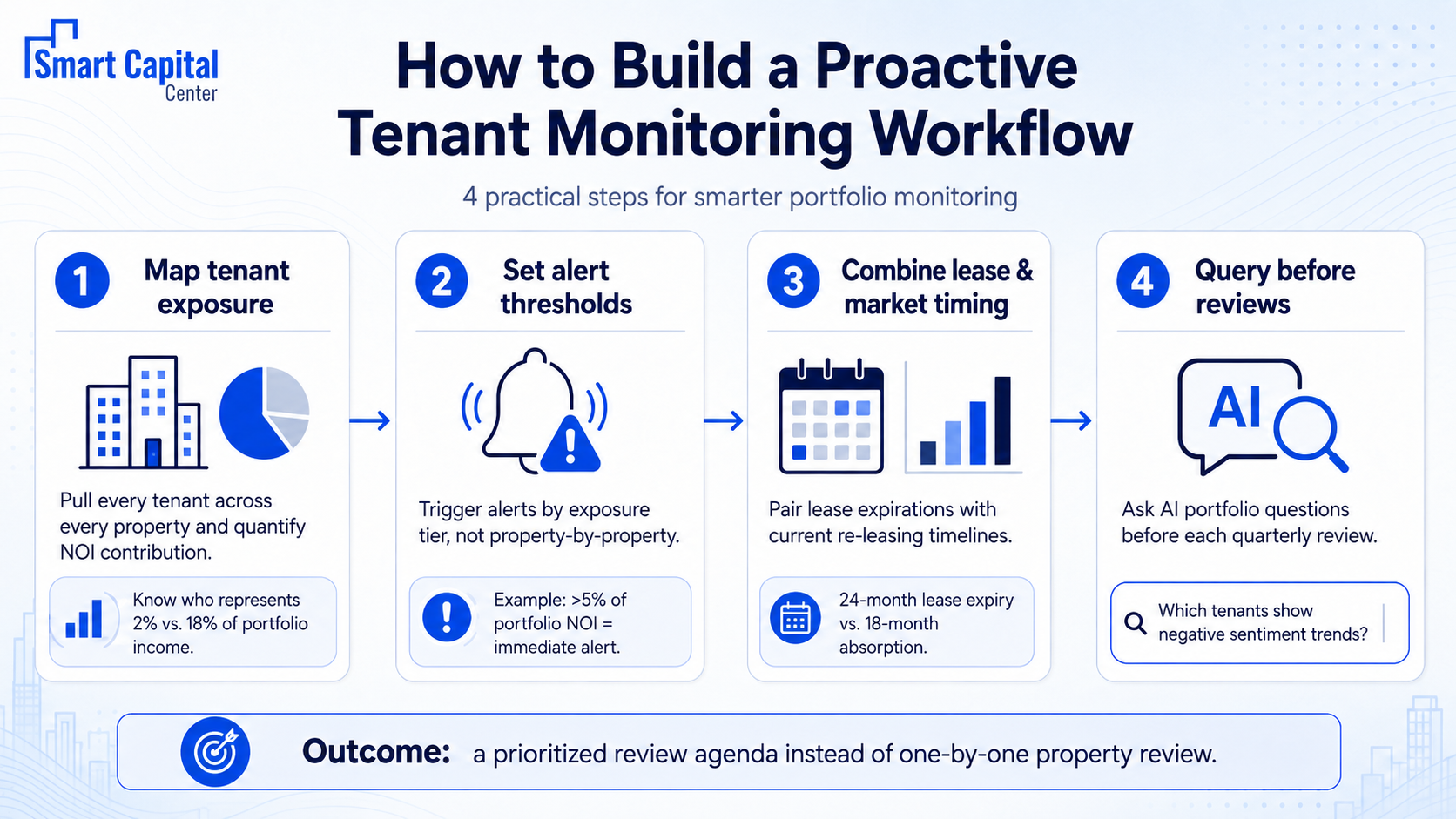
1. Step 1: Map your full tenant roster with income exposure before setting any monitoring parameters. Pull every tenant across every property, calculate their contribution to total portfolio NOI, and identify concentration clusters – tenants or industries that represent outsized income share. This baseline is what makes subsequent alerts meaningful: a negative news flag on a tenant representing 2% of income requires a different response than one representing 18%.
2. Step 2: Set alert thresholds by exposure tier. Portfolio-level thresholds – any tenant representing over 5% of total portfolio NOI triggers an immediate alert on negative news – are more useful than property-by-property settings that miss cross-asset concentration. A tenant representing 8% of income at each of three properties should trigger the same response as one representing 24% at a single asset.
3. Step 3: Integrate lease expiration data with current market re-leasing timelines for each asset class and submarket. A lease expiring in 24 months in a market with 18-month average absorption requires active attention now. The same expiration in a market with 6-month absorption is a different priority. Rollover analysis is only actionable when it is combined with current market leasing velocity data.
4. Step 4: Query your portfolio in natural language before every quarterly review. Before assembling a portfolio review, ask the AI which tenants show negative sentiment trends, which leases expire within 36 months with no renewal option noted, and which properties have the highest single-tenant income concentration. Smart Capital Center answers all of these in seconds, across the full portfolio, giving the quarterly review a prioritized agenda rather than a one-by-one property review.
The investors and lenders who avoid the largest tenant-driven NOI surprises are those whose monitoring systems surface distress signals quarters before a default.
Smart Capital Center’s commercial tenant analysis layer runs continuous deep research on every tenant, aggregates sentiment signals from public sources, monitors for negative news in real time, and answers portfolio-level queries in natural language across 1B+ real-time signals spanning 120M+ properties. The result is a tenant monitoring capability that scales with portfolio size rather than analyst headcount.
See which tenants in your portfolio are showing early distress signals before they surface in a quarterly report. Book a demo with Smart Capital Center.
AI-powered commercial real estate data platforms perform continuous per-tenant research across every property simultaneously, without requiring a human analyst to initiate each review. Smart Capital Center surfaces prioritized alerts when material signals emerge on tenants with significant portfolio exposure, directing analyst attention to the situations that require it rather than asking the team to monitor every tenant with equal depth.
The most reliable leading indicators are sustained negative sentiment across public review channels, expansion contraction signals such as store closure announcements or workforce reductions, and credit deterioration in financial reporting. According to PwC’s Emerging Trends in Real Estate 2026, firms integrating alternative tenant signals into portfolio monitoring are identifying lease risk two to three quarters earlier than those relying on financial statement review alone. A monitoring system that tracks these continuously captures the window when renegotiation or re-leasing is still viable.
Commercial real estate analytics platforms apply monitoring logic across retail, office, industrial, and mixed-use tenants simultaneously, adjusting the relevant signals by asset class. For retail tenants, sentiment and foot traffic data carry more weight. For office tenants, workforce signals and subletting activity are more predictive. For industrial tenants, supply chain news and logistics sector trends are the primary external signals. Smart Capital Center classifies each tenant by industry, applies the relevant signal weighting, and surfaces alerts matched to the risk profile of each tenant type.
Smart Capital Center’s portfolio-level AI querying answers this question in natural language. Asking “Which properties have leases expiring in the next 36 months with tenants representing more than 10% of building income?” returns a ranked, source-linked result across the full portfolio in seconds. The same interface surfaces largest-tenant analysis by property, giving asset managers the portfolio-wide rollover picture that individual property reviews cannot produce.
Public sentiment is aggregated by Smart Capital Center into a clear positive, neutral, or negative read per tenant, updated continuously. When sentiment shifts materially on a tenant with significant lease exposure, the alert arrives with the underlying sources cited, the specific properties affected identified, and the income exposure quantified. The alert arrives in context: tied to a specific tenant, a specific property, and a quantified income exposure. The analyst makes the final call.