


CRE Investors

September 14, 2026
CRE Investors
September 14, 2026
Lean commercial real estate (CRE) investment teams keep hitting the same wall in 2026. Deal flow arrives in waves. A 1031 exchange deadline, a competitive bid window, or a value-add redevelopment cycle can create a month of surge demand that one underwriter cannot absorb, and then a quiet stretch leaves a full-time analyst under-used. At the same time, family-office and accredited investors now expect the depth of analysis they would get from a billion-dollar shop: institutional-grade valuations, assumptions they can trace, and an investor-ready memo on every deal.
The firms feeling this most are not large institutions. They are lean advisors and principal-led firms. Increasingly, these teams meet that pressure with an AI-powered analyst on demand rather than a new hire. The model is a platform that performs the underwriting, market analysis, and reporting an in-house analyst would do, scaled to the deal instead of the calendar.
Smart Capital Center was built for this. The platform pairs deep data infrastructure, with over 1 billion real-time data points across more than 120 million U.S. properties, with AI deep research to produce property cash flow projections, comps analysis, market intelligence, and investor memos. This article explains what the model delivers, why lean teams are adopting it now, how it compares to outsourced analyst support, the risks to weigh, and how to evaluate the infrastructure against the workflow it replaces.
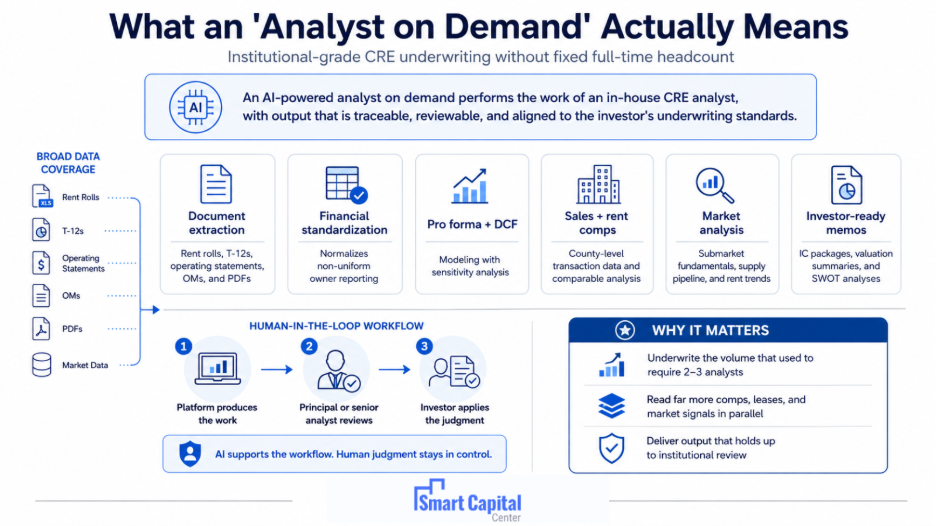
An AI-powered analyst on demand is an underwriting platform that performs the work of an in-house CRE analyst, without the fixed cost of full-time headcount. The output is meant to read like an analyst’s: traceable, reviewable, and aligned to the investor’s own underwriting standards.
The model does not replace the principal’s judgment. The technology is paired with a human in the loop, usually the principal or a senior analyst who directs and reviews the AI’s output. The platform produces the work. The investor applies the judgment.
The advantage is not only speed. A human analyst can hold a limited set of comps, leases, and market signals in view at one time. An AI platform reads far more. It ingests every comp, parses every lease and offering memo, and tracks market data across submarkets in parallel, then ranks what matters most. That breadth lets it surface patterns and trends a single analyst would not have the time to find. The result is a workflow where one principal can underwrite the volume that used to require two or three analysts, with output that holds up to institutional review and often goes deeper than manual review alone.
Three market realities are pushing lean CRE teams toward on-demand underwriting infrastructure.
Family-office capital is flowing back into CRE, with higher expectations. PwC’s Global Family Office Deals Study found that real estate rebounded to 39% of total family office investment in the first half of 2025, its highest share since the second half of 2019, up from 26% two years earlier. J.P. Morgan Private Bank’s 2026 Global Family Office Report shows that family offices most concerned about inflation hold roughly 16% of their portfolios in real estate, about double the broader pool. The capital is moving, and it is moving with sharper expectations. Family offices increasingly favor club and deal-by-deal structures over blind-pool funds, which gives them more transparency, control, and traceability over what they own and how decisions get made. Advisors need to deliver underwriting that survives that scrutiny.
The cost of a full-time analyst no longer matches the workflow. Per Glassdoor’s February 2026 data, a U.S. commercial real estate analyst’s median total pay is $113,286, with the 75th percentile at $153,957 and top earners reporting up to $200,990. Loaded for benefits, software, and overhead, a single seat runs $150K to $250K-plus per year. For a firm reviewing 30 to 80 deals annually with seasonality, that fixed cost is over-resourced in slow months and under-resourced during 1031 windows or competitive bid sprints.
Deal complexity exceeds what any single analyst can process. Modern CRE underwriting requires integrating tenant-level credit data, submarket supply pipelines, comparable transaction sets across thousands of records, and live rent benchmarks. No human analyst can read every comp, parse every offering memo, and monitor every market at once. AI underwriting platforms can, and that capacity gap widens every quarter.
Cost figures based on 2026 Glassdoor compensation ranges plus a typical 25–35% benefits and overhead loading.

Surge-driven workloads. CRE deal flow is rarely linear. A 1031 exchange identification window compresses an acquisition timeline to 45 days. Multifamily value-add and redevelopment cycles create burst demand around lease-up and refinancing. Competitive bid windows in industrial and self-storage often require LOIs and underwriting in under a week. Hiring against the surge means carrying analyst cost through the troughs. Hiring against the trough means missing deals at the peak. An on-demand model flexes with the cycle.
Institutional-grade output for sophisticated investors. When the investor is a family office or a sophisticated individual, the investment committee memo is the deal. Sloppy comps, inconsistent assumptions, or untraceable inputs erode trust quickly. AI-driven underwriting enforces a consistent methodology across every deal, including the same comp filters, the same DCF structure, and the same risk callouts, so the firm’s standards hold no matter the volume.
Data depth a single analyst cannot replicate. A human analyst can review maybe 15 to 20 comps in detail before fatigue degrades quality. An AI underwriting layer can ingest hundreds and rank them by relevance based on submarket, asset class, vintage, and transaction date. The same holds for tenant credit research, lease abstraction, and supply analysis. Independent research points in the same direction. In a 2024 University of Chicago Booth School of Business study, GPT-4 predicted the direction of companies’ future earnings with about 60% accuracy, roughly seven points higher than professional human analysts, and showed its largest edge in the very cases where analysts tend to struggle. The study was financial-statement analysis, not real estate, but the lesson for CRE is straightforward. Judgment still belongs to the principal, and pattern-heavy analytical work, run across a deep enough data set, now produces sharper output than manual review alone.
Capturing institutional knowledge. Lean firms have a hidden vulnerability. When the senior analyst leaves, the underwriting methodology often leaves too. An AI platform codifies a firm’s standards, including preferred comp filters, hold-period assumptions, exit cap conventions, and debt sizing rules, and applies them consistently across every deal and every team member. The methodology becomes a firm-level asset rather than a personal one.
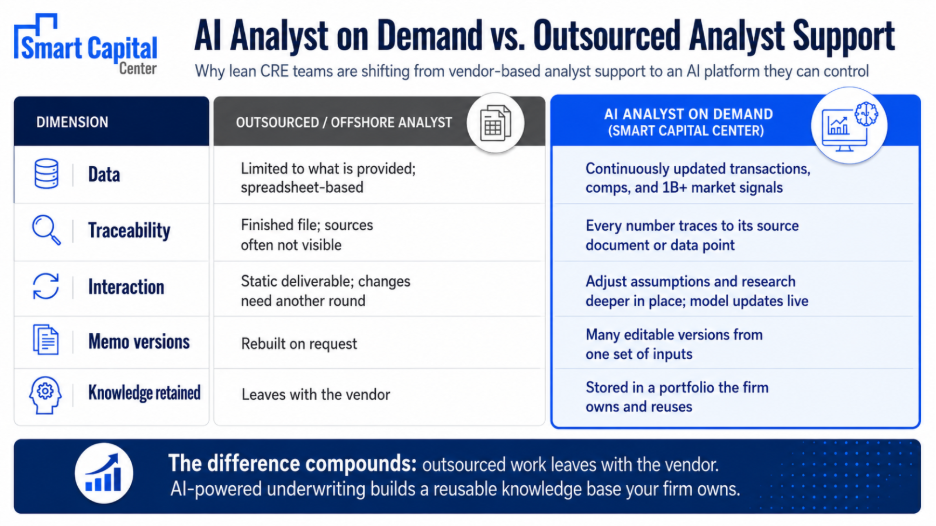
Lean teams have long had another on-demand option: outsourced or offshore analyst support, where a firm sends its documents to a remote team and gets models and memos back. It is flexible and it lowers cost. It also works very differently from an AI platform in ways that matter for depth, control, and what the firm keeps afterward.
Depth of analysis. Outsourced analysts work in spreadsheets, with whatever data the firm hands them. An AI platform analyzes far more, drawing on a continuously updated base of transactions, comps, and market signals, and presents the analysis with the supporting data attached.
“It's a lot easier now to have a team that helps me. The end product is so detailed that the finance brokers were impressed — sponsors usually don't hand over that kind of underwriting. The software and the scrubbing capability with the AI has been enormous. As a sponsor, you must know your numbers cold, and Smart Capital Center lets me do that.” — George Arce, Jr., founder and CEO, Centers Dynamic Partners
Traceability. With outsourced work, the firm usually receives a finished file and has to trust the numbers inside it. On an AI platform, every figure connects back to the original document or data source, so the principal can see exactly where each number came from.
Interactivity. An outsourced model is a static deliverable. Changing an assumption means another round trip. On the platform, the principal can adjust assumptions, ask the AI to research a specific angle more deeply, and watch the model update in place.
Versioning. From a single set of inputs, the firm can produce and edit many versions of an investor memo, tailored to different audiences or scenarios, without rebuilding from scratch.
A knowledge base the firm owns. This is the difference that compounds. Every deal an outsourced analyst touches leaves with them, in their spreadsheets. On the platform, it all stays in one portfolio view. Past deals, sales comps, rent comps, and market insights remain available for the next underwrite. The firm’s work becomes a digital knowledge base it owns, and that accumulated analysis is the firm’s own intellectual property, not files scattered across vendors. It makes every future deal faster and better informed.
The model is easiest to understand through the firms already using it.
A mission-driven lender expanding pipeline coverage. Rose Community Capital is an affordable housing lender whose entire model turns on covering more of the pipeline without diluting underwriting standards — mission fit is judged on the deal, not the volume. The platform lets the team pre-screen more applications and direct underwriting attention where it changes decisions.
"Smart Capital Center has become an integral part of our initial underwriting and loan analysis. With the platform, we can review significantly more applications with greater depth and consistency, allowing us to identify and prioritize the strongest opportunities aligned with our affordable housing finance mission. We're not just working faster — we're focusing our underwriting attention where it's needed most."
— Kelly Boyer, President, Rose Community Capital
A boutique advisor serving family offices. HNL Capital Advisors is a boutique CRE advisor based in Honolulu, serving family-office clients across the U.S. with deal flow concentrated in industrial. Its founder runs full underwriting on roughly five deals a month, screens many more, and had been working in Excel and Word, which made a full-time analyst hard to justify against uneven volume. When asked which part of his work was the biggest pain point and took the longest, he pointed to the underwriting itself:
“It takes a lot of time to get to it and actually do all this manual entry.” — William Crowley, founder, HNL Capital Advisors
Smart Capital Center now performs that production work, sized to each deal, so the principal can stay on assumptions, client relationships, and judgment.
A retail sponsor scaling toward a fund. Centers Dynamic Partners, a San Mateo retail sponsor, has raised capital from friends and family for nearly three decades and repositions vacant retail boxes into modern, leased centers. Those deals turn on construction costs, lease-up timing, and exit assumptions rather than in-place income, and the firm is trying to accelerate deal flow as it grows toward a fund. The founder is direct about where the work gets stuck:
“For us, it’s redevelopment modeling. That’s the biggest pain point.” — George Arce, Jr., founder and CEO, Centers Dynamic Partners

The case for AI-powered underwriting is real, but it is not unconditional. Investors evaluating on-demand models should pressure-test three risks.
Over-automation of judgment calls. Routine analytical work, such as data extraction, standardization, comps pulling, and DCF mechanics, is well suited to automation. Judgment calls on basis assumptions, sponsor quality, market thesis, and deal structure are not. The firms getting this right keep the principal close to the strategic layer and let the platform handle production.
Data quality and traceability. AI is only as good as the data it ingests and the sources behind it. Investors should require platforms to surface their data sources, freshness dates, and confidence levels, not just deliver outputs. Traceability matters most when an investor, lender, or committee asks how a number was derived.
Garbage-in risk on the input side. Rent rolls and T-12s from sellers and brokers are notoriously inconsistent. A platform that cannot reliably normalize messy inputs introduces silent error into the underwriting. Look for systems that show their work, surfacing extraction confidence and flagging anomalies for human review.
Smart Capital Center addresses these by exposing source data, version history, and assumption logs at every step, so the principal can audit any input or output behind a valuation or memo.
For investors weighing whether to adopt on-demand underwriting, four questions cut through the noise.
The hiring debate for lean investment teams used to be binary: carry an analyst, or pass on deals. The AI-powered analyst on demand changes the math. Institutional-grade underwriting is no longer gated by headcount, and surge capacity no longer requires permanent overhead. For independent investors and family-office advisors operating in a market where investors expect more rigor and capital is more selective, the model is becoming the default rather than the exception.
The firms that adopt early gain two compounding advantages: more deals reviewed per principal, and a captured methodology that strengthens with every transaction.
Underwrite more deals, at institutional grade, without expanding headcount. See how the Smart Capital Center investor platform delivers AI-powered underwriting, market analysis, and investor memos on demand. Book a demo today.
Q: When does it make sense to use an AI analyst on demand instead of hiring a full-time CRE analyst?
A: When deal flow is uneven, which describes most lean teams, family-office advisors, and acquisition specialists running 1031 cycles or value-add strategies. A full-time analyst at $150K to $250K loaded is over-resourced in slow months and under-resourced during surge windows. Smart Capital Center scales with deal flow, automating the production work that consumes most of an analyst’s day, including offering memo extraction, rent roll normalization, T-12 standardization, pro forma generation, and comps analysis, so a single principal can review the volume that used to require two or three hires. The cost savings are immediate, but the more durable advantage is reviewing more deals per quarter without losing depth.
Q: How is an AI-powered analyst different from outsourcing underwriting to an offshore team?
A: Both give a lean firm on-demand capacity, but they differ in depth, control, and what the firm keeps. Outsourced analysts work in spreadsheets with the data they are given. Smart Capital Center analyzes far more, ties every figure back to its source, and lets the principal change an assumption or research an angle more deeply in place rather than waiting on another round trip. It also stores every deal in a portfolio the firm owns, so past sales comps, rent comps, and market insights stay available for the next underwrite. That accumulated analysis becomes the firm’s own intellectual property, not files held by a vendor.
Q: Can AI deliver institutional-grade underwriting for family-office and accredited investors?
A: Yes, when the platform combines deep data infrastructure with traceable methodology. Family-office investors increasingly want deal-by-deal transparency, audit trails on every assumption, and consistent comps and DCF treatment across every memo. The Smart Capital Center investor solution maps every data point, including leases, rent rolls, financials, and market reports, into a structured, audit-ready data lake fused with 1B+ market signals across 120M+ U.S. properties. Each underwriting model and memo is sourced, versioned, and reviewable, so the analysis holds up under investor, committee, and lender scrutiny.
Q: Does AI replace the in-house analyst entirely?
A: No, and it should not. The strongest model pairs AI with a principal or senior analyst who directs and reviews outputs. Smart Capital Center handles the production layer, including data consolidation from external and internal sources, extraction from unstructured documents such as offering memos, rent rolls, T-12s, leases, and appraisals, financial standardization, pro forma and DCF generation, comps analysis, SWOT analysis, and memo drafting, while the principal owns market judgment, sponsor diligence, deal strategy, and final decisions. The platform is best understood as an always-on AI analyst that reports to a human reviewer.
Q: How can a lean CRE investment team compete with larger institutional firms on underwriting depth?
A: By replacing manual production work with AI infrastructure and the data depth behind it. A single principal supported by Smart Capital Center can screen and evaluate far more deals than a small analyst team, running offering memo extraction, red-flag screening, market-comp benchmarking, and sensitivity analysis on every opportunity, then producing institutional-grade memos in minutes rather than days. The leverage comes from the depth of the underlying data, with $500B+ of analyzed CRE transactions and 120M+ properties, and the consistency of the methodology applied across every deal, not from the number of seats on the team.
Q: How does AI handle messy seller-provided rent rolls and T-12s?
A: Mature platforms normalize inconsistent owner reporting automatically, flag anomalies for human review, and expose extraction confidence on every field. Smart Capital Center extracts data from rent rolls, leases, offering memorandums, market research, and financials, structured or unstructured, and maps it directly into dynamic underwriting models. As new data flows in, the analysis updates instantly with metrics like NOI, DSCR, and ROI, while the platform flags hidden risks such as rising concessions, declining tenant credit, or capex underinvestment. Source visibility and version history on every input are what separate this from black-box automation.