


CRE Lenders

September 15, 2026
CRE Lenders
September 15, 2026

A loan that closed five years ago was underwritten against a property that no longer exists in the same form. Rents moved, expenses moved, and the market rate moved. The file that supported the original credit decision now describes something else. By the time a borrower calls about the maturity, the underwriter has weeks to rebuild a picture that should have taken shape months earlier, and every structure that could close a proceeds gap takes longer to arrange than the time remaining.
The volume makes it worse. The Mortgage Bankers Association's 2025 Commercial Real Estate Survey of Loan Maturity Volumes, released February 9, 2026 at the CREF Convention, puts $875 billion of the $5.0 trillion outstanding at maturity in 2026, a 9 percent decline from the $957 billion that matured in 2025.
Smart Capital Center gives lenders the gap nine months early instead of nine weeks late. For the credit and portfolio teams using it, that means:
● The proceeds gap is sized before the borrower calls. NOI, coverage, debt yield, and value recalculate against live market data as conditions move.
● Nothing on the book goes unwatched. Covenants, key dates, and draw activity track continuously across every position, not on a review calendar.
● The file is exam-ready as it's built. Every figure traces to the document behind it, so nothing has to be reconstructed after the fact.
This article covers the four tests that decide what a maturing loan can refinance to, how to size the gap in week one, and a nine-month readiness sequence.
Lenders check current normalized net operating income first, then coverage at a current market rate, then debt yield, then loan-to-value against a current appraisal. Each test can bind independently, and the lowest resulting loan amount sets what the deal can support. Skipping this order is how proceeds gaps go unnoticed until underwriting is already underway.
● Maturity wall: the concentration of commercial mortgage debt scheduled to come due within a defined period.
● Balloon payment: the principal balance due in full at maturity on a loan that was not fully amortizing.
● Non-performing matured balloon: a loan past its maturity date, unrepaid or unrefinanced, and no longer performing.
● Debt yield: net operating income divided by the loan amount. A sizing constraint that does not move with rates.
● Debt service coverage ratio: net operating income divided by annual debt service.
● Extension compared with modification: an extension pushes the maturity date; a modification changes terms such as rate, amortization, or covenants.
● Cash-in refinance: a refinance where the borrower contributes equity at closing to meet sizing constraints.
● Rescue capital: capital placed into a deal, usually as preferred equity or mezzanine debt, to cover a proceeds shortfall.

Maturity exposure is not spread evenly across property types, which changes how urgently a lender should start the refinance conversation.
Life insurance companies will see 10 percent of their balances mature in 2026, and depositories carry the largest maturing share at $396 billion. Refinancing commercial real estate loans against this backdrop means treating the maturity date as the start of the underwriting clock.
Trepp's July 2026 CMBS delinquency data shows the overall rate rose 51 basis points to 7.86 percent, up from 7.23 percent a year earlier, and non-performing matured balloon loans made up 66 percent of newly delinquent balances that month. Including loans past maturity but current on interest, the rate climbs to 9.62 percent. Most large newly delinquent loans transferred to special servicing because of refinancing difficulty, which is why the first-pass test needs to start well before maturity.
Four checks determine what a maturing loan can refinance to, and each runs in sequence because a later test can override an earlier one.
● Current normalized NOI: strip out one-time items and confirm the trailing twelve months reflects stabilized operations.
● Coverage at a current market rate: recalculate debt service using today's rate and amortization, not the maturing note's rate.
● Debt yield: divide NOI by the proposed loan amount. This constraint does not soften even if rates fall.
● Loan to value against a current value: apply a current market cap rate to NOI.
The lowest loan amount these four tests produce is what a refinance can actually support.
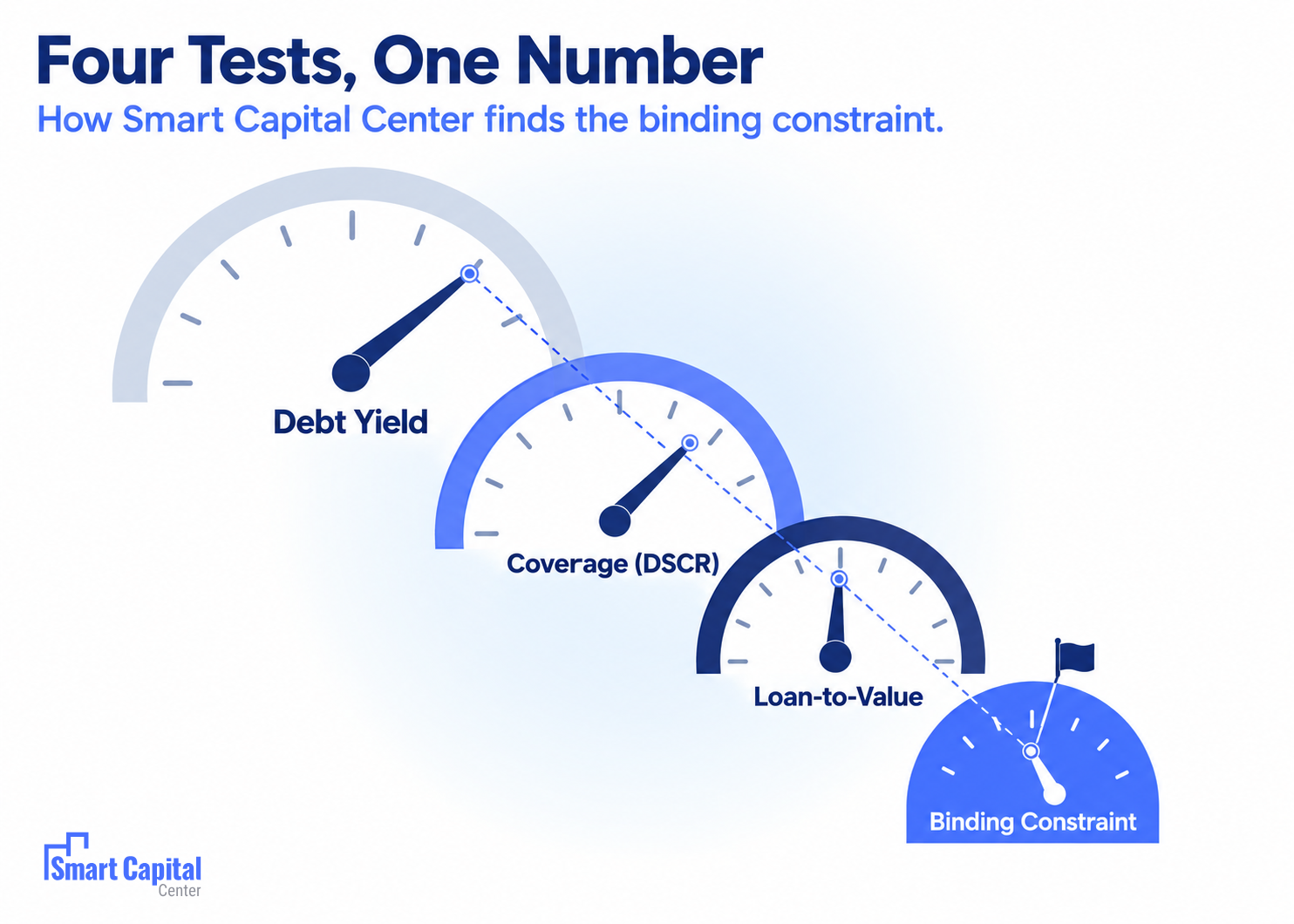
A 150-unit multifamily property carries an $18.0 million balance maturing in 2026, with $1.65 million in current NOI. Running the four tests against current terms shows where the gap sits.
The debt service coverage test binds at roughly $16.3 million, below the debt yield and loan-to-value constraints, leaving a proceeds gap of about $1.7 million. Sizing that gap in week one gives both sides time to arrange a solution.
Verification follows a set sequence, since each item narrows or confirms what the prior one found.
● Rent roll and lease abstracts: checked against current occupancy and rent.
● T-12 normalization: adjusting for one-time expenses and deferred capex.
● Capex history and forward reserves: since deferred maintenance today becomes a coverage problem later.
● Borrower and guarantor liquidity: confirmed against current financial statements.
● Tenant credit: particularly for any tenant representing a meaningful share of income.
● Rollover exposure: mapping lease expirations against the proposed loan term.
When the four tests leave a gap, several structures can close it, and the right one depends on the size of the gap and the time remaining before maturity.
● Paydown: the borrower brings cash to reduce the loan to a supportable amount.
● Extension: the maturity date moves without changing the loan's economic terms.
● Modification: rate, amortization, or covenants change to bring the loan back into balance.
● Preferred equity: rescue capital sits above common equity and below the mortgage, closing a moderate gap without a second lien.
● Mezzanine debt: subordinate debt secured by equity interests.
● Recapitalization: new equity replaces existing equity, resetting the capital stack.
● Sale: when none of the above pencil, a sale before or at maturity avoids a forced workout.
Examiners expect the refinance analysis documented as it happens, not reconstructed afterward. The current rent roll, the normalized T-12, the rate and cap rate assumptions, and the resulting proceeds calculation should sit in the file with a clear source for each figure. A file assembled after the fact draws more scrutiny than the credit decision itself.

Working backward from the maturity date keeps every option, including the slower ones, on the table.
1. Nine months out: run the first-pass refinance test and size any proceeds gap.
2. Seven months out: order the rent roll, lease abstracts, and updated financials.
3. Six months out: normalize the T-12 and confirm capex history and reserve needs.
4. Five months out: identify rollover exposure and tenant credit concerns.
5. Four months out: if a gap exists, start conversations on paydown, preferred equity, or mezzanine, since these take the longest to arrange.
6. Three months out: finalize the loan structure and begin documentation.
7. Two months out: complete underwriting and move to closing preparation.
8. One month out: close, or execute an extension if more time is needed.
Four signals should prompt a second look at any maturing loan, regardless of what the headline coverage ratio shows.
● Near-term rollover concentration: a large share of income expiring within the new loan term changes the coverage picture.
● Deferred maintenance: unresolved capex needs show up as reduced NOI or an unplanned draw on reserves.
● Expense growth outrunning rent growth: rising costs and flat rent signal a coverage problem even if today's NOI looks stable.
● A guarantor already stretched across other assets: liquidity that looks adequate alone may not hold up against a borrower's full portfolio of obligations.
The Mortgage Bankers Association forecasts $805.5 billion in total commercial mortgage originations for 2026, up 27 percent from $633.7 billion in 2025, with the 10-year Treasury yield averaging 4.2 percent. “2025 was an active year for commercial real estate lending, with strong origination activity across all commercial capital sources,” said Reggie Booker, MBA's Associate Vice President of CREF Research, at the 2026 CREF Convention. The Federal Reserve's July 2026 Senior Loan Officer Opinion Survey on Bank Lending Practices found that banks generally reported easier standards and basically unchanged demand for CRE loans in the second quarter, a combination that favors borrowers arriving with a documented, current file.
The proceeds gap on a maturing loan can be sized in the first week if current NOI, coverage, debt yield, and value are checked in order. Every structure that closes a gap takes time to arrange, which is why nine months out is the point to start. Smart Capital Center supports this by monitoring loan positions continuously and recalculating NOI, coverage, and debt yield against live market data, so the refinance conversation starts months ahead of the maturity date.
Catch a proceeds gap nine months before it becomes a closing-table problem.
Book a demo with Smart Capital Center →
Q: When should I start refinancing a maturing commercial loan?
A: Start the first-pass refinance test at least nine months before the maturity date, since every structure that closes a proceeds gap takes time to arrange. Waiting until the final quarter narrows the options to whichever can close fastest, not whichever fits the deal best.
Q: What happens if my loan does not qualify for commercial property refinancing?
A: Options include a paydown, extension, modification, preferred equity, mezzanine debt, recapitalization, or sale, and the right choice depends on the gap size and time remaining. A loan that cannot refinance typically moves toward special servicing, which is what happened to most large loans behind July 2026's jump in CMBS delinquencies.
Q: How do I calculate the proceeds gap on a maturing CRE loan?
A: Run current NOI against coverage at a market rate, debt yield, and loan to value against a current appraisal, then take the lowest resulting loan amount. Subtract that from the existing balance to find the gap, and document each input so the calculation can be reviewed later.
Q: What is a debt yield test, and why does it matter for refinancing commercial real estate loans?
A: Debt yield divides net operating income by the loan amount, and unlike a coverage ratio, it does not soften when rates fall. It can become the binding constraint even when coverage looks acceptable.
Q: Why are matured balloon loans such a large share of new CMBS delinquencies?
A: Most matured balloon loans that become delinquent transferred to special servicing because refinancing did not close in time. Trepp's July 2026 data shows non-performing matured balloons made up 66 percent of newly delinquent balances.
Q: What documents does a lender need to refinance commercial property?
A: A current rent roll and lease abstracts, a normalized trailing twelve months of financials, capex history and reserve estimates, current borrower and guarantor financial statements, and documentation on major tenant credit. Each figure should trace back to a specific document, since traceability is what an exam-ready file requires.
Q: How does Smart Capital Center help lenders manage maturing CRE loans?
A: It monitors loan positions continuously, tracking covenants, key dates, and draw activity across the book, and recalculates NOI, coverage, and debt yield against live market data as conditions move. KeyBank Real Estate Capital reported a 40 percent reduction in financial model prep time and 15 to 20 percent in origination cost savings, according to Ken Schroeder, SVP.