


AI in Commercial Real Estate

September 2, 2026
AI in Commercial Real Estate
September 2, 2026

According to CBRE's U.S. Real Estate Market Outlook 2026, U.S. commercial real estate investment surged 29% in Q4 2025 to $171.6 billion, with improved lending conditions and rising LTV ratios signaling a market that rewards speed, precision, and data quality above all else. The firms closing deals fastest are not the ones with the largest teams. They are the ones with the best commercial real estate data infrastructure.
This analysis draws on Smart Capital Center – a CRE AI platform that has processed $500B+ in transactions across 120M+ properties, used by JLL, KeyBank, and leading institutional lenders – to map what unified CRE data actually looks like, how aggregation works in practice, and why fragmented data is the single largest drag on deal velocity today.
CRE data is the structured and unstructured information that describes commercial properties, their financial performance, market conditions, and transaction history, which enables investment, lending, and asset management decisions to be made with measurable confidence.
The term gets used loosely. In practice, commercial real estate data spans six distinct categories:
• Property-level data: Physical attributes (square footage, year built, zoning, asset class), ownership records, and assessed valuations sourced from county assessors and title records.
• Financial performance data: Rent rolls, T-12 operating statements, NOI history, DSCR, vacancy rates, and lease schedules, typically extracted from offering memorandums or directly from property management systems.
• Transaction data: Sales comparables, cap rates, loan origination volumes, debt terms, and deal structure, sourced from deed filings, CMBS disclosures, and proprietary brokerage databases.
• Market intelligence data: Submarket vacancy, absorption, asking rents, supply pipeline, and investment volumes published by brokerages like CBRE, JLL, and Cushman & Wakefield on a quarterly basis.
• Alternative data: Foot traffic counts, social media location popularity, public transit access, and demographic signals that predict property performance before it shows up in financials.
• Loan and portfolio data: Covenant tracking, draw requests, maturity schedules, and watchlist status, critical for lenders managing large books.
Each category matters. The problem is that most organizations access them from four to eight different platforms, none of which talk to each other.
The traditional CRE workflow treats data as a series of manual handoffs. An analyst pulls a rent roll from a property management export, re-enters key figures into an underwriting spreadsheet, cross-references market comps from a separate subscription, and pastes the result into a Word document for the credit committee. Every step is a potential error, a time delay, and a data integrity risk.
According to Deloitte's 2026 Commercial Real Estate Outlook, CRE leaders who combine disciplined underwriting with operational execution and local-market pattern recognition are the firms that will outperform in the coming cycle. That combination is structurally impossible without aggregated, clean, real-time data feeding the analysis.
Before AI-powered extraction, a single financial statement took 30 to 40 minutes for an analyst to process manually. Smart Capital Center's document processing layer reduces that to 1 to 3 minutes – a 90%+ reduction in analysis time documented in production at JLL. KeyBank's senior lending team reported a 40% reduction in time preparing financial models for loan decisions, a result observed mid-implementation.
That kind of compression does not come from working harder. It comes from having a commercial real estate data aggregator that handles the extraction, structuring, and validation automatically.
When data flows from a single, structured source rather than multiple disconnected systems, three things happen:
1. Underwriting accuracy improves because assumptions are grounded in live market data rather than last quarter's comp sheet.
2. Deal velocity increases because analysts spend time on judgment calls, not copy-pasting figures between tools.
3. Portfolio risk becomes visible in real time because the same data layer powering acquisition decisions also monitors covenant compliance, tenant health, and market drift across the held portfolio.
Smart Capital Center aggregates over 1 billion real-time data signals across 120 million+ properties – spanning debt and equity perspectives, alternative data sources, and millions of transaction comparables.
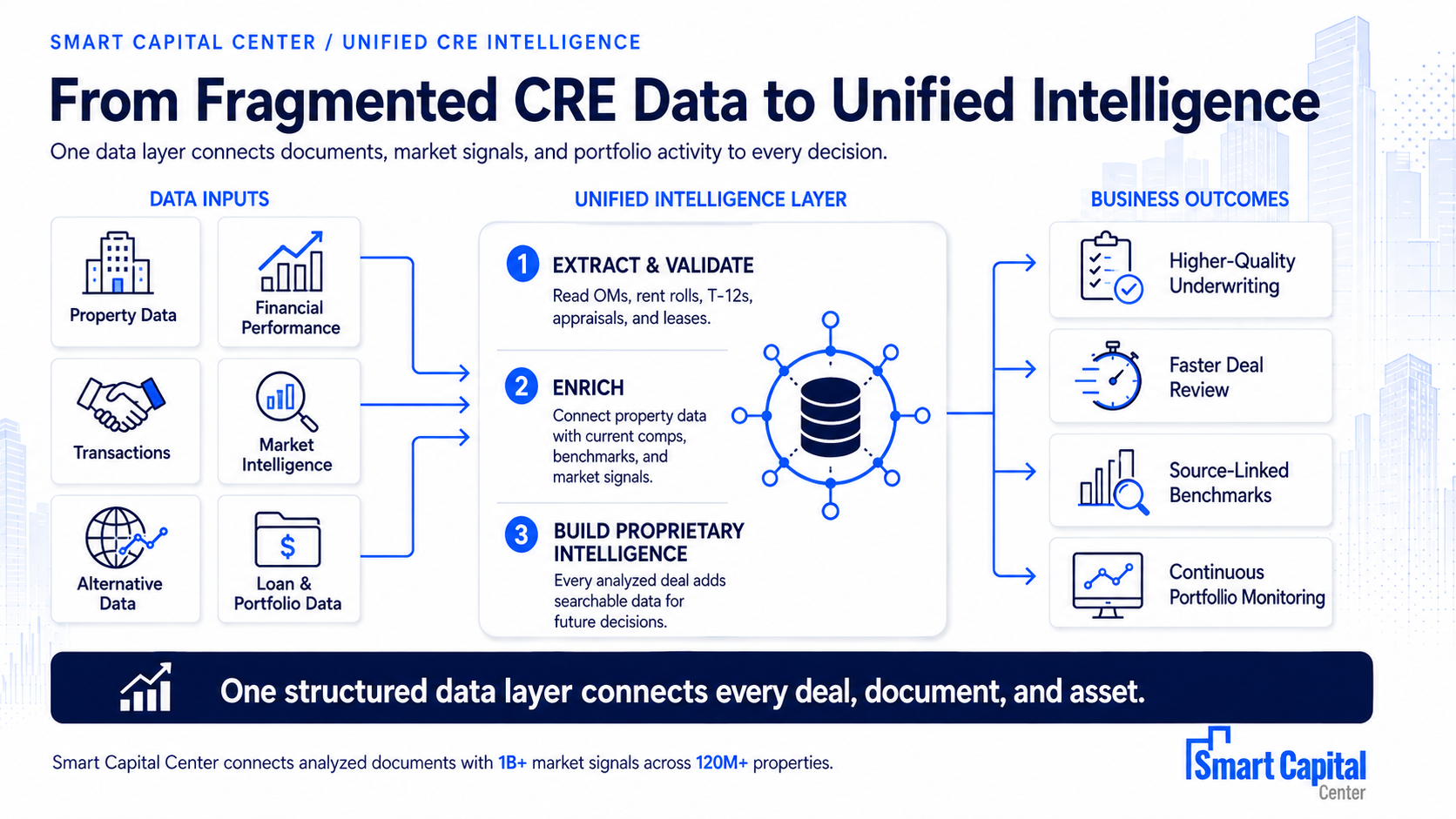
Most CRE financial data lives in PDFs: offering memorandums, rent rolls, appraisals, T-12 statements, and leases. Getting it out requires either manual re-entry or optical character recognition combined with semantic understanding of CRE document structures.
Smart Capital Center's AI extraction layer reads these documents, identifies the relevant fields, validates figures against each other (flagging anomalies like occupancy inconsistencies across rent roll and T-12), and outputs structured, audit-ready data, handling non-standard formats that would stump a generic OCR tool.
KeyBank’s Senior Vice President testified, “The ability to automate data extraction and reduce financial model preparation time by 40% was realized mid-implementation, and that was before full platform deployment.”
Additionally, a Director of Asset Management at JLL remarked, “We’ve reduced document processing time from 30-40 minutes per financial statement to under 3 minutes, achieving more consistent outputs with significantly fewer manual interventions.”
Extracted property data is only useful in context. A 94% occupancy rate in a market with 6% average vacancy reads differently than the same figure in a submarket averaging 12%. The aggregation layer enriches property-level financials with live market benchmarks, sales comparables, and alternative data signals, ensuring every underwriting session reflects current conditions rather than a six-month-old snapshot.
Every document analyzed adds to a firm's proprietary benchmarking database. Over time, this creates a competitive moat: an organization that has analyzed 500 deals in the Southeast multifamily market has a rent, expense, and cap rate benchmark library that no commercial subscription database can replicate. This is how an aggregator compounds in value: each analysis makes the next one faster and more accurate.
The pattern is consistent: tasks that previously required hours or days compress to minutes when commercial real estate data aggregation removes the manual extraction and structuring work from the analyst's plate.
1. Upload a complex document from your actual portfolio: a multi-tenant rent roll with non-standard formatting or a T-12 with unusual expense line items, and verify that the extraction output is structured, accurate, and complete without manual cleanup. If it requires significant correction, the underlying extraction model is not production-ready for your document types.
2. Test the freshness of market data: ask the platform when its comp database was last updated and whether market benchmarks refresh automatically or require a manual pull. Stale comp data is functionally equivalent to no comp data when market conditions are moving.
3. Verify the portfolio monitoring layer: confirm that the platform tracks DSCR, lease expiration, occupancy, and covenant compliance continuously, not just at deal close. Ask specifically whether it generates automated alerts when metrics drift outside defined thresholds.
4. Assess the proprietary data lake capability: determine whether each analyzed document contributes to a searchable, reusable benchmark database owned by your firm. Platforms that analyze deals but do not retain structured outputs for future benchmarking are extracting value from you, not building it with you.
5. Confirm integration with your existing property management and accounting systems, including Yardi, SS&C Precision, or similar platforms. A CRE data aggregator that requires parallel manual entry alongside your system of record defeats its own purpose.
Smart Capital Center executes all five of these steps natively, with SOC 2 Type II security, AES-256 encryption, and private U.S.-based servers ensuring that the proprietary benchmarking data your firm builds over time stays yours.
An AI model that misreads a rent roll – treating vacant spaces with signed letters of intent as occupied units, or failing to catch month-to-month leases listed under standard terms – can produce a materially incorrect NOI and valuation. The error does not surface until due diligence, or worse, post-closing.
Smart Capital Center mitigates this through AI-powered validation and exception management: every extraction runs cross-validation against expected ranges, flags anomalies for review, and maintains a full audit trail connecting every calculated figure back to its source document.
A lender managing a portfolio of 200+ loans cannot manually track DSCR, vacancy thresholds, and reserve requirements for each asset on a continuous basis. When covenant stress develops gradually – a tenant vacates, NOI drops, DSCR approaches the breach threshold over two quarters – the lag between real-world events and portfolio review creates legal and financial exposure.
Smart Capital Center's automated covenant monitoring layer watches every loan metric in real time and generates alerts the moment a metric approaches a defined threshold. The breach is visible weeks before it becomes a formal default event.
An asset manager evaluating a sale often relies on a comp analysis that was current at underwriting but has since drifted – cap rates compressed, a new competitive supply pipeline emerged, or a major tenant in the submarket vacated. Decisions anchored to outdated benchmarks produce pricing that leaves money on the table or, in adverse markets, triggers prolonged listing periods.
Smart Capital Center's live market intelligence layer – drawing on 1B+ real-time signals – ensures that disposition analysis reflects current conditions rather than historical snapshots embedded in spreadsheets last updated months ago.
In volatile markets, relying on stale market comps or outdated cap rate assumptions exposes CRE firms to pricing risks, especially when assets are listed for extended periods. OCC examiners emphasize the need for timely market intelligence to support prudent risk-taking.
Solution: Smart Capital Center integrates real-time market data, ensuring disposition decisions reflect current conditions rather than outdated models.
Alternative data does not replace financial analysis. It contextualizes it. A tenant with strong foot traffic growth but flat reported revenue may have a near-term rent reset in its favor. Smart Capital Center integrates alternative data signals alongside traditional financial metrics, giving analysts a 360-degree view rather than a financial-only picture.
Most CRE firms analyze dozens to hundreds of deals annually. Each deal involves a stack of documents – OMs, rent rolls, appraisals, leases, T-12s – that contains benchmarking data with real market value. The question is whether that data disappears into a shared drive after closing or whether it compounds into a searchable, structured asset.
A properly built proprietary data lake does four things over time:
• Establishes market-specific expense benchmarks from actual analyzed deals – more accurate than national averages for specific submarkets and asset types.
• Creates a comparable transaction database that reflects your firm's actual investment universe rather than a brokerage's transaction set.
• Enables portfolio-wide pattern detection – identifying which tenant types, submarkets, or lease structures correlate with outperformance in your specific portfolio.
• Accelerates future underwriting by pre-populating assumptions from historical deals with similar profiles.
According to McKinsey's research on data and analytics in credit portfolio management (2022), more than 75% of financial institutions surveyed expected to increase their use of advanced analytical techniques, including machine learning, for credit portfolio decisions over the following two years. The firms that built proprietary data assets early are now compressing analysis cycles that their peers cannot match.
Smart Capital Center automatically builds this proprietary data lake with every analyzed document; no additional configuration or export is required.

Institutional-grade CRE data should cover all income-generating property types across the capital stack:
• Multifamily, including garden, mid-rise, high-rise, student housing, and senior housing
• Office: Class A, B, and C, suburban and CBD
• Industrial and logistics: warehouse, last-mile distribution, cold storage, manufacturing
• Retail: strip, power center, grocery-anchored, regional mall, net lease single-tenant
• Hospitality: full-service, select-service, extended stay
• Specialty: mobile home parks, self-storage, medical office, data centers
Smart Capital Center's 120M+ property database spans all of these asset classes with consistent data schemas, enabling apples-to-apples benchmarking across a diversified portfolio or a multi-asset underwriting pipeline.
The competitive gap between CRE firms that operate on unified, real-time commercial real estate data and those still managing fragmented spreadsheet workflows is widening. Market cycles that compress the window between identifying an opportunity and closing it reward firms with data infrastructure that moves at the speed of decisions, not the speed of manual processing.
Smart Capital Center provides the end-to-end CRE data and analytics layer – from document extraction to live portfolio monitoring to proprietary benchmarking – that turns raw CRE data into actionable intelligence across every stage of the investment and lending lifecycle.
The firms gaining ground in today’s market are not those with the largest teams – they are the ones who can evaluate more deals with real-time data and sharp assumptions.
Smart Capital Center gives you the infrastructure to:
Book a demo to see how our AI-driven platform can accelerate your acquisition process.
If analysts are spending more than 30 minutes extracting data from a single offering memorandum or financial statement, that is a measurable inefficiency. A second indicator: if your portfolio risk reviews happen quarterly rather than continuously, you are working with data that is already stale by the time it informs a decision. Both are addressable with a commercial real estate data aggregator that automates extraction and monitoring.
Most institutional-grade platforms handle offering memorandums (OMs), rent rolls, T-12 operating statements, lease abstracts, appraisals, and financial statements. Smart Capital Center's extraction layer processes all of these formats and transforms unstructured PDFs into structured, audit-ready data without requiring standardized templates from the submitting party.
A database subscription gives access to data that someone else collected and organized. A commercial real estate data aggregator with a proprietary data lake builds from your own analyzed documents, so benchmarks reflect your actual deal universe, your markets, and your asset classes. The aggregation layer also handles document extraction and validation, not just data retrieval.
AI extraction quality varies significantly by platform. The relevant test is whether the platform includes validation logic: cross-checking extracted figures against expected ranges, flagging anomalies, and maintaining a full audit trail. Smart Capital Center's extraction has been deployed by JLL at scale, producing a 90%+ reduction in manual analysis time with accuracy sufficient for institutional-grade underwriting and credit presentations.
KeyBank's lending team reported a 40% reduction in financial model preparation time mid-implementation, not at full deployment. JLL's asset management team saw processing time fall from 30–40 minutes to 1–3 minutes per financial statement within the initial rollout phase. Organizations with high document volumes typically see meaningful time compression within the first weeks of active use.
Market data is the raw input: vacancy rates, cap rates, absorption figures, and rent benchmarks. Analytics is the layer that contextualizes it, comparing a specific property's performance against relevant submarket benchmarks, modeling scenarios, and detecting patterns across a portfolio. Commercial real estate data and analytics platforms deliver both: the underlying data and the analytical layer that converts it into decisions.
The minimum security standard for institutional use is SOC 2 Type II compliance – independently audited, not self-reported. Beyond that, verify whether the platform uses end-to-end AES-256 encryption in transit and at rest, private U.S.-based servers (rather than shared multi-tenant cloud infrastructure), and a contractual guarantee that your data is never used to train the underlying AI models. Smart Capital Center meets all four of these requirements.