


CRE Investors

October 20, 2026
CRE Investors
October 20, 2026
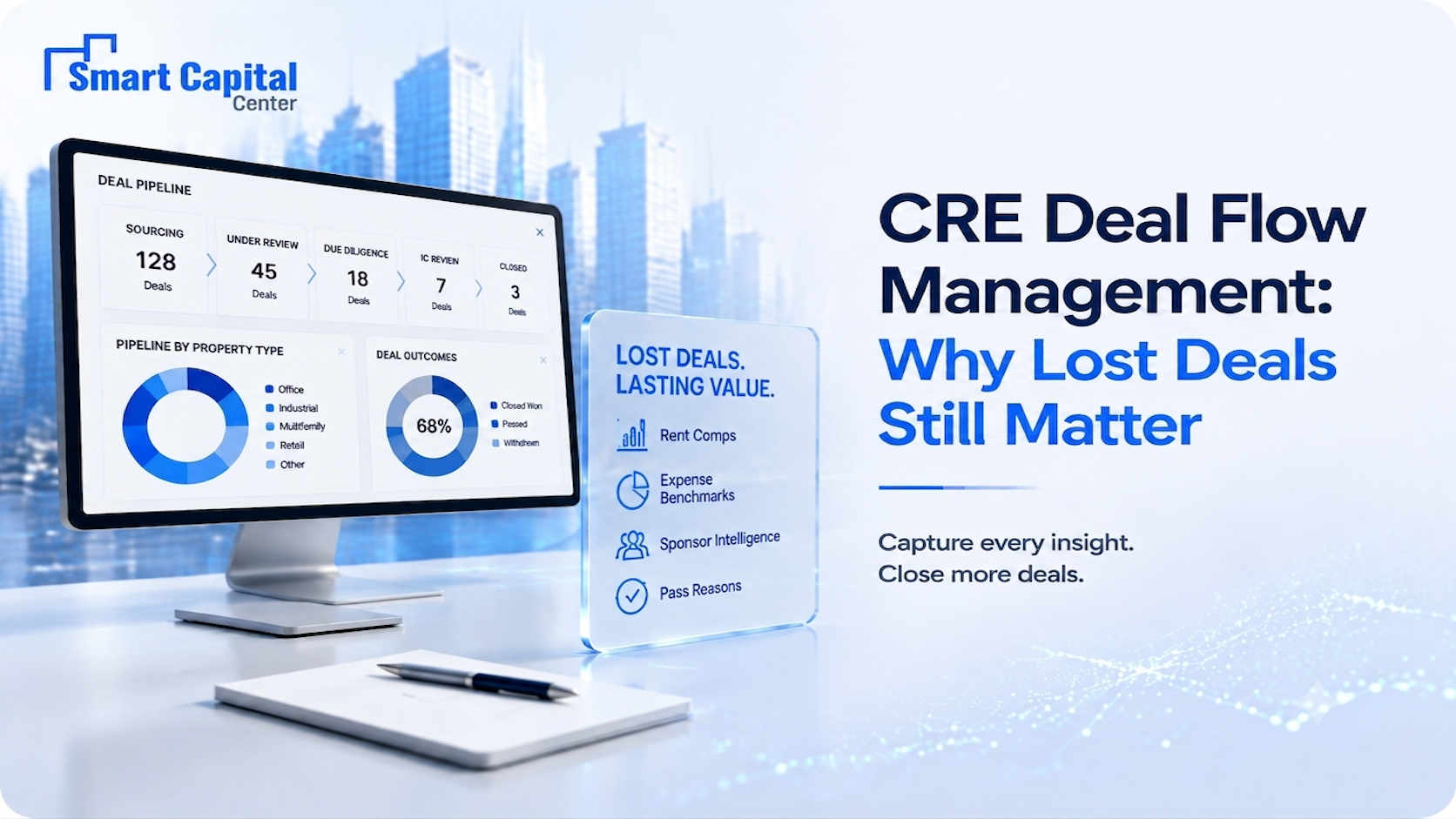
75% of European and Asia-Pacific respondents plan to increase investment levels, per Deloitte's 2026 Commercial Real Estate Outlook. Deloitte reports CRE dry powder of roughly $585 billion ready for deployment as of August 2025 – capital that intensifies competition for every live deal. Sally Ann Flood, Vice Chair and U.S. Real Estate Sector Leader at Deloitte, captured the underlying confidence: "We're seeing that leaders still see commercial real estate as potentially a safe investment haven, given its performance during similar periods of uncertainty in the past." Yet the same survey found that 27% of respondents are experiencing challenges with AI implementation from a lack of structured deal data that makes AI outputs reliable. That gap begins before the first deal closes. It begins with every deal that does not.
This analysis draws on Smart Capital Center, a CRE AI platform that has processed $500B+ in transactions across 120M+ properties, used by institutional investors, lenders, and asset managers including JLL and KeyBank, to map why commercial real estate deal management infrastructure must capture the value locked inside rejected deals, not just closed ones.
Most acquisition teams describe CRE deal flow management as a pipeline tracking problem, but it is more than that. Pipeline tracking is the surface layer. What sits underneath is the data layer that accumulates across every deal the team touches, whether or not it closes.
A fully structured deal flow management system covers six distinct stages, each generating data that has value beyond the deal itself:
• Sourcing and inbound screening: The broker source, deal type, submarket, asking price, and initial pass/advance decision. Every rejection at this stage is a data point about the market and the firm’s investment criteria.
• Initial underwriting: Rent roll extraction, T-12 processing, NOI calculation, and first-pass DSCR. This work is complete whether or not the deal advances.
• Due diligence and IC preparation: Appraisal review, lease abstraction, tenant credit analysis, and IC memo. This is the highest-quality analytical work the team produces, and it disappears with the deal file when a pass decision is made.
• IC and approval: Return scenarios, final assumptions, and the committee’s specific objections to deals that did not advance. These objections are structured criteria that should inform every future evaluation in the same submarket.
• Closed deals: Executed acquisition data, final pricing, cap rate at close, and origination-era assumptions. This is the proprietary benchmark layer that third-party data cannot replicate.
• Dead deals: The underwriting work, the market context, the comps discovered, the reason for the pass. Currently, most firms discard this entirely.

A deal that does not close does not generate revenue. But it generates something that third-party data sources cannot: firsthand, transaction-tested market intelligence specific to the firm's deal criteria, underwriting standards, and submarket focus. According to "Investment Memos and Decision-Making," a research brief by Barbara McEvilley, Ashby Monk, and Dane Rook published through the Stanford Research Initiative on Long-Term Investing (Working Paper #42, 2023), “designing memos for subsequent use as part of organizational knowledge bases is a worthwhile consideration, now or in the near future.” The same research documents that most investors do not track the performance of opportunities they passed on, creating a systematic loss of information that compounds with every cycle. The deal you passed on in Q2 is the comp you need in Q4, and without structured retention, that intelligence disappears entirely.
The specific categories of data locked inside a rejected deal include:
• Rent comps: Actual in-place rents from the rent roll, extracted during underwriting, validated against market listings. These are more granular and more current than any published comp database for that specific submarket and vintage.
• Expense benchmarks: Operating expense ratios, management fee structures, and CAM recovery rates from T-12 statements. These become the proprietary benchmark database that improves every future underwriting comparison in the same property type.
• Sponsor intelligence: The seller, the broker, the asking cap rate, the spread between ask and internal valuation, and the specific reason the deal did not work. Every future deal from the same sponsor is better understood with this context.
• Pass criteria in structured form: Why the IC said no: lease rollover concentration, market repricing risk, submarket fundamentals, pricing gap documented at the deal level creates a structured record of investment criteria that informs future evaluations.
Smart Capital Center builds a proprietary benchmark database from every document analyzed on the platform, regardless of whether the deal closed. Firms using Smart Capital Center can compare new deal assumptions against actual performance data from their own analyzed deals.
The structural reason the CRE deal data disappears is architectural. Deal files are organized as projects, not as records. A deal lives in a folder with a property address, a date, and a status. When the status changes to “passed,” the folder closes. The underwriting work is still there, but it is not indexed, queryable, or structured in a way that makes it useful for the next deal.
Three specific failure modes drive this pattern:
• Project-based file structure instead of data-based: Deal files organized by address and date cannot be searched by submarket, property type, cap rate range, or pass reason. The data exists but is functionally inaccessible.
• No structured pass-reason field: The IC’s objection lives in an email thread or a meeting note. It is not captured in a structured field that makes it queryable. The next analyst evaluating a similar deal starts from the same analysis that was already done and rejected.
• Document-level data not extracted at origination: If the rent roll and T-12 were read by a person rather than extracted into a structured format, the data inside them cannot be compared against future deals.
Smart Capital Center addresses all three failure modes. Document-level data is extracted and structured at ingestion, regardless of outcome. Every analyzed deal contributes to the firm’s proprietary benchmark database. Natural-language querying across the firm’s own deal history surfaces relevant comparables instantly, without manual file retrieval.
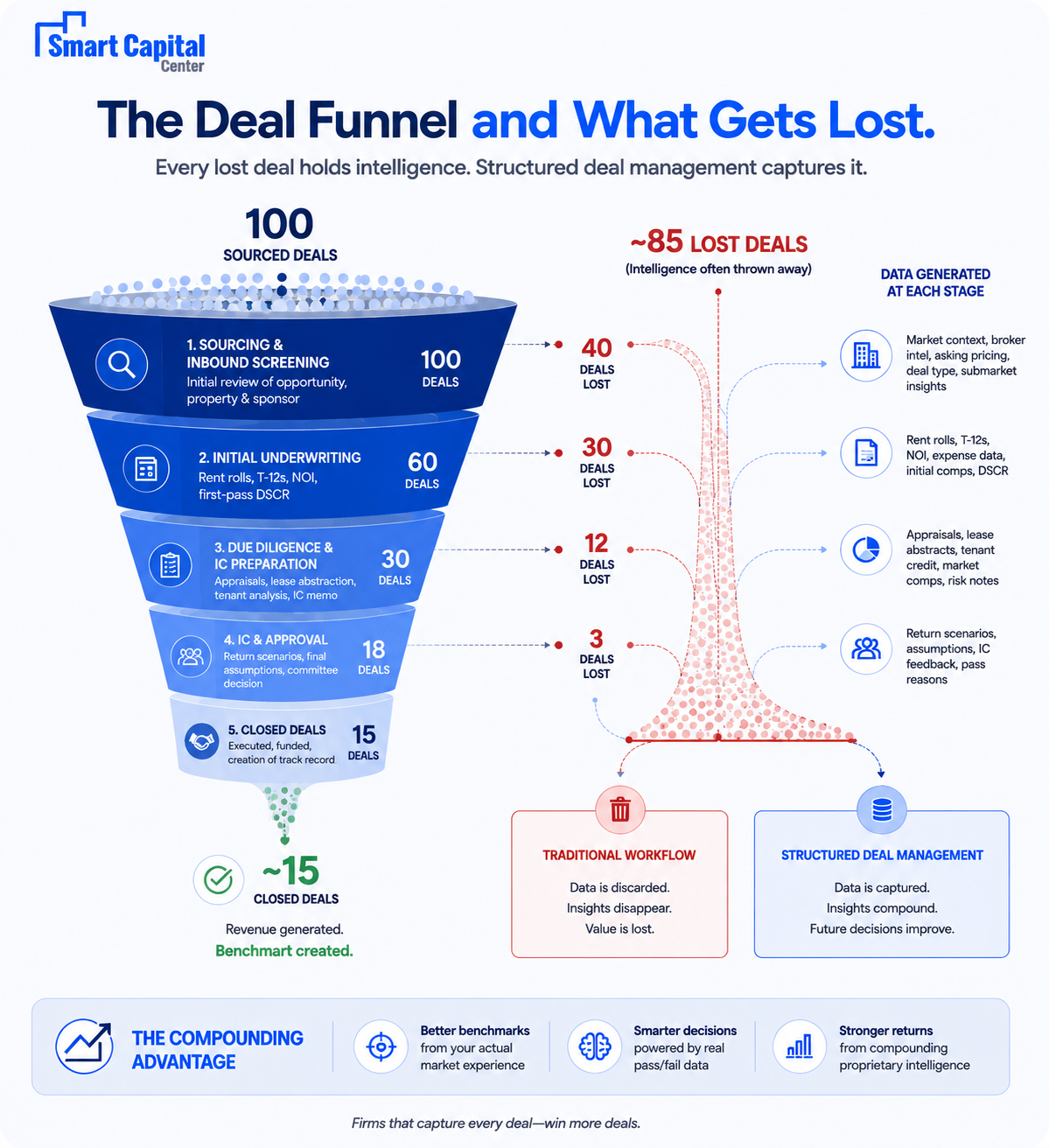
Institutional memory in commercial real estate deal flow is structuring the data from every deal: every document, every extracted figure, every pass reason, so that it remains accessible, queryable, and comparable when the next similar opportunity arrives.
The compounding effect is what makes this infrastructure matter more with every cycle. A team in its first year of structured deal management has a thin proprietary dataset. A team in its fifth year has a benchmark database that reflects five years of actual deal activity in their specific markets, property types, and price ranges. That dataset is more accurate for underwriting new deals than any third-party data source, because it reflects the specific deal universe the team actually operates in.
The MBA’s 2025 Commercial Real Estate Survey of Loan Maturity Volumes documented $875 billion in commercial mortgage maturities for 2026 alone, followed by $652 billion in 2027. At that volume of market activity, the teams that can evaluate more opportunities faster, because their prior deal work informs their current underwriting rather than being redone from scratch, have a structural sourcing advantage.
An analyst spending two days on a new multifamily acquisition in a submarket where the team evaluated three similar deals in the past 18 months is doing work that was already done. The prior rent comps, the expense benchmarks, the market context – all of it was assembled once and then filed away, inaccessible without manual retrieval. At scale, this duplication is one of the most consistent drains on the acquisitions team's capacity.
Smart Capital Center mitigates this through a proprietary benchmark database that makes prior deal data queryable regardless of whether the deal closed. An analyst can query “What rent comps did we use for multifamily deals in this submarket in 2024?” and receive a structured answer from the firm’s own analyzed deals in seconds.
A deal rejected 18 months ago because of an interest rate environment that has since changed, a tenant situation that has been resolved, or a pricing gap that has since closed, without a structured pass-reason record, an analyst will re-evaluate it from scratch rather than recognizing the prior context. The risk runs in both directions: passing on a deal that should now advance, or advancing one that failed for a reason that still applies but was not documented.
Smart Capital Center mitigates this through structured pass-reason capture at the deal level, queryable across the full deal history. Every pass reason becomes part of the firm’s documented investment criteria, available to every future analyst evaluating a similar opportunity in the same market.
A rent roll extracted during due diligence on a rejected deal contains more accurate rent data for that specific submarket and vintage than any published comp database. When that deal file closes without structured extraction, the comp data is inaccessible. The next analyst in the same submarket starts from third-party data that reflects market averages rather than the specific micro-market conditions the firm’s own diligence surfaced.
Smart Capital Center mitigates this through automatic document-level extraction that structures rent roll, T-12, and lease data into the firm’s benchmark database at ingestion, regardless of deal outcome. The data is retained, structured, and queryable even after the deal is marked as passed.

1. Step 1: Audit your current deal file structure and identify where pass-deal data disappears. Pull five rejected deals from the past 12 months and attempt to extract the rent comps, the pass reason, and the expense ratios from each. The difficulty of that exercise maps exactly where your structured deal management gap is. Smart Capital Center’s document extraction layer addresses this gap at ingestion, before the deal advances or is rejected.
2. Step 2: Define a standard set of structured fields to capture at every stage of the pipeline. At minimum: submarket, property type, asking cap rate, internal valuation, pass/advance decision, IC objection reason, and key document data (rent roll, T-12, major lease terms). These fields need to exist in a structured, queryable format.
3. Step 3: Require structured extraction from every document uploaded to the pipeline, not just closed deals. The rent roll from a deal you pass on this week is still a comp you need next quarter. Smart Capital Center extracts and structures document data at upload, adding it to the firm’s proprietary benchmark database regardless of the deal’s final status.
4. Step 4: Capture the IC pass reason as a structured field, not a meeting note. Define a controlled list of pass reasons: pricing gap, lease rollover concentration, market repricing risk, sponsor quality, leverage constraint, and require one to be selected at the IC stage. This creates a queryable record of the firm’s investment criteria over time, not just an archive of files.
5. Step 5: Run a natural-language query across your deal history before starting any new underwriting in a familiar submarket. Before building a model for a new multifamily deal, query your pipeline: “What comparable deals did we evaluate in this submarket and what were the in-place rents?” Smart Capital Center executes all five steps in a single platform that covers the full deal lifecycle.
Every deal you underwrote is data your firm generated and then abandoned. At scale, that abandoned data is the institutional memory gap that forces analysts to start from scratch on every new opportunity in familiar markets.
Smart Capital Center’s commercial real estate deal management software retains, structures, and makes queryable the data from every analyzed deal, closed or passed, building the proprietary benchmark layer that compounds in value with every cycle. The deals that did not close are are the dataset your next deal needs.
Smart Capital Center helps investment teams, including clients like JLL and The RMR Group, capture and analyze full deal flow across 1B+ real-time market signals and 120M+ properties, with $500B+ in transactions analyzed.
Evaluate 10x more deals by building on the underwriting work your team has already done. Book a demo with Smart Capital Center today.
The key is ensuring that document-level data is extracted into a structured format at the time of analysis rather than living only inside the deal file. When rent rolls, T-12 statements, and lease abstracts are processed through an AI extraction layer, the data becomes structured and queryable regardless of what happens to the deal. Smart Capital Center builds a proprietary benchmark database from every document analyzed on the platform, so the rent comps discovered on a rejected deal in Q2 are immediately available when a similar deal arrives in Q4, without manual file retrieval.
At minimum, every pass decision should generate a structured record with: the property address and submarket, the asking cap rate and your internal valuation, the specific IC objection (pricing gap, lease rollover risk, market repricing, sponsor quality, leverage constraint), and any document-level data already extracted during diligence. The pass reason is the most consistently missing data point in most firms’ commercial real estate deal flow systems – it is captured in email threads and meeting notes, but almost never in a queryable structured field. Without it, the investment criteria the team has developed over years of deal evaluation is invisible to the next analyst who encounters a similar opportunity.
This requires two things: a CRE deal platform that stores deal-level data in a structured, searchable format, and document-level extraction that converts rent rolls and financials into queryable data rather than static files. Smart Capital Center’s natural-language querying allows analysts to ask questions like “What multifamily deals did we evaluate in this submarket last year and what were the in-place rents?” and receive structured answers from the firm’s own deal history in seconds, without opening individual files.
A pipeline tracker shows you where active deals are in the process. A structured CRE online investment software platform captures the data inside every deal in a structured, queryable format that remains accessible regardless of outcome. The pipeline tracker tells you the status of today’s deals. The structured database gives every future deal access to the institutional knowledge generated by every past deal, including the ones that did not close.
Third-party comp databases reflect aggregate market behavior. Your own analyzed deals reflect the specific submarkets, property types, and price ranges where your firm actually operates. To use your own data as a benchmark, you need document-level extraction that structures rent roll, T-12, and lease data into a consistent format across all analyzed deals, and a querying layer that makes that data searchable by submarket, property type, and vintage. Smart Capital Center builds this proprietary benchmark layer automatically, accumulating with every document analyzed, so the first-party data layer gets more accurate with every CRE deal the firm evaluates.
The connection is bidirectional. A CRE deal flow management platform that captures pass reasons and deal outcomes informs sourcing by identifying which broker sources, submarkets, and deal types produce the highest-potential opportunities over time. Smart Capital Center’s deal history layer allows acquisitions leadership to identify patterns across the pipeline, which source channels produce the most advanced deals, which submarkets show the largest gap between ask and internal valuation, which pass reasons are appearing repeatedly and might signal a need to revisit investment criteria. That feedback loop is what turns a deal pipeline from a status tracker into a proprietary competitive intelligence resource.