


AI in Commercial Real Estate

September 30, 2026
AI in Commercial Real Estate
September 30, 2026
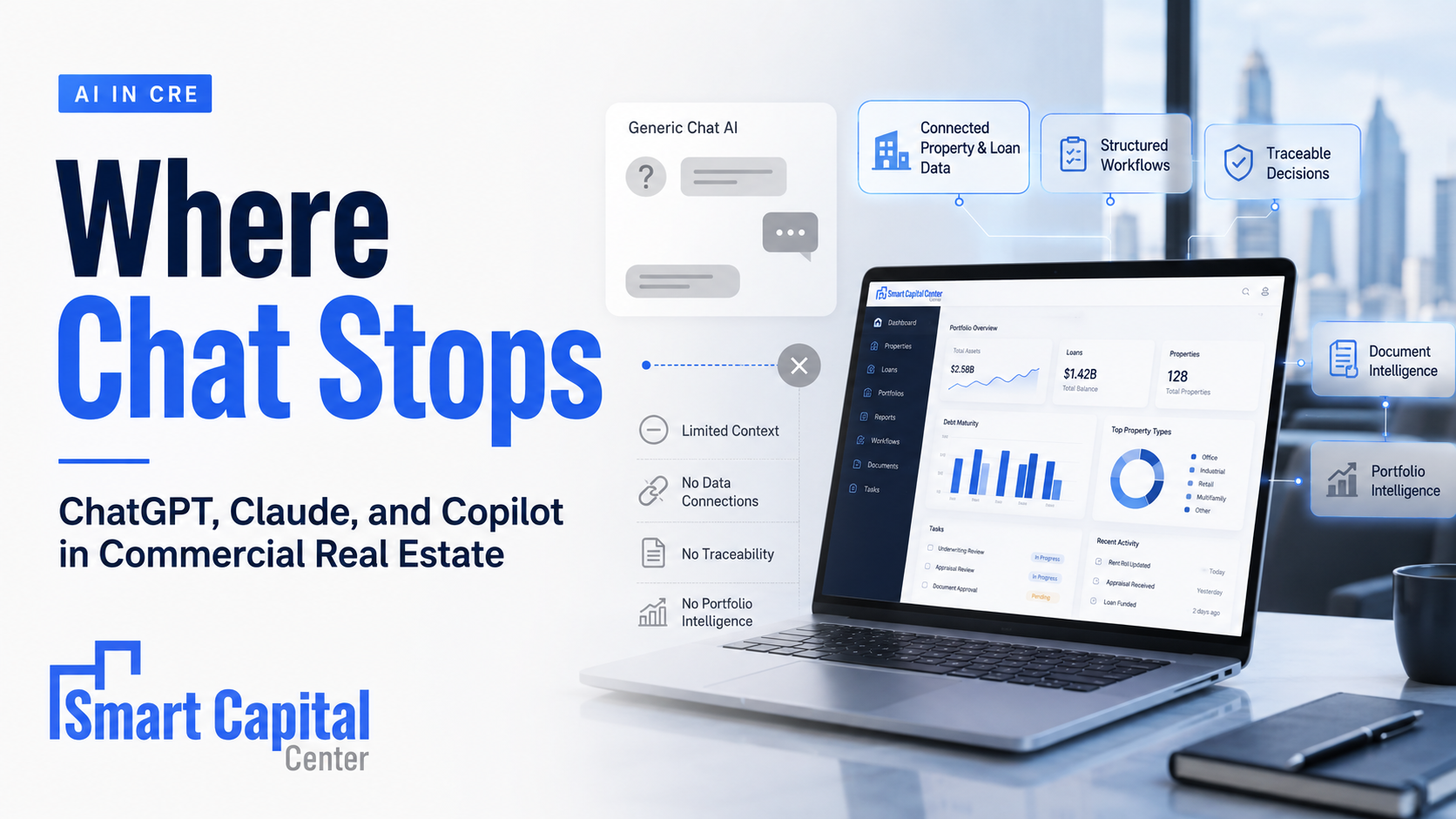
Almost every commercial real estate team is running the same experiment right now. An analyst drops a rent roll into a chat window, asks for a summary, and gets something useful back in seconds. A director pastes bullet points into the same window and receives a passable first draft of an investment memo. The conclusion feels obvious: why pay for commercial real estate software when a general AI subscription already does this?
It is a fair question, and it deserves a fair answer, starting with an admission. Smart Capital Center runs on the same frontier models. The platform uses several of them internally and swaps them by task as performance changes.
It is also a question the industry has answered badly so far. In Deloitte's 2026 Commercial Real Estate Outlook, a survey of more than 850 executives across 13 countries, only 7% of CRE firms reported a transformative impact from AI and 19% were still in an early or experimental phase, after two years of heavy sector-wide investment. Plenty of firms have bought AI. Far fewer have changed how the work actually gets done.
So why build an entire platform on top of tools our clients could subscribe to for the price of a monthly seat?
Because the model was never the hard part. The hard part is everything a commercial real estate decision has to carry with it:
None of that is a model capability. All of it is a system capability. As one client put it:
"Smart Capital Center allows us to transform our business. My team and I are more confident that our decisions are more objective, data-driven, which minimizes our risk." - Chief Risk Officer, Commercial Mortgage Lender
Three tools account for almost all general AI activity in CRE teams today: ChatGPT, Claude, and Microsoft Copilot, the last of which arrives bundled with Microsoft 365 and therefore sits on the desktop of most finance and asset management staff by default. Everything in this guide applies to all three, and to whatever replaces them next year, because the limits described here are structural to the chat interface itself.
The term covers two different categories of product, and most confusion in the market comes from treating them as one.
A general-purpose model is a conversational AI system trained on broad public data and accessed through a chat interface. ChatGPT, Claude, and Copilot are general-purpose models. They hold only what you provide in a given session and produce text as their output.
A purpose-built CRE platform is software that applies AI inside a structured system of record for property and loan data. It holds your portfolio permanently, links records to each other, runs calculations in code, and produces underwriting files, memos, and covenant tests as its output.
Four terms recur throughout this guide and are worth defining precisely.
DSCR (Debt Service Coverage Ratio) measures whether a property's income covers its debt payments.
DSCR = Net Operating Income ÷ Annual Debt Service
A property generating $1.2 million in NOI against $1.0 million in annual debt service has a DSCR of 1.20x. Most lenders require a minimum between 1.20x and 1.35x.
Covenant testing is the recurring process of checking whether a borrower still satisfies the conditions written into the loan agreement, most commonly minimum DSCR and occupancy thresholds. It runs quarterly or annually for the life of the loan.
Source traceability is the ability to take any figure in a financial output and see the exact passage in the original document it came from. Without it, a number cannot be independently verified by an auditor or a credit committee.
System of record is the single authoritative source for a given set of data within an organization. When a system of record exists, every user sees the same figures and every change is logged. A chat session is not a system of record, because nothing it produces persists or is visible to anyone else.

Any honest comparison starts here, because dismissing these tools costs credibility with the analysts already using them daily.
General models perform well on:
If your firm's AI use is confined to these tasks, a general subscription is a reasonable tool and you should keep using it. Our guide to the best AI tools for commercial real estate professionals covers where each of them fits.
The gap opens when the output has to become a decision, a record, or a repeated process.
Two datasets frame why this question is being asked now. The first is workload. According to the Mortgage Bankers Association's 2025 Commercial Real Estate Survey of Loan Maturity Volumes, released February 9, 2026, $875 billion in commercial and multifamily mortgages, 17% of the $5.0 trillion outstanding, comes due in 2026, with a further $652 billion in 2027. Every one of those loans needs analysis, and most CRE teams are absorbing that volume without adding headcount.
The second is how little of the AI investment made against that workload has produced results.
| Metric | Figure | Source and Period |
|---|---|---|
| Commercial mortgages maturing in 2026 | $875 billion (17% of $5.0T outstanding) | MBA, 2025 CRE Survey of Loan Maturity Volumes, February 9, 2026 |
| Commercial mortgages maturing in 2027 | $652 billion | MBA, same release |
| Change from 2025 maturity volume | Down 9% from $957 billion | MBA, same release |
| Hotel/motel loans maturing in 2026 | 30% | MBA, same release |
| Industrial loans maturing in 2026 | 23% | MBA, same release |
| Office loans maturing in 2026 | 17% | MBA, same release |
| Health care loans maturing in 2026 | 15% | MBA, same release |
| Multifamily loans maturing in 2026 | 13% | MBA, same release |
| Bank and depository maturities in 2026 | $396 billion (21% of their balances) | MBA, same release |
| CRE firms reporting transformative AI impact | 7% in 2025, up from 1% in 2024 | Deloitte 2026 Commercial Real Estate Outlook, September 2025 (850+ executives, 13 countries) |
| CRE firms reporting incremental AI improvement | 24%, up from 7% | Deloitte, same survey |
| CRE firms still in the early stages of their AI journey | 19% | Deloitte, same survey |
| CRE firms facing AI implementation challenges | 27% | Deloitte, same survey |
The Deloitte figures are the more revealing pair. After two years of heavy AI investment across the sector, fewer than one firm in three reports operational improvement of any kind, and roughly one in five have not moved past experimentation. That is the pattern of tools being adopted without the surrounding structure required to make them useful.
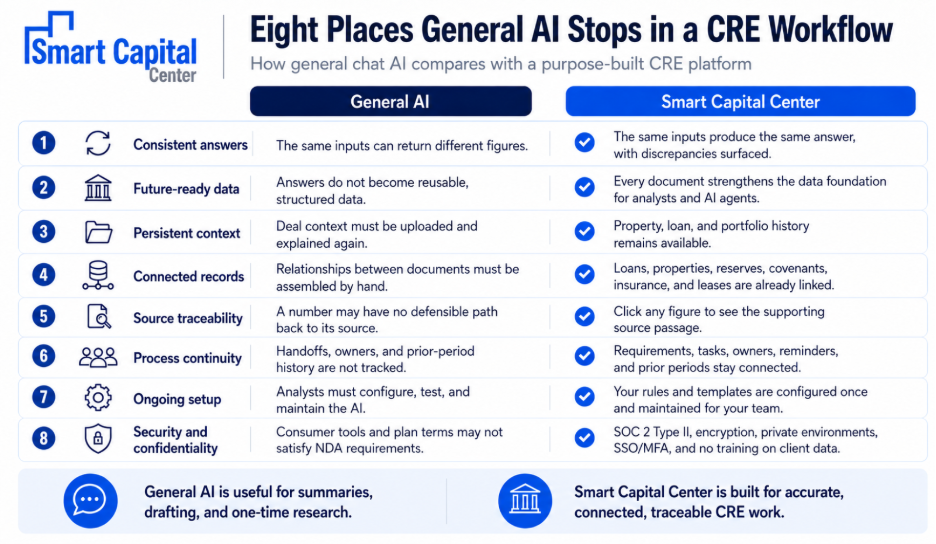
1. It Cannot Guarantee The Same Answer Every Time
Commercial real estate runs on numbers that have to hold still. A DSCR that feeds a covenant test, an NOI that sets a valuation, a debt yield that decides whether a loan clears committee. Those figures get quoted in memos, defended in meetings, and examined months later.
General models like ChatGPT and Claude are probabilistic. When you run the same operating statement through one twice, the reasoning can shift, because the model is generating an answer rather than retrieving one. That is acceptable for brainstorming but unacceptable for a covenant determination, where the same inputs have to produce the same answer every time or the result cannot be relied on.
" I use ChatGPT and Claude every day, and sometimes the number comes back wrong. I only catch it because I double-check. When I prompt again, it corrects itself." - Suma Rayi, Product Team, Smart Capital Center
The problem compounds across a team. When multiple analysts ask the same question in separate chat sessions, nothing guarantees they get the same figure, and neither of them has any way of knowing they disagree.
What this means with Smart Capital Center: you can put the number in front of a committee without checking it by hand first. Calculations run in code, so the same inputs produce the same answer every time and for everyone. Anything that fails to reconcile is held back and surfaced instead of passing through quietly, which means the errors you need to catch find you instead of the other way round. AI suggests, and the analyst decides.
"Smart Capital's capability to extract, standardize, and analyze data from property financials, combined with automated reconciliations and analyses, has already transformed our operations. Instead of the 30 to 40 minutes it took us previously to process a single financial statement, it now takes 1 to 3 minutes." - Fernando Salazar, Director of Asset Management, JLL
2. It Does Not Build a Foundation for Future Work
General AI tools can summarize a document or answer a question, but each interaction is largely separate. The information is not automatically organized into a structured record that your team or an AI agent can use later.
This matters because AI agents need accurate, well-structured data to perform CRE tasks reliably. An agent sizing a loan, testing a covenant, or reviewing a portfolio for risk needs to understand where each figure came from, how it relates to the deal, and whether it has been verified.
“The future of work, especially in a data-heavy industry like CRE, will involve people working alongside AI agents. As agents take on more work, they will need large amounts of accurate, well-structured data to perform reliably. Smart Capital Center provides the environment, tools, and infrastructure these agents need to execute work accurately and quickly.” - Laura Krashakova, CEO, Smart Capital Center
What this means with Smart Capital Center: every document your team processes contributes to a structured and traceable source of property, loan, and portfolio data. Instead of producing a one-time answer, the work becomes part of a reliable foundation that your team and AI agents can continue using. Smart Capital Center provides the environment and infrastructure these agents need to complete CRE work accurately and quickly.
3. Context Does Not Persist
A chat session ends and the knowledge goes with it. Next quarter, the same property arrives as a stranger. The same happens to rejected deals: the analysis is done, the answer was no, and everything learned in reaching that answer disappears.
" Smart Capital Center gets sharper on your portfolio every quarter, because nothing gets thrown away. The leases, the financials, the offering memoranda all stay in one place, extracted and structured. With ChatGPT, you are re-uploading and re-explaining from scratch every single time.” - Laura Krashakova, CEO, Smart Capital Center
Project folders and persistent memory features narrow this gap for a single user working alone. They do not solve it for a firm, because the knowledge still lives in one person’s account in unstructured form, and it cannot be queried, benchmarked, or reported on.
What this means with Smart Capital Center: your firm stops paying for the same work twice. Every document processed becomes permanent structured data, so this quarter's analysis starts with five years of history already in place instead of a blank window. Analysts spend their time on judgment instead of re-uploading and re-explaining. The intelligence accumulates as an asset the firm owns, and it stays when the analyst who built it moves on.
4. The Data Has No Relationships
Uploading five documents is different from having five connected records. Most CRE teams already run four to ten systems that do not exchange data, and a chat window becomes one more place data has to be re-entered by hand.
"The loan details are connected to the same property and the insurance, so everything is interlinked. A general tool won't have that information unless you provide it." - Suma Rayi, Product Team, Smart Capital Center
A covenant test that draws on the loan agreement, the trailing twelve, the reserve balance, and the insurance certificate is a query across four linked objects. In ChatGPT, Claude, or Copilot it is a manual assembly job the analyst performs before every single question, and the assembly itself is where errors enter.
What this means with Smart Capital Center: you can ask a portfolio question and get an answer the same day. Which assets have leases expiring inside five years, which loans are trending toward a covenant breach, where is occupancy slipping ahead of a maturity. Loans, properties, reserves, covenants, insurance, and abstracted lease terms are already connected, so the answer is a query instead of a week of assembling spreadsheets.
5. No Source Trail a Credit Committee Can Follow
This is the decisive gap for lenders. A chat window returns a number. It does not return a defensible path from that number back to page 34 of the operating statement. With $396 billion in bank-held mortgages maturing in 2026, according to the MBA survey cited above, the volume of refinancing files subject to examiner review is substantial.
What this means with Smart Capital Center: when an examiner or a credit committee asks where a number came from, the answer takes seconds instead of an afternoon of document archaeology. Click any figure and the source passage appears beside it. Every action is logged and exportable, and an approved coding locks so downstream figures cannot drift. For a chief credit officer weighing commercial real estate underwriting software, that defensibility is usually what makes adoption possible at all.
6. No Memory of State Across a Multi-Party Process
Lending and acquisitions are not single sessions. They involve a borrower, a processor, an approver, and a reviewer, across weeks. When a team is already absorbing more deal volume than it can staff against, anything that falls between those handoffs is expensive to recover.
"You upload the requirements into a general tool and you get one response. We need to actually keep track of everything so they have all the history. What was it last year, was it satisfied or not." - Santiago Ramos, Smart Capital Center
What this means with Smart Capital Center: nothing falls between the handoffs, and the same team carries more volume. Requirements are tracked against the loan, tasks sit with named owners, borrowers submit through a portal or by email, and reminders stop once someone has already replied, so your team is not chasing people who have done the work or apologizing for the ones who have not. Prior periods stay available for comparison. lenders and asset management teams use this to review substantially more deals without adding headcount.
"Smart Capital Center has become an integral part of our initial underwriting and loan analysis. With the platform, we can review significantly more applications with greater depth and consistency, allowing us to identify and prioritize the strongest opportunities aligned with our affordable housing finance mission." - Kelly Boyer, President, Rose Community Capital
7. The Setup Burden Lands on Your Analysts
All three platforms now offer custom agents and reusable skills, which closes part of the gap. It also creates a new job. The Deloitte survey found 19% of CRE firms still in an early or experimental AI phase, and implementation barriers it names include lack of internal expertise and resistance to change. One analyst at an investment firm evaluating AI platforms described the problem during a discovery call:
"We use ChatGPT, helping us where we can, but the capabilities are somewhat limited. They have the agent features and the different skills you can create, but you have to go in and set it all up yourself. You have to do all these trial runs, make sure it runs as intended. We're looking for something that takes that step out of the process."
Senior Analyst, Private CRE Investment Firm
The same applies to Claude projects and skills, and to Copilot agents. Someone at your firm becomes a part-time prompt engineer, that person is usually your strongest analyst, and the work is invisible on the org chart until it stops getting done.
What this means with Smart Capital Center: your best analyst goes back to analyzing. Extraction logic, chart of accounts mapping, covenant rules, and report templates are configured once at onboarding and maintained for you, with your firm's own methodology and language built in. Nobody on your team has a second job keeping the AI working, and the output does not quietly drift when that person takes a holiday.
"Smart Capital Center has removed most of the manual work that was taking a lot of time from our team. The solution allows us to focus on more productive, higher-level work, and we get the results much faster." - Credit Risk Manager, Top US Insurance Company
8. Your NDA Is the Real Blocker
Most deal materials arrive under confidentiality, and for many firms this is the single reason an AI program has stalled before it started. Firms have started adding explicit clauses prohibiting the upload of financial information to any AI tool, and several institutional managers now restrict AI work to assets they own outright while their legal teams work through the question.
Plan tier matters more than most teams realize. Enterprise agreements across ChatGPT, Claude, and Copilot carry materially different data handling terms than the consumer versions an analyst signs up for personally, and the version in use is often the personal one. Retention policies at the model level also change, sometimes with little notice, so a review completed last year may no longer describe what is actually happening today.
What this means with Smart Capital Center: counsel can sign off, so the program can actually start. Security is built into the architecture, not promised in a policy: SOC 2 Type II certification, AES-256 encryption in transit and at rest, private US-based servers, SSO and organization-wide MFA, an isolated environment per firm, and no client data used to train shared models. The distinction that matters to a legal review is that a confidentiality obligation restricts uncontrolled disclosure, and a controlled, isolated environment is a different thing from a consumer chat window.
| What you need to do | ChatGPT, Claude, or Copilot | Smart Capital Center |
|---|---|---|
| Summarize a long document quickly | Yes | Yes |
| Draft a memo from rough notes | Yes | Yes, written from live deal data |
| Pick up a property where you left off last quarter | Start over each session | Five years of history already there |
| Answer a question spanning loan, property, and insurance | Assemble the inputs by hand first | Ask and get an answer |
| Produce the same figure twice | Can vary between runs | Same inputs, same answer |
| Show a committee where a number came from | Not possible | Click the figure, see the source |
| Hand an examiner an audit trail | Not possible | Exportable action log |
| Run a process across borrower, processor, and approver | Not possible | Tracked end to end |
| Compare this period against last | Rebuild it manually | Already side by side |
| Check comps, tenant signals, and tax status | Public web only | 120M+ properties, 1B+ real-time data points |
| Pull figures from Yardi, ARGUS, or Excel without re-keying | Not possible | Connected |
| Pass a confidentiality review | Depends on plan tier | SOC 2 Type II, isolated, no shared-model training |
| Get started without building it yourself | Ongoing internal effort | Configured at onboarding |
No honest comparison is one-sided, and senior buyers discount content that pretends otherwise.
A platform requires onboarding. A general subscription is live in a minute. Connecting a portfolio, mapping a chart of accounts, and configuring covenant logic takes structured work up front. The payback arrives at volume, not on day one.
Frontier models move fast. Capabilities that look like differentiators today may become table stakes. This is why the durable advantages are structural ones: your accumulated data, your audit trail, your workflow state. Those do not commoditize when the next model ships.
Some tasks genuinely belong in a chat window. Exploratory research, learning a new asset class, and quick one-off questions do not need a system of record. Firms that route everything through one tool tend to be inefficient in one direction or the other.
Extraction accuracy is a shared problem. Any AI reading a non-standard document will make mistakes. The meaningful question is whether the system surfaces them. Reconciliation flags and source links exist precisely because extraction is imperfect.
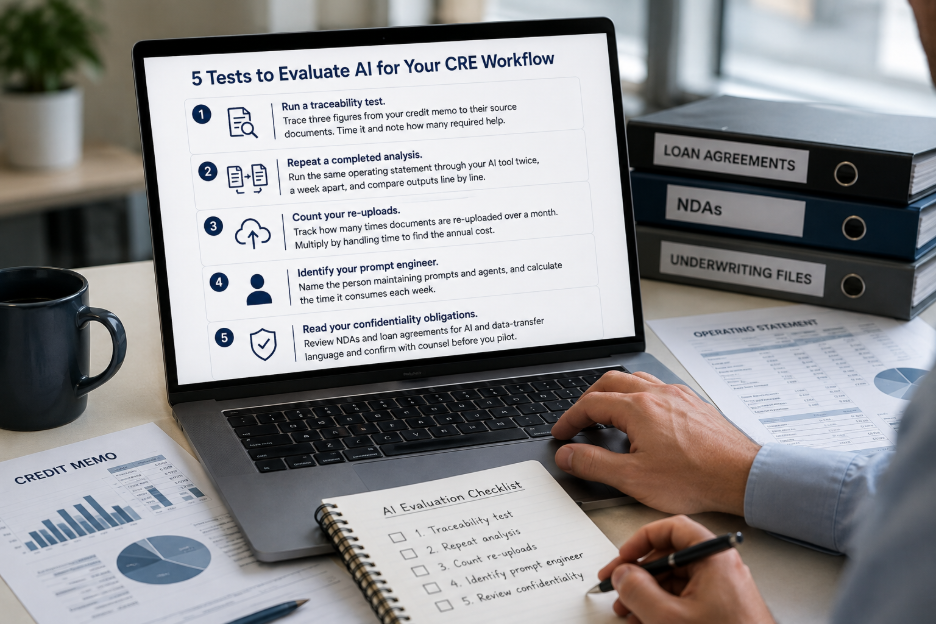
Run these five tests against your own process before committing to either path.
1. Run a traceability test. Take three figures from your most recent credit memo and trace each one back to its source document. Time how long it takes and count how many required asking a colleague. If the answer exceeds a few minutes per figure, your current process will not withstand examiner review at volume.
2. Repeat a completed analysis. Feed the same operating statement through your general AI tool twice, a week apart, and compare the outputs line by line. Any variance in a figure that feeds a covenant calculation tells you the tool belongs in research, not in production.
3. Count your re-uploads. Over one month, log how many times an analyst uploads a document the firm has already processed before. Multiply by average handling time. That number is the annual cost of context that does not persist.
4. Identify your prompt engineer. Name the person maintaining your custom agents and prompts, and calculate what share of their week it consumes. If nobody owns it, your AI outputs are drifting without anyone watching.
5. Read your confidentiality obligations before the pilot, not after. Pull three current NDAs and loan agreements, search them for AI and data-transfer language, and confirm with counsel which plan tier your team is actually using. This determines the entire shape of your AI program.
Laura Krashakova's summary of the whole question, from an internal review of exactly this comparison:
"Data extraction is just one piece of the puzzle." - Laura Krashakova, CEO, Smart Capital Center
General AI models are strong at reading, drafting, and research, and CRE teams should use them for that work. They stop where commercial real estate actually operates: across years, across people, across linked records, and under obligations to prove how a conclusion was reached.
The timing matters, and the MBA's chief economist framed why in the February 2026 release:
"The data from this survey show that 2025 was a transition year, with the maturity wall shrinking after several years where the wall of scheduled maturities had been increasing. Even though longer-term interest rates were little changed over the course of the year, lenders were no longer simply extending loan terms." - Mike Fratantoni, SVP and Chief Economist, Mortgage Bankers Association
Refinancing analysis that lenders deferred for two years is now landing on desks that have not grown. Our 2026 CRE Outlook covers what that means for cap rates and lending conditions.
The firms handling that volume are doing it with a system, not a subscription:
"We can underwrite a deal in a week instead of a month. The end product is so detailed that the finance brokers were impressed. As a sponsor, you must know your numbers cold, and Smart Capital Center lets me do that." - George Arce, Jr., President and CEO, Centers Dynamic Partners
See what a system of record does that a chat window cannot. Book a Smart Capital Center demo today.
Q. How Do You Use AI in Commercial Real Estate?
A. Most firms start with document reading, summarization, and drafting, which general AI handles well. Production use extends into data extraction from rent rolls and operating statements, covenant testing, variance analysis, memo generation, and portfolio monitoring. Those later stages require persistent data, traceability, and workflow. Smart Capital Center covers the full transaction lifecycle from screening through disposition, keeping every extracted figure linked to its source document and every workflow tracked.
Q. Can ChatGPT or Claude Underwrite a Commercial Real Estate Deal?
A. Either can produce directional analysis from documents, but an analyst still needs to verify every calculation and correct any errors. They also do not maintain a connected record of the deal or reliably show where each figure came from. Smart Capital Center includes checks and balances throughout the process. It runs calculations in code, reconciles extracted data, flags discrepancies for review, and links each figure to its source. Analysts can focus on exceptions and decisions rather than manually rechecking the entire file.
Q. Is Claude or ChatGPT Better for Commercial Real Estate Work?
A. The differences between frontier models matter less than most buyers expect, and they change with every release. Smart Capital Center uses several of them internally and swaps by task as performance shifts, which means the choice between them is one clients do not have to make. The durable question is whether general AI is the right layer at all for work that requires persistent portfolio data, an audit trail, and multi-user workflow.
Q. Can Microsoft Copilot Handle CRE Underwriting and Asset Management?
A. Copilot has an advantage in reach, since it comes with Microsoft 365 and already sits alongside the Excel and Word files where CRE analysts work. It shares the same structural limits as other general models: no persistent linked portfolio data, no source traceability, and no multi-party workflow state. Smart Capital Center integrates with Excel and with existing deal management, asset management, and accounting systems, so data flows into a system that holds it permanently.
Q. What Is the Leading AI for Commercial Real Estate?
A. General models and CRE platforms solve different problems, so the practical approach is to use general models for research and drafting and a purpose-built platform for anything requiring accuracy, persistent data, audit trails, and workflow. Evaluate platforms on data traceability, integration depth, workflow coverage, and security posture. Smart Capital Center holds 1B+ real-time data points across 120M+ properties, has analyzed $500B+ in CRE transactions, and is used by teams at JLL, KeyBank, The RMR Group, Gantry, Tremont Realty Capital, and Community Preservation Corporation.
Q. Is It Safe to Upload Deal Documents to ChatGPT, Claude, or Copilot?
A. That depends on your confidentiality obligations and your plan tier, and the two interact. Deal materials frequently arrive under NDA, some leases and loan agreements now prohibit uploading financial information to AI tools, and enterprise agreements carry very different data handling terms than the personal accounts staff often use. Smart Capital Center is SOC 2 Type II certified, encrypts data in transit and at rest, runs on private US-based servers, and never trains models on client data, which is a materially different position for counsel to review.
Q. Does Smart Capital Center Use ChatGPT or Claude?
A. Smart Capital Center uses several frontier models internally and selects them by task, swapping when a different model performs better for a specific job. The differentiation sits in the layer around the models: the structured data lake, deterministic calculation, source traceability, workflow engine, and integrations into existing deal management, asset management, and accounting systems and built-in checks and balances that help ensure the accuracy of analyses and actions completed by AI agents. Within this environment, Smart Capital Center’s AI agents can perform tasks for analysts, including financial analysis, DCF generation, investment memo drafting, and more.
Q. How Does Smart Capital Center Handle AI Accuracy?
A. Through three layers. Calculations run deterministically in code wherever the math allows. Every extracted figure links back to the source passage in the original document. Reconciliation checks flag any statement that fails to balance, holding it for review instead of approving it. AI suggests, and the analyst decides.