


AI in Commercial Real Estate

September 16, 2026
AI in Commercial Real Estate
September 16, 2026
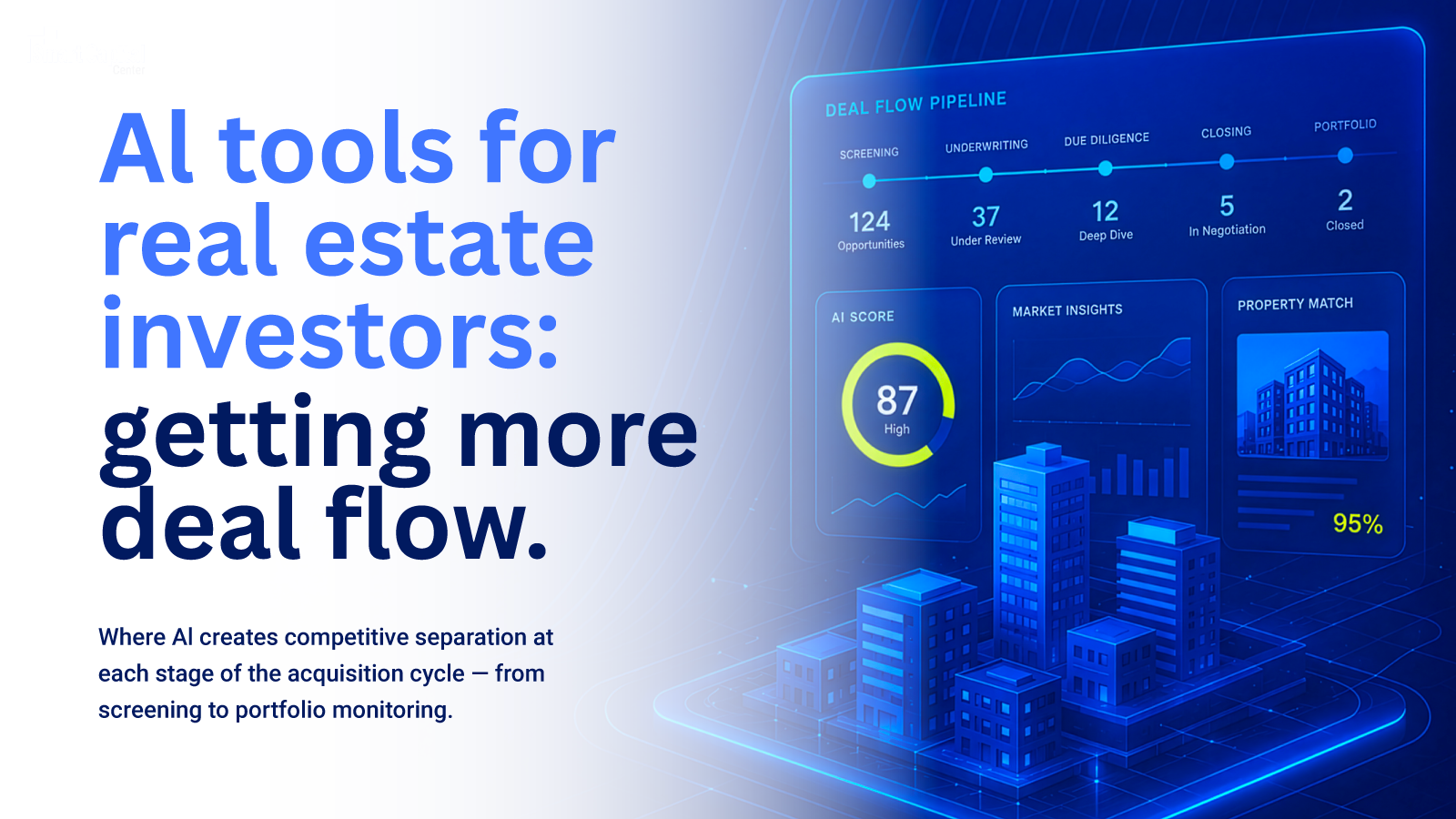
According to McKinsey's Global Private Markets Report 2026, alpha in real estate is increasingly "made, not found" – asset selection now accounts for roughly 70% of performance variance, with the tailwinds of declining cap rates and rising valuations no longer doing the heavy lifting. In that environment, the investors evaluating the most deals with the sharpest assumptions are the ones capturing the best opportunities first.
This analysis draws on Smart Capital Center – a CRE AI platform that has processed $500B+ in transactions across 120M+ properties, used by JLL, KeyBank, and leading institutional lenders – to map where AI tools for real estate investors create competitive separation at each stage of the acquisition cycle.
The gap between investors who have operationalized AI and those still running manual workflows is not theoretical. JLL's Global Real Estate Outlook 2026 found that 88% of investors launched AI pilots in 2025, but only 5% achieved most of their program goals. The tools exist. The bottleneck is knowing where to deploy them – and which workflows actually return time to the acquisition team.
Acquisition teams are not constrained by deal flow – they are constrained by how many deals they can realistically evaluate.
In a manual workflow, one analyst can underwrite four to six deals per month. Increasing volume requires either hiring or reducing diligence quality. AI removes this constraint by automating document extraction, initial screening, and model population, allowing the same team to evaluate significantly more opportunities without expanding headcount.
In competitive CRE transactions, timing shapes outcomes. The buyer who delivers the first credible offer, supported by clean, defensible assumptions often sets the negotiation baseline.
AI tools compress the time between receiving a deal and producing an initial underwriting view. This allows investors to move earlier in the process, when pricing is less efficient and competition is still forming.
Manual underwriting introduces variability. Two analysts working from the same documents can produce slightly different models depending on interpretation and formatting choices.
AI standardizes data extraction and model structure across all deals. This consistency improves comparability between opportunities and reduces the risk of decisions driven by inconsistent assumptions rather than actual asset performance.
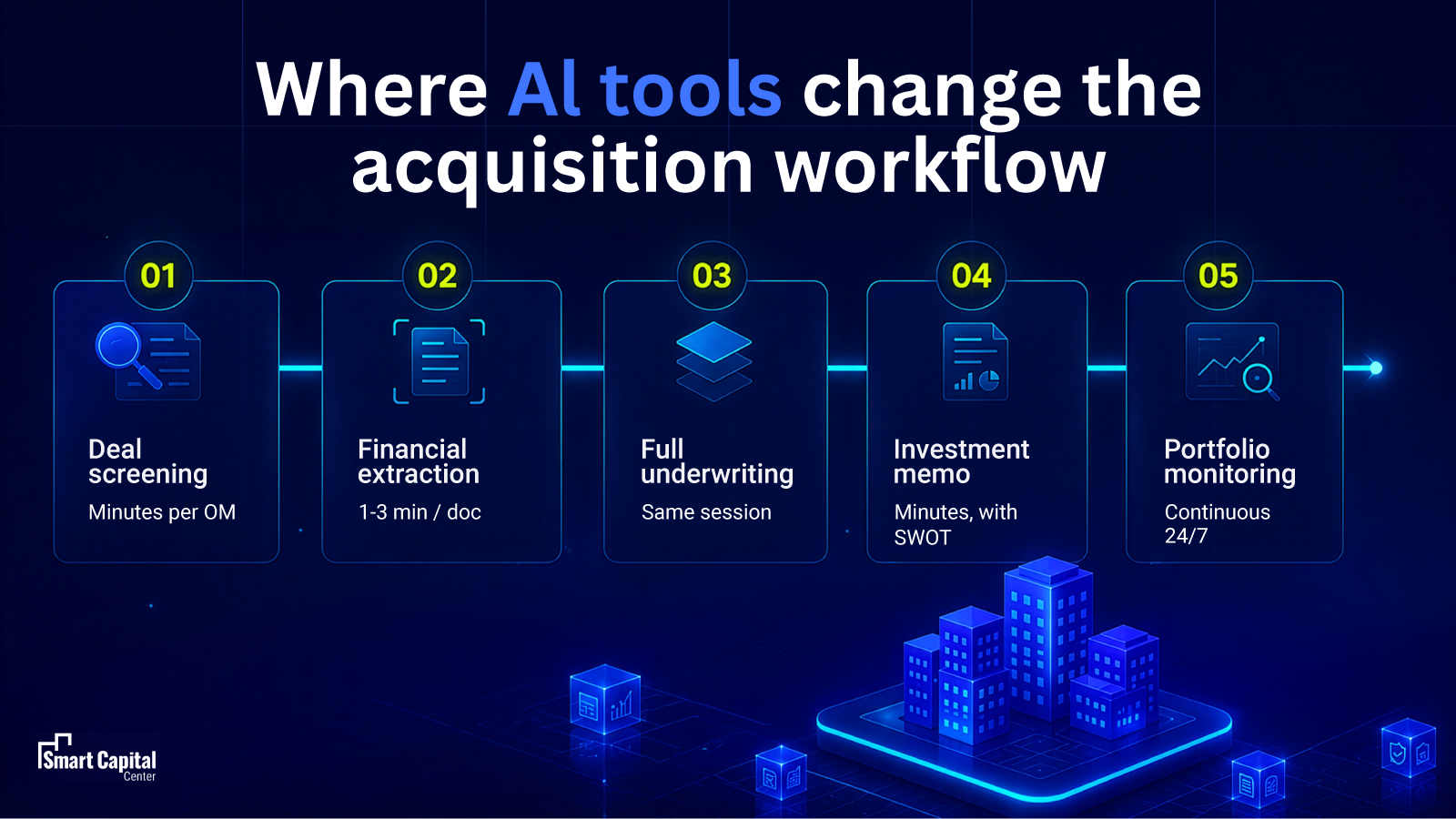
AI tools for real estate investors are software platforms that use AI, machine learning and automation to handle the data-intensive tasks in the acquisition and asset management cycle – from processing deal documents to generating underwriting models and monitoring portfolio performance.
Rather than replacing investor judgment, they compress the time between receiving a deal and making a decision on it. The result is a higher volume of deals evaluated with consistent analytical depth, without proportional headcount increases.
Main types of AI tools used by CRE investors:
Smart Capital Center combines all six functions in a single end-to-end platform, covering the full investor lifecycle from deal screening through asset management.
The first place AI earns its cost is at the top of the funnel – screening inbound opportunities before committing analyst hours to full underwriting. AI commercial real estate investment platforms like Smart Capital Center can process an offering memorandum, extract key metrics, and return a preliminary NOI and DSCR within minutes of document upload.
This matters because most deals at screening stage do not make it to LOI. An analyst spending three hours on a deal that fails screening criteria is not a diligence problem – it is a throughput problem. When AI handles the initial pass, analysts engage only after a deal has cleared the threshold filters the acquisition team actually cares about: yield, leverage coverage, tenant concentration, lease term.
Screening is not underwriting. When a deal clears the initial filter, the depth of analysis shifts. Smart Capital Center deploys 24/7 AI agents that function as dedicated underwriting support – mapping rent roll data directly into cash flow models, calculating NOI, IRR, DSCR, and LTV automatically, and running stress tests across multiple exit cap rate scenarios without requiring analyst input at each step.
The time savings are real. Financial statement processing drops from 30 to 40 minutes per document to under 3 minutes. Across a full due diligence package, that is an afternoon returned to the analyst – every deal, every time. JLL's own data shows AI now assists with 80% of its investment sales processes. The operational logic is the same whether a firm manages $10 billion or $500 million in assets.
Most acquisition assumptions rest on comparable sales and rental data pulled at a point in time. In a market where conditions can shift between LOI and closing, static comps introduce basis risk. Smart Capital Center draws on 1B+ real-time signals across 120M+ properties – including foot traffic patterns, public transit quality, and submarket vacancy trends – so the benchmarks used to validate cap rate and rent growth assumptions stay current through the deal cycle, not just at initial screening.
AI tools for acquisitions introduce three risks worth naming before deployment.
An AI model trained predominantly on liquid primary markets can return rent growth and cap rate assumptions that look precise but reflect national averages rather than local conditions. In secondary submarkets – where some of the best value-add opportunities sit – comp depth is thinner and AI assumptions should carry a wider margin of review.
Smart Capital Center's proprietary data lake builds submarket benchmarks from every document analyzed across the platform, and surfaces data depth signals so analysts know when to weight outputs more conservatively.
When a deal takes 60 to 90 days to close, the market can move. A memo built on comps pulled at screening may not reflect cap rate conditions at funding. Smart Capital Center's real-time market signal layer keeps comp references current through the full deal lifecycle – so the memo an investment committee approves reflects conditions at approval, not deal initiation.
AI that helps a team screen 10x more deals creates a new exposure: maintaining diligence quality across a larger pipeline. Without standardized templates and exception flagging, higher volume can mean shallower review on deals that deserved more scrutiny. Smart Capital Center's customizable underwriting models enforce consistent methodology across all deals, with automated alerts for figures that fall outside user-defined parameters.
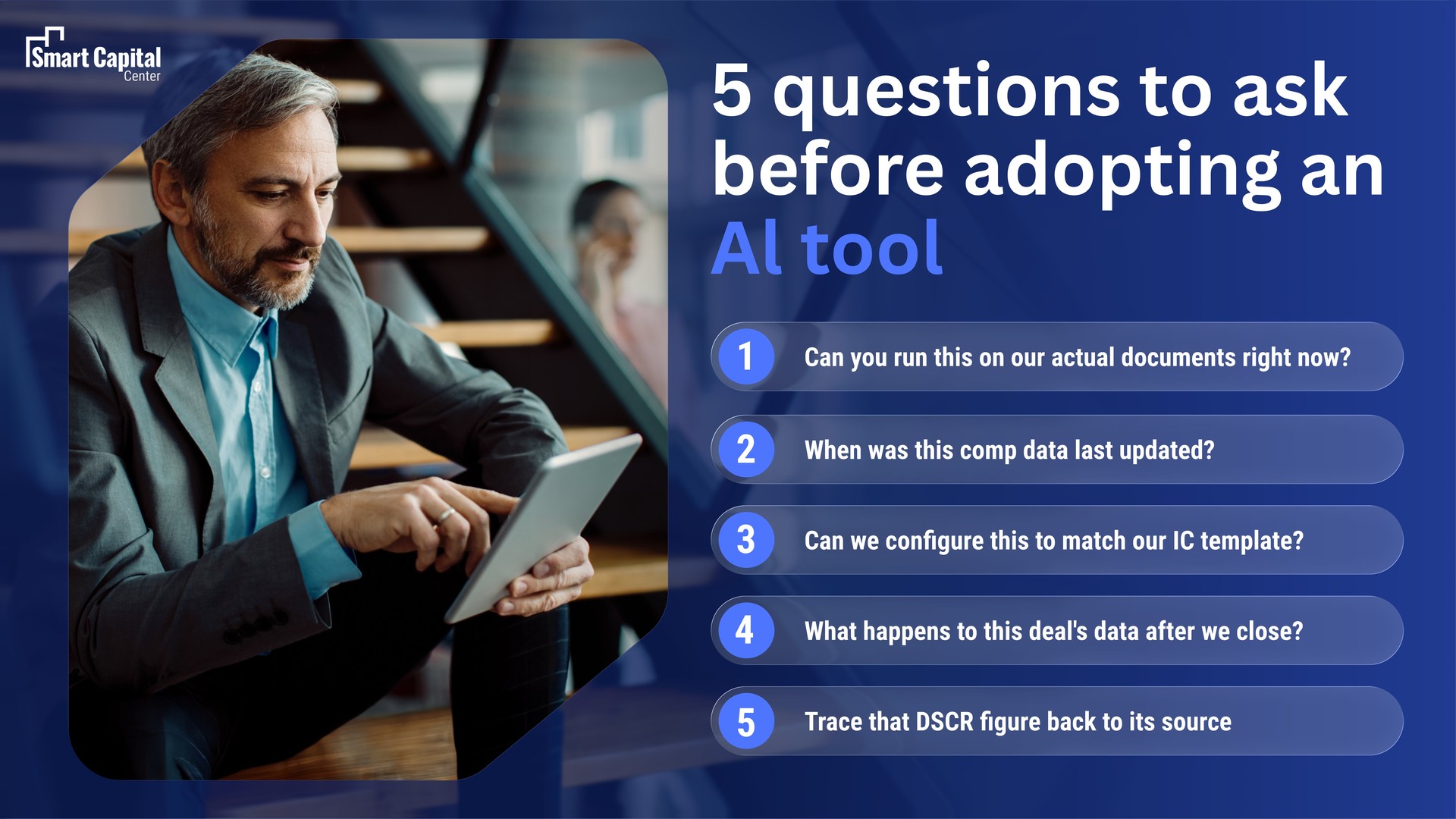
Most platforms look capable in a rehearsed walkthrough. These questions are harder to fake.
Smart Capital Center holds up on all five – and connects directly to Yardi, SS&C Precision, and other accounting platforms so data flows into portfolio monitoring without re-entry.
AI tools for real estate investors improve performance by increasing both deal volume and decision consistency.
By automating document processing, underwriting, and market validation, these platforms allow investors to evaluate more opportunities within the same timeframe while maintaining consistent analytical depth across each deal.
This leads to:
In a market where asset selection drives the majority of returns, the ability to evaluate more deals with consistent assumptions directly improves acquisition outcomes.
Most investors do not lack opportunities, they lack the capacity to evaluate them all.
Smart Capital Center combines AI-powered document extraction, real-time underwriting, and continuous portfolio monitoring in a single platform.
See how your current acquisition workflow compares.
Book a demo with Smart Capital Center and evaluate your next deal in minutes or explore how AI can integrate into your existing process.
How can I use AI tools to screen more CRE deals without hiring additional analysts?
Smart Capital Center's AI agents process offering memoranda, extract key financials, and return initial NOI and DSCR figures within minutes. This compresses the screening stage enough that a single analyst can cover the top-of-funnel volume previously requiring two or three team members, with full underwriting hours reserved for deals that clear the filter.
How do I know if an AI commercial real estate investment platform will hold up in front of my investment committee?
Ask the platform to trace any three figures in a generated memo – NOI, DSCR, and a tenant rent figure – back to their source lines in the original documents. Clean traceability means the output is IC-defensible. If the platform cannot demonstrate that on demand, it is not suitable for formal committee review.
How long before AI tools meaningfully increase my deal flow?
Most acquisition teams see measurable screening throughput gains within the first two weeks of active use, as extraction and initial NOI calculation become near-instantaneous. Full investment memo and stress-testing improvements typically reach their impact within the first month, once model templates are configured.
Can AI for real estate investors handle all my property types?
Smart Capital Center covers multifamily, office, retail, industrial, hotel, senior housing, student housing, storage, and mobile home communities. The platform applies asset-class-specific underwriting conventions automatically based on the document type it detects.
How do I protect deal confidentiality when uploading documents to an AI platform?
Smart Capital Center is SOC 2 Type II compliant, uses AES-256 encryption in transit and at rest, operates on private US-based servers, and does not use uploaded client documents to train its models.
How do AI tools help me maintain underwriting quality when deal volume increases?
AI tools standardize how financial data is extracted and how underwriting models are structured, so each deal is evaluated using the same methodology. Exception management flags unusual inputs or outliers, ensuring that higher deal volume does not reduce analytical depth or introduce inconsistent assumptions across the pipeline.