


AI in Commercial Real Estate

September 2, 2026
AI in Commercial Real Estate
September 2, 2026

According to CBRE’s Cap Rate Survey H2 2025, cap rates stabilized across all major U.S. commercial property types in the second half of 2025, with total transaction volume up approximately 19% for the year, yet the spread between high- and low-quality asset pricing reached near-record levels, driven by divergence between Class A and Class B/C assets. In a market defined by that kind of dispersion, the quality of your commercial real estate benchmarks determines whether your pricing assumptions match reality or mirror someone else’s outdated comp.
This analysis draws on Smart Capital Center – a CRE AI platform that has processed $500B+ in transactions across 120M+ properties, used by JLL, KeyBank, and leading institutional lenders to clarify what reliable CRE benchmarks actually require, and where the gaps in standard sourcing approaches appear.
CRE benchmarks are reference points – rent per square foot, cap rates by asset class and submarket, lease structure terms, expense ratios – that practitioners use to validate underwriting assumptions and compare assets against market norms.
The issue is not data availability. It is data specificity. National averages obscure submarket realities. A published cap rate for industrial assets in the Southeast tells an investor almost nothing about a Class B distribution center in a secondary market 40 miles from Atlanta. The benchmark exists; it just does not apply.
Three categories of benchmarks matter for most CRE decisions:
• Rent comps: Actual asking and effective rents per square foot for comparable properties in the same submarket and asset class, adjusted for lease vintage, tenant credit, and concession packages.
• Lease comps: Comparable executed lease structures – term length, base rent, annual escalations, free rent periods, TI allowances – that reveal how landlords and tenants are actually transacting, not just quoting.
• Cap rate data: Asset-class and submarket-specific yields from recent closed transactions, not survey estimates or national averages that mask local conditions.
Each is only reliable when it reflects transactions that are recent, proximate, and genuinely comparable. The gap between “a benchmark exists” and “this benchmark applies to my asset” is where most underwriting errors occur.

Reports from CBRE, JLL, and Cushman & Wakefield provide the most consistently structured market data available – vacancy, absorption, rent trends, and investment volumes by sector and metro.
According to JLL's Global Real Estate Trends and Perspectives, February 2026, global office leasing rose to its highest annual level since the pandemic in 2025, while industrial leasing increased across both North America and Europe – directional data that sets useful context. Their limitation remains: reports reflect the publishing firm's transaction set, which may skew toward larger, higher-quality assets and miss secondary markets, smaller deals, and niche asset types. They are the right starting point, not the full picture.
County deed records and CMBS disclosures surface actual transaction prices and are free. The tradeoff is lag: public records typically reflect closings from 60 to 120 days prior, which in a repricing environment means the benchmark you are using describes a market that no longer exists. The scale of this problem is visible in CMBS data: according to Trepp's Q1 2025 Quarterly Data Review, delinquent CMBS loan volumes reached $39.26 billion in Q1 2025, with office property prices still 20.35% below their 2022 peak – figures that would look materially different in a public record pulled 90 days prior to the actual pricing event.
Commercial database subscriptions offer deeper comp sets than public records. Quality varies by market – coverage in major metros is dense, but secondary and tertiary markets remain thin. More importantly, subscription comps reflect what other people analyzed, not what your firm has actually underwritten. The proprietary benchmark advantage does not exist in off-the-shelf subscriptions.
The last row is the structural difference. A commercial real estate benchmarking solution that builds from your own analyzed documents produces benchmarks specific to your markets, your asset types, and your deal structures, and it compounds with every new analysis.
Traditional benchmarking requires an analyst to manually pull comps from multiple sources, adjust for differences in lease vintage or asset quality, and make judgment calls about which comps are truly comparable. That process takes hours per asset and introduces compounding accuracy risk.
Smart Capital Center’s CRE benchmarking software automates the extraction and structuring of benchmark data directly from analyzed documents – OMs, rent rolls, T-12 statements, appraisals, and leases – and enriches it with 1B+ real-time market signals across 120M+ properties. Every document analyzed contributes to a proprietary data lake that builds benchmarks specific to your firm’s actual deal history.
The practical impact:
• Rent comps populate automatically from analyzed rent rolls, with adjustments for lease vintage, concession packages, and tenant credit quality extracted from lease abstracts.
• Cap rate benchmarks reflect closed transactions your firm has analyzed – not survey estimates – calibrated against live market signals for context.
• Lease structure comparables surface from extracted lease abstracts across your analyzed deal history, making TI allowance and escalation benchmarks specific to your actual submarket exposure.
“What used to take 30 to 40 minutes per financial statement now takes one to three minutes,” said a Director of Asset Management at JLL. “We’ve seen a 90%+ reduction in financial analysis time — and every benchmark that comes out of it is tied directly to a source document we can pull up on demand.”
“By mid-implementation we had already cut the time to prepare financial models for loans by 40%,” noted a Senior Vice President at KeyBank. “The benchmarks were current, the audit trail was clean, and the credit committee could trace every assumption back to a transaction. That is what moves a package forward.”
“Our decisions are more objective now — grounded in data from comparable transactions rather than averages that may not apply to the specific assets we’re looking at,” said a Chief Risk Officer at a commercial mortgage lender using Smart Capital Center. “The confidence in our benchmarks has gone up materially, and so has our confidence in the decisions those benchmarks support.”
A rent comp pulled from a quarterly report published in Q2 may not capture a concession wave that materialized in Q3 as new supply came online in the same submarket. An investor underwriting to that stale benchmark overestimates stabilized NOI and, by extension, acquisition value. Smart Capital Center mitigates this through real-time market signal integration – benchmarks reflect current submarket conditions, not the most recent report cycle.
CBRE’s Cap Rate Survey H2 2025 documents a near-record spread between Class A and Class B/C asset pricing, with office cap rate divergence remaining extreme. An underwriter using a blended cap rate benchmark, rather than a tier-specific, transaction-validated figure, can misprice by 100 to 200 basis points. Smart Capital Center’s benchmarking layer isolates cap rate data by asset class, submarket, and quality tier, preventing blended-average distortions from entering deal models.
Investment managers reporting performance to limited partners face increasing scrutiny over the benchmark assumptions used to justify valuations, hold-period projections, and return calculations. When a quarterly LP report contains a cap rate assumption derived from a brokerage survey average rather than a closed-transaction benchmark in the subject submarket, and an LP’s consultant or auditor asks for the source, the answer “CBRE market report” does not satisfy an institution requiring transaction-level provenance.
Fund auditors and valuation specialists conducting independent valuations for annual audits are now routinely requesting source documentation for benchmark inputs — a standard that survey-based comps and subscription databases with opaque sourcing cannot reliably meet.
SCC mitigates this through a full source-level audit trail on every benchmark produced by the platform. Each cap rate figure, rent comp, and lease structure benchmark is linkable back to the source document — an OM, appraisal, or executed lease — from which it was extracted, giving fund managers the transaction-level provenance that LP auditors and valuation consultants require.
Bank examiners conducting targeted CRE reviews and stress-test validations under DFAST, concentration risk frameworks, and interagency CRE guidance are increasingly examining the data provenance of benchmark assumptions embedded in origination models and credit packages.
A loan file that documents a rent growth assumption of 3.5% per year without a dated, submarket-specific, transaction-based source is a documentation deficiency that examiners at the OCC, FDIC, and Federal Reserve have flagged in recent examination cycles. The risk is not just that the assumption may be wrong; it is that the institution cannot demonstrate it was reasonable at the time it was made, which is the evidentiary standard applied during supervisory review.
SCC mitigates this through automatic source documentation that records the benchmark assumption, its source transaction or market signal, and the date at which it was current — creating the dated, named, transaction-linked audit trail that regulatory examination standards require. Every figure in a credit package generated on Smart Capital Center is accompanied by the documentation chain that satisfies examiner provenance standards.

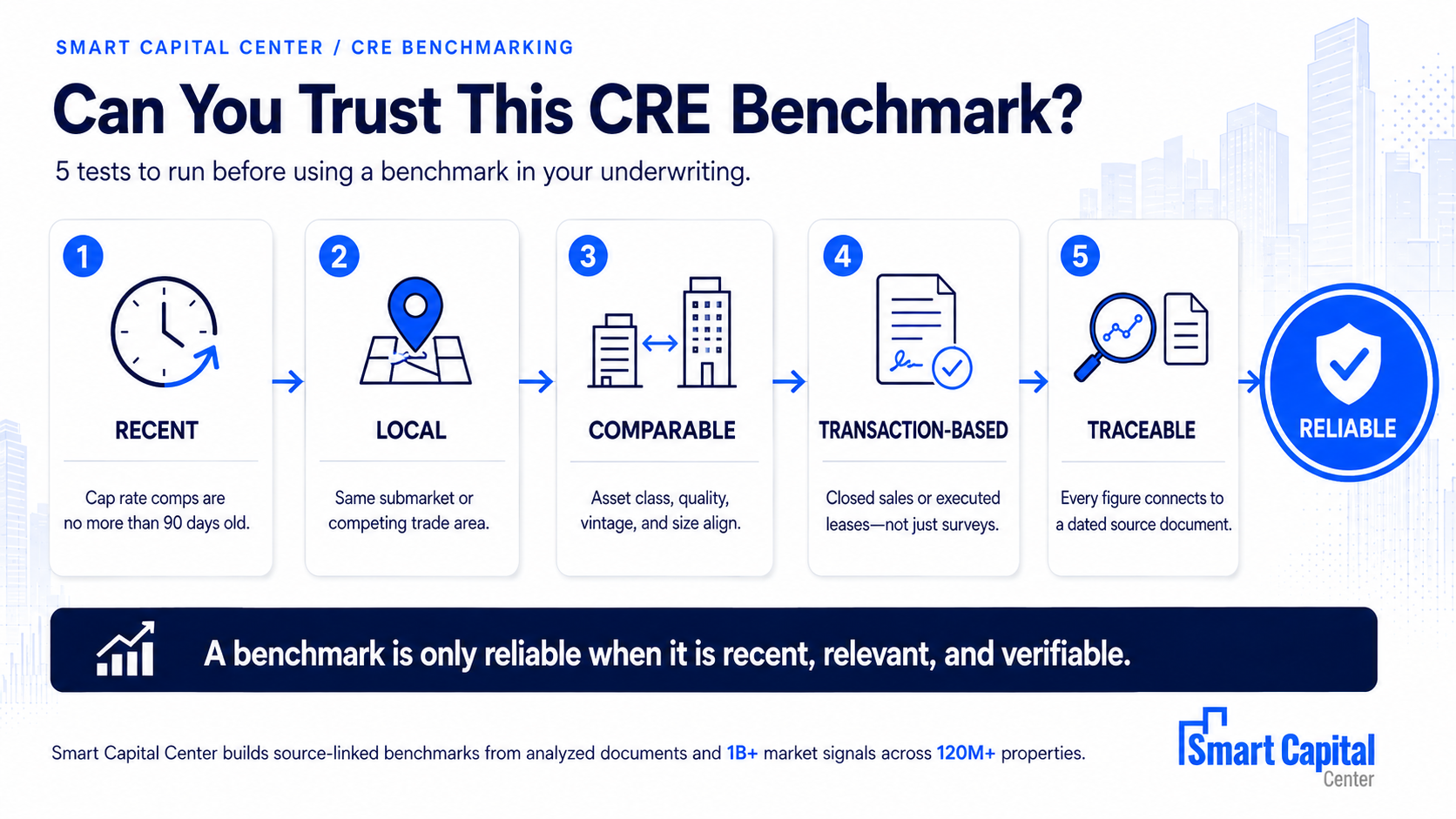
1. Establish the relevant comp universe before pulling any data: define the submarket boundary, asset class, vintage range, and size range that make a comparable genuinely comparable. Benchmarks from outside this universe should be flagged, not used as primary inputs.
2. Cross-reference at least two independent sources for rent and cap rate assumptions – a brokerage quarterly report for directional context and a transaction-level comp source for deal-specific validation. Discrepancies between sources are analytical information, not noise to be averaged away.
3. Extract lease comps from executed documents, not marketing materials: asking rents and quoted TI packages diverge from executed terms in active markets. Lease abstracts from closed deals in your portfolio or analyzed pipeline are the only reliable source of true lease structure benchmarks.
4. Apply a recency filter of 90 days or less for cap rate comps: in a market where CBRE’s H2 2025 survey documents significant dispersion between asset tiers, cap rate benchmarks older than one quarter may reflect a pricing environment that no longer exists for the specific asset type you are underwriting.
5. Document every benchmark assumption and its source in the underwriting model, so when market conditions shift, the assumptions most at risk of obsolescence are immediately identifiable. Smart Capital Center’s audit trail ties every calculated figure back to its source document automatically.
The firms producing the most accurate CRE underwriting are those whose benchmarks come from structured, current, transaction-specific data rather than published averages assembled manually from multiple disconnected sources.
Smart Capital Center’s commercial real estate benchmarking solution builds that infrastructure automatically, compounding in accuracy with every deal analyzed, and enriched by 1B+ real-time market signals that keep assumptions current as market conditions shift.
See what zero benchmark lag looks like across your full underwriting pipeline. Book a demo with Smart Capital Center.
A reliable rent comp shares at least three characteristics with your subject: submarket proximity (same trade area or competing corridor), asset class and quality tier, and lease vintage within 12–18 months. If the comp is from a different submarket or was executed before a material market shift – new supply delivery, tenant credit event, or macro repricing – it should be treated as directional context, not a primary benchmark.
Transaction-level data from closed deals, sourced from deed records, CMBS disclosures, or proprietary comp platforms with coverage in your target market, is more reliable than survey-based estimates for secondary markets. CBRE’s biannual Cap Rate Survey is the most rigorous published source for directional context, but it has limited granularity below the metro level. Proprietary benchmarks built from your firm’s own analyzed transactions fill this gap for markets where subscription coverage is thin.
A comp subscription gives access to data collected by a third party from their transaction set. Commercial real estate benchmarking software, particularly platforms with AI-powered document extraction, builds benchmarks from your firm’s own analyzed deals. Over time, this creates a proprietary database calibrated to your specific markets, asset types, and deal structures. The proprietary layer compounds in accuracy with each new analysis, while a subscription database reflects someone else’s universe.
For cap rates, any assumption older than 90 days should be revalidated before it enters a final underwriting model, particularly given CBRE’s documented near-record spread between asset tiers as of H2 2025. Rent benchmarks should be verified against current listings and executed comps within 30–60 days for active acquisitions. In submarkets with significant new supply delivery or rapid concession movement, more frequent updates are warranted.
For markets where your firm has significant deal history, your proprietary comp set is often more accurate than off-the-shelf subscriptions. The challenge is structuring that data consistently enough to make it searchable and comparable. Smart Capital Center’s document extraction layer automatically structures data from each analyzed deal into a proprietary benchmarking database, making your historical deal history a live analytical asset rather than a static archive.