


AI in Commercial Real Estate

August 28, 2026
AI in Commercial Real Estate
August 28, 2026

Commercial real estate valuation drives every major CRE decision: what to buy, at what price, at what financing terms, and when to sell. Smart Capital Center gives investors, lenders, and asset managers continuous, source-traceable valuations backed by 1B+ real-time market signals across 120M+ properties, so valuation stops being a periodic exercise and becomes an always-current view of asset value. That currency matters in 2026, as markets reprice faster than traditional appraisal cycles can keep up. The MSCI Real Capital Analytics Commercial Property Price Indexes, published December 2025, now cover more than 350 indexes across 15 countries using repeat-sales regression methodology, giving the industry more transaction-based data than ever, but only teams equipped to integrate it in real time can act on it.
Commercial real estate valuation is the process of estimating the present market value of an income-producing property using the income, sales comparison, and cost approaches. It differs from a formal appraisal in legal status: an appraisal is a certified, USPAP-compliant opinion produced by a licensed MAI-credentialed appraiser for a specific intended use, carrying legal weight in regulated transactions. A CRE valuation model may be produced internally by a lender, investor, or asset manager without third-party certification. Underwriting applies the valuation output to a credit decision, testing whether a proposed loan is supportable against the collateral value. Errors in valuation compound through underwriting because every DSCR, LTV, and return projection depends on it.

Discounted cash flow (DCF): projects a property’s future cash flows over a defined hold period and discounts them to present value using a required rate of return.
Direct capitalization: divides one year’s stabilized NOI by a market-derived cap rate. Best suited to stable, market-rented assets where a single-period income assumption is defensible.
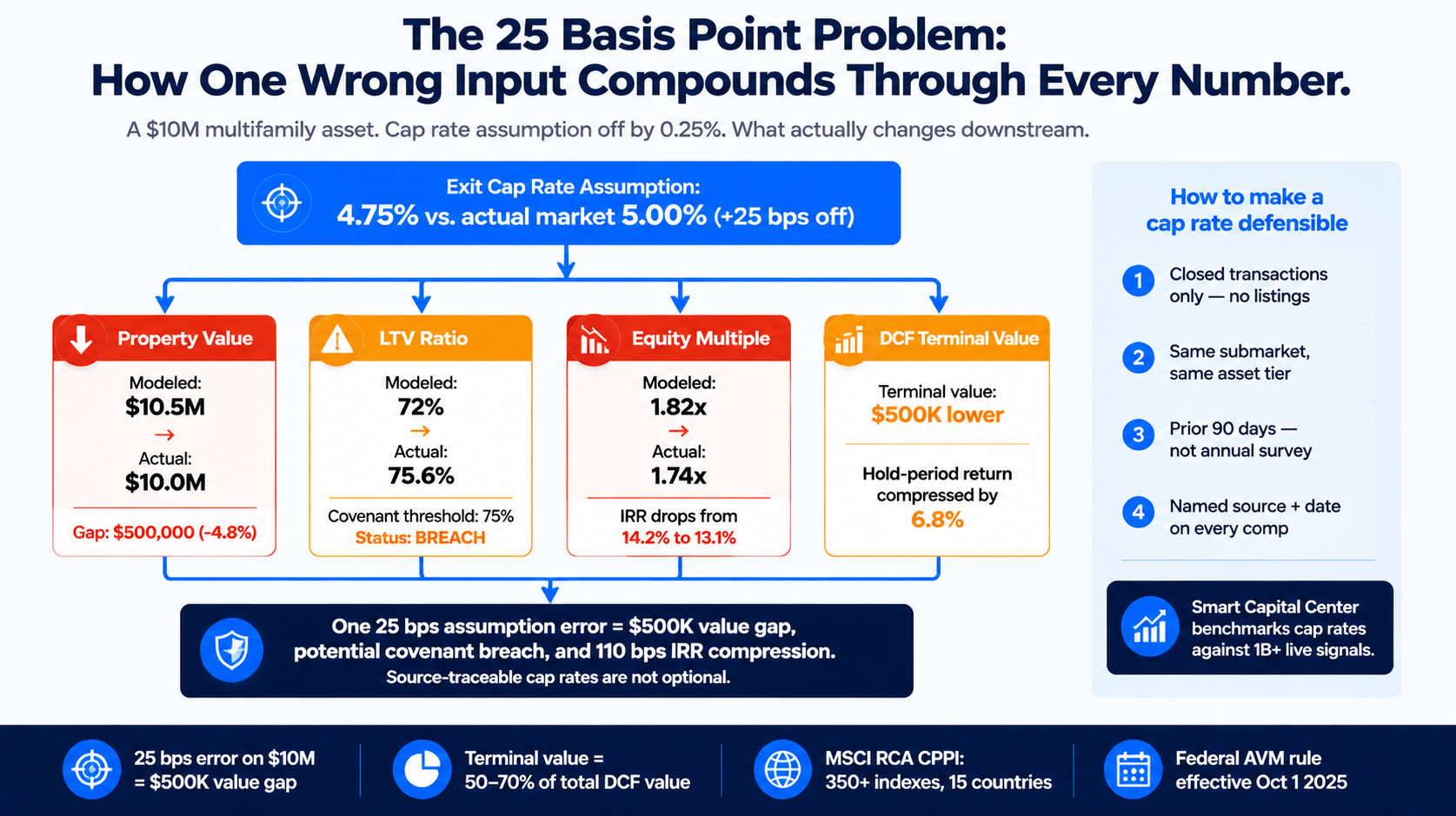
Terminal value: the estimated sale value at the end of a DCF hold period, typically calculated by applying an exit cap rate to year-11 NOI. Terminal value typically represents 50–70% of total DCF value, making the exit cap rate the most sensitive assumption in the model.
Replacement cost: the cost to construct a functionally equivalent property using modern materials and methods, as distinct from reproduction cost (replicating the original structure exactly).
Economic depreciation: loss in value from external factors like neighborhood decline, regulatory change, permanent demand shifts distinct from physical wear (physical depreciation) or outdated design (functional depreciation). Economic depreciation is the hardest to quantify and the most commonly understated.
Reconciliation: the valuator’s final weighting of results from multiple approaches to produce a single value conclusion, with documented rationale for how each approach was weighted.
The income approach is the primary commercial real estate valuation method for investment-grade assets because it directly measures the property’s income-generating capacity. It has two forms, each suited to different asset conditions.
The commercial real estate valuation formula for direct capitalization is: Value = Stabilized NOI ÷ Market Cap Rate. NOI must be derived from the T-12 operating statement, normalized for non-recurring items, and benchmarked against market expense norms. The cap rate must come from documented closed transactions in the same submarket, asset class, and quality tier. A cap rate from anything other than closed-transaction evidence will not survive credit committee or examiner review. Smart Capital Center’s benchmark database cross-references cap rate inputs against 1B+ real-time signals, flagging divergences between the assumed rate and the rate observed in closed transactions within the prior 90 days.
DCF projects income at the lease level over a defined hold period (typically 10 years) and adds a terminal value discounted to present value at a required rate of return. It is the appropriate commercial real estate valuation model when the property has near-term lease expirations, a rent-to-market gap, value-add execution risk, or a multi-tenant income stream that a single-period stabilization cannot capture. A 25-basis-point error in the exit cap rate on a $50M asset produces a $2M–3M change in terminal value. Defensible DCF models document the basis for both exit cap rate and discount rate with closed-transaction evidence and run sensitivity analysis across at minimum three exit cap rate scenarios.
The sales comparison approach estimates valuation of commercial real estate by adjusting recent comparable closed transactions to the subject property. For most investment-grade assets it serves as a corroborating check against the income approach, unless the asset class has thin income data but robust transaction volume.
“The index is one of the key tools that the three regional associations have to pursue our common ultimate goal, which is to help reinforce the message that real estate has earned the right to be considered as a mature and transparent asset class.” – Dan Dierking, President, NCREIF
A defensible comp set requires: closed transactions only; same submarket or immediately adjacent markets; same asset class and quality tier; prior 12 months in active markets; and adequate comparability on lot size, building age, and tenant quality. The MSCI RCA CPPI’s repeat-sales methodology – tracking the same properties across multiple transactions – is the most rigorous academic standard for controlling comp selection bias at portfolio scale.
Each comparable is adjusted across key attributes: sale conditions, financing, property rights, location, physical characteristics, income characteristics, and market timing. The adjustment grid must be documented with stated basis for each adjustment. Adjustments exceeding 25–30% of sale price signal the comp is not genuinely comparable. Smart Capital Center surfaces the underlying comp set with each adjustment source-linked, so every figure in the CRE valuation report is traceable during IC or examiner review.
The cost approach estimates value as land value plus the depreciated cost of improvements. For most investment-grade income-producing assets it is a reasonableness check, not the primary method. It is determinative for new construction (minimal depreciation), special-use assets (insufficient income or transaction data), and assets where functional obsolescence is the core valuation issue.
Physical depreciation: loss from wear, age, and deferred maintenance, estimated from the Property Condition Assessment.
Functional depreciation: outdated design, systems, or configuration reducing competitiveness against modern alternatives.
Economic depreciation: external factors like neighborhood decline or regulatory change. The hardest to estimate, most commonly understated, and the error with the longest downstream compounding effect.
A complete commercial real estate property valuation applies all applicable approaches and reconciles the results. The income approach typically receives primary weight for investment-grade assets. Sales comparison corroborates when adequate closed transactions exist. Cost approach provides a floor for new construction and a reasonableness check for specialty assets.
A CRE valuation that averages approach conclusions without documented rationale produces a number that satisfies no analytical purpose and survives no serious review. Defensible reconciliation requires explicit documentation:
• Which approaches were applied and what each produced
• Why each approach does or does not best reflect the market signals relevant to this asset and transaction purpose
• How that reasoning produces the stated weighting (e.g., income approach given primary weight because the property is stabilized and cap rate is supported by X closed transactions within 90 days in the same submarket)
Smart Capital Center’s continuous benchmarking layer validates each approach’s inputs against live transaction data, flagging divergences between the assumed cap rate and the market-observed rate, between the rent roll and submarket rent comps, and between cost approach estimates and replacement cost indices.
On August 7, 2024, six federal regulators: the Federal Reserve, OCC, FDIC, FHFA, NCUA, and CFPB finalized the AVM quality control rule, effective October 1, 2025. The rule establishes that AVMs used in credit decisions must satisfy quality control standards for accuracy, non-discrimination, data integrity, and model independence.
“These deviations exhibit structured variation that boosting trees can capture and further explain, thereby increasing appraisal accuracy and eliminating structural bias.” – Juergen Deppner, Benedict von Ahlefeldt-Dehn, Eli Beracha, and Wolfgang Schaefers, Journal of Real Estate Finance and Economics, vol. 71(2), 2025
The JREFE study’s finding – systematic deviations between appraisal-based values and transaction prices across all four major property types – is the research basis for AI as a commercial real estate valuation validation layer. Machine learning identifies where conventional methods systematically diverge from market evidence; it does not replace appraiser judgment. Smart Capital Center’s continuous valuation layer provides real-time property valuations with every comparable transaction cited and every assumption source-traceable, flagging when model assumptions have diverged from current market data.

A defensible CRE valuation report is the one that documents how it reached its conclusion with enough precision that a reviewer can reconstruct the logic, challenge any input, and understand the approach weighting. The four required elements:
1. Source-traceable inputs: every NOI line item, cap rate, and comparable transaction traceable to a named, dated source document or closed-transaction record.
2. Transaction-validated assumptions: cap rates, rent growth projections, and vacancy assumptions supported by closed transactions in the specific submarket, asset class, and quality tier within a defensible recency window.
3. Documented reconciliation rationale: explicit statement of why each approach was weighted as it was, with reference to asset type, transaction purpose, and data quality.
4. Sensitivity analysis on critical assumptions: at minimum, cap rate sensitivity (income approach) and exit cap/discount rate sensitivity (DCF) across three scenarios. Smart Capital Center provides the source traceability and continuous market benchmarking supporting all four elements, with real-time flagging when market conditions move the analysis outside its original assumption range.
Every commercial real estate valuation conclusion rests on assumptions that were reasonable as of a point in time and that begin aging the moment they are set. The MSCI RCA CPPI’s 350+ transaction-based indexes across 15 countries represent the most comprehensive attempt to track those movements continuously. The JREFE study’s finding that appraisal deviations are systematic is the research foundation for continuous validation as standard practice.
Smart Capital Center provides continuous, source-traceable commercial real estate valuation benchmarking, flagging when model assumptions have diverged from current market evidence and providing the comparable transaction foundation that makes every valuation defensible in credit committee, IC review, and regulatory examination.
Validate your next valuation against live market data before it reaches the credit committee. Book a demo with Smart Capital Center.
Commercial real estate valuation is the analytical process of estimating a property’s market value using the income, sales comparison, and cost approaches. A formal appraisal is a certified, USPAP-compliant opinion produced by a licensed MAI-credentialed appraiser, carrying legal weight in regulated transactions. Both use the same methodologies; the difference is legal defensibility, third-party certification, and intended use.
The three commercial real estate valuation methods are: the income approach (direct capitalization and DCF), primary for income-producing investment assets; the sales comparison approach: adjusting comparable closed transactions to the subject; and the cost approach: land value plus depreciated replacement cost, primary for new construction and special-use assets. A complete commercial real estate valuation applies all applicable approaches and reconciles results with explicit weighting rationale.
The commercial real estate valuation formula for direct capitalization is: Value = Stabilized NOI ÷ Market Cap Rate. The DCF formula is the present value of projected hold-period cash flows plus terminal value (exit cap rate applied to year-11 NOI), discounted at a required rate of return. Both formulas produce defensible results only when each input is supported by documented market evidence.
Use direct capitalization when the property is stabilized, market-rented, and operated at market expenses. Use DCF when the property has lease-up risk, near-term rollover, a rent-to-market gap, or value-add execution complexity that a single-period stabilization cannot capture. The choice determines which inputs the commercial real estate valuation model treats as the primary value driver: a mismatched choice produces a conclusion that does not reflect the property’s actual risk profile.
Reconciliation is the valuator’s final weighting of income, sales comparison, and cost approach results to produce a single value conclusion. It requires explicit documentation of why each approach was weighted as it was, reflecting asset type, data quality, transaction purpose, and which approach most directly reflects how market participants price the asset. Reconciliation is not averaging: a CRE valuation report that averages approach conclusions without documented rationale cannot be reconstructed or challenged by a reviewer.
A peer-reviewed study by Deppner, von Ahlefeldt-Dehn, Beracha, and Schaefers in the Journal of Real Estate Finance and Economics (2025), analyzing 7,133 NCREIF NPI properties from 1997 to 2021, found that deviations between appraisal-based values and transaction prices “exhibit structured variation” across all four major property types. Machine learning (boosting trees) identified and corrected these deviations, “increasing appraisal accuracy and eliminating structural bias.” AI improves valuation of commercial real estate by providing a continuous, transaction-validated data layer that identifies where conventional methods systematically diverge from market evidence.
The income approach using direct capitalization is most defensible when the cap rate is supported by documented closed transactions in the specific submarket and the NOI is derived from the T-12 with each normalization item documented. The DCF is most defensible when the exit cap rate and discount rate are supported by market evidence and sensitivity analysis across three scenarios is attached. For commercial real estate valuation approaches, defensibility comes from traceability to market evidence.