


AI in Commercial Real Estate

September 14, 2026
AI in Commercial Real Estate
September 14, 2026

Commercial real estate appraisals shape credit decisions, IC votes, and refinancing outcomes, but the appraisal process itself is often opaque to the people relying on the result. Smart Capital Center gives investors, lenders, and asset managers the underlying data infrastructure to validate appraisals against real-time market conditions, spot deficiencies before they cause problems, and defend valuation assumptions in credit committee. That validation matters more as AVMs take on greater weight in decisioning: a peer-reviewed study of 7,133 U.S. commercial properties in the NCREIF Property Index, published in the Journal of Real Estate Finance and Economics in 2025, found that appraisal deviations from subsequent transaction prices contain systematic patterns that data-driven methods can identify and correct.
A commercial real estate appraisal is a formal, USPAP-compliant opinion of value produced by a licensed MAI-credentialed appraiser, based on a defined effective date, a stated intended use, and a specific property interest being valued. It differs from a lender’s or investor’s internal underwriting valuation in one critical way: an appraisal is a certified, defensible opinion of value that carries legal weight in loan origination, litigation, tax appeals, and portfolio reporting. An internal underwriting valuation is an analytical input to a decision. An appraisal is the documented basis for that decision.
The three most common contexts in which a CRE appraisal is ordered:
• Lender-required: FIRREA mandates an independent appraisal for federally regulated transactions above $500,000 – the lender orders and owns the appraisal, which is used to establish the collateral basis for the loan.
• Investor-ordered: for acquisition pricing validation, portfolio reporting, or litigation support – the investor or fund commissions the appraisal for its own due diligence or disclosure obligations.
• Tax appeal or legal proceeding: when assessed value is disputed or when valuation is at issue in a lawsuit, an appraisal provides the certified evidence base.
Discounted cash flow (DCF): a valuation technique that projects a property’s future cash flows and discounts them to present value using a required rate of return. Used for assets with lease-up complexity or significant near-term rollover.
Direct capitalization: divides one year’s stabilized net operating income by a market cap rate to estimate value. Best suited to stable, market-rented income-producing assets.
Cap rate (capitalization rate): the ratio of a property’s net operating income to its market value. A rising cap rate implies a declining value for the same NOI; a falling cap rate implies appreciation.
Automated Valuation Model (AVM): a statistical or machine-learning model that estimates property value from transaction and property characteristic data. Increasingly used as a supplement to formal appraisals, subject to the federal AVM quality control rule effective October 1, 2025.
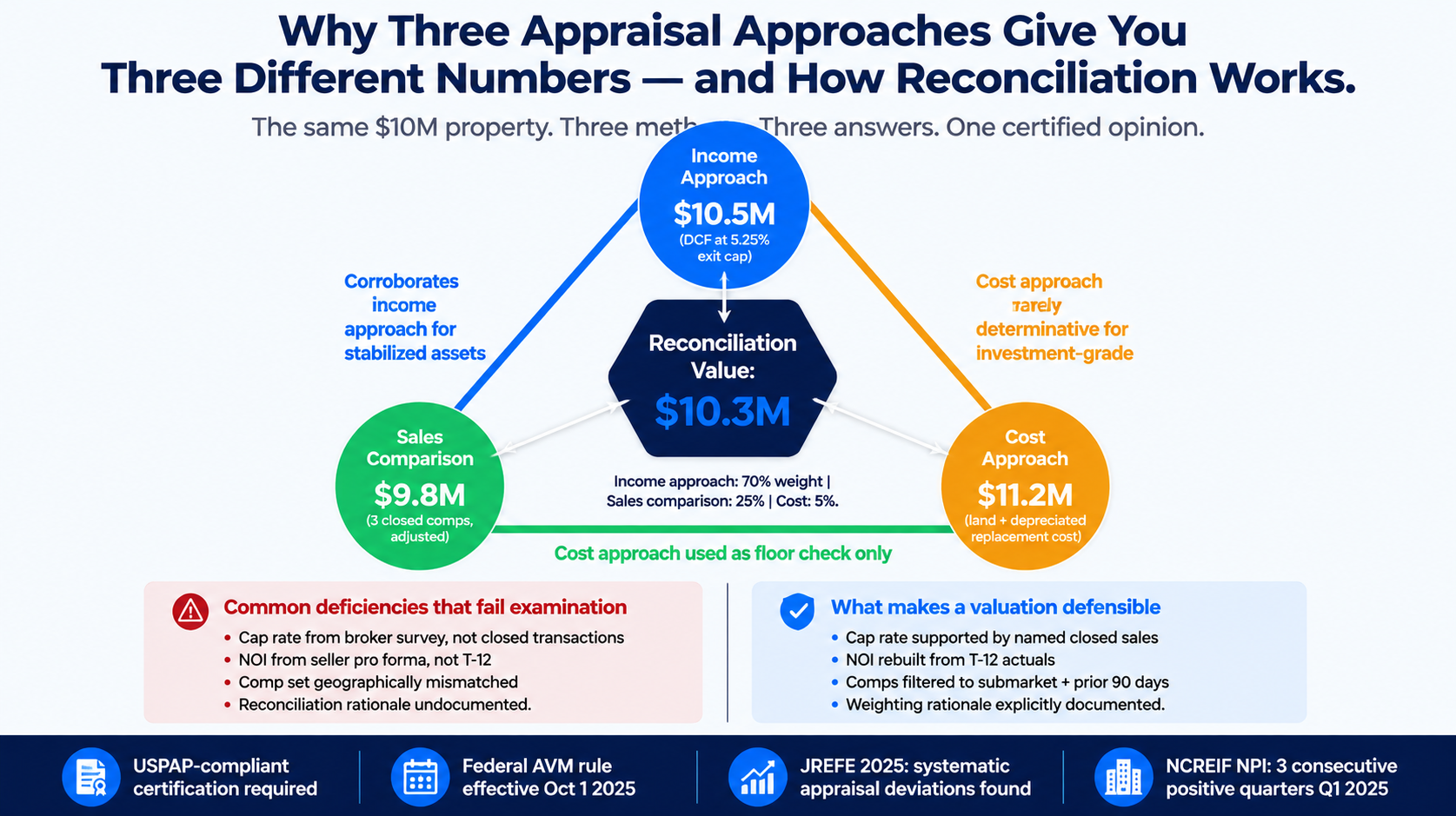
Reconciliation: the appraiser’s final weighting of results from the three approaches to produce a single opinion of value, with documented rationale for how each approach was weighted.
A standard CRE appraisal follows seven steps from engagement through certified report delivery. Most commercial appraisals take 2 to 6 weeks to complete; complex or large assets may take longer.
The effective date is one of the most consequential elements of any appraisal. An appraisal reflects conditions as of its effective date. In fast-repricing markets, a 60-day appraisal lag creates a certified value opinion that may no longer reflect current market conditions by the time it is used. This is the appraisal staleness problem that continuous commercial real estate appraisal data platforms are designed to address.

Direct capitalization is the most common commercial real estate appraisal method for stabilized income-producing assets. The appraiser reconstructs a stabilized NOI from the T-12 and rent roll, normalizes for one-time items and non-recurring expenses, and divides by a market-derived cap rate. The defensibility of the result depends entirely on two inputs: the quality of the NOI normalization and the evidence base for the selected cap rate. Cap rates derived from broker surveys, not closed transactions are the most frequent source of challenged appraisal conclusions.
The DCF approach projects lease-by-lease cash flows over a defined hold period and adds a reversion value: the assumed sale price at the end of the hold period, derived by capitalizing terminal-year NOI at an exit cap rate. The result is discounted to present value at a required rate of return. DCF is more appropriate than direct cap for assets with near-term lease expirations, rent-to-market gaps, or value-add execution risk. Its sensitivity to terminal cap rate and discount rate assumptions makes it the most forensically useful approach for challenging a value conclusion: a 25-basis-point error in either assumption produces a material change in value on a large asset.
The sales comparison approach adjusts recent comparable transactions to the subject property on a per-unit, per-square-foot, or per-room basis. Its reliability depends on the adequacy of the comp pool: ideally closed transactions within the prior 12 months, in the same submarket, of similar vintage and quality. For most institutional CRE appraisals, the income approach carries the most weight; sales comparison is used as a corroborating check and is given primary weight only when comparable transaction volume is high enough to produce a reliable indication of value.
A USPAP-compliant commercial real estate appraisal report must include:
• Statement of the problem: property identification, effective date, interest appraised (fee simple, leasehold, partial interest), and intended use
• Scope of work: what data was gathered, what analyses were performed, and what was excluded
• Market area and property analysis: submarket overview, property description, improvement analysis, and highest and best use conclusion
• Income approach: rent comparables with adjustment grid, market rent conclusion, vacancy and expense benchmarks, NOI derivation, and cap rate support with comparable sales
• Sales comparison approach: comparable sales with adjustment grid, price-per-unit or price-per-SF analysis, and value indication
• Reconciliation and value conclusion: documented weighting of approaches and certified opinion of value
• Certification and limiting conditions: appraiser’s certification of independence, USPAP compliance statement, and assumed/limiting conditions
Dan Dierking, President of NCREIF, has described the index underpinning many appraisal benchmarks as “one of the key tools that the three regional associations have to pursue our common ultimate goal, which is to help reinforce the message that real estate has earned the right to be considered as a mature and transparent asset class.” The NCREIF Property Index posted its third consecutive quarter of positive total returns in Q1 2025 per Capital Economics analysis – a benchmark against which individual appraisals should be measured.
Stale effective date: an appraisal completed 60+ days before closing in a market that has repriced significantly since the effective date. The appraiser’s cap rate selection may reflect conditions that no longer exist.
Inadequate or geographically mismatched comps: comparable sales drawn from adjacent submarkets or older vintages to compensate for insufficient local transaction volume. The adjustment grid will show large adjustments – a signal that the comps are not genuinely comparable.
NOI constructed from seller representations rather than verified source documents: a normalized NOI that uses the seller’s expense assumptions without cross-referencing against the T-12 or market expense benchmarks.
Cap rate not supported by closed transactions: a cap rate derived from broker surveys, listing-based estimates, or verbal market commentary, not documented closed sales at known prices and NOIs.
Highest and best use conclusion inconsistent with current zoning or market demand: an HBU conclusion that does not reflect actual market feasibility for the stated use.
On August 7, 2024, six federal regulators: the Federal Reserve, OCC, FDIC, FHFA, NCUA, and CFPB, finalized the Automated Valuation Model (AVM) quality control rule, which became effective October 1, 2025. The rule requires that AVMs used in credit decisions satisfy quality control standards for accuracy, non-discrimination, data integrity, and model independence. It establishes that AVM outputs used in regulated lending must meet the same evidentiary standard as any other valuation input.
“These deviations exhibit structured variation that boosting trees can capture and further explain, thereby increasing appraisal accuracy and eliminating structural bias.” – Juergen Deppner, Benedict von Ahlefeldt-Dehn, Eli Beracha, and Wolfgang Schaefers, Journal of Real Estate Finance and Economics, vol. 71(2), 2025
The JREFE study’s finding is a precise articulation of what AI adds to the CRE appraisal workflow: a structured validation layer that identifies where conventional appraisal methods systematically under- or overstate value. Smart Capital Center gives investors, lenders, and asset managers the confidence to validate any appraisal in minutes, backed by real-time benchmarks drawn from 1B+ market signals across 120M+ properties, with source-traceable inputs and clickable citations for every comparable transaction used. Cross-transaction comparables validate appraisal assumptions against observed market pricing in real time.

A CRE appraisal can be challenged when: the effective date does not reflect current market conditions; the comparable set is geographically or temporally insufficient; the cap rate is not supported by documented closed transactions; or the NOI is constructed from seller-provided figures instead of verified operating statements.
The challenge must be data-driven. An effective appraisal reconsideration of value (ROV) provides:
1. Alternative comparable sales: closed transactions in the same submarket, same asset class, same vintage, within the prior 12 months, with documented prices and NOIs that support a different cap rate conclusion
2. Market data on current conditions: submarket vacancy, absorption, and rent trend data from a named, dated source that postdates the effective date of the challenged appraisal
3. NOI reconstruction from verified source documents: a T-12-based NOI that diverges significantly from the appraiser’s stabilized NOI, with the specific line items causing the divergence identified and documented
Smart Capital Center’s market benchmarking layer provides the current submarket data and comparable transaction set needed to support a data-based appraisal challenge.
A certified appraisal is the most legally defensible valuation tool available in CRE. It is also the most expensive, the slowest to produce, and the most exposed to staleness in fast-moving markets. The right approach is to supplement formal appraisals with continuous, source-traceable market data that validates appraisal conclusions in real time.
Smart Capital Center provides that validation layer: real-time property valuations backed by 1B+ market signals, with every comparable transaction cited and every assumption traceable to its source.
Validate your next appraisal against live market data before it reaches the credit committee. Book a demo with Smart Capital Center.
A commercial real estate appraisal is a USPAP-compliant, certified opinion of value produced by a licensed MAI-credentialed appraiser as of a specific effective date for a stated intended use. It is the legally defensible valuation standard required for federally regulated lending above $500,000, and is used in acquisition due diligence, portfolio reporting, tax appeals, and litigation. It differs from an internal underwriting valuation in that it carries legal certification and is produced by an independent third party.
A complete commercial real estate appraisal report includes: a statement of the problem (property, effective date, interest, intended use); scope of work documentation; market area and property analysis; income approach analysis with rent comps, NOI derivation, and cap rate support; sales comparison approach with adjustment grid; cost approach (where applicable); reconciliation with documented weighting rationale; and the appraiser’s USPAP certification. For lender-ordered appraisals, the report must also meet the financial institution’s own appraisal requirements for commercial real estate as defined by the OCC, FDIC, or Federal Reserve.
Most commercial real estate appraisals take 2 to 6 weeks from engagement to report delivery, depending on property size, complexity, and the availability of comparable transaction data. Complex assets like large mixed-use properties, specialty use types, or assets in thin markets with limited comparable sales can take 6 to 10 weeks. Expedited appraisals are available from some firms at a premium and typically deliver in 1 to 2 weeks, though tight timelines can compromise comparable research depth.
A CRE appraisal typically costs $2,000 to $10,000 for single-tenant or simpler assets and $10,000 to $50,000+ for complex, large, or specialty properties. Cost drivers include: property size and complexity, number of income-producing units or tenants, availability of comparable data in the market, and whether the assignment requires a DCF-based income approach (more complex) or direct cap only. Portfolio appraisals and retrospective appraisals may be priced differently. For FIRREA-regulated lenders, the appraisal must be ordered and paid for by the lender to ensure independence.
The three commercial real estate appraisal methods are: the income approach (direct capitalization and DCF), most commonly the primary approach for income-producing assets; the sales comparison approach: adjusting comparable closed transactions to the subject property; and the cost approach: land value plus depreciated replacement cost, used primarily for special-use or new construction assets. A USPAP-compliant appraisal applies all applicable approaches and reconciles their results into a single certified value opinion.
Challenge a CRE appraisal when: the effective date predates material market movement; the comparable set is geographically mismatched or temporally stale; the cap rate is not supported by documented closed transactions; or the stabilized NOI diverges materially from what the T-12 and rent roll support. An effective challenge must be data-driven, providing alternative closed-transaction comparables, current submarket data from a named and dated source, and a T-12-based NOI reconstruction that documents where the appraiser’s figures diverge from verifiable operating history. Smart Capital Center’s real-time market benchmarking layer provides the comparative transaction data needed to build this case.
AI is changing the commercial real estate appraisal process in two distinct ways. First, for validation: AI-powered platforms provide continuous, real-time property valuations that can be compared against a formal appraisal’s conclusions immediately after delivery, identifying whether the effective-date cap rate and NOI assumptions still reflect current conditions. Second, for appraisal accuracy itself: the JREFE study by Deppner et al. (2025) demonstrated that machine learning applied to 7,133 NPI properties found systematic appraisal deviations that boosting tree models could identify and correct, “increasing appraisal accuracy and eliminating structural bias.” The October 1, 2025 federal AVM rule establishes quality control requirements for AI-derived valuations used in regulated credit decisions.