


AI in Commercial Real Estate

September 2, 2026
AI in Commercial Real Estate
September 2, 2026

According to Emerging Trends in Real Estate® 2025, published by PwC and the Urban Land Institute from surveys of over 2,000 industry specialists, real estate firms are increasingly incorporating real-time data into decision-making and risk assessments, with those operating on faster information cycles better positioned to act as capital markets recover. The gap between firms that see market shifts as they happen and those still working from quarterly PDFs is no longer a technology preference. It is a competitive fact.
This analysis draws on Smart Capital Center – a CRE AI platform that has processed $500B+ in transactions across 120M+ properties, used by JLL, KeyBank, and leading institutional lenders – to map the real difference between CRE data source categories and explain where static data creates blind spots that cost deals.
A CRE data source is any system, database, or feed that supplies property-level, market-level, or financial data to support investment, lending, or asset management decisions. The category matters because not all sources are created equal on the dimension that actually drives decision quality: timeliness.
The commercial real estate data landscape broadly sorts into four tiers:
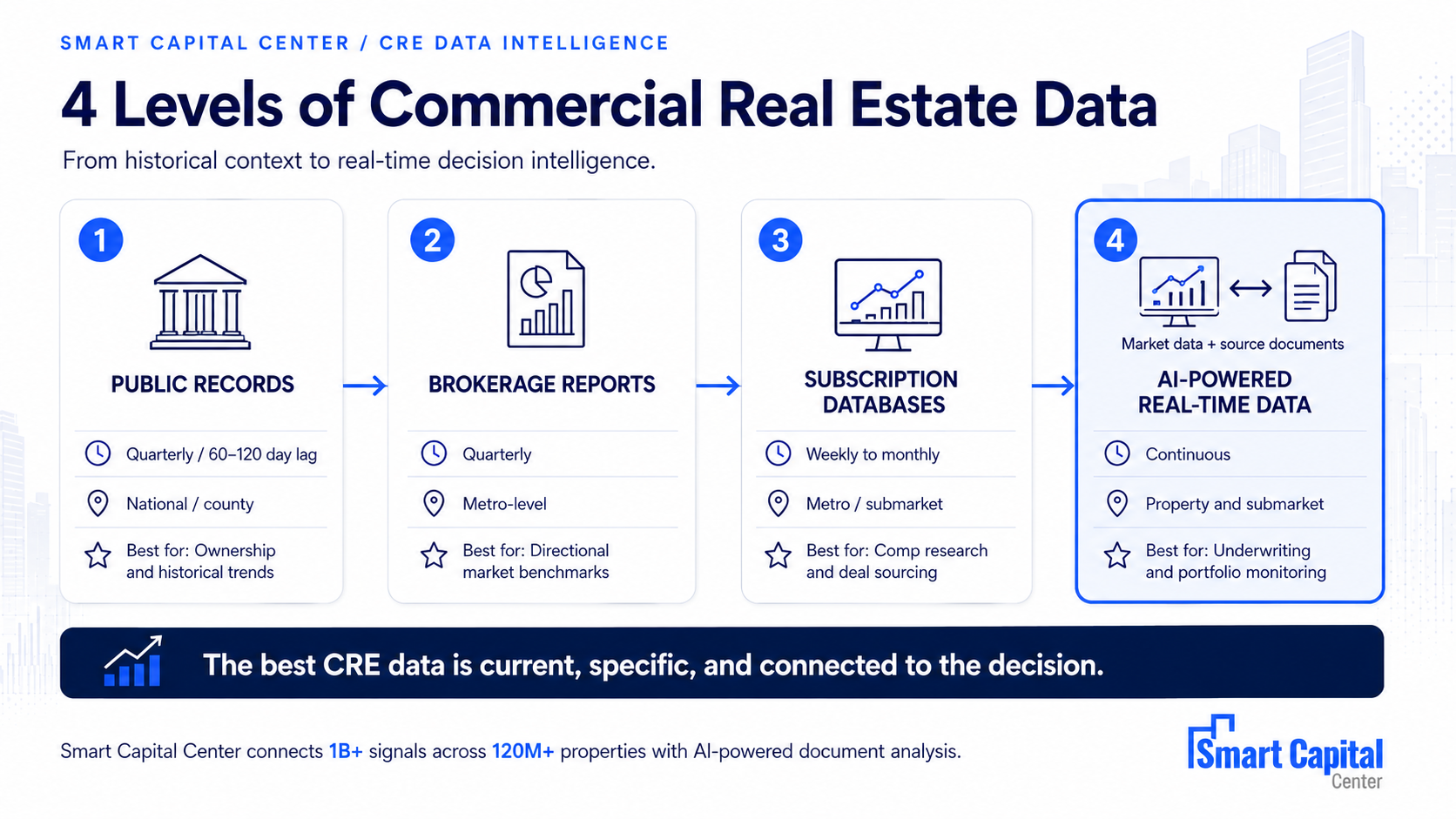
• Public records and government databases: county assessors, deed filings, FDIC reports, and the Federal Reserve’s Commercial Real Estate Price Index via FRED. These are foundational and free. They update quarterly at best, and deed-level records typically lag closings by 60 to 120 days.
• Brokerage market reports: quarterly publications from major advisory firms covering vacancy, absorption, rents, and investment volumes. Authoritative at the metro level; limited below it, and published on a cycle that reflects conditions from weeks or months prior.
• Subscription databases: commercial platforms aggregating property records, transaction comps, and market analytics. Updated more frequently than brokerage reports, but still dependent on data collection pipelines with inherent lag. Coverage thins sharply in secondary and tertiary markets.
• AI-powered real-time platforms: systems that ingest live data signals, extract from documents automatically, and continuously update benchmarks without waiting for a human to publish a report cycle.
The difference between tier one and tier four is not just speed. It is the difference between reacting to what happened and positioning ahead of what is happening.

Survey-based data, including most brokerage cap rate estimates, reflects professional opinion, not closed deals. Transaction-based data reflects what buyers and sellers actually agreed to. Both have value, but conflating them produces underwriting assumptions that feel precise while resting on subjective inputs. The best sources for commercial real estate trend data are explicit about which type they provide and separate survey estimates from transaction-derived benchmarks.
Quarterly updates were sufficient when deal timelines ran six to twelve months and market conditions shifted slowly. In a cycle where the Federal Reserve’s CRE Price Index documents value corrections of 20%+ across asset classes within 24-month windows, quarterly benchmarks can embed assumptions already overtaken by market events.
According to Emerging Trends in Real Estate® 2025 (PwC/ULI, October 2024), real estate firms that incorporate real-time risk assessments into their decision-making are better equipped to navigate the current cycle – a finding drawn from over 2,000 top industry specialists. The best CRE data sources today refresh market-level signals continuously, not on a publication schedule.
National and metro-level data masks the submarket divergence that drives actual deal outcomes. Sun Belt markets are diverging between oversupplied corridors and supply-constrained pockets. Office markets bifurcate between trophy Class A assets and distressed B/C product within the same city block. A CRE data source that reports only at the metro level cannot capture this divergence, and submarket-resolution data is no longer optional for accurate underwriting.
The most overlooked dimension of CRE data source quality is integration: whether market data connects directly to the property-level documents your team is analyzing, or whether it requires a separate manual lookup. A comp that sits in a separate platform while a rent roll lives in an email attachment is functionally useless during a fast-moving underwriting session.
The structural advantage of the last row is not just speed; it is that the data layer and the document workflow are the same system. There is no manual bridge between a market benchmark and the rent roll it should be applied to.
Industrial net absorption fell to a decade low in mid-2025 as new supply hit markets that had been dramatically undersupplied 18 months prior. An investor underwriting a warehouse acquisition in Q3 2025, using a Q1 brokerage report as their rent growth assumption, was working with a benchmark from a structurally different market. The report was not wrong when published; it was simply describing conditions that no longer existed.
Smart Capital Center mitigates this by drawing on 1B+ real-time data signals that reflect current submarket conditions rather than the most recent publication cycle, ensuring that rent growth assumptions in underwriting models reflect what the market is doing now.
A lender monitoring a 150-loan portfolio against quarterly financial reports will learn about a DSCR breach at the next reporting cycle, which may be 60 to 90 days after the underlying deterioration began. By the time the covenant issue surfaces in a static report, the remediation window has compressed significantly.
Smart Capital Center’s 24/7 AI monitoring layer continuously monitors DSCR, occupancy, and covenant metrics, generating automated alerts the moment a metric approaches a defined threshold, not when the next report is pulled.
CRE lenders whose LTV calculations rely on periodic appraisals are carrying a structural lag risk that bank examiners and regulators have increasingly flagged during exam cycles since 2023. In markets where cap rates expanded 150–200 basis points within 18-month windows — as documented in the Federal Reserve’s CRE Price Index through Q3 2025 — a loan originated at 65% LTV against a 2022 appraisal may be materially undercollateralized against current market values, with the lender unaware until the next formal appraisal cycle.
FDIC guidance issued in 2023 and reaffirmed in 2024 explicitly requires lenders to maintain current collateral valuations in high-volatility market conditions, making appraisal-cycle lag not just an underwriting risk but a regulatory compliance exposure.
SCC mitigates this through continuous AI-driven collateral valuation benchmarking that updates LTV estimates as market conditions shift, drawing on 1B+ real-time signals including live transaction data, current cap rate movements, and submarket vacancy trends — giving lenders a current-cycle read on collateral adequacy between formal appraisal cycles.
Supervisory guidance under the 2006 Interagency CRE Concentration Risk Framework — and its subsequent reinforcement in 2023 FDIC and OCC examination priorities — requires banks to maintain stress-tested assessments of CRE concentration exposure that reflect current market conditions. A concentration risk report populated with static, quarterly-lagged data can present a materially distorted picture of portfolio exposure: failing to capture recent acquisitions added to the book, ignoring submarket repricing that has shifted the risk profile of existing positions, or using outdated LTV benchmarks that no longer reflect collateral values.
Examiners conducting targeted CRE reviews in 2024–2025 have specifically cited data currency as a deficiency in concentration risk frameworks at institutions of all sizes.
SCC mitigates this through a real-time portfolio monitoring layer that continuously aggregates current-cycle metrics — DSCR, LTV, occupancy, and lease rollover — across the full loan book, giving credit teams and compliance functions a live picture of portfolio exposure that reflects actual current conditions rather than the most recent quarterly snapshot.

1. List every data source used in your last three underwriting decisions, including market reports, comp databases, brokerage publications, and property management exports. Identify which are transaction-based versus survey-based, and note the publication date versus the analysis date.
2. For each source, determine the lag between data collection and your use of it: a brokerage report published in October reflecting data collected through September represents a 30 to 90-day lag before it reaches your model. Identify which assumptions carry the highest lag exposure.
3. Identify where market data and document data are manually bridged: any step where an analyst looks up a comp in one system and enters it into a spreadsheet is a lag point, an error-introduction point, and a scalability bottleneck. Flag every manual bridge in your current workflow.
4. Test one deal against real-time submarket data and compare the output assumptions: take a recently closed deal and re-run the rent growth and cap rate assumptions using the most current available data. If the outputs differ materially from what was used in the model, the lag in your data sources had a measurable impact on underwriting accuracy.
5. Evaluate whether your portfolio monitoring uses the same data infrastructure as your acquisition underwriting: if the answer is no, you have a structural inconsistency: the data that informs your buy decision does not track whether the asset is performing to that decision’s assumptions. Smart Capital Center integrates acquisition underwriting and portfolio monitoring into a single real-time data layer, closing that gap by design.
The best commercial real estate data sources in 2025 are not those with the largest historical archives. They are the ones whose data is current enough to inform the decision in front of you, specific enough to apply to the submarket you are analyzing, and integrated enough to connect market intelligence directly to the documents your team is working with.
Static data sources – quarterly reports, lagged public records, and subscription databases with publication-cycle updates – remain useful as directional context. They are insufficient as the primary data layer for competitive CRE underwriting, lender portfolio monitoring, or asset management decisions in a market where conditions can reprice materially within a single quarter.
Smart Capital Center’s real-time intelligence layer, drawing on 1B+ signals across 120M+ properties combined with AI-powered document extraction, closes the gap between market conditions and the models that reflect them.
Evaluate 10x more deals in the same time your team currently underwrites one. Book a demo with Smart Capital Center.
Check two things: when the underlying data was collected (not just when the report was published), and whether the source reflects transaction-level data or survey-based estimates. A report published this month describing data collected last quarter is 90 to 120 days stale by the time it reaches your model. For active deal underwriting, any market benchmark older than 60 days warrants revalidation against a more current source.
For directional context, PwC and ULI’s Emerging Trends in Real Estate® provides the most comprehensive annual survey across asset classes and geographies. For portfolio-level benchmarking tied to your actual deal history, Smart Capital Center builds proprietary trend benchmarks from every document you analyze, calibrated to your specific markets and asset types rather than national averages.
Public sources – particularly the Federal Reserve’s FRED database for price indices and county assessor records for ownership and transaction history – are reliable for the type of data they collect. Their limitation is lag (60 to 120 days for deed records, quarterly for price indices) and resolution (national or county-level, rarely submarket). They are appropriate as foundational context and historical price trend reference, but should not serve as primary benchmarks for submarket-specific underwriting assumptions.
Lenders increasingly scrutinize the data sources behind borrower underwriting assumptions during credit review. A rent growth assumption tied to a current, transaction-based submarket benchmark with a clear source citation is materially stronger than one derived from a national average or an undated comp. As underwriting standards tighten in the post-2025 lending environment, the provenance and freshness of data inputs has become part of the credit package quality signal.
The relevant question is not whether data was AI-generated, but whether it is validated, auditable, and sourced from real transactions. Smart Capital Center’s AI extraction layer produces audit-ready, structured data tied directly to source documents, with cross-validation logic that flags anomalies before they reach the model.
“What used to take our team 30 to 40 minutes per financial statement now takes one to three minutes — and the output goes directly into the model without a manual transfer step,” said a Director of Asset Management at JLL. “We’ve seen a 90%+ reduction in the time spent on financial analysis, which lets the team focus on the work that actually requires judgment.”
“By mid-implementation we had already cut the time to prepare financial models for loans by 40%,” noted a Senior Vice President at KeyBank. “The data layer is current, it’s traceable, and it holds up in credit review — which is what matters when the committee is looking at provenance.”
“The manual work is essentially gone. What we get back is faster results and a team that can focus on higher-level credit analysis rather than data reconciliation,” reported a Credit Risk Manager at a top U.S. insurance company using Smart Capital Center for institutional portfolio review.