


CRE Investors

October 1, 2026
CRE Investors
October 1, 2026
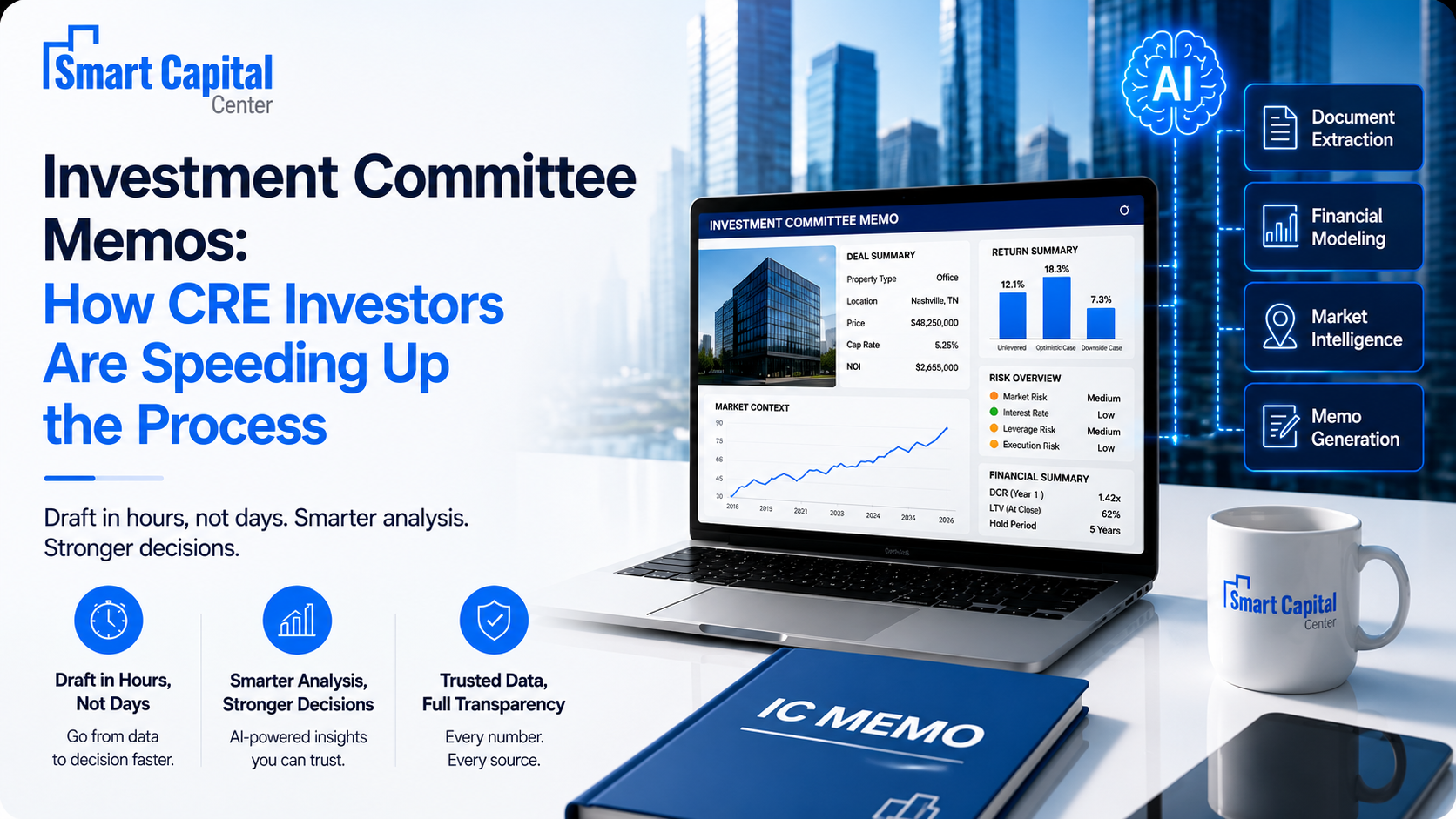
“The sentiment is a net positive even while this uncertainty exists,” said Sally Ann Flood, Vice Chair and U.S. Real Estate Sector Leader at Deloitte, on the firm's 2026 Commercial Real Estate Outlook. She summarized the sector’s posture: “Leaders still see commercial real estate as a safe investment haven, given its performance during similar periods of uncertainty in the past.” For acquisitions teams preparing investment committee memos, the pressure those leaders feel to act faster on the right opportunities makes the speed of IC memo preparation a direct competitive variable, not a back-office inefficiency.
This analysis draws on Smart Capital Center, a CRE AI platform that has processed $500B+ in transactions across 120M+ properties, used by JLL, KeyBank, and leading institutional investors, to map how AI investment committee memo generation compresses the front-end process without removing the judgment that makes a memo worth presenting.
A real estate investment committee memo has a defined structure because it answers a defined set of questions for a committee whose time is limited and whose standards are high. Every element earns its place by advancing the investment decision.
The core sections are consistent across institutional formats:
• Deal overview: Property type, location, size, seller, pricing, and proposed structure. This section exists to orient the committee before analysis begins.
• Market context: Submarket fundamentals, cap rate environment, comparable transactions, and rent and vacancy benchmarks that establish whether the deal is priced correctly against its market.
• Financial summary: NOI, cap rate at acquisition, DSCR, levered and unlevered returns, sources and uses, and a clear projection of hold-period cash flows.
• Risk analysis: Lease rollover concentration, tenant credit, market repricing risk, capital expenditure exposure, and exit assumptions under stress conditions.
• Return scenarios: Base, upside, and downside cases with stated assumptions for each, so the committee can see which variables drive the outcome and stress-test the thesis in the room.
The memo's job is to present the deal so clearly that the committee's decision is defensible in either direction, not to advocate for a specific outcome. That clarity requires complete sourcing, consistent formatting, and a narrative that connects the data to the recommendation without papering over the risks.

Most of the time an analyst spends on an investment committee memo goes to mechanics, not judgment: locating the offering memorandum, extracting figures from the rent roll, transferring data into the financial model, pulling market comps from a separate source, and writing a narrative that ties everything together in the firm’s format. According to McKinsey’s 2025 State of AI Survey, authored by Alex Singla, Alexander Sukharevsky, Lareina Yee, and Michael Chui of QuantumBlack, the organizations that capture measurable EBIT value from AI are those that redesign workflows around AI capabilities rather than layering AI tools onto existing manual processes. Senior Partner Alex Singla has stated: “The companies reporting EBIT impact tend to have progressed further in their scaling journeys, moving beyond rolling out tools to actually redesigning how work gets done.” IC memo preparation is precisely the kind of sequential, extraction-heavy workflow that AI redesign eliminates.
| IC Memo Task | Manual Time Estimate | AI-Assisted Time | Source & Period |
|---|---|---|---|
| Financial statement extraction and structuring | 30–40 min per document | 1–3 min per document | JLL Director of AM; Smart Capital Center, 2024 |
| Rent roll extraction and model population | 1–2 hours per deal | Minutes; auto-mapped to model | Smart Capital Center deployment data, 2024 |
| Market comp research and context writing | 2–4 hours per deal | Generated from 1B+ live signals | Smart Capital Center; CBRE 2025 U.S. Market Outlook |
| Full IC memo draft (all sections) | 4–8 hours per deal | Under 30 minutes from deal data | Smart Capital Center deployment data, 2024 |
| Source verification and audit prep | Ad hoc; inconsistent | Every figure clickable to source | Smart Capital Center, 2024 |
The benchmark is well-documented. JLL’s Director of Asset Management reported a 30x productivity gain in financial statement processing after deploying Smart Capital Center, compressing per-document time from 30–40 minutes to under 3 minutes, with a 90%+ reduction in processing errors. The full case is documented in AI Document Analysis in Commercial Real Estate. Applied to IC memo preparation, that compression means the front-end extraction that previously consumed an analyst day is complete in under an hour, and the analyst’s remaining time concentrates on the sections where their judgment is irreplaceable.
The most painful version of the IC memo problem is the detailed memo an analyst spends three days preparing for a deal the committee passes on in 20 minutes. That time is not recoverable. The memo that did not win is indistinguishable in preparation cost from the memo that did.
At a firm evaluating 50 deals a year with a 15% close rate, roughly 42 deals generate full IC memos that produce no transaction. If each memo represents two to three analyst days, that is 84 to 126 analyst days per year spent on non-closing diligence. For a team of three, that is a meaningful share of total capacity absorbed by process rather than sourcing.
The calculus changes when memo preparation takes hours instead of days. A team that can draft a memo for a no-win deal in three hours rather than three days has not just saved time. It has unlocked capacity to evaluate more deals, advance earlier on conviction opportunities, and divert hours saved from losing memos into finding better ones.
Smart Capital Center automates the three stages of IC memo generation that consume the most analyst time without requiring any judgment: document ingestion (any format, any source, no clean export required), data extraction (rent rolls, T-12s, OMs, appraisals, and leases extracted and structured automatically), and model population (extracted figures map directly into the financial model without manual data entry). The platform generates an investment committee memo draft in minutes from the underlying deal data, formatted to the firm’s own template and IC conventions.
Every figure in the generated draft is linked to its source document. An NOI figure in the financial summary is one click from the T-12 line that generated it. A rent assumption is one click from the lease clause. That source traceability is what makes the draft reliable enough to submit rather than requiring a full analyst re-verification pass.
Document extraction and model population can be automated reliably because they are rule-based: figures are in documents, models have inputs, and the mapping between them is consistent. The sections that cannot be automated are those requiring judgment applied to information.
Those sections are:
• IC-specific risk framing: What the committee at this firm weighs most heavily, which risks are acceptable, and which assumptions they will push back on hardest. This knowledge lives with the analyst, not in any document.
• Return scenario assumptions: The upside and downside cases require choosing which variables to stress and by how much.
• Investment thesis narrative: Why this deal, why now, why at this price. The persuasive case for an investment is the one section where analyst synthesis is not replaceable.
• Final sign-off: Every IC memo should carry the analyst’s name and judgment. The platform produces the structure; the analyst controls the conclusion.
.png)
The counterintuitive argument for AI-generated IC memos is that they are more consistent and complete than manually written ones. Manual memos vary in completeness depending on which analyst wrote them, how much time was available, and whether the firm has enforced a template standard consistently. Automated memos built from a structured template apply the same completeness check to every deal.
Smart Capital Center’s customizable templates match the firm’s own format and IC conventions, ensuring that the same sections appear in the same order with the same sourcing standard regardless of which team member initiated the draft. The result is a consistent baseline that senior reviewers can interrogate efficiently.

A transposed figure from a rent roll that populates the NOI projection incorrectly produces a cap rate that looks acceptable while resting on an incorrect income number. The error is not caught in review because the memo’s financial summary is a separate document from the rent roll, and manual cross-checking across 200 line items per deal is inconsistent at best. When the committee asks where the NOI figure came from, the analyst cannot answer in real time.
Smart Capital Center mitigates this through source-level traceability on every extracted figure. Every number in the generated investment committee memo is clickable back to the source document that generated it, so analyst verification is fast, and the committee’s questions can be answered in the room.
A deal with a 48-hour bid deadline produces a compressed IC memo timeline. When time is limited, the risk section is where depth is sacrificed. A missed lease rollover concentration or an undisclosed environmental issue that should have been flagged in the risk analysis does not surface until post-close, when the investor cannot exit.
Smart Capital Center mitigates this through automated document cross-referencing that flags inconsistencies and exceptions across all deal documents simultaneously, before the memo draft is completed, not after the committee has approved.
A committee reviewing three deals in one session with three differently formatted memos is working harder than it needs to. The inconsistency also signals to experienced IC members that the team does not have a standardized process, which is a credibility signal independent of deal quality.
Smart Capital Center mitigates this through customizable templates that enforce the firm’s IC format consistently across every deal, regardless of which team member initiated the draft, so the committee always receives the same structure in the same order with the same sourcing standard.
1. Step 1: Define your firm’s required IC memo template and confirm it is consistent across deal types. Before configuring any automation, document exactly what your committee expects: section order, return presentation format, risk framing convention, and any deal-type-specific sections for multifamily vs. office vs. industrial. This template is the standard that the AI generation system enforces.
2. Step 2: Upload a complete deal document package and verify that the extraction maps correctly to your model inputs. Submit the offering memorandum, rent roll, T-12, and any available lease abstracts. Review the extracted data against the source documents before the model populates. Smart Capital Center flags low-confidence extractions for analyst review, so the verification step concentrates on the outputs that warrant scrutiny.
3. Step 3: Generate the IC memo draft and review AI-generated narrative sections against your firm’s investment thesis. The AI-generated draft populates the data-driven sections (financial summary, market context, deal overview) from extracted and benchmarked data. The analyst’s review concentrates on IC-specific risk framing and return scenario assumptions that require judgment applied to deal-specific conditions.
4. Step 4: Verify source citations on every key figure before submission and confirm the audit trail is complete. Before the memo goes to the committee, click through the source citations on the NOI, cap rate, and DSCR figures. Confirm every figure traces to a named, dated source. Smart Capital Center executes all four steps in a single platform, with templates that match your IC format and every figure linked to its source for instant verification.
The hours an acquisitions analyst spends formatting an investment committee memo for a deal that does not close are hours that cannot be spent finding the next one. It limits how many deals a team can pursue and how quickly they can move on the ones that matter.
Smart Capital Center’s automated investment committee memo generation compresses document ingestion, data extraction, model population, and draft writing into minutes rather than days, with every figure linked to its source and customizable templates that match your firm’s IC format. The analyst reviews, refines, and signs off. The platform handles the process. Smart Capital Center helps investment teams, including clients like JLL and The RMR Group, automate IC memo preparation across 1B+ real-time market signals and 120M+ properties, with $500B+ in transactions analyzed.
Evaluate 10x more deals in the same time your team currently spends preparing one IC memo. Book a demo with Smart Capital Center today.
The depth of an investment committee memo lives in the risk analysis, return scenario framing, and investment thesis that an analyst applies to the deal. AI-powered memo generation automates the front-end stages (document ingestion, data extraction, model population, narrative drafting for data-driven sections) and concentrates analyst time on the judgment-intensive sections. Smart Capital Center generates IC memo drafts in minutes from underlying deal data, with every figure linked to its source, so analyst review focuses on sections where their input is irreplaceable rather than on sections where the work is mechanical.
The answer depends on whether the platform provides source-level traceability. If every figure in the generated real estate investment committee memo is clickable back to the source document that generated it, the analyst can verify any figure in seconds rather than re-checking every number manually. Smart Capital Center provides this traceability by design: an NOI figure links to the T-12 line that drove it, a rent assumption links to the lease clause, and a cap rate assumption links to the market comp set. For low-confidence extractions, the platform flags them for analyst review rather than routing them through silently, which is what makes AI-generated memos submission-ready rather than requiring a full manual re-pass.
A repeatable AI investment committee memo generation workflow starts with documenting your committee’s exact format requirements for each deal type: the section order, return presentation convention, risk framing standard, and any asset-class-specific sections that apply to multifamily but not industrial, or to value-add but not core. Smart Capital Center’s customizable templates encode these conventions and enforce them consistently across every deal, regardless of which team member initiates the draft. The result is that your committee receives the same structure in every memo, which makes review faster and signals institutional process discipline.
The time saved is most significant in the front-end extraction and structuring stages, not in the judgment-intensive sections. JLL’s Director of Asset Management documented a 30x productivity gain in financial statement processing after deploying Smart Capital Center, with per-document time falling from 30–40 minutes to under 3 minutes. For a full IC memo package, the benchmark is compressing front-end preparation from 4–8 hours of analyst work to under 30 minutes for the data-driven sections. Analyst time then concentrates on risk analysis, return scenario refinement, and investment thesis writing. For a team evaluating 50 deals per year with a 15% close rate, that compression reclaims 84–126 analyst days annually from non-closing process.
The risk factor gap in manual memo preparation happens when document review is sequential and time-constrained: the analyst reads the OM, then the rent roll, then the T-12, and flags what stands out in each individually. Cross-document inconsistencies are rarely caught because sequential review does not create the side-by-side view required to see them. Smart Capital Center’s cross-document consistency checks run all deal documents simultaneously, flagging conflicts with the specific source clauses on both sides. The risk section of the automated investment committee memo includes these flags with AI-generated reasoning, so the analyst sees not just that something is off but what caused it.
The reason IC memo work gets outsourced or delegated to the most junior team member is that the mechanical front-end is time-consuming and low-leverage for experienced analysts. When AI handles those stages, the work can come back in-house because the experienced analyst’s time goes to the judgment-intensive sections rather than the mechanical ones. Smart Capital Center allows firms to generate investment committee memos with AI from a deal package without requiring clean exports from brokers or sponsors. The analyst starts from a structured draft rather than a blank page, and every section is linked to its source for verification. That is the workflow that brings IC memo preparation back inside the team without the time cost of sending it out.