AI in Commercial Real Estate

November 5, 2026
AI in Commercial Real Estate
November 5, 2026

A value conclusion is only as current as the inputs behind it, and most valuation files mix inputs from different dates: a rent roll from one quarter, comparables from another, a cap rate from a broker call last month. Commercial real estate valuation software that hides those dates makes the problem worse. According to the Federal Reserve's Financial Stability Report, May 2026, real commercial real estate prices fell 1.5% from December 2024 to December 2025, after significant declines between mid-2022 and early 2024, and capitalization rates have recovered to a level just below their historical average. A valuation built on last year's comps and last year's cap rate can miss that movement.
Smart Capital Center's agentic AI supports valuation work for investors, lenders, and asset managers, built on 120M+ properties, 1B+ signals, $500B+ analyzed. That means:
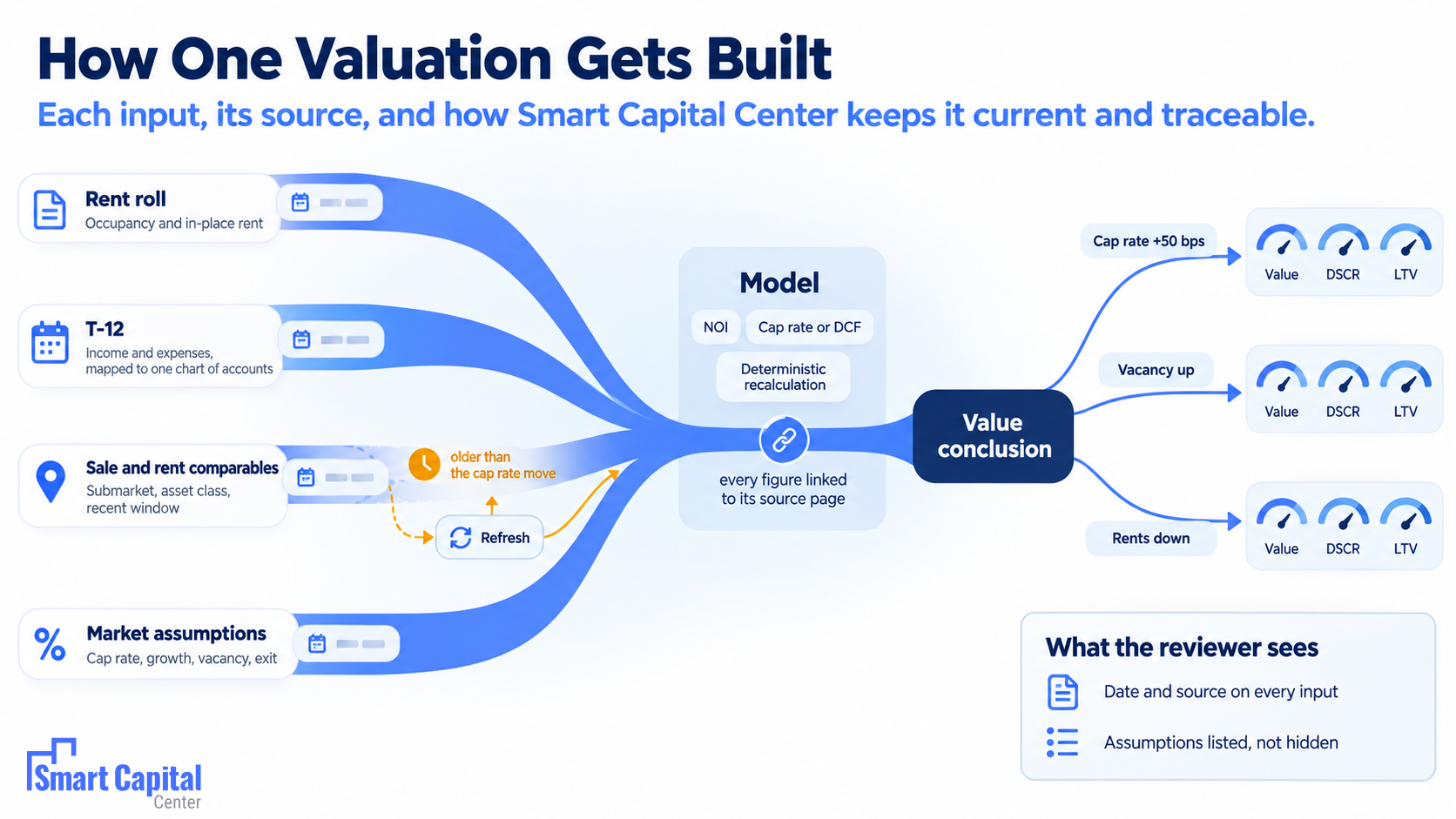
• Inputs from source documents: AI agents pull rent rolls, T-12s, and financial statements from borrower files, and each figure links to its page.
• Current market evidence: comparables and market data sit in the same workflow as the model.
• Defensible numbers: calculations run deterministically, so the result can be explained in committee.
This guide defines commercial real estate valuation software, covers the features that matter, compares the main types of CRE valuation tools, and lists the steps and risks to check before you buy.
Commercial real estate valuation software is a category of tools that estimates what an income-producing property is worth, usually by combining property income and expense data, comparable sales, and market assumptions such as cap rates and discount rates. Some tools produce a single model-based estimate. Others support an analyst building a full valuation with documented assumptions.
• CRE valuation software: tools that produce or support value estimates for commercial properties.
• CRE valuation tools: the individual products in this category, from models to comparable databases to appraisal workflow systems.
• Commercial real estate valuation technology: the broader set of software, data, and AI methods applied to value work.
• AVM (automated valuation model): a model that estimates value from property and market data, usually without a site visit.
• Income approach: a method that converts a property's net operating income into value using a cap rate or discounted cash flow.
• Evaluation versus appraisal: a regulated lending term. An appraisal follows appraisal standards, while an evaluation is a lighter valuation allowed for some lower-value transactions.
The Federal Reserve's May 8, 2026 Financial Stability Report shows real CRE price growth of negative 1.5% for the year from December 2024 to December 2025, against an average annual growth of 2.6%. It also notes that vulnerabilities tied to upcoming refinancing needs remained. Prices have stabilized, which makes the precision of each input matter more, since smaller moves leave less room for error.
Susan Wachter, professor of real estate and finance at the Wharton School, said in a Knowledge at Wharton interview published December 31, 2025:
“Office is still down from its high by more than 30%.”
Susan M. Wachter, professor of real estate and finance, Wharton School, Knowledge at Wharton, December 31, 2025
A property-type gap of that size means a single market-wide cap rate will mislead. Commercial real estate valuation software needs to work at the level of asset class, submarket, and lease.
A supervisory review from the European Central Bank's Banking Supervision newsletter of August 14, 2024, which examined how banks value commercial property collateral, noted that ECB interest rates rose from 0.25% to 4.5% over the period it covered. Its worked example shows how sensitive some valuations are: a 7.5% increase in total costs combined with a 7.5% reduction in market value on completion reduced the estimated site value by over 90%. That example is a single development project, not an average, but it shows why stale inputs can distort a conclusion.
The appraisal threshold matters for software buyers. The agencies' April 2, 2018 final rule raised the threshold for commercial real estate transactions requiring an appraisal from $250,000 to $500,000, so many smaller loans rely on evaluations. Those evaluations still need defensible inputs, and software is where most lenders get them.

Seven features separate commercial real estate valuation software an analyst can defend in committee from software that only produces a number.
Valuation starts with net operating income, and NOI starts with a rent roll and a T-12. A tool that makes an analyst retype those figures adds error at the first step.
What to test: Upload a real rent roll and T-12 and check that each line maps to a standard chart of accounts and links to its source page.
Sale and rent comparables anchor the cap rate and rent assumptions, and their age matters as much as their price.
What to test: Run a comparable search for a specific submarket, asset class, and recent window, and check that dates and sources are visible.
Cap rate, growth, vacancy, and exit assumptions drive the result, and a reviewer needs to see each one without opening a hidden tab.
What to test: Open a completed valuation and confirm every assumption is listed with its source or rationale.
A single point estimate hides risk. Reviewers want to see how value moves when cap rates, rents, or occupancy change.
What to test: Change the cap rate by 50 basis points and check that value and DSCR update correctly across the model.
Credit and investment committees ask where a number came from, and examiners expect documentation as the work happens.
What to test: Pick three figures in a finished file and trace each to its source document in under a few minutes.
A firm with many assets needs the same method applied across the portfolio, with results that roll up to NAV and concentration views.
What to test: Load a small portfolio and check that updated assumptions flow through to a portfolio view.
Valuation data lives in accounting and property management systems, and borrower files are sensitive.
What to test: Confirm which systems the tool connects to, ask for SOC 2 Type II documentation, and ask whether files train models.
CRE valuation tools fall into five broad types, and many firms use more than one. This comparison is by type, not by vendor.
Commercial real estate valuation solutions now use AI mainly for the front of the process: reading documents, gathering evidence, and flagging conflicts. Appraisers are taking this up as a professional skill. Michael J. Acquaro-Mignogna, President of the Appraisal Institute, wrote in his May 4, 2026 message about an education program he described as:
“a growing learning community focused on integrating artificial intelligence into everyday valuation practice”
Michael J. Acquaro-Mignogna, MAI, SRA, AI-GRS, President, Appraisal Institute, Appraisal Institute, May 4, 2026
Smart Capital Center's founder describes how the platform keeps numbers honest:
"Inside our platform, we recalculate all the numbers and then we raise a flag if something doesn't make sense, if something doesn't add up."
Laura Krashakova, Founder & CEO, Smart Capital Center, client call, November 2025
KeyBank Real Estate Capital cut financial model prep time by 40% with Smart Capital Center.
1. Pick a past valuation. Choose a completed deal and note the NOI, cap rate, and value your team reached.
2. Rebuild it in the tool. Upload the same rent roll and T-12, and time how long it takes to reach a draft.
3. Compare the inputs. Check every extracted figure against the source page and list any differences.
4. Test the comparables. Pull comps for the same submarket and compare dates, sources, and adjustments with your file.
5. Change an assumption. Move the cap rate and vacancy, and check that value, DSCR, and LTV update together.
6. Ask for the audit trail. Request the documentation a committee or examiner would see, and confirm security certification and integrations.
Smart Capital Center is built to satisfy all six steps: it reads your documents, links every figure to its source, pulls comparables into the same workflow, recalculates the model deterministically, and is SOC 2 Type II certified with integrations to systems such as Yardi, SS&C Precision, and Midland Enterprise.

With office still more than 30% below its high, a market-wide cap rate applied to an office asset and an industrial asset will misprice at least one of them. Smart Capital Center benchmarks each deal by asset class and submarket, so the cap rate in the model matches the property in front of the analyst.
A collateral value built on comparables that predate a cap rate move can overstate loan proceeds and leave a thinner cushion than the file shows. Smart Capital Center mitigates this by placing current comparables and market data beside the model, and by flagging inputs that conflict.
When each asset is revalued in a different model with different assumptions, the portfolio view adds numbers that do not compare. Smart Capital Center applies one method and one chart of accounts across the portfolio, so a change in assumptions flows through every asset the same way.
Software gathers the evidence and checks the arithmetic. Comparability between similar-looking assets, submarket nuance, tenant credit, and the choice of cap rate remain decisions for an analyst or appraiser, and regulated appraisals stay with credentialed appraisers.
The best commercial real estate valuation software shows its inputs, dates, and assumptions, so a reviewer can trust the number without trusting the vendor. Smart Capital Center gives analysts source-linked inputs and current market evidence in one workflow, so their time goes to the assumptions that drive value.
See a past valuation rebuilt from your own rent roll and T-12, with every input linked to its source. Book a demo with Smart Capital Center →
Q: What should I look for in commercial real estate valuation software?
A: Look for inputs read from source documents, current comparables, visible assumptions, sensitivity analysis, an audit trail, portfolio-level revaluation, and integrations with strong security. Test each one on a past deal from your own files. Smart Capital Center is built around source-linked inputs and a traceable model.
Q: Can I trust AI-powered commercial real estate valuation software for a lending decision?
A: Trust it to the degree you can trace it. Check that every input links to a source page, that conflicts are flagged, and that calculations are repeatable. Regulated appraisals still require a credentialed appraiser, so software supports the decision and does not replace the appraiser.
Q: How do CRE valuation tools differ from an AVM?
A: An AVM produces a model-based estimate from property and market data, often with limited visibility into assumptions. Broader CRE valuation tools also read documents, build cash flows, and document each assumption. Many firms use an AVM for screening and a fuller tool for deals.
Q: How can I check whether a valuation tool uses current market data?
A: Run a comparable search for a specific submarket and recent window, and look at the dates and sources on each result. Then compare the cap rate it suggests against recent closed sales you know. Smart Capital Center places comparables and market data beside the model so dates stay visible.
Q: Do I need commercial real estate valuation technology if I already use spreadsheets?
A: Spreadsheets work for a single deal but become hard to audit across many files. Technology helps most when volume grows, since it reads documents, keeps one method, and records where each figure came from. KeyBank Real Estate Capital cut financial model prep time by 40% with Smart Capital Center.
Q: Which commercial real estate valuation solutions fit a lender versus an investor?
A: Lenders need collateral values with a clear audit trail and covenant monitoring after closing. Investors need fast screening across many deals and a model that updates as assumptions change. Both need source-linked inputs, which is the common test across the six evaluation steps.
Q: How can I see Smart Capital Center handle a valuation on my own deal files?
A: Book a demo and bring a recent rent roll and T-12. Smart Capital Center will show the agents reading the documents, linking each figure to its source, and updating the model when you change an assumption.