CRE Investors

November 3, 2026
CRE Investors
November 3, 2026
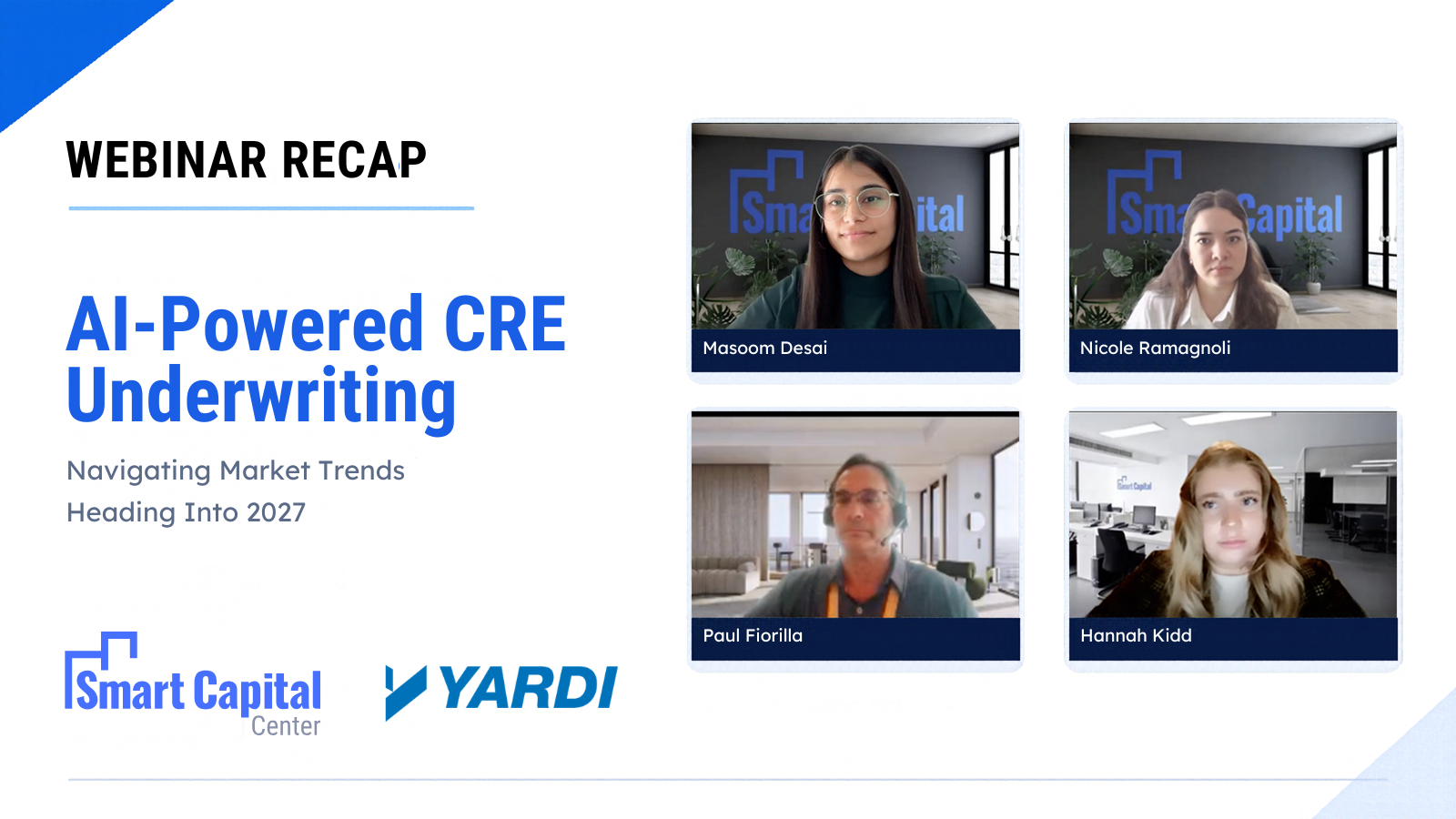
On October 28, 2026, Smart Capital Center hosted a webinar with Yardi Matrix exploring how AI-powered commercial real estate (CRE) underwriting and market intelligence can help CRE investors analyze opportunities in greater depth, identify potential risks, and make better-informed investment decisions.
The session explored how agentic AI is changing the way investors research, underwrite, and evaluate deals, alongside the market trends shaping CRE investment opportunities heading into 2027.
Hannah Kidd, Senior Financial Associate at Smart Capital Center, discussed how the platform's specialized AI agents connect market research, property financials, and underwriting workflows, helping investors move from gathering information to analyzing opportunities more efficiently.
Paul Fiorilla, Director of Research at Yardi Matrix, shared his outlook on the commercial real estate market, highlighting the trends and risks investors should consider as they prepare for 2027.
Here are the key takeaways from the webinar and what they mean for CRE investors preparing for the year ahead.

Investment teams have access to more information than ever before. The challenge is bringing that information together and making practical use of it.
Evaluating a new opportunity often involves reviewing offering memorandums, rent rolls, operating statements, lease agreements, and market research. Analysts then need to organize that information, prepare financial models, and determine whether the assumptions behind a deal are realistic.
Much of this work still takes place across separate spreadsheets, research platforms, and documents.
Smart Capital Center helps investment teams connect these activities within one platform.
Its specialized AI agents work with deal documents, financial information, historical transactions, and market intelligence to support different stages of investment analysis.
For example, an investor considering a multifamily acquisition in a market with significant new supply may need to question the seller’s projected rental growth.
Instead of relying solely on the assumptions provided in the offering materials, the team can use Smart Capital Center to research local rental trends, review occupancy conditions, and incorporate relevant market information into its underwriting.
The same information can support financial projections, discounted cash flow (DCF) models that project a property’s future net cash flows and discount them to present value at a required rate of return, and investment committee memos.
Smart Capital Center’s AI agents draw on 120M+ properties, 1B+ signals, and $500B+ analyzed, along with a firm’s own documents and historical information.
The benefit comes from using that information throughout the investment process without gathering and preparing it again in separate systems.

Another important distinction is how information can be used beyond an individual underwriting task.
General-purpose AI tools can assist with research, document review, and individual questions. However, investment teams often need information to remain connected as a deal progresses.
Smart Capital Center is designed to support these workflows across the investment lifecycle, from underwriting and acquisition through asset management, portfolio monitoring, and investor reporting.
Information gathered during underwriting can continue to support decisions after a transaction closes. Historical transactions and prior research can also provide useful context when evaluating future opportunities.
The platform is composable, allowing firms to begin with the capabilities most relevant to their needs and add others over time.
Investment teams can incorporate AI into the processes they already use instead of adding it as a separate tool for isolated tasks.
As AI becomes more widely used in commercial real estate, investment teams need confidence in the information supporting their decisions.
One of the challenges with AI-generated financial analysis is ensuring that extracted figures and findings are accurate and can be verified.
An incorrect figure from a rent roll or operating statement can affect multiple parts of an underwriting model. Without clear supporting information, analysts may need to spend additional time identifying and correcting errors.
Smart Capital Center addresses this through source-level traceability, which means every extracted figure links back to the document or data source it came from, so an analyst can verify it. It is the foundation of AI underwriting a team can rely on, and our guide on how to trust AI in CRE underwriting covers it in more depth.
This keeps the investment team in control of the analysis, a human-in-the-loop approach in which people review and approve the work before it is used, so the team does not have to accept AI-generated findings without verification.
Understanding market conditions is just as important as having the tools to analyze them. During the webinar, Paul Fiorilla of Yardi Matrix shared the trends shaping CRE investment opportunities heading into 2027. One of the central messages from the market outlook was that commercial real estate performance varies significantly across property types and locations.
While some sectors are showing signs of recovery, others continue to face challenges related to new supply, financing costs, and changing demand.
Interest rates remain a major consideration. Elevated borrowing costs and uncertainty around property valuations have contributed to slower transaction activity, making it especially important for investors to carefully evaluate financing assumptions, the exit cap rate they underwrite, and projected returns.
Multifamily remains relatively stable, but the outlook differs considerably between markets.
Several Sunbelt markets, including Austin, Nashville, Charlotte, Denver, and Phoenix, have experienced substantial new apartment development. This has increased competition, put pressure on rents, and led some property owners to offer concessions to attract tenants.
Meanwhile, markets with more limited new development have generally experienced stronger rental performance.
“Rent growth has been negative for most of the last 3 years in most of the Sunbelt,” said Paul Fiorilla, Director of Research at Yardi Matrix, on October 28, 2026.
According to Yardi Matrix’s outlook, some Sunbelt markets may not return to more typical rent growth until around 2028, as recently delivered apartments are gradually absorbed.
Other CRE sectors present different conditions:
The table collects the dated Yardi Matrix figures behind this outlook, from Paul Fiorilla’s October 28, 2026 presentation and from Yardi Matrix’s published reports.
Market averages can provide useful context, but they rarely tell the full story of an individual investment.
An acquisition that looks attractive based on national rent growth forecasts may perform very differently once local supply, occupancy, financing costs, and property-specific conditions are considered.
Investors need to understand these differences and incorporate them into their underwriting before making a decision.
That’s where connecting market intelligence directly to investment analysis becomes valuable.
Two risks in the outlook deserve a place in every 2027 underwriting model:
These market trends highlight why investors need to look beyond general forecasts and examine the assumptions behind each opportunity. Smart Capital Center's AI agents help investment teams incorporate relevant market information into their underwriting, test different scenarios, and identify potential risks before making investment decisions.
Speed is one of the most visible benefits of AI, but faster underwriting alone does not necessarily lead to better investment decisions.
The real value comes from giving investment teams the capacity to examine opportunities more thoroughly.
Underwriting models depend on assumptions about rent growth, vacancy, expenses, capital expenditures (CapEx), financing costs, and future property performance.
If those assumptions are unrealistic, the projected returns may not reflect the actual risks of the investment.
Smart Capital Center’s AI agents support research and validation of these assumptions against available property and market information.
For example, an investor can investigate whether projected rental increases are consistent with local conditions or whether the expense assumptions deserve additional review.
This gives teams more information to assess the financial outlook instead of relying entirely on the initial deal package.
Investment performance rarely follows one exact set of projections.
Leasing may take longer than expected. Operating costs may rise. Financing terms may change, or a property’s eventual sale price may differ from the original estimate.
Smart Capital Center supports detailed financial modeling and stress testing, allowing investment teams to explore how different assumptions affect projected returns.
By comparing potential outcomes, investors can better understand the risks associated with an opportunity and determine whether it fits their investment strategy.
Investment analysis also involves identifying issues that may not be immediately apparent from the financial model.
Smart Capital Center’s AI agents can examine connected financial information, market research, and supporting documents to highlight potential concerns and areas that require additional review.
This helps investment professionals focus their attention on the questions that matter most before moving further into due diligence.
The objective is to support more comprehensive underwriting, with investment teams reviewing the analysis and making every final decision.
A seller’s rent growth projection is one of the first assumptions worth testing, especially in markets with heavy new supply. Four steps cover the check:
Smart Capital Center’s AI agents research local rental trends and occupancy for the property, so the team can run these checks before due diligence begins.

One of the practical examples discussed during the webinar was Centers Dynamic Partners, a real estate investment firm focused on value-add retail opportunities.
Like many investment firms, Centers Dynamic Partners needed to evaluate complex opportunities while managing a changing volume of incoming deals.
Preparing detailed financial analyses for every opportunity required considerable time and resources.
By using Smart Capital Center, the firm has achieved:
“The software and the scrubbing capability with the AI has been enormous. As a sponsor, you must know your numbers cold, and Smart Capital Center lets me do that,” said George Arce Jr., President and CEO of Centers Dynamic Partners, in the firm’s announcement with Smart Capital Center.
These results demonstrate how AI-supported workflows can increase investment teams’ capacity while maintaining detailed financial analysis.
The value extends beyond processing more deals. It gives investment professionals more time to evaluate assumptions, explore financing scenarios, and determine which opportunities deserve further consideration.
For firms operating with lean investment teams, that additional capacity can make a meaningful difference when deal flow increases.

As commercial real estate investors prepare for the year ahead, three important lessons emerge from the webinar.
1. Deeper Underwriting Starts With Better Information
Market conditions can vary significantly between property types, cities, and individual assets.
Investors need to look beyond broad market forecasts and evaluate the assumptions behind each opportunity using reliable property-level information and local market research.
AI can help bring these different sources together, making more comprehensive investment analysis practical.
2. AI Can Expand Investment Teams’ Capacity
Researching markets, reviewing documents, and preparing financial models can take substantial time.
By reducing repetitive work, AI allows investment professionals to spend more time evaluating opportunities, reviewing potential risks, and testing different scenarios.
This can help teams manage larger deal pipelines without sacrificing the depth of their analysis.
3. Investment Decisions Remain With the Team
AI can support research, identify potential issues, and prepare financial analysis, but it does not replace investment judgment.
Analysts and investment professionals still need to review assumptions, verify findings, and determine whether an opportunity aligns with their investment objectives.
Source traceability and connected workflows help make that review process more transparent and manageable.
Heading into 2027, commercial real estate investors face a market where local conditions, financing assumptions, and property-level performance can significantly influence investment outcomes.
Having access to reliable information is important. Being able to connect that information to detailed underwriting and investment decisions is what makes it useful.
Smart Capital Center helps CRE investment teams bring together market intelligence, property financials, and AI-powered underwriting to evaluate more opportunities, identify potential risks, and make better-informed decisions.
Our webinar with Yardi Matrix highlighted how combining market expertise with connected AI-supported analysis can help investors navigate these challenges.
We thank Paul Fiorilla and the Yardi Matrix team for sharing their market insights and contributing to the discussion.
See how Smart Capital Center can support your investment team.
Book a personalized demo to explore how our AI agents can help you analyze opportunities, validate assumptions, and test scenarios in one workflow.
Q: How is AI used in commercial real estate underwriting?
A: AI underwriting helps investment teams extract information from rent rolls and financial statements, research market conditions, analyze property performance, and test underwriting assumptions. Smart Capital Center connects these activities within one platform, allowing analysts to work with supporting information and review the results.
Q: How does Smart Capital Center help CRE investors?
A: Smart Capital Center helps investors evaluate opportunities, connect market research with financial analysis, prepare underwriting models, and monitor portfolio performance. Its AI agents support multi-step workflows, reduce repetitive preparation, and give investment teams more information to support their decisions.
Q: How is Smart Capital Center different from ChatGPT or Claude?
A: ChatGPT and Claude are general-purpose AI tools that can support research and answer questions. Smart Capital Center is built for commercial real estate, connecting deal documents, financial information, underwriting models, and market intelligence across the investment process. Its AI agents support multi-step analysis, with source-level traceability and analyst oversight. Our full comparison is in ChatGPT and Claude for CRE Underwriting: What They Miss.
Q: How do I check whether a seller’s rent growth projection is realistic?
A: Compare the seller’s projected rent growth in the offering memorandum with current rent growth and new-supply figures for the same submarket, then re-run the DCF at the lower local rate and see whether the deal still meets your return threshold. Smart Capital Center’s AI agents research local rental trends and occupancy for the property, so the team can test the seller’s assumption before due diligence and flag any gap.
Q: Why is local market research important for CRE underwriting?
A: Local market conditions can differ significantly from national averages. Rent growth, occupancy, new construction, comparable properties, and operating expenses can all affect investment performance. Researching these factors helps investors develop more realistic projections and identify potential risks. Smart Capital Center’s AI agents research these local figures for each property so the team can test its assumptions against them.
Q: Can AI replace investment professionals in underwriting?
A: AI can reduce repetitive data preparation, support market research, and help analyze financial information. Investment professionals remain responsible for reviewing findings, evaluating assumptions, and making final investment decisions. With Smart Capital Center, every extracted figure links back to its source so the team can verify the analysis.