


AI in Commercial Real Estate

November 26, 2026
AI in Commercial Real Estate
November 26, 2026

A deal arrives as a stack of PDFs, and the first question from your committee is a simple one: when does the largest tenant's lease expire? Finding that answer usually means opening the rent roll, then the lease, then checking that the two agree. In the RICS AI in Commercial Property and Construction Report 2026, which surveyed more than 3,100 respondents globally, 39% of commercial property respondents were running early-stage pilots and 29% used AI regularly, so most teams are still working out which questions to put to it. Asking a question in plain language and getting a sourced answer changes how that first look at a deal works.
Smart Capital Center's agentic AI answers from your extracted deal data, with 120M+ properties, 1B+ live market data points and $500B+ analyzed transactions behind the market answers. Smarty, the AI assistant inside the platform, takes the questions below. That means:
• Answers in seconds: you ask about a deal and see where each answer came from.
• Fewer surprises in diligence: asking more questions early shows you what to ask next.
• Faster scenario testing: changing a renewal probability or market rent takes one sentence.
This guide covers why prompts work better on structured data, a prompt library grouped by stage, how to write a good prompt, how to check an answer, and how general chatbot prompts differ. It is part of our guide to What Is AI Underwriting? How It Works in Commercial Real Estate Lending and Investing.
The best AI prompts for commercial real estate underwriting are short, specific questions about a deal you can verify in seconds, such as a lease expiration, the largest expense, or a covenant status. The library below groups them by stage and shows what each returns and what to check.
Every prompt marked "Live demo" was run in Smarty during live demos and can be used as written. Prompts marked "Adapted" follow the same pattern and should be tested on your own deal before you rely on them.
• Prompt: a plain-language question or instruction given to an AI assistant.
• Rent roll: a list of every unit or tenant in a property, with rent, lease dates and occupancy status.
• T-12: a trailing twelve-month operating statement showing a property's actual income and expenses.
• Loan covenant: a condition in the loan agreement, such as a minimum DSCR, that the borrower must meet.
• Source link: a link from an answer or figure back to the page of the document it came from.
AI prompts for real estate deals work better on structured data because the assistant answers from extracted, reconciled figures with sources, not from a pile of PDFs. Hannah Kidd, Senior Financial Associate at Smart Capital Center, described it in a demo:
“You can also ask any questions on the deal as well. So when does the largest tenant at this property, when does their lease expire? And ultimately, because Smarty has access to all the information on this deal, it can provide that answer for you.” Hannah Kidd, Senior Financial Associate, Smart Capital Center.
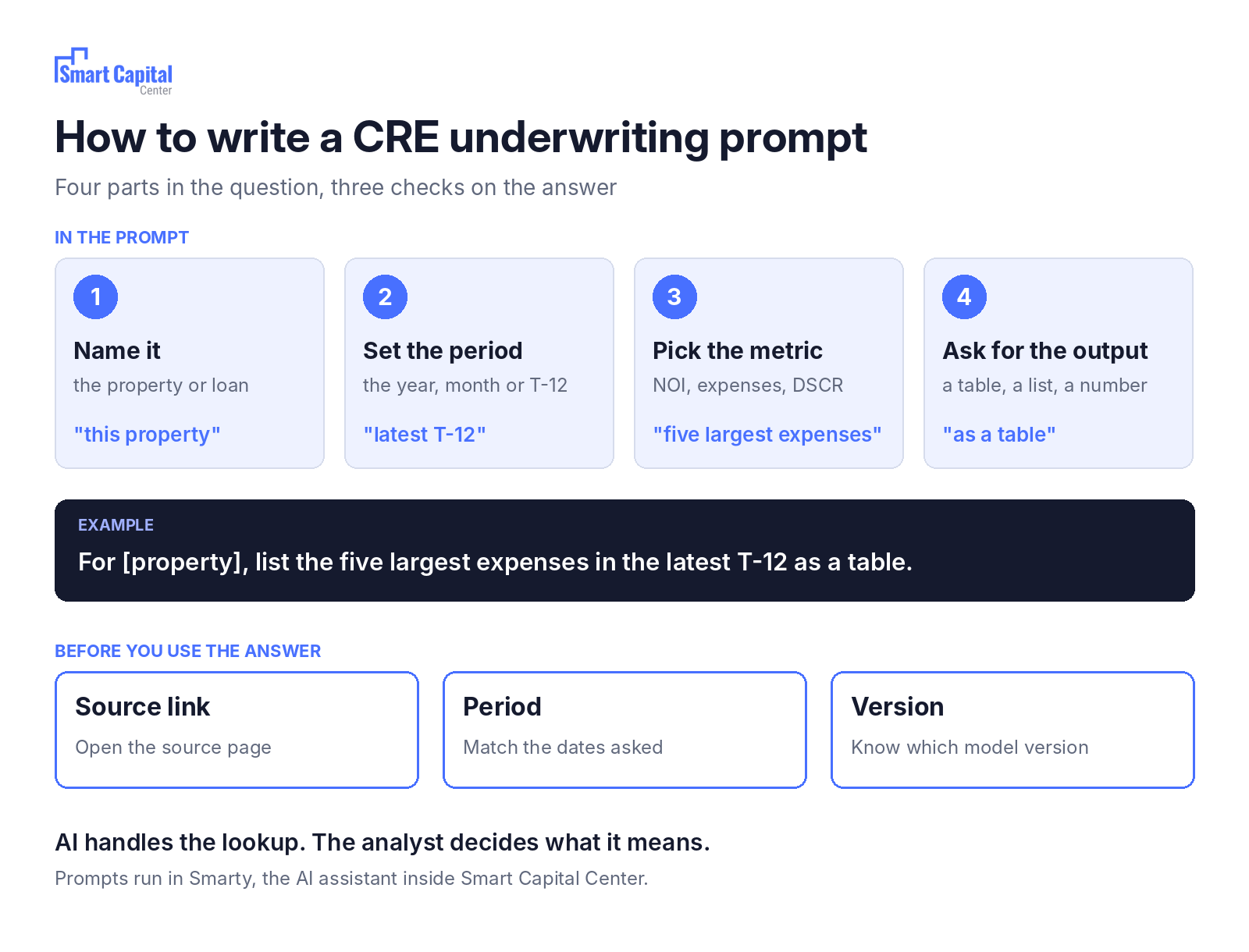
Figure 1. Four parts of an underwriting prompt and three checks on the answer. See Smarty answer questions on a live deal
Screening prompts give your team a first read on a deal before anyone builds a model, so you know what to ask in diligence. Hannah Kidd described the range of questions Smarty takes:
“You can ask different levels, portfolio level, property level. This is ultimately your assistant. So here you can track different questions. What is the largest expense? What school zone is this property zoned to? Ask different questions on the property itself. Any risks, if any covenants have been breached.” Hannah Kidd, Senior Financial Associate, Smart Capital Center.
Rent roll prompts tell you who your tenants are and when risk arrives, without reading the rent roll line by line. AI prompts for real estate rent rolls should name the tenant, the date and the output. The first three prompts below were run in live demos.
For a deeper guide to tenant analysis, see How to Analyze CRE Tenant Data Using AI.
Financial prompts show you where the money goes and which period drives it. They give your analyst a direct answer to the questions committees ask first.
Yes. In Smart Capital Center, a prompt can change an assumption in the underwriting, so you can test a scenario with one sentence instead of editing cells by hand. Your analyst still sets the assumption and reviews the result.
Testing a change takes one sentence, so analysts explore more scenarios before committee. The analyst decides which scenario to believe.

Document prompts help your team find problem terms before they become a diligence surprise. They work on uploaded leases, term sheets and loan agreements, and each answer should point to the clause it came from.
Portfolio prompts let an asset manager ask about a covenant or a fund's liquidity without opening reports. Both prompts below were run in live demos.
Write a good underwriting prompt by naming four things: the property or loan, the period, the metric, and the output you want. The example in Figure 1 follows the pattern: "For [property], list the five largest expenses in the latest T-12 as a table."
• Name the property or loan: inside a deal, "this property" works. At portfolio level, name the asset.
• Set the period: say the year, month or T-12, since a metric without a period can mean several things.
• Pick the metric: NOI, a specific expense, DSCR or lease expiration.
• Ask for the output: a table, a list or a single number.
Check the source link, the period and the underwriting version before an answer goes into a memo. Those three checks catch most errors, and they take less time than finding the answer by hand.
1. Open the source link. Confirm the figure appears on the page cited.
2. Confirm the period. Make sure the dates match the question you asked.
3. Note the underwriting version. Know which version of the underwriting produced the answer.
4. Ask the follow-up. If the answer is surprising, ask what it came from and where.
Reliability varies by tool, even for products built for professionals. In Hallucination-Free? Assessing the Reliability of Leading AI Legal Research Tools, a Stanford study posted to arXiv on May 30, 2024, researchers found that two leading legal research tools each hallucinated between 17% and 33% of the time. The study covers legal research, not CRE, but the lesson applies: verify the answer against its source.
ChatGPT prompts for real estate and Claude prompts for finance transfer well as a starting pattern, but a general chatbot needs extra checking on CRE deals. It answers from whatever you paste or upload, so you carry the burden of confirming the document, the period and the figure.
The same four-part prompt works in either tool. Structured deal data changes where the check happens: with Smart Capital Center, the answer comes with its source, so verification is a click. For the limits of general tools, read ChatGPT and Claude for CRE Underwriting: What They Miss and ChatGPT, Claude and Copilot in Commercial Real Estate. To see Smarty work on a live deal, watch AI-Powered CRE Underwriting in Real Time: Smart Capital Center's Live Demo.
The gains from AI assistants are largest for people still building expertise. In Generative AI at Work, NBER Working Paper 31161 by Erik Brynjolfsson, Danielle Li and Lindsey Raymond (April 2023, revised November 2023), access to an AI tool raised productivity, measured as issues resolved per hour, by 14% on average and by 34% for novice and low-skilled workers. The setting is customer support, not CRE, but it suggests junior analysts gain the most from a tool that answers questions about their deals.
Kartik Hosanagar of the Wharton School described the analyst's role at the Wharton Scale School session How to Scale Smarter with AI Agents and Automation, recorded April 22, 2026:
“An interesting role for the human is to teach the AI. Figure out what's repeatable and verifiable, and pass that on. What you keep is the nuanced domain knowledge, the taste, the relationships.” Kartik Hosanagar, Professor at the Wharton School, How to Scale Smarter with AI Agents and Automation, Wharton Scale School, April 22, 2026
Rose Community Capital "reviews significantly more applications with greater depth and consistency," according to Kelly Boyer, President.

Three risks matter most for analysts, associates and asset managers. Each has a mitigation inside Smart Capital Center.
A lender's analyst asks about expenses and receives a figure from an older statement than the one in the file. The number looks plausible, so it goes into the memo. Smart Capital Center mitigates this through source links on every figure, so the analyst opens the page and sees the period.
An acquisitions analyst asks for a 90% renewal probability for major tenants, and the definition of major differs from the committee's. The value shifts without anyone noticing. Smart Capital Center mitigates this through the edit log, which records who changed which number and when, so the change can be reviewed before committee.
An asset manager asks about liquidity or covenants and the answer rests on a fund administrator report from a prior quarter. Decisions then follow stale data. Smart Capital Center mitigates this through document-based answers that show the report used, so the manager checks the date.
The best AI prompts for real estate teams are specific questions you can verify in seconds. The analyst's value is in knowing what to ask and what the answer means.
Smart Capital Center gives your team answers about a deal in seconds, with the source beside each one, so your analysts spend their time on judgment.
Ask your own deal the questions in this guide and see the source behind every answer. Book a demo with Smart Capital Center →
Q: How can I ask questions about a CRE deal without searching through the files?
A: Upload the deal documents to an assistant that works on extracted data, and ask in plain language. Each answer should show its source, so you can check a lease date or an expense without opening every file. Smart Capital Center's Smarty does this on the extracted deal data.
Q: What prompts can I use to review a commercial rent roll?
A: Start with the largest tenant's lease expiration, the leases expiring this year, and tenants below market rent. Check the lease against the rent roll before using the date. In Smart Capital Center, Smarty answers each from the extracted rent roll and links back to the source.
Q: How can I test a new market rent or renewal probability without editing the model by hand?
A: State the change in one sentence, such as updating market rent to $1,800 for all studio units, then review the result before it goes anywhere. Testing a change this way lets you run more scenarios before committee. In Smart Capital Center, Smarty updates the underwriting from that sentence.
Q: How can I find problem clauses in a lease before closing?
A: Ask the assistant to identify clauses a lender would consider problematic, then read each cited clause yourself. Your credit team decides which clauses matter under your policy, and the assistant only points to where they are.
Q: How can I check portfolio covenants and fund liquidity quickly?
A: Ask whether any covenants have been breached, or ask for total commitments, capital called and available liquidity from uploaded fund administrator reports. Confirm the report date before acting, since the answer is only as current as the report it rests on.
Q: Can I use ChatGPT or Claude prompts on my CRE deals?
A: You can use the same four-part prompt pattern, but a general chatbot answers from whatever you paste, so you check the source yourself. Structured deal data with a source link makes that check faster and keeps the analyst's time on judgment, which is how Smart Capital Center's Smarty works.