


AI in Commercial Real Estate

November 26, 2026
AI in Commercial Real Estate
November 26, 2026
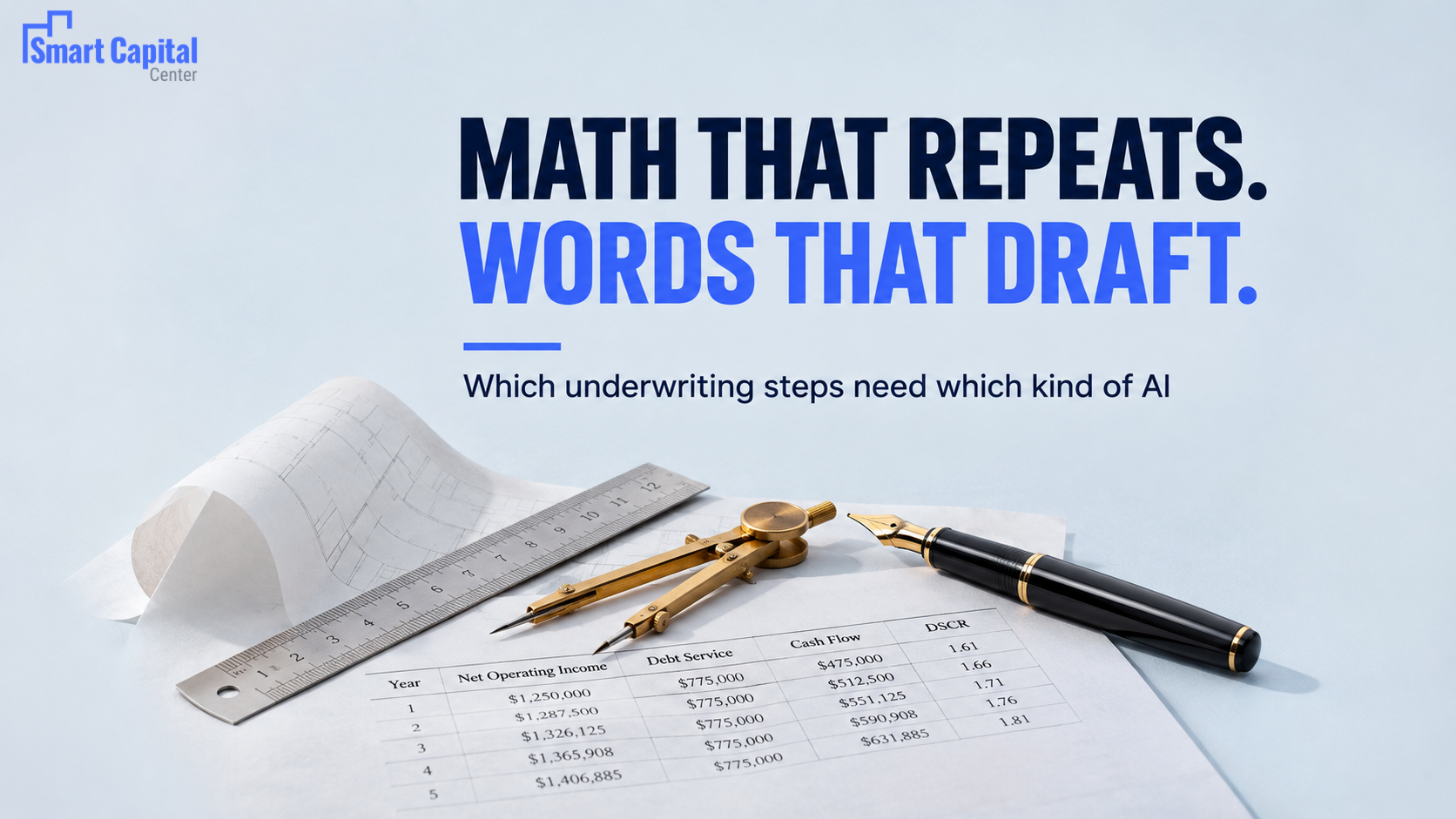
A credit committee expects the same NOI every time the file is opened. If a number can change between two runs of the same documents, nobody can defend it. That concern has evidence behind it: in Non-Determinism of "Deterministic" LLM Settings, posted to arXiv (version dated April 2, 2025), Berk Atil and colleagues report accuracy variations of up to 15% across naturally occurring runs, even with settings meant to make the output repeatable.
Smart Capital Center's agentic AI uses deterministic code where the answer must be the same every time, and generative AI only where it is needed, such as reading messy documents and drafting narrative, backed by 120M+ properties, 1B+ live market data points and $500B+ analyzed transactions. That means:
• Repeatable numbers: NOI, DSCR and DCF come out the same every time, so every decision is defensible and auditable.
• Fewer errors at committee: reconciliation failures and low-confidence items are flagged before the workflow moves on.
• AI where it helps: your team gets the reading and writing strengths of AI without giving up accuracy on the numbers.
This guide defines both approaches, maps each underwriting step to the one that fits, explains how generative output is checked, and lists the questions to ask any AI vendor. It is part of our guide to What Is AI Underwriting? How It Works in Commercial Real Estate Lending and Investing.
Deterministic AI is software that gives the same output every time it receives the same input. In CRE underwriting, that means a calculation or check you can run twice and get the same answer, which is what makes the result auditable.
Deterministic code takes the data as it is in the database and applies fixed rules to it. There is no prediction involved, so there is no room for hallucination.
Generative AI predicts the next word, or the next concept, which makes it useful for reading messy documents and writing narrative. Laura Krashakova, Founder & CEO of Smart Capital Center, put it this way:
“In reality, what Claude does inside it, what ChatGPT does inside it, they also have multi-step agentic process and they use traditional code. If you look under the hood, you will see the agents actually running the code... Ultimately, what is an LLM? LLM is just prediction of the next word, prediction of the next concept.” Laura Krashakova, Founder & CEO, Smart Capital Center.

No. Generative AI is probabilistic, so the same prompt can produce different outputs on different runs, and the output can change when the model is updated. Adjusting settings can reduce the variation but does not remove it.
Researchers at Stanford and UC Berkeley measured the effect of model updates. In How Is ChatGPT's Behavior Changing over Time?, Lingjiao Chen, Matei Zaharia and James Zou (arXiv, July 2023) found that the March 2023 version of GPT-4 identified prime versus composite numbers with 84% accuracy, and the June 2023 version scored 51% on the same task. The task is not CRE, but it shows why a number that goes to a credit committee should not depend on a model that can change.
The authors write that the behavior of the same LLM service “can change substantially in a relatively short amount of time, highlighting the need for continuous monitoring of LLMs.” Lingjiao Chen, Matei Zaharia and James Zou, arXiv, July 2023.
Deterministic AI gives your team numbers that repeat, and probabilistic AI gives your team reading and writing that adapts. Underwriting needs both, applied to different steps.
Laura Krashakova described why Smart Capital Center prefers code wherever it can:
“If it's possible not to use AI, we don't use AI, for the reason of latency, speed of answer, and cost, lower cost, but also deterministic outputs for financial analysis, financial workflows. You don't want to have any hallucinations, or you don't want to have some answers fluctuate. You really want to make sure it's deterministic.” Laura Krashakova, Founder & CEO, Smart Capital Center.
Deterministic code handles scans, Excel parsing, reconciliation and calculations, and generative AI handles reading, classifying, narrative and questions, with rules confirming anything the AI suggests. The infographic and table below map each step.
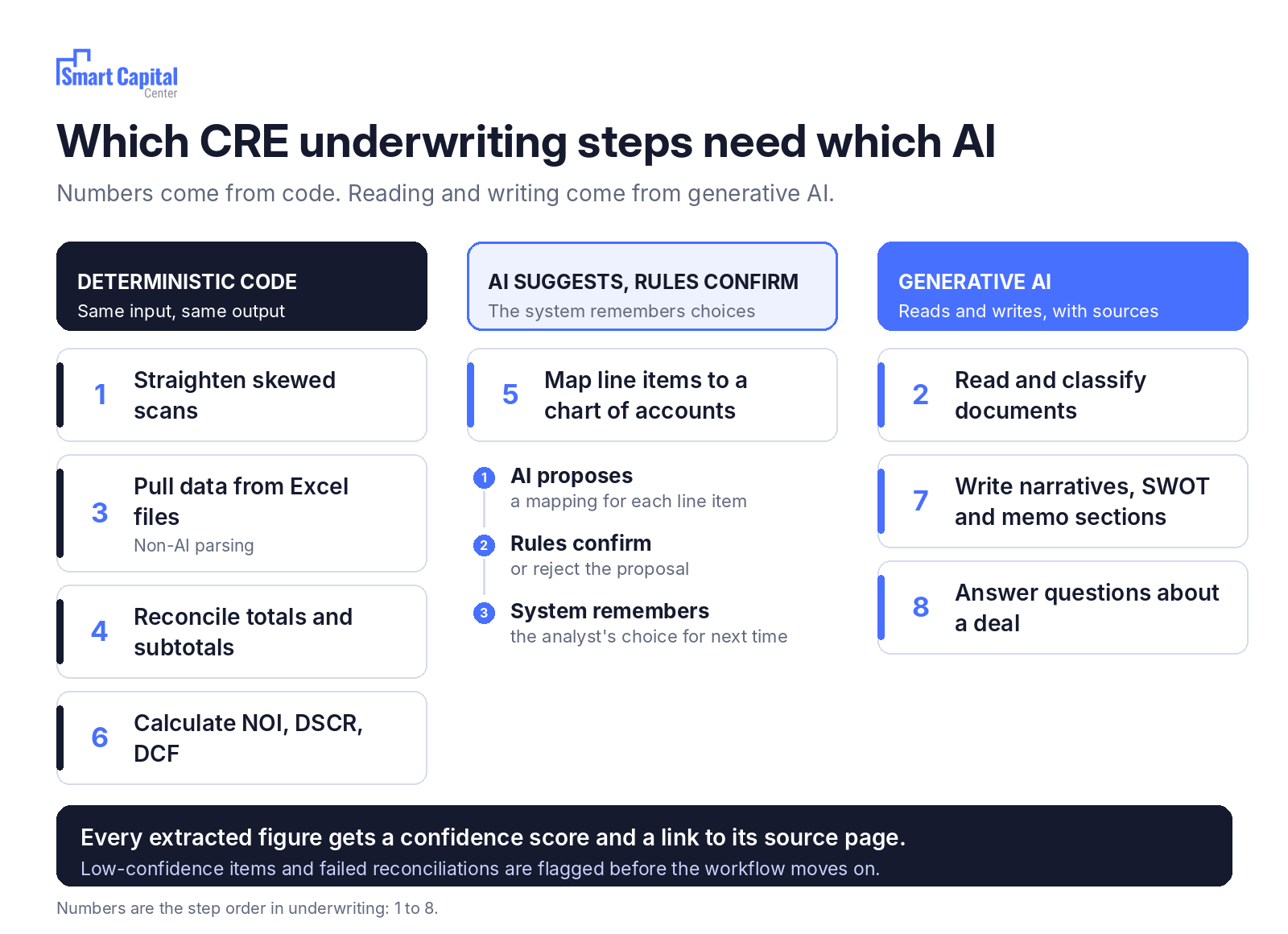
Figure 1. Eight CRE underwriting steps and the approach each one uses. See how Smart Capital Center handles underwriting
Any step where the same input must give the same answer needs deterministic code. That covers four steps:
• Cleaning up skewed scans: code straightens scans before any AI reads them.
• Pulling data from Excel files: non-AI parsing reads the cells as they are.
• Reconciling totals and subtotals: code checks that the parts add up to the whole.
• Calculating NOI, DSCR, DCF and other metrics: code computes them from confirmed data, so committee numbers repeat.
Generative AI helps where documents are messy and language matters. It reads and classifies documents, writes narrative, SWOT and memo sections with sources, and answers questions about a deal by reading structured, confirmed data.
Mapping line items to a chart of accounts uses both. The AI suggests a mapping, rules confirm it, and the system remembers the analyst's choices, so the same line item maps the same way next time.
Smarty, the AI assistant inside Smart Capital Center, is both: it reads and answers with generative AI, and the figures it reads come from deterministic steps. A prospect at a CRE investment firm asked this exact question during a demo, and the answer follows Laura Krashakova's description:
“We don't use LLM for everything. In many instances we just use traditional code because it is deterministic, because it just takes the data as it is from the database. There's no room for hallucination.” Laura Krashakova, Founder & CEO, Smart Capital Center.
AI data validation keeps CRE data accurate by checking every extracted figure before it reaches a model, so errors are caught at the source. The cost of poor data is large in general: in Bad Data Costs the U.S. $3 Trillion Per Year, Thomas Redman reported in Harvard Business Review on September 22, 2016 that IBM estimated poor quality data cost the U.S. $3.1 trillion in 2016.
Smart Capital Center checks generative output in five ways:
• A second AI agent double-checks each extracted value and assigns a confidence score.
• Required fields and confidence thresholds are set per client.
• Low-confidence items are flagged before the workflow moves on.
• Reconciliation failures are flagged before the workflow moves on.
• Every figure links to its source page, so your analyst can open the document and check.
Because "occupancy" can mean economic, physical or underwritten occupancy, and the system has to be told which one to use. An AI that picks the wrong one produces a plausible number that is wrong for your credit policy. A rule that fixes the definition removes the ambiguity.

Three risks matter most for credit officers and heads of underwriting. Each has a mitigation inside Smart Capital Center.
A DSCR in the credit memo differs from the one in the model because it was regenerated. The committee cannot tell which is right, and the approval can be challenged later. Smart Capital Center mitigates this through deterministic code for NOI, DSCR and DCF, so calculations repeat.
A rent roll subtotal does not match the total, and the gap goes unnoticed into the underwriting. The model then rests on numbers that do not add up. Smart Capital Center mitigates this through reconciliation checks that flag failures before the workflow moves on.
A system reads occupancy as physical when the credit policy requires economic. The number looks right and is used in sizing. Smart Capital Center mitigates this through rules that set which definition applies, with every figure linked to its source page.
Ask three questions: which steps use an LLM, what happens when numbers do not reconcile, and whether you can see the source of every figure. Then run these six steps:
1. Ask for a step-by-step list of where the vendor uses an LLM and where it uses code.
2. Run the same file twice and compare the NOI, DSCR and DCF outputs.
3. Break a total on purpose in a test rent roll and see whether the system flags it.
4. Pick five figures and ask the vendor to show the source page for each.
5. Ask how confidence thresholds are set and who can change them.
6. Ask about data handling: whether client data is used to train models for other clients.
Smart Capital Center satisfies all six: it uses code for calculations and checks, flags reconciliation failures, links every figure to its source page, sets thresholds per client, is SOC 2 Type II certified, and never shares client data or uses it to train models for other clients. For evaluation tests beyond these questions, see How to Trust AI in Commercial Real Estate Underwriting; for extraction tips, see AI Data Extraction in CRE: Considerations and Tips; and for how general tools differ, see ChatGPT and Claude for CRE Underwriting: What They Miss. The generative side is covered in From Origination to Closing: The Future Role of Generative AI in CRE Lending (Part 1).
The results back the approach: at JLL, the asset management team saw a 30x productivity gain with Smart Capital Center.
Use code for every number that goes to committee, and use generative AI for reading and writing. That split gives your team the strengths of AI without giving up accuracy.
Smart Capital Center applies that split across underwriting, so numbers come out the same every time and every figure traces to its source.
Put numbers in front of your committee that come out the same every time, with a source behind each one. Book a demo with Smart Capital Center →
Q: Does Smarty use more of an LLM approach or is it more deterministic?
A: Both, applied to different steps. Deterministic code handles calculations and checks, and generative AI handles reading documents, drafting narrative and answering questions, so the figures behind an answer come from code. Smarty, the AI assistant inside Smart Capital Center, works this way.
Q: How can I make sure the same documents give the same NOI every time?
A: Use a system that calculates NOI and DSCR with deterministic code instead of a language model, so the same input gives the same output. You can test it by running one file twice and comparing the results. Smart Capital Center works this way.
Q: How can I catch numbers that do not reconcile before they reach credit committee?
A: Ask for reconciliation checks that run before the workflow moves on, plus a second check on each extracted value with a confidence score. Your analyst then reviews the flags instead of rechecking every figure. Smart Capital Center flags reconciliation failures and low-confidence items this way.
Q: Can I see the source of every figure in an AI underwriting file?
A: You should be able to, and you should ask any vendor to show it. Your analyst or committee should be able to open the source document from the figure itself and check the number.
Q: How can I stop an AI from using the wrong definition, such as occupancy?
A: Set the definition as a rule instead of leaving it to the model, and have the system remember analyst choices when mapping line items. That keeps the metric consistent across deals. In Smart Capital Center, the system is told which occupancy to use, whether economic, physical or underwritten.
Q: Can I trust AI with confidential borrower data?
A: You can when the provider commits to strong controls. Look for SOC 2 Type II certification and a written commitment that client data is never shared or used to train models for other clients. Ask any vendor for both answers before uploading files.