October 21, 2026
October 21, 2026

Sponsors are closing deals in 2026 by adding tranches. Common equity is thin, senior proceeds have pulled back, and the gap gets filled with some combination of a ground lease, subordinate debt, preferred equity, or a recapitalization that replaces a partner who wants out. The economics often work.
Every tranche added to a capital stack also adds a test. Each piece carries its own coverage requirement, its own priority on repayment, and its own payment that may or may not count as debt service under the senior loan documents. A three-piece stack is not three times the modelling work of a one-piece stack, it is considerably more, because the pieces interact. The result is that analysts spend their time rebuilding the same structure in spreadsheets when the valuable work is the sizing, the structuring, and the credit terms.
Smart Capital Center takes a full deal package and builds a standardized model from it, with agentic AI reading borrower files, market comparables, and hard-to-find web sources and finding the patterns that sharpen the analysis. The output is a sizing memo in minutes, with the same model structure for every analyst on the team. A later section covers what that means when the stack has four pieces in it.
This article sets out what each tranche of the stack actually costs in the current market, how a ground lease tranche is sized and priced, where subordinate debt pricing has moved, and what LP equity is asking for. The pricing comes from the IMN Real Estate Private Funds Summer conference in Newport in June 2026, on a Track B panel titled "Debt, equity & mezz: creative capital stack solutions," where the capital providers described their own terms on the record.
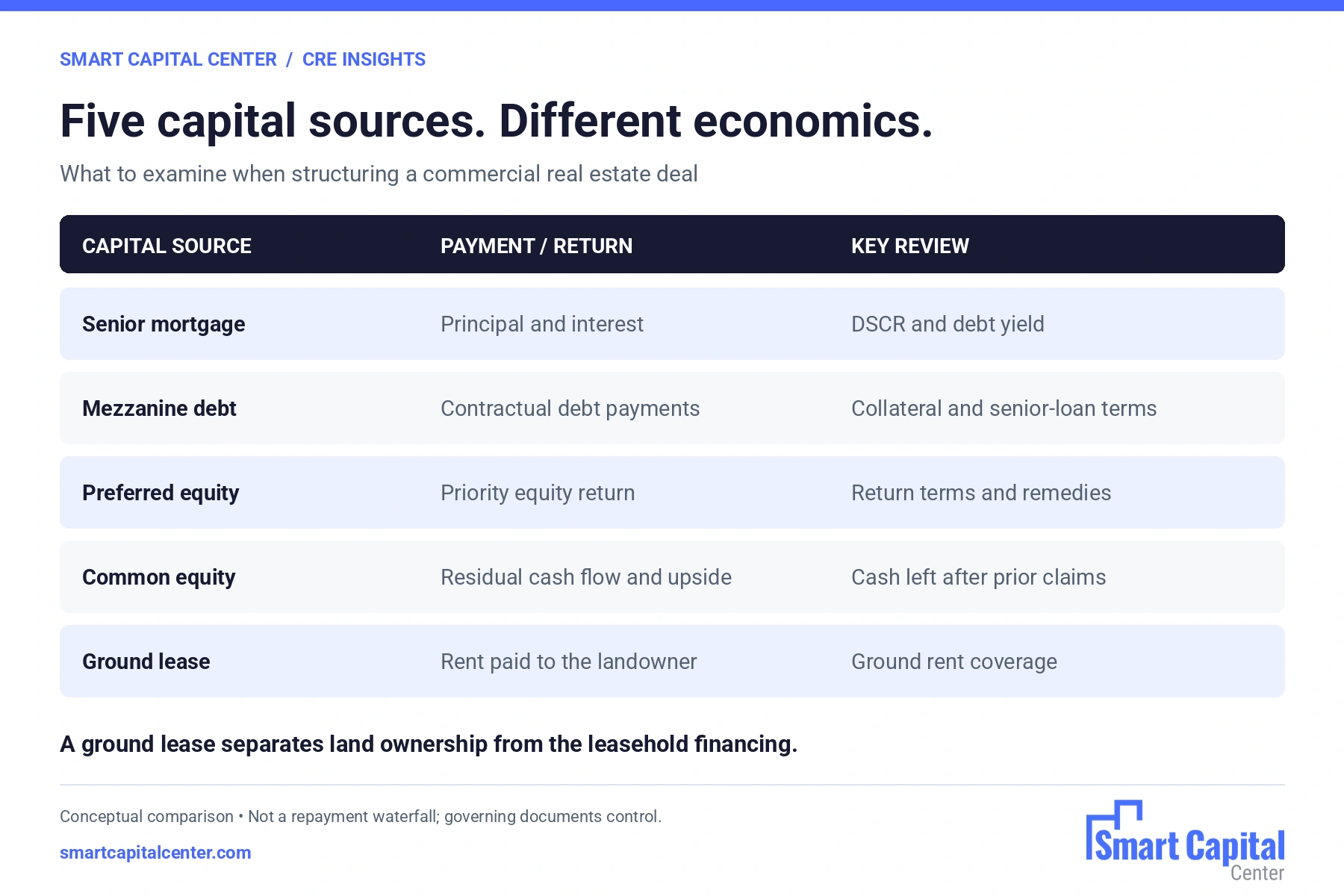
The capital stack is the set of capital sources funding a property, ordered by priority of repayment. A senior mortgage sits at the bottom with first claim, common equity sits at the top with last claim and the largest upside, and everything in between exists because someone needed to bridge a gap between the two.
Two features of the current market are shaping how those middle pieces get used.
The first is that structured products have become the default, not the fallback. Dan Nagler of Cabot Cabot & Forbes described traditional mortgage financing as very difficult for multifamily development and harder still for commercial, life science, and industrial projects. His firm has turned to structured products, and he made the point that spreads have tightened enough that those products have priced themselves in without eating much into profit margins. Traditional common equity is what he would prefer, and he described having pockets of it: an Opportunity Zone fund site where the return threshold is lower, and an upper-end suburban location that draws support. For the rest, the debt products are what makes the deals work.
The second is that the senior piece has shrunk. Dan Cooperman of Mavik Capital described banks that used to fund 75 to 80 percent of cost on value-add acquisitions now sitting closer to 55 to 65 percent. That 15 to 20 point gap is the whole reason the middle of the stack has grown.
A ground lease splits a property into land and improvements. The landowner holds fee title and receives ground rent; the sponsor holds a leasehold interest in the building and finances it separately. Danny Jumblatt of Safehold set out the mechanics on the panel in unusual detail.
The sizing works off coverage. His firm looks at the underlying net operating income of the building above the land, then sizes the deal to a multiple of the annual ground rent. He put that coverage as low as three times for multifamily and as wide as five times for hotels. The resulting rent stream is then purchased at a cap rate. For a long stretch that cap rate was priced close to the 30-year Treasury, which was highly accretive when the 30-year sat lower than it does now. Today he described buying land at roughly a 4.25 to 5 percent cap, varying by asset class and by whether the deal is an acquisition or a development.
The part that matters to a senior lender is where it sits. Jumblatt described the ground lease as the first tranche covering 25 to 40 percent of the capitalization, and at 40 percent it is meaningfully cheaper than where senior lenders are pricing today. That allows the mortgage lender to lend above it, reach a higher last-dollar proceeds figure, and still hold a wider debt yield than the same lender would accept on a fee simple basis. The debt yield, meaning net operating income divided by the loan amount, is the metric that improves for the lender even as total proceeds to the sponsor go up.
On priority and collateral, he said the structure has been worked out across roughly 190 deals, about 50 of them with Freddie Mac, covering what happens in a casualty or condemnation, with the ground lease holding first priority on repayment. His firm has also added senior leasehold loans and preferred equity for certain asset classes, so the same counterparty can now sit in more than one place in the stack.
He was also specific about how the product is priced against the alternative. Compared with C-PACE at a similar proceeds level, he put C-PACE a few hundred basis points wider, with meaningful state-by-state variation. The pricing target he described is to leave the developer with roughly 150 basis points of additional unlevered development yield, or about 100 basis points of additional yield on cost for an operating asset, which is the margin intended to make the decision straightforward.
Mezzanine debt and preferred equity both sit above the senior mortgage and below common equity. Mezzanine is structured as debt, often secured by a pledge of equity interests; preferred equity is structured as an equity interest with a priority return. The practical difference for a sponsor is how each is treated in the senior loan documents and what remedies the provider holds.
Cooperman gave a clear picture of how pricing has moved. In the first quarter of the prior year his firm was writing multifamily construction lending at 75 percent of cost priced at SOFR plus 550 to 600. That has tightened by 200 to 300 basis points. Debt capital markets have supplied considerably more liquidity to the space, and pricing has come in across the stack, including on the subordinate debt where his firm concentrates. He attributed part of that to competition: more entrants into the space, and managers raising larger funds with a real need to place the dollars.
His example of how the gap gets filled is worth the detail. A heavy value-add industrial specialist, well banked for years and able to go to any number of regional banks, found those banks had pulled proceeds back from 75 or 80 percent of cost to the 55 to 65 percent range. The sponsor was well capitalized and did not want to write a much larger equity check, and the individual deals were small enough to be awkward for institutional equity. Cooperman’s firm built a revolving preferred equity facility that lets the sponsor draw against each acquisition and recycle the same capital two to three times over a three to five year period. He noted it was not a deal that had been brokered, and not something the sponsor had known to ask for.
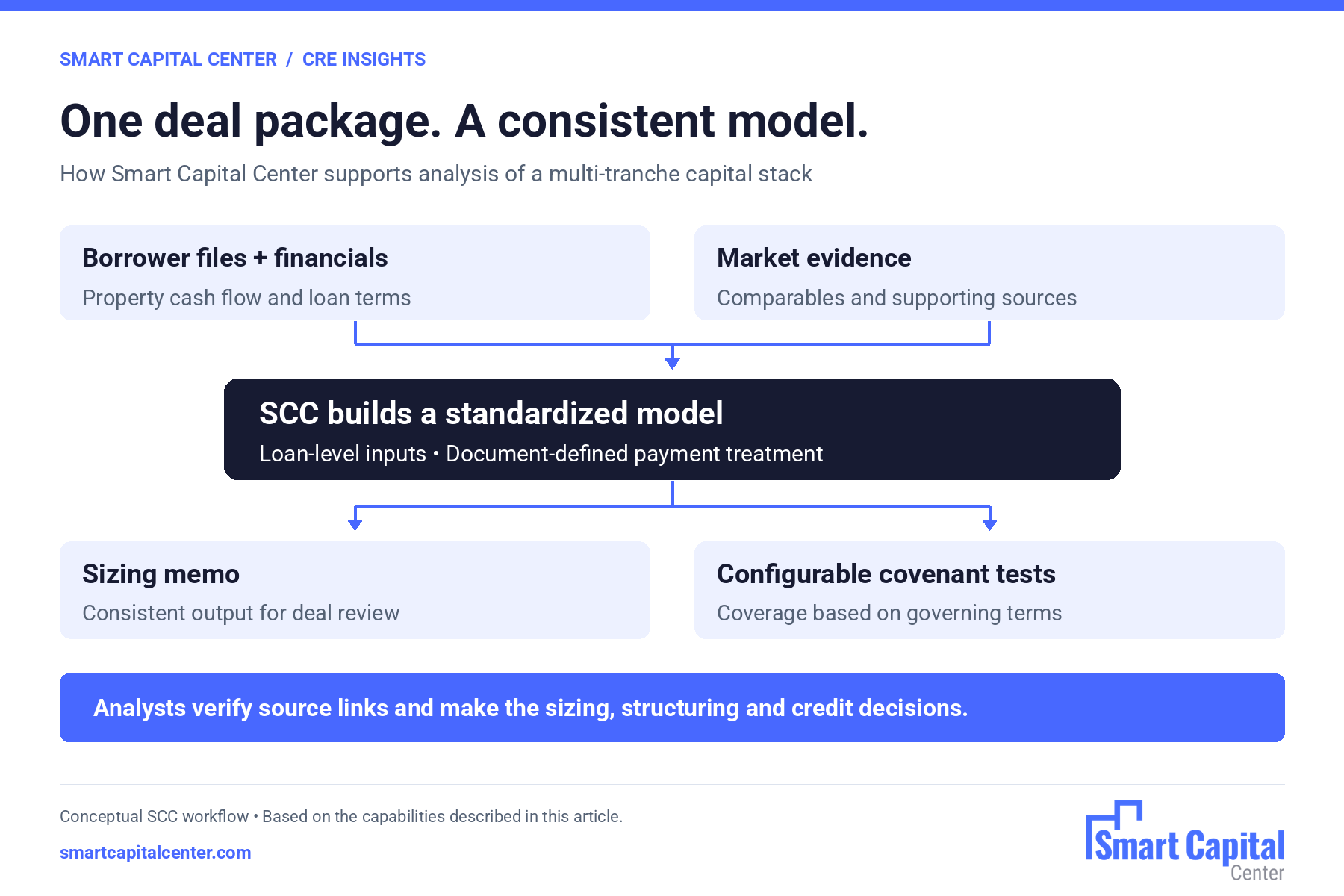
A stack with a ground lease, a senior leasehold loan, a preferred equity facility, and common equity has four sets of economics that all have to be sized against one property’s cash flow. Each piece brings its own coverage requirement. The ground lease is sized to a rent coverage multiple, the senior loan to a debt service coverage ratio and a debt yield, the preferred piece to its own return priority. Change one assumption about net operating income and all of them move at once.
Most teams handle that by hand. An analyst builds the stack in a spreadsheet for the sizing memo, someone rebuilds a version of it for the credit committee, and a third version gets reconstructed at the next quarterly review. Each rebuild is an opportunity for the pieces to drift apart, and none of that work is the part that requires judgment.
Smart Capital Center handles the reconstruction. Agentic AI reads the borrower files, market comparables, and harder-to-find web sources behind a deal, finds the patterns in them, and produces a standardized model from the full package, with a sizing memo following in minutes and the same model structure applied for every analyst. Debt inputs are held at the loan level, so a preferred or mezzanine payment can be treated the way the documents actually treat it instead of being approximated. A separate configurable covenant column carries tranche-specific coverage tests, which matters when the senior loan’s definition of debt service includes the subordinate payments and the sponsor’s model does not. Where data comes from several systems, the platform extracts from the loan documents themselves and reconciles that against the records, because the documents are what govern the tests.
Three things make the output usable. Any figure in the model can be traced back to the exact passage in the source document it came from. Portfolios can be re-underwritten in bulk for surveillance, so a change in rates or rent assumptions gets tested across every deal at once instead of one at a time. And every conclusion the AI reaches carries its source links, with a person making the call on what it means. Analysts get their time back for sizing, structuring, and credit terms.

A recapitalization changes the ownership or capital structure of an asset while the asset itself stays in place. In a market where selling means accepting today’s pricing, it has become the way a partner exits without the sponsor losing the deal.
Scott, a panelist whose firm invests across the stack, described the pattern directly: deals where partners want out but the operator wants to continue, or where the mortgage is coming due and there is not enough equity behind it to make the numbers work. His firm has done retail on that basis and is looking at multifamily.
His worked example was a three-property retail portfolio in Mobile, Alabama. A good operator had held the assets for a while alongside an institutional joint venture partner. The mortgage was coming due, the institutional partner wanted to go home, and there was still value to be created. His firm took the position the institution had held and closed the new loan, planning to stay with the operator for about five years.
The same firm made its first office investment this year, a two-property San Diego portfolio at roughly $43 million. The submarket was over 93 percent leased and the property was at 60 percent. The prior owner had taken cash out about five years earlier, stopped maintaining the property, and put tenants on one-year leases. The basis was well below replacement cost in a market with no new development, and the plan runs through renovation and lease-up with an operating partner.
Jonathan, a capital markets advisor on the panel, described common equity as very light and the days of a marked-up land basis as rarer than they have ever been. He had one counterexample: a multi-building, multi-phase site out west where the operator materially outperforms an underperforming market, and an investor came to the table on a marked-up per-door basis reflecting additional density.
His framing of the current market was that it is a bottoms-up world. The investor who is active is the one valuing assets at the location and operator level, not allocating from a macro view. When a sponsor comes to him looking for traditional LP equity, the questions he asks first are what the capital is for, what the underwriting says, how hard that underwriting has been stressed, and how the sponsor is positioned in the market.
On where the appetite sits, he described more interest in student housing and seniors housing than there had been, condominium development making sense in certain markets, and logistics and advanced manufacturing depending entirely on the businesses consuming the space. On sources, he pointed to substantial capital from Asia going into US housing, alongside domestic allocators and private equity shops that remain active.
Nagler’s description of how his firm now brings deals to LPs fits that picture. Several years ago his firm acquired sites unpermitted and took the entitlement risk itself. Today the three multifamily projects it has in the $100 to $150 million range are tied up through purchase and sale contracts, funded through the firm’s own general partner capital, and taken as close to fully designed as possible before equity is raised. His reason was straightforward: LPs want to come in when a project is shovel ready.
The middle of the capital stack has become where deals get done, and the terms are more specific than a summary suggests. A ground lease sized to three times rent coverage on multifamily and priced at a 4.25 to 5 percent cap behaves nothing like a preferred equity facility priced off compressed subordinate debt spreads, and neither behaves like the institutional partner being replaced in a recapitalization.
What they share is that each one adds a coverage test, a priority position, and a payment stream that the senior documents may treat differently than the sponsor’s model does. The sizing work compounds, and the analysts doing it are the same people who should be structuring the deal.
Smart Capital Center produces a standardized model and a sizing memo from the full deal package in minutes, with tranche-level coverage tests and every figure traceable to its source document. Book a demo today.
What is a capital stack in commercial real estate?
It is the set of capital sources funding a property, ordered by priority of repayment. A senior mortgage sits at the bottom with the first claim on cash flow and collateral, common equity sits at the top with the last claim and the largest upside, and mezzanine debt, preferred equity, and ground lease positions fill the space between them.
How is a ground lease sized and priced?
The provider looks at the net operating income of the improvements above the land and sizes the deal to a coverage multiple of the annual ground rent, described at the 2026 IMN private funds conference as low as three times for multifamily and as wide as five times for hotels. That ground rent stream is then bought at a cap rate, described as roughly 4.25 to 5 percent, varying by asset class and by whether the transaction is an acquisition or a development.
Why would a senior lender want a ground lease above it in the stack?
Because the ground lease occupies the cheapest portion of the capitalization, described as the first 25 to 40 percent. The mortgage lender can then lend above it, reach a higher last-dollar proceeds figure for the sponsor, and still hold a wider debt yield than it would accept on a fee simple basis.
What is the difference between mezzanine debt and preferred equity?
Both sit above the senior mortgage and below common equity. Mezzanine is structured as debt and is often secured by a pledge of the borrowing entity’s equity interests. Preferred equity is structured as an equity interest carrying a priority return. The practical differences for a sponsor are how the senior loan documents treat each one and what remedies the provider holds on a default.
How much has subordinate debt pricing tightened?
A subordinate debt manager on the 2026 IMN private funds panel described writing multifamily construction lending at 75 percent of cost priced at SOFR plus 550 to 600 in the first quarter of the prior year, and said pricing had come in by 200 to 300 basis points since, attributing the compression to more entrants and to larger funds with capital to place.
What is a revolving preferred equity facility?
It is a preferred equity commitment a sponsor can draw against repeatedly across multiple acquisitions instead of on a single deal. The example described on the panel allowed a value-add industrial specialist to recycle the same capital two to three times over a three to five year period, filling the gap left when its banks pulled senior proceeds back from 75 or 80 percent of cost to the 55 to 65 percent range.
How does Smart Capital Center handle a multi-tranche capital stack?
It builds a standardized model from the full deal package, with agentic AI reading borrower files, market comparables, and harder-to-find web sources, then produces a sizing memo in minutes using the same model structure for every analyst. Debt inputs sit at the loan level so preferred and mezzanine payments are treated the way the documents treat them, a separate configurable covenant column carries tranche-specific coverage tests, and every figure traces back to the passage in the source document it came from.