

CRE Investors

November 19, 2026
CRE Investors
November 19, 2026

Investors who have waited for a retail development wave to refill the market are likely to keep waiting. Retail real estate investment now rests on a simple fact: very little new space is being built, so almost every dollar of return has to come from the buildings that already exist. That raises a harder question than whether retail is “back.” It asks what return an investor should expect from an asset class that is nearly full, and who is bidding the price up.
The insights in this article come from the IMN Real Estate Private Funds Summer conference in Newport, Rhode Island, held June 24 to 26, 2026, where investors in grocery-anchored centers, community centers, unanchored strip centers, and enclosed malls compared how they underwrite retail today. The article adds national data from CBRE and Cushman & Wakefield.
Smart Capital Center’s AI agents help investment teams test a retail deal before they bid. The team brings its own leases and financing terms, and the agents read them into the underwriting, build the projected cash flows and a discounted cash flow model, and show how returns change when rents, leasing costs, and the exit cap rate move. A later section explains how that works for the questions this panel raised.
New retail construction stopped because the math stopped working. Building costs rose about 40 percent after 2022 and interest rates climbed 100 basis points, but retailer sales per square foot did not rise anywhere near that much, according to Andy Weiner of RockStep Capital. Retailers pay rent out of sales, so a new building cannot charge the rent its cost requires.
A second force closed the other door. David Moret of Highline Real Estate Capital noted that “we’re not seeing the merchant build like we used to.” Merchant builders were the developers who built centers and sold them to investors, so their absence removes the steady flow of new product institutions used to buy.
National data confirms the pattern. CBRE’s Q3 2026 retail report, published November 3, 2026, found that completions fell to a quarterly low of 5.5 million square feet, and that the four-quarter total of 7.4 million square feet is a record low. CBRE cited rising construction costs and labor shortages. Cushman & Wakefield’s third-quarter report, published October 29, 2026, put the shopping center pipeline at 0.4 percent of existing inventory.
The two firms measure different things. CBRE reports availability, which includes space on the market, and Cushman & Wakefield reports shopping center vacancy, so the rates differ.
For an investor, this changes the usual logic of a high-priced market. The normal cure for strong rents is new supply, and in retail that cure is largely missing. Existing centers keep their occupancy and rent growth, but the same scarcity is what attracts the competing bids discussed below.
Retail fundamentals have been solid for seven to ten years, yet institutional money has arrived only in the last year or two. The panel offered two explanations. The first is habit. Rob Holuba of CenterSquare Investment Management pointed to “the herd mentality and inertia”: a team that has spent years buying apartments or industrial buildings keeps doing so until something forces a change. The second is Amazon. Weiner noted that Amazon’s market share gains leveled off around 2022 and 2023, and the retailers that survived learned how to compete, so the fear that kept investors out faded only recently.
New retail investors often arrive with a 16 to 18 percent IRR target. Holuba’s response was that this is not realistic when “it’s really hard to generate 16 to 18% IRRs in an asset class that is 96% nationally occupied.” CBRE’s 4.8 percent availability rate supports the point. His view, shared by others on the panel, is that retail belongs closer to core plus, with returns in the range of 12 to 14 percent.
The reason is where the return comes from. Connor O’Brien of Slate Asset Management explained that retail starts with positive leverage and steady income, so “a good chunk of your returns, often 50 to 70%, could often be in the cash flow itself.” That matters because of a test an investor in the audience described: if more than about two-thirds of a projected return depends on cap rate compression, the deal is relying on something the owner cannot control. A retail deal that passes the test depends on net operating income growth, and several panelists said they hold cap rates flat unless there is a specific reason to compress them.
Underwriting has also become less forgiving. The mark-to-market opportunity that gave investors a cushion in 2017 is smaller now, O’Brien said, and a buyer who does not push rent to market is likely to lose the deal to one who does.
Money is arriving from both sides of the capital stack. Retail debt is available again through CMBS, banks, and life companies, and O’Brien noted that higher leverage is obtainable even at aggressive debt yields. The moderator recalled that years ago a deal might draw two or three term sheets, while lenders now compete for open-air retail. Buyers limited on leverage are losing deals to buyers willing to underwrite more aggressively.
Bid counts show how far this has gone. A marketed, core-quality grocery-anchored deal in a large sports-city market draws “NDAs kind of north of 100” and “true bids of probably 20 plus for the core, core type product,” O’Brien said. Holuba put that in perspective: a garden-style apartment sale of his drew 25 to 35 offers, while an asset in Tampa drew nine. By that measure retail capital is not yet fully deployed, and he thinks the sector has room to run.
Pricing follows the bids. Grocery-anchored properties that Slate bought at 7 and 8 cap rates five or more years ago now trade in some cases into the fives, and recent portfolio sales carried premiums where they would once have sold at discounts. Holuba sees resilient retail at 6.5 to 7 percent as hard to square with high-supply garden apartments: “something’s mispriced.” Either apartment cap rates must rise or retail cap rates must fall, and the panel sees evidence of the second.
Underneath this is a principle the panel returned to. Holuba repeated a line from a podcast: “Not interest rates that dictate cap rates. It’s flows of capital.” O’Brien’s European experience supports it. Slate’s cap rates there widened as rates rose, while US retail cap rates have not, which he attributes to lower-cost capital competing for assets. A related warning came from the moderator: value-add equity bidding for retail pushes prices until a deal with value-add metrics delivers closer to core-plus returns.
Smart Capital Center gives an investment team a way to put these questions into a model before it submits a bid. The team brings its own documents, including the rent roll, the leases, and the financing terms. The agents read them into the underwriting, pull market comparables from 1B+ live market data points across 120M+ properties, and build the projected cash flows and a discounted cash flow (DCF) model. The team then changes the assumptions to see what each does to returns.
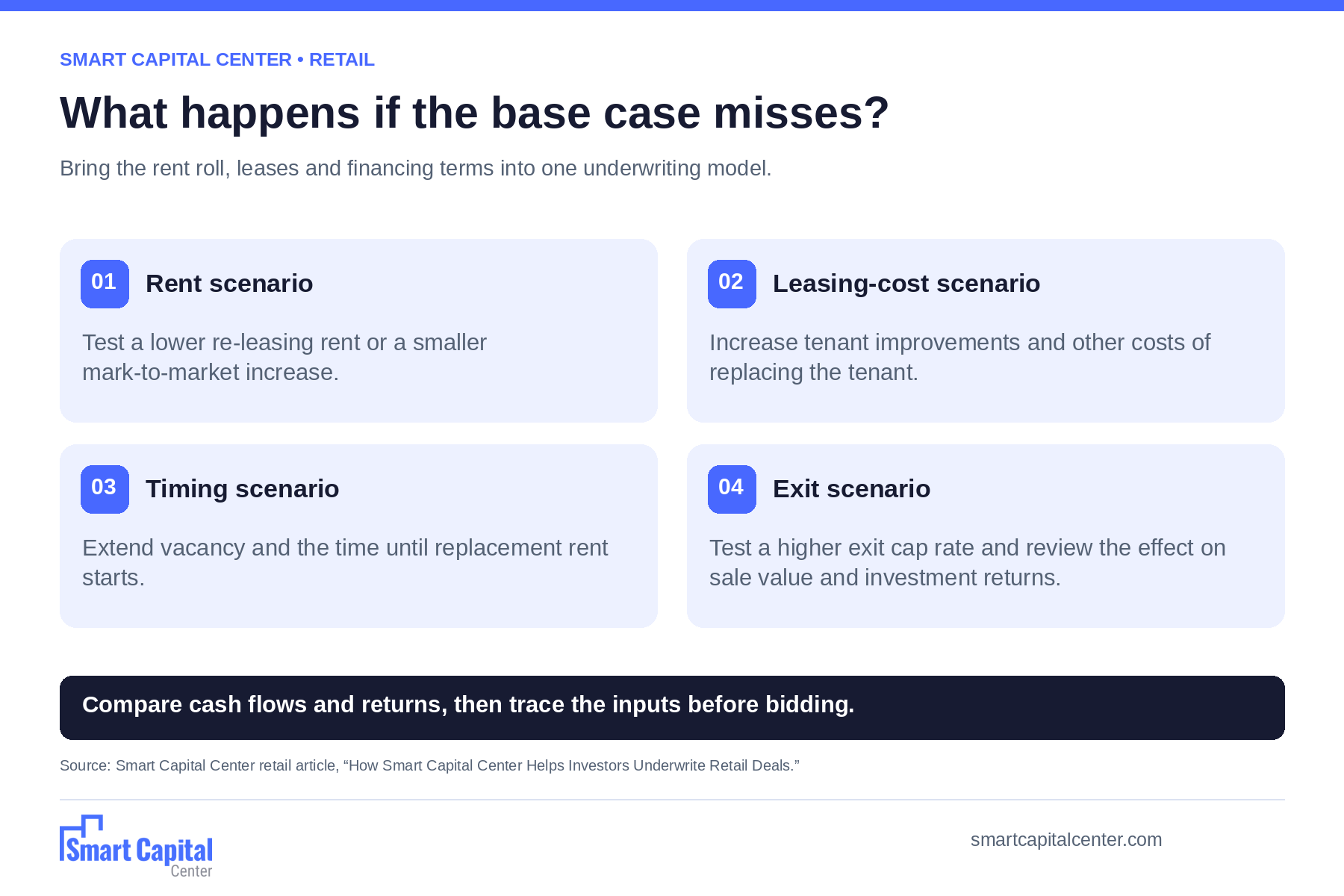
For retail, the useful changes map to what the panelists debated. The team can move the exit cap rate by 25 basis points and see how much of the return disappears, the same exercise Holuba described when his team proposes a lower exit than his standard. It can raise the cost of re-leasing a box and see the effect on net operating income. And it can split the return between cash flow and sale proceeds, which answers the audience question about reliance on cap rate compression.
Every figure in the output links back to its source document or data point, so a reviewer can trace a number before it goes to an investment committee. Teams can review the underwriting platform and the investor solutions page to see how the same approach applies across property types.
Grocery-anchored centers drew the strongest conviction. Slate has held a grocery-anchored thesis for 15 years, calls it “one of our highest conviction investment themes globally,” and owns more than 600 centers across North America and Europe. Yet even Slate has been a less active buyer lately, because the cost of capital that sets today’s pricing leaves little room for an operator to win on price alone. Its edge, O’Brien said, is operating expertise.
Moret described the limit on scale. In Florida, an investor competes with the tenant: Publix buys centers in the market, and once they trade, “they go into a black hole.” Combined with the lack of merchant builders, “scale becomes an issue,” and institutions that want large checks soon face multiple boxes, co-tenancy provisions, and weaker tenants.
Scarcity has shifted negotiating power. With so little new supply, a landlord whose grocer is coming off its options has more room to push back on terms such as fixed common area maintenance charges, and Weiner called the shift toward landlords “serious” and “recognizable.” Tenants have noticed too. Ross and Burlington have approached landlords well before lease expiry to ask for more options, because “these retailers are professional tenants” negotiating across hundreds of locations who want to tie up space for the long term. Investors should expect early renewal requests and treat each one as a negotiation over economics.

The moderator warned that some new entrants are underwriting too little for tenant replacement: “it’s going to cost them 120 bucks a foot versus the $60 a foot that they underwrote.” Moret agreed that “it costs 100 plus dollars a foot to do a turnkey or what it costs to split a box,” and said his firm passes on deals where several anchors already pay full rents.
The distinction that matters is in-place rent against market rent. Moret described an American Signature box that had paid about $10 per square foot, which his team re-leased at $14 with a $25 tenant improvement allowance. That worked because the old rent was below market. A box paying $18 or $19 is the reverse, since losing it means downtime, a capital outlay, and a smaller rent gain. O’Brien made the same point about bankruptcies. When a failed retailer paid single-digit rents, re-leasing at mid-teens to 20s more than offsets the downtime, and a landlord can even bid at the bankruptcy auction to take space back and re-lease it higher.
Box size and shape belong in the same review. Fewer tenants want 50,000 square feet today, and splitting a box can fail on frontage or position. O’Brien added that credit looks healthy: weaker tenants were cleared out during Covid, little new supply means replacement tenants often line up at bankruptcy auctions, and a takeover of the lease can mean no downtime and no cost for the landlord.
Weiner’s firm owns 14 enclosed malls and is actively buying. The cap rates are of a different order, with “typical cap rates are 13 to 17 cap,” and the case rests on three strategies: cash flow, arbitrage of the periphery, and redevelopment. The deal works if the investor has conviction that net operating income is stable and uses about 55 percent leverage. His team targets markets with strong population growth, including communities within a 90-minute drive of large metros.
Exit assumptions show how differently these investors manage risk. Weiner’s team debates lowering an open-air exit cap by 25 basis points when the going-in rate is above 8 percent, and lowers a mall exit by about 50 basis points. Holuba keeps his standard exit near 6.5 percent even though repeated sales have cleared at 6 to 6.25 percent, because “I want to see things apples to apples relative to our standard underwriting procedures.” Moret said his firm is not underwriting wild swings in cap rates in a higher-for-longer rate environment. The shared rule is that returns should not depend on a cap rate the investor cannot control.
Five steps follow from what the panelists described.
The panelists agreed that retail has the supply and demand picture investors want. Construction stopped because costs rose faster than retailer sales, merchant builders left, and space is tight at 96 percent occupied. They also agreed that this has pulled in more capital, which raises prices and lowers the return an investor should expect. The risks they named were boxes that cost $100 or more per foot to replace, bidders who do not understand the asset class, and an exit that depends on cap rates that already compressed.
Retail rewards investors who underwrite each lease and each box rather than the sector. Analyze retail deals faster. See how Smart Capital Center helps your team test rents, leasing costs, and exit cap rates, with every figure linked to its source. Book a demo today.
Q: Is retail real estate a good investment right now?
A: Retail has strong fundamentals and rising competition. CBRE’s Q3 2026 data shows availability of 4.8 percent and record-low construction, and panelists at the 2026 IMN private funds conference said bids and prices have risen. Rob Holuba of CenterSquare said investors should expect returns closer to core plus than value add. Whether a given deal fits depends on price, leasing costs, and the exit assumption.
Q: Why has there been so little new retail construction?
A: Panelists at the 2026 IMN private funds conference said construction costs rose about 40 percent after 2022 and rates rose 100 basis points, while retailer sales per foot did not rise by that much. They also said merchant builders are no longer active. CBRE reports a record-low 7.4 million square feet of completions over the last four quarters.
Q: What cap rates are grocery-anchored shopping centers trading at?
A: Connor O’Brien of Slate Asset Management said at the 2026 IMN conference that deals Slate would have bought at 7 and 8 cap rates five or more years ago now trade in some cases into the fives. Holuba described resilient retail at 6.5 to 7 percent. Cap rates vary by market, anchor, and lease term, so check the specific deal.
Q: What return should investors expect from retail?
A: Holuba said retail is closer to a core plus asset class, and that investors should expect IRRs in the range of 12 to 14 percent rather than 18 percent or more. O’Brien said 50 to 70 percent of the return over a five-year or longer hold can come from cash flow. These are panelists’ views, not forecasts.
Q: What costs do retail investors underestimate?
A: The panel pointed to tenant improvements, box splitting, and downtime. Moret said it costs $100 or more per square foot to turn or split a box, and the moderator said some buyers underwrite $60 where $120 is likely. Box size and shape also matter, since few tenants today want a 50,000 square foot space.
Q: How does Smart Capital Center help with retail investment analysis?
A: Smart Capital Center’s AI agents read a team’s leases, rent roll, and financing terms into the underwriting, pull market comparables, build projected cash flows and a discounted cash flow model, and run exit and financing scenarios. Every figure links back to its source, so a team can test exit cap rates and re-leasing costs before bidding.