

CRE Investors

November 19, 2026
CRE Investors
November 19, 2026

Sponsors who want to raise money from overseas hear two stories at once. One says foreign investors are pulling back from the US. The other says they are coming back in larger numbers. Both are partly true, and the difference matters for anyone building a capital plan, because the investors who are active are not the same ones as two years ago, and they are not asking for the same things.
The picture in this article comes from a conversation at the IMN Real Estate Private Funds Summer conference in Newport, Rhode Island, held June 24 to 26, 2026. Gunnar Branson, CEO of the Association of Foreign Investors in Real Estate (AFIRE), joined Alyssa Lang of G4 Capital Partners, a New York private credit firm with Latin American investors, and Aaron Friedman of Centeridge, a multifamily operator in Nashville and Chicago. Branson brought the view from AFIRE’s members around the world, and the other two described what direct dealings with overseas investors look like. The article adds data from MSCI and AFIRE.
Smart Capital Center’s AI agents help investment teams build the kind of traceable underwriting that overseas partners ask for. The team brings its own leases, financing terms, and business plan, and the agents read them into the model, build the projected cash flows and a discounted cash flow (DCF) analysis, and link every figure to its source. A later section covers how that supports a foreign capital raise.
The start-and-stop pattern is real. Branson described a year in which many overseas investors told him they wanted to buy bigger US portfolios, then paused when policy and trade headlines turned. Europe, in his words, was “holding,” and Canadian institutions were quieter in public than in practice. Yet when AFIRE surveys its members, the finding is that “the interest is in more, not less.”
The reason is a lack of alternatives. Branson said Asian investors who pulled back from the US two years ago came back within about six months because they “can’t find anything” comparable elsewhere. The US accounts for “almost half of institutional real estate in the world,” so a global portfolio without it is hard to build. He also made a point that is easy to miss: a foreign investor sees the same data a domestic one does, and reaches a similar conclusion about where the opportunity is.
Outside data supports the idea that capital shifted rather than left. MSCI reported in November 2025 that Canadian investors were the second-largest source of cross-border capital for global property markets in 2025 through the third quarter, that data centers made up 40 percent of Canadian outbound capital from 2023 through the third quarter of 2025, and that they were 50 percent of Canadian acquisitions in the US in the third quarter alone. That matches Branson’s remark that Canada’s recent US activity was concentrated in data centers and infrastructure. A June 2026 GlobeSt report, citing Colliers data, said Canadian volume had begun to slow, so the picture is still moving.
Observations are from the conference panel, except the Canadian data center figures, which are from MSCI.
The practical reading for a sponsor is that the pool of overseas capital has rotated from Europe toward Asia and Australia, and the largest flows are going to residential, logistics, and data centers. Branson summed up the starting point as “beds and sheds and data centers,” although AFIRE’s surveys show people “seeing daylight” in everything except hospitality, including retail and discounted office in the right location.
Lang’s investors are Latin American family offices that invest alongside her firm’s credit funds, and she was clear about their motive: “capital preservation.” They want a hard, dollar-denominated asset as a hedge against volatility at home, and they see the US as a market where one legal and regulatory framework covers a large and deep market. Putting capital into the UK and then France means learning each country’s property law and tax structure, which investors see as “a bit more fragmented,” while in the US they only have to learn one system.
Their geography is widening, but carefully. Lang said Latin American investors had begun to look beyond Miami, where supply concerns have grown, toward other primary markets and some secondary ones, without going into tertiary markets. Branson has seen the same movement across the Sun Belt and into the Great Lakes region and New York.
Credit is part of the draw. Lang said senior secured credit appeals to investors who want to be “opportunistic, but also conservative,” sitting senior in the capital stack, and she did not think private credit has peaked. Branson added that credit offered foreign investors a way into deals before they broke, and that operating company acquisitions were an unusual feature of this cycle. Friedman saw plenty of interest from operating company investors, mostly domestic.
Branson also argued that investors are not purely rational. Where overseas capital goes, he said, closely tracks “where your network that you created when you were 20 years old is.” Friedman gave an example: an Asian sovereign wealth fund took a 3,000-bed student housing stake and moved further up the risk curve than usual with one operating partner because of a personal connection to the university. For a sponsor, comfort and familiarity are underwriting inputs on the investor’s side.
The most consistent message was that overseas investors have stopped trying to go it alone. Branson said Japanese investors learned from the late 1990s, when they tried to move fast on their own, and now favor joint ventures and local partners. Friedman described the next step. A decade ago, foreign money reached his former firm through private equity funds. In the last five years it has arrived as direct investment from groups in places such as the Netherlands and Singapore, and those investors increasingly follow a specialist operator across the country, whether in student housing or Sun Belt multifamily, instead of choosing a city.
Structuring is evolving as well. Lang expects rated note structures, which are already growing in Japan and the UK, to unlock more alternative capital and bring more foreign investors into the US. Another speaker argued in closing that “US real estate is an international asset class. It just is.”
The scale of the opportunity for fund sponsors is large. AFIRE noted in October 2026 that foreign investors hold nearly 30 percent of US private real estate fund assets, and that success in raising it varies widely between firms and funds. The difference, the panel suggested, is how well a sponsor understands the investor’s motive and structure.
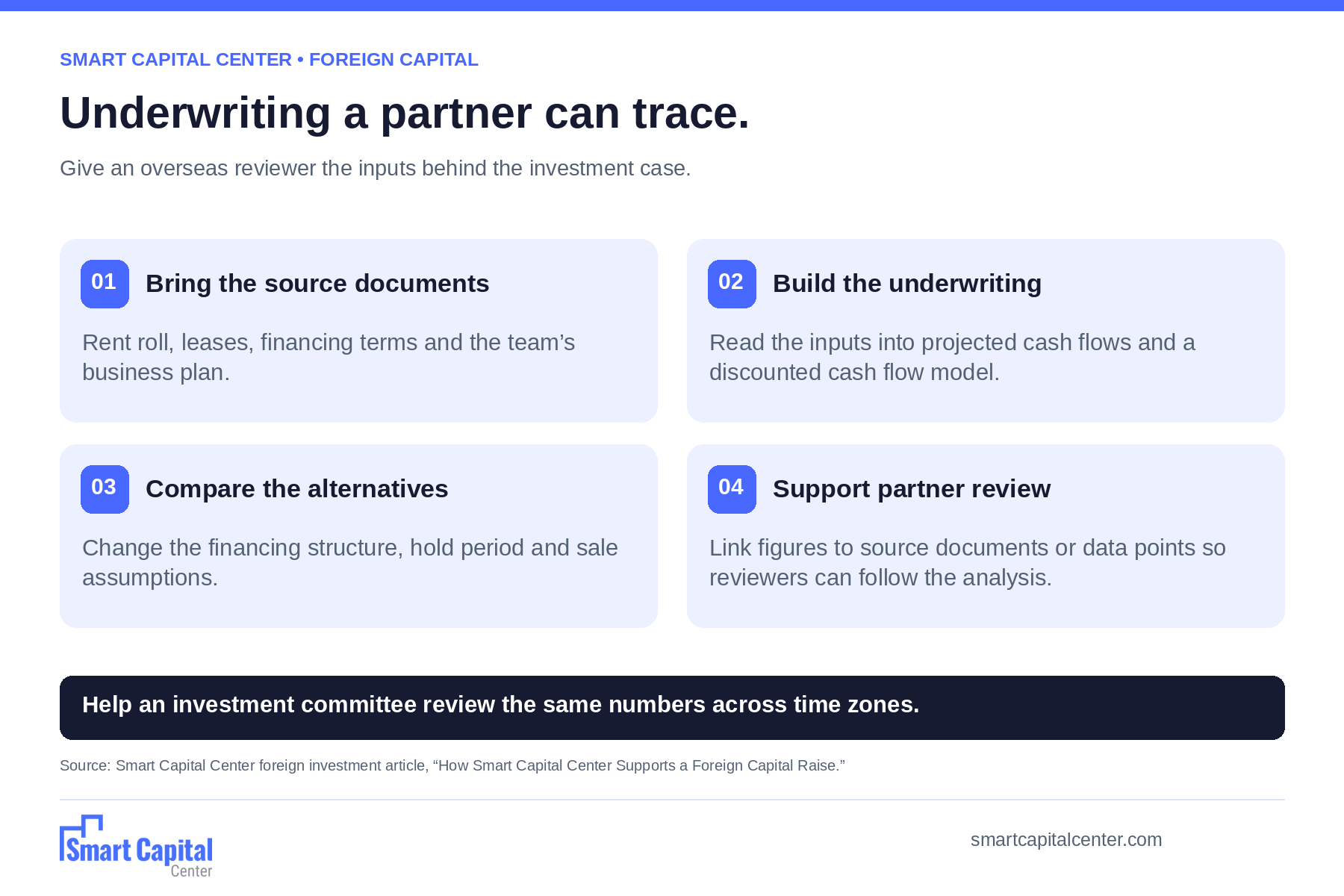
Overseas investors usually diligence a US deal from a distance, often through a local partner and an investment committee in another time zone. Smart Capital Center gives a sponsor a way to put the underwriting into a form that travels. The team brings its own documents, including the rent roll, leases, and financing terms. The agents read them into the underwriting, pull market comparables from 1B+ live market data points across 120M+ properties, and build the projected cash flows and a discounted cash flow (DCF) model.
Every figure in the output links back to its source document or data point, so a partner who was not in the room can trace a number without a call. The team can also change the financing structure and the sale assumptions to see what each does to returns, which helps when an investor asks how a deal performs under a different structure or a longer hold. Teams can review the underwriting platform and the investor solutions page to see how the same approach applies across property types.
Currency came up from two directions. Lang’s Latin American investors treat a US asset as a hedge against their local currency. Friedman said his retail investors are more concerned about the dollar, and that tariffs can complicate the idea that a weaker dollar always favors investing abroad.
Branson’s answer was about time. Real estate is a generational asset, and capital that crosses a border expects to stay, which in itself reduces the currency question. He added that the US habit of buying and selling quickly while rates fall is the exception in real estate’s history. Now investors “have to think like real estate investors instead of commodity traders,” and overseas investors, who find it risky to move in and out, already do.
The sharper tool comes from MSCI. In a paper published in July 2026, MSCI’s Jim Costello and Michael Savino argued that cross-border investors should underwrite using the hedged cap rate instead of a currency hedge, and that when the hedged cap rate falls below the home-country rate, a US deal needs “heroic assumptions” about income growth to hit its target. For a sponsor, the useful step is to know the home cap rate the investor is comparing against before pitching the return.

Branson’s advice for anyone raising money abroad was to treat it as “a long term engagement” for the company and for the person doing it, and he noted that “if you think it’s hard to build a relationship with a US pension plan, try a Japanese one.” Once the relationship exists, he said, the investor’s institutional approach rewards patience, because it assumes that value compounds over time.
Lang’s experience shows how the first relationship works: “once you find that one person, that one investor, then that kind of gets you into the market.” In Latin America, she said, expanding became easier once a reference point could vouch for her firm. Branson called it “a trust game and it’s a transparency game.”
The panel also named places to start. Branson pointed to AFIRE, which keeps at least half of its members headquartered outside the US, and to the European and Asian non-listed real estate associations, which publish research on those markets. Another panelist recommended attending real estate fund conferences in Asia and Europe, joining the Royal Institution of Chartered Surveyors (RICS), and taking part in the Urban Land Institute’s Global Exchange Council, since ULI chapters abroad bring a different group of people than the US chapters do. Their shared point was that the community is small and reputation travels fast.

Five steps follow from what the panelists described.
Foreign investment in US real estate is changing more than it is shrinking. Capital has rotated toward Asia and Australia, concentrated in residential, logistics, and data centers, and moved from fund commitments toward joint ventures and direct partnerships with specialist operators. The investors still want the same things as before: a stable legal system, a dollar-denominated hard asset, and a partner they trust.
Sponsors who succeed will understand each investor’s motive, offer a structure that shortens the investor’s learning curve, and give overseas partners numbers they can trace. Raise capital with underwriting that travels. See how Smart Capital Center helps your team test structure, hold period, and exit assumptions, with every figure linked to its source. Book a demo today.
Q: Why do foreign investors buy US real estate?
A: Panelists at the 2026 IMN private funds conference gave several reasons. The US is deep and covered by one legal framework, which lowers the barrier compared with learning several countries’ property laws. It offers a dollar-denominated hard asset and, according to Gunnar Branson of AFIRE, accounts for almost half of institutional real estate worldwide, which makes it hard to leave out of a global portfolio.
Q: Are foreign investors still buying US commercial real estate?
A: Interest remains high, although flows have shifted. Branson said AFIRE’s surveys show interest in more US real estate, not less, and described a rotation from Europe toward Asia and Australia. MSCI data shows Canadian investors concentrated in data centers through 2025, and a June 2026 report said Canadian volume had started to slow.
Q: How do foreign investors invest in US real estate?
A: Panelists described joint ventures with local partners, direct investment with specialist operators, private credit funds and co-investments, rated note structures, and investment in operating companies. Alyssa Lang of G4 Capital Partners said Latin American family offices often invest alongside a credit manager, and Aaron Friedman of Centeridge said foreign groups increasingly invest directly with operators.
Q: How long does it take to raise capital from foreign investors?
A: Branson called it a long-term engagement that builds over time, and said relationships with institutions such as Japanese pension plans take longer than with US pensions but tend to last. Lang said that once one investor vouches for a manager, expansion in that market gets easier.
Q: How do foreign investors manage currency risk in US real estate?
A: Some treat a US asset as a hedge against volatility in their home currency. Branson said the long hold period of real estate reduces currency concerns. MSCI recommends underwriting on the hedged cap rate compared with the investor’s home-country rate, because a US deal needs very strong income growth to hit targets when the hedged rate falls below it.
Q: How does Smart Capital Center help with raising foreign capital?
A: Smart Capital Center’s AI agents read a team’s leases, rent roll, and financing terms into the underwriting, pull market comparables, build projected cash flows and a discounted cash flow model, and run financing and sale scenarios. Every figure links back to its source, so an overseas partner can trace a number without a call.