


CRE Investors

November 19, 2026
CRE Investors
November 19, 2026
Investors who field questions about data center investment are being asked to underwrite an asset that does not behave like an office building or an apartment property. A single project can cost a billion dollars, its value is set by megawatts of power capacity instead of square feet, and the list of buyers who can take the exit is short. This article covers how two panelists at a major private funds conference framed those risks, including illiquidity, exit paths, power supply, and the structure an investor chooses, and what the capital markets have done since to answer them.
The material comes from a morning session at the IMN Real Estate Private Funds Summer conference in Newport, Rhode Island, held June 24 to 26, 2026. The session, titled “State of the funds industry: large funds investment perspective,” ran on June 25. Jim Costello, Head of Real Estate Economics at MSCI Real Estate, and Sondra Wenger, Head of Capital Markets at KBS, spoke about data centers after a moderator asked what the data shows about who is buying them. Their answers, along with primary-source data on power use and recent exits, are the substance of what follows.
Smart Capital Center’s AI agents help investment teams test a data center deal before capital goes in. The team brings its own leases, construction budget, and financing terms, and the agents read those documents into the underwriting, build the projected cash flows and a discounted cash flow model, and run the sale scenarios that decide whether an exit works. A later section covers how that looks in practice.
Costello opened his answer by pointing to why the topic draws so much attention. In his words, “everybody’s talking about it and everybody’s interested in it because it’s a shiny new thing.” He then raised the question investors keep debating, which came up at the PREA conference, of whether a data center is infrastructure or real estate. His view was “I’m of the opinion they’re both.”
The distinction matters because the two groups of managers behave differently. Costello said infrastructure managers “tend not to flip assets as quickly as we do on the real estate side,” and lean toward a buy-or-develop-and-hold philosophy. A real estate fund that expects to sell and an infrastructure vehicle built to hold can price the same data center differently, so the first underwriting decision is which of the two the investment really is.
Costello was direct about trading activity. “It’s highly illiquid,” he said, and described the transaction record in terms of concentration: his team tracked only 49 property sales last year, with about $30 billion of activity, most of it in a single deal. “So it’s a lumpy market,” he said, and compared it to regional malls: “I think of it a lot like the regional mall market.” Some regional malls went through serious challenges, and the ones that survived are the best of the best, which “you don’t trade them every day. You hold on to it.”
The way owners hold a trophy asset, he said, is a publicly traded structure, which “fits the nature of the asset class.” He added that a multibillion-dollar investment cannot be traded every few years the way an investor might trade a logistics building in the Inland Empire.
Money is also flowing to a different part of the cycle. “There’s a lot more money though currently going into the development of the centers than into the sale of them,” Costello said, which makes sense when an investor cannot buy what it wants and builds it instead. He noted that macroeconomists argue data center spending has been the one thing keeping the US economy afloat over the past year, given the construction activity and jobs behind it. For investors, though, “the real estate play that comes from it, it’s not as intense right now.” Costello suggested it may turn into a trading asset class later, once development reaches the market, but said “I’m a little suspicious that it’s probably like office in that regard with CapEx in the future.”
A few weeks after the session, MSCI published its own look at the same question. Its July 15, 2026 analysis of data center capital markets found that transaction volume for single assets has risen steadily since 2022, reaching record years in 2024 and 2025, and that growth in hyperscale asset sales is spreading to newer markets. MSCI also noted that most equity historically went in at the platform level through growth equity or platform buyouts, while asset-level deals were rarer and smaller. The two views fit together. Individual-asset liquidity is improving from a low base, and the market is still concentrated in a small number of very large transactions.
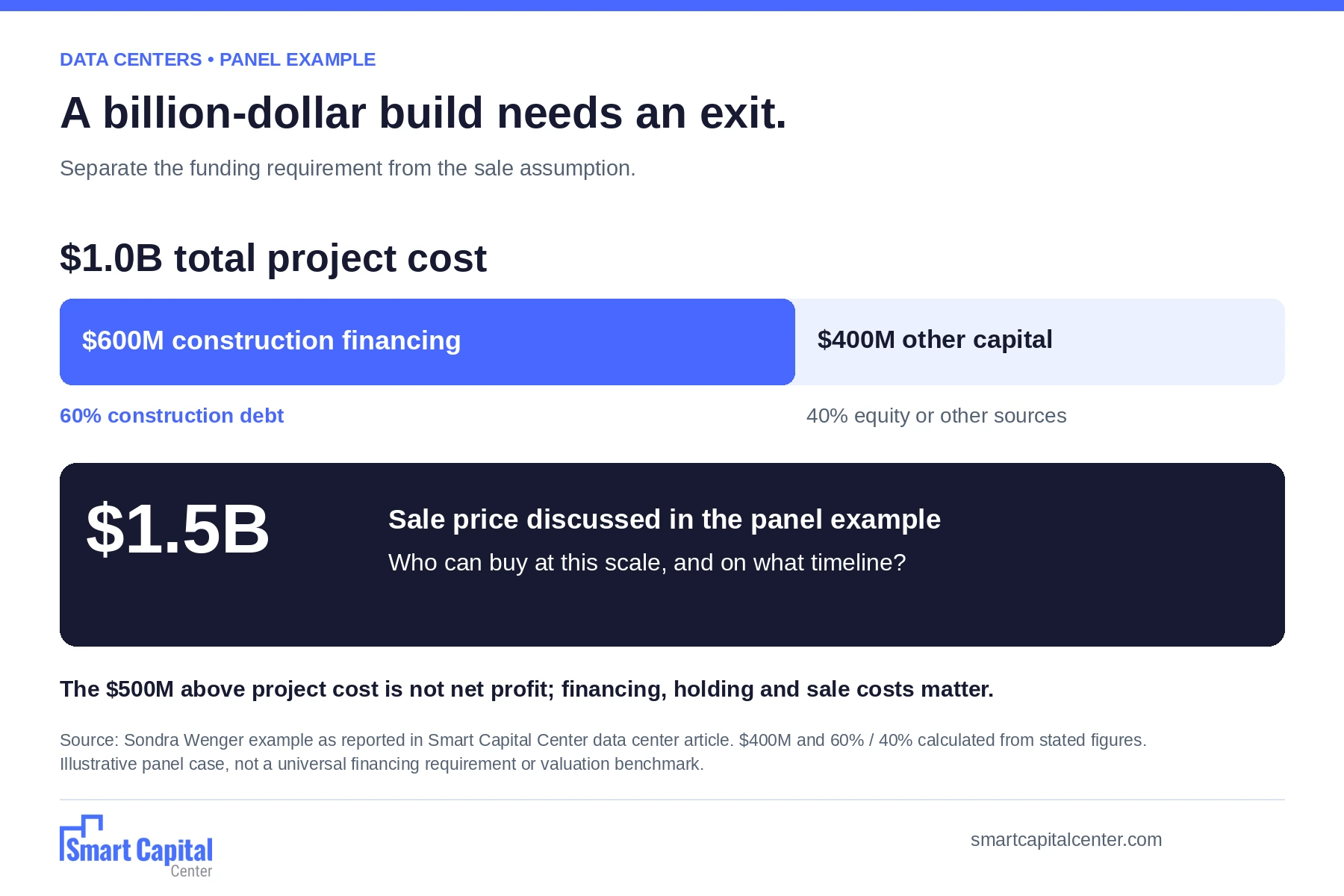
Wenger brought a development investor’s view, shaped by her years at CIM Group, where she said “we were one of the first investors in data centers.” Back then, she said, they were “$200 million deals at the max,” held in an infrastructure fund. Because of demand for compute power from artificial intelligence and quantum computing, the economics changed. Data centers are “all priced based off of megawatts,” a megawatt being a measure of the power capacity a facility can deliver, and more megawatts are needed to make a site viable. As she put it, “it cost a billion dollars to build a data center.”
She then walked through what that does to the capital structure. A team building a billion-dollar data center has to raise about $600 million in construction financing, and somebody has to provide the loans and the guarantees on it. To get out of a $1 billion basis, the building has to sell for roughly a billion and a half dollars. Her question to the room was “who is going to want to take that concentrated risk for that area?”
Wenger said she sees the other side of the trade too. The tenants “typically have long term credit,” which makes the investment attractive from a return standpoint, and the development returns are high. The open questions are obsolescence and the exit. She asked whether the building could become obsolete at some point and said “how are we going to get out of it?” Her team looked at bond financing instead of typical debt structures, and at the public market. “Your only alternative to get out of that billion and a half investment is in fact doing an ipo,” she said, pointing to what Blackstone was doing.
She also raised SpaceX’s goal of putting data centers in space, which she said would remove the cooling power needed on the ground, and asked what happens to a billion and a half dollar investment ten years down the line. A technology shift of that kind is a risk an investor underwriting a ten-year hold has to price, and one an apartment owner rarely faces.
Wenger’s reference to Blackstone points to the clearest recent example of an exit path being built. Blackstone Digital Infrastructure Trust completed its initial public offering by selling 87.5 million shares at $20 each to raise $1.75 billion, and began trading on the New York Stock Exchange under the symbol BXDC on May 14, 2026. The trust intends to invest in newly constructed, stabilized data centers leased to investment-grade hyperscale tenants on long-term contracts, according to the offering coverage, and Blackstone’s registration statement describes the focus as top data center markets with strong supply and demand dynamics. The session’s moderator had mentioned the offering just before Costello’s answer.
MSCI’s analysis adds the wider picture. As the capital intensity of the asset class grew, operators began exploring other ways to recycle capital, from co-investments and joint ventures to yieldcos, which are vehicles that hold stabilized assets apart from development vehicles, along with data center REITs and core funds. MSCI said the variety of transaction and vehicle types signals that the capital markets are maturing, which should help developers underwrite with greater confidence.
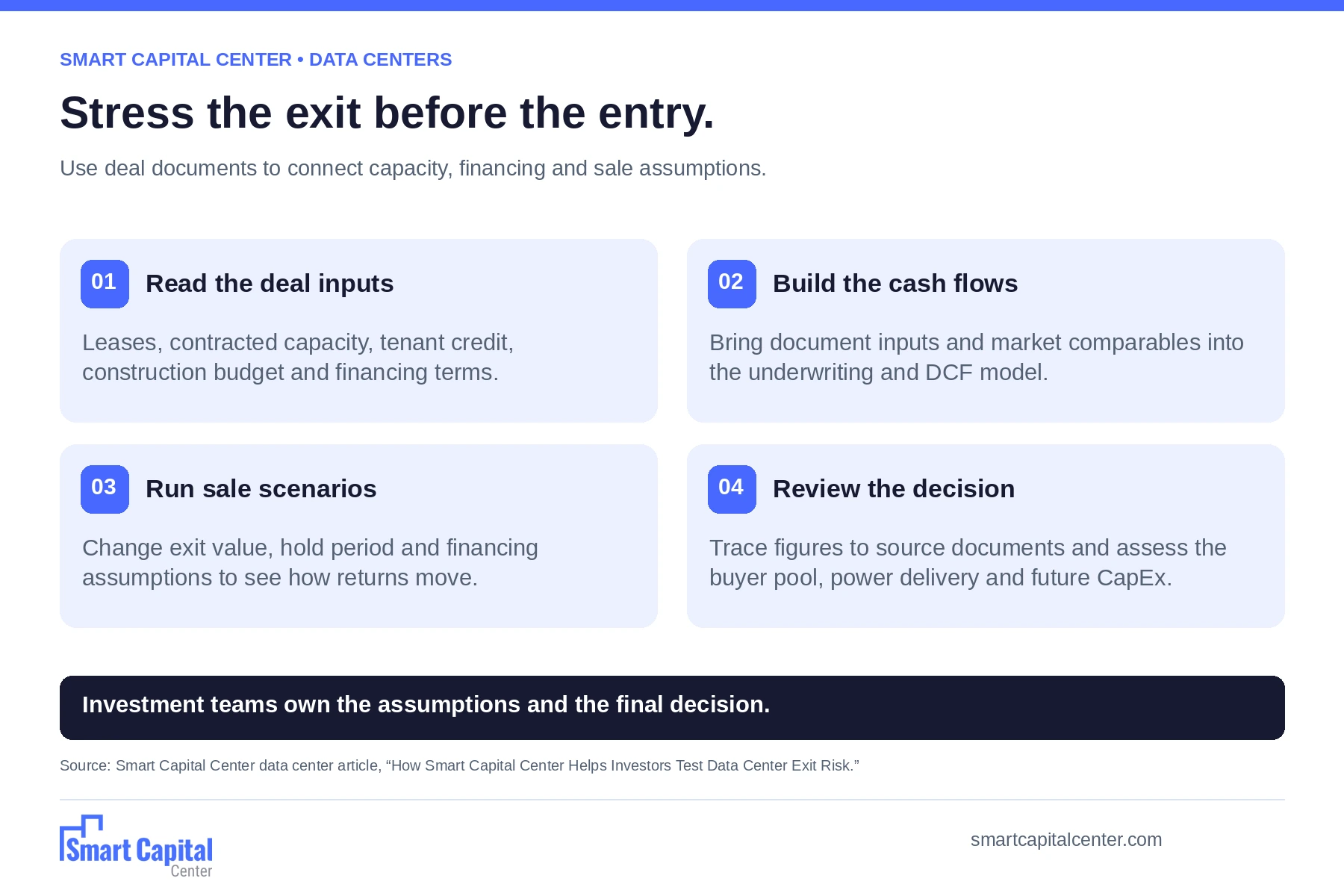
Smart Capital Center gives an investment team a way to stress the exit before committing to the entry. The team brings its own documents, including the lease, the construction budget, and the financing terms. The inputs that define a data center deal, such as contracted megawatts, lease term, and tenant credit, come from those documents, and the AI agents read them into the underwriting. The agents then pull market comparables from 1B+ live market data points across 120M+ properties, build the projected cash flows and a discounted cash flow (DCF) model, and let the team change the financing structure and the sale assumptions to see what each does to returns.
That matters for the question Wenger raised, because the sale price and timing are assumptions the whole return rests on. When the team changes the exit value or the hold period, the effect on net operating income and returns shows up right away. Every figure links back to its source, and draft investment memos pull directly from the underwriting, so an investment committee reads the numbers the analyst built. Centers Dynamic Partners underwrites deals 4x faster. The work runs inside the systems your team already uses.
Teams can review the underwriting platform and the investor solutions page to see how the same approach applies across property types.

Wenger tied site selection to power while describing how her team picks markets for a new fund. She called digital infrastructure “even more critical” than before, and said “you want to make sure that these locations that we are picking have the fiber lines, have multiple, multiple electric companies that you can go to to get power.”
Government research frames the scale. The Department of Energy announced in December 2024 a Lawrence Berkeley National Laboratory report finding that data center electricity use climbed from 58 terawatt-hours in 2014 to 176 terawatt-hours in 2023, and estimating between 325 and 580 terawatt-hours by 2028. The laboratory’s summary puts data centers at about 4.4 percent of total US electricity use in 2023 and between 6.7 and 12 percent by 2028, depending on how much the rest of the economy grows.
For an investor, those figures turn power into an underwriting item. A site that cannot secure power on schedule delays rent, and a site with several electric providers and fiber has options. That is why Wenger treated them as part of location quality, next to the political and regulatory environment.
Five steps follow from what the panelists described.
The panelists agreed that data center investment is attractive and hard to exit. Costello described an illiquid, lumpy market where the best assets are held, and Wenger described a billion-dollar building that has to sell for about a billion and a half dollars, with few buyers able to take that concentrated risk.
The capital markets have started to respond. A public data center REIT priced in May 2026, and MSCI reports record single-asset volume in 2024 and 2025 along with new vehicles such as core funds and yieldcos. Investors still need to underwrite the exit, the power supply, and obsolescence on every deal.
Analyze data center deals faster. See how Smart Capital Center helps your team test exit and financing scenarios, with every figure linked to its source. Book a demo today.
Q: How do you invest in data centers?
A: Investors reach data centers through development, ownership of stabilized assets, public REITs, and core funds. MSCI notes that the capital markets now include co-investments, joint ventures, yieldcos, REITs, and core funds, and Blackstone’s data center REIT priced a $1.75 billion public offering in May 2026. Smart Capital Center helps a team compare these routes by building the cash flows and sale scenarios from its own documents.
Q: How is a data center valued?
A: Data centers are priced by power capacity in megawatts, according to Sondra Wenger of KBS at the 2026 IMN private funds conference, along with lease term and tenant credit. A discounted cash flow model then tests the income and the exit value. Smart Capital Center reads the lease and financing terms into the underwriting and builds the discounted cash flow model from them.
Q: Are data center REITs a good investment?
A: Their fit depends on the investor’s goals, and the structure addresses a real problem, since Jim Costello of MSCI Real Estate described the asset class as illiquid and suggested publicly traded entities may be a better vehicle for some of these assets. A REIT gives a stabilized portfolio a public market, but it carries the usual equity market price swings. Smart Capital Center lets a team compare a direct investment against a public vehicle by testing the returns under different exit assumptions.
Q: How much power do data centers use?
A: Data centers used about 176 terawatt-hours of electricity in 2023, roughly 4.4 percent of US electricity, according to Lawrence Berkeley National Laboratory. The laboratory estimates 6.7 to 12 percent by 2028. Smart Capital Center puts the power-related lease terms and expenses from a team’s own documents in the same underwriting model as rent and financing.
Q: How do investors exit a data center investment?
A: Common exits include a sale to a data center REIT or core fund, a public offering of a stabilized portfolio, and a sale to another investor. Wenger said that for a billion-dollar project the options are narrow, and she pointed to an initial public offering as the main alternative. Smart Capital Center lets a team change the sale price and hold period and see the effect on returns right away.
Q: How does Smart Capital Center help with data center investment analysis?
A: Smart Capital Center’s AI agents read a team’s leases, construction budget, and financing terms into the underwriting, pull market comparables, build projected cash flows and a discounted cash flow model, and run sale and financing scenarios. Every figure links back to its source document or data point, and draft investment memos pull from the same underwriting. See how it works on a live deal.